150 Favorite Movies: #26 — Ratatouille
“If you focus on what you left behind, you will never see what lies ahead.”
150 Favorite Movies: #26 — Ratatouille
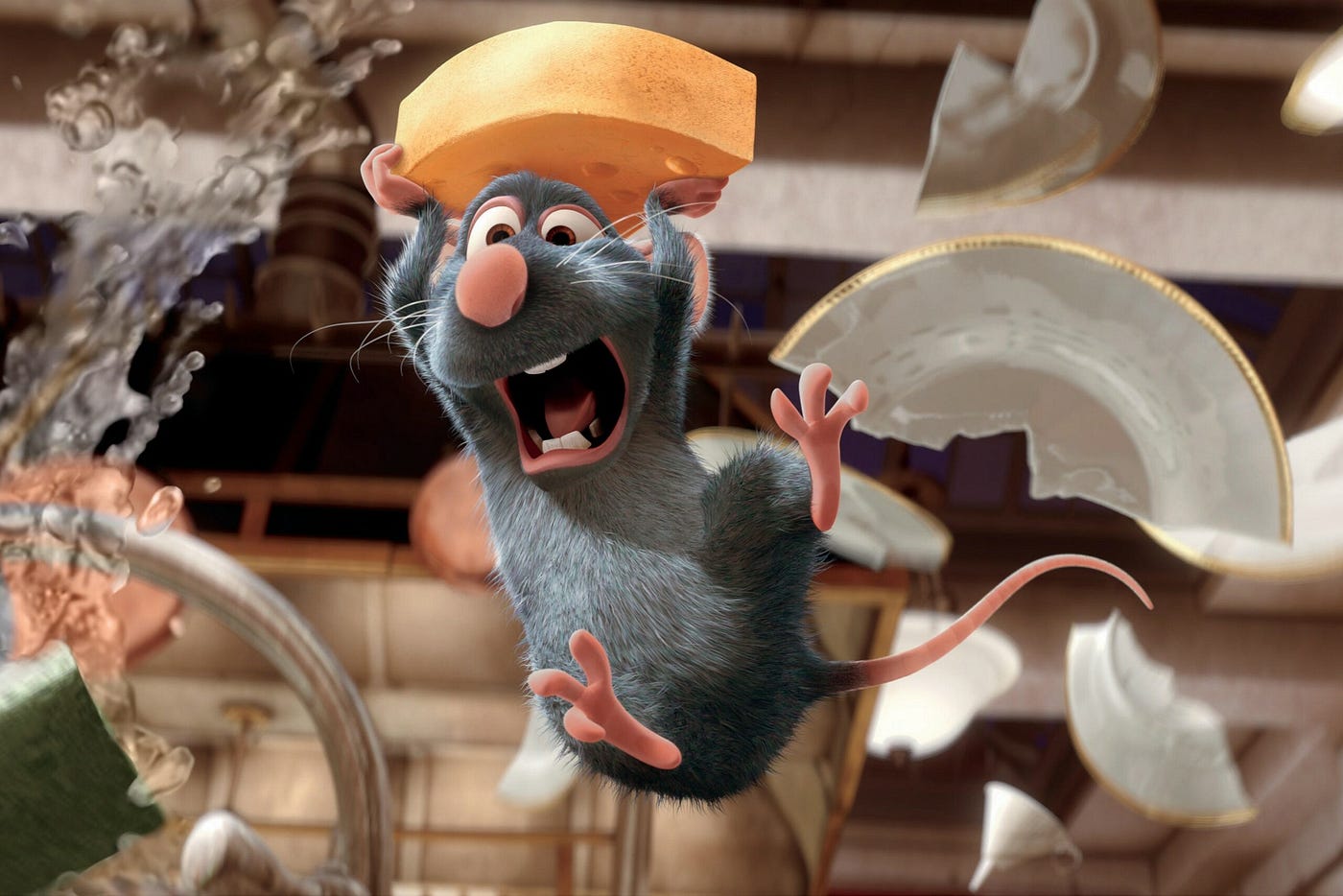
Image from Birmingham 365
“If you focus on what you left behind, you will never see what lies ahead.”
When Pixar was ready to break free of an agreement they made with then-Disney CEO Michael Eisner, studio chief John Lasseter commissioned the top filmmakers at what was considered the gold standard of animated storytelling to craft movies that were personal to them, worthy of the Pixar moniker, and capable of proving that the Emeryville enterprise didn’t need Disney overlords anymore. In Lasseter’s inner circle were Andrew Stanton (Finding Nemo), Pete Docter (Monsters, Inc.), and Brad Bird (The Incredibles). Their follow-ups ended up becoming, respectively, Wall-E, Up, and Ratatouille, each released in consecutive years (from 2007 to 2009, beginning with Bird’s). It was an unprecedented run for any studio (without even mentioning 2010’s Toy Story 3) and more than enough to convince (during the production process for each of them) Eisner’s successor, Bob Iger, to bring Pixar back into the fold — thanks as well to a partnership he forged with vital Pixar exec Steve Jobs. Still, Ratatouille became a defining film for Pixar (and one without an official follow-up and only recently a theme park presence), thanks to its heady ideals and gonzo premise. When a culinary-inclined rat named Remy (Patton Oswalt) feels he’s destined for greatness, he makes his way to Gusteau’s, a gourmet restaurant in Paris, France. There, he forms an alliance with the hapless-in-a-kitchen Linguini (Lou Romano), a bus boy, to cook for the customers by residing underneath Linguini’s chef hat and pulling his hair to control his muscles. If you haven’t seen Ratatouille (which was also written by Bird), I promise this bonkers plot overview works exceptionally well on screen.
[embed]
Try listening to this while you read to set the mood. Spoilers ahead!
In Ratatouille, when the rats speak to each other, we — the audience — hear them communicating with the English language. However, when the movie shifts into the point-of-view of the human characters, the rats merely squeak. It’s a fun, twisting conceit that enables the creativity behind Ratatouille to be geared toward finding a different way to communicate than would otherwise be easier. On the one hand, it enables stream-of-consciousness monologues from Remy to be played off against the imaginary manifestation of Gusteau’s (Brad Garrett) ghost. To Remy, Gusteau is both a figment of his imagination and a metaphysical depiction of his conscience. Yet, due to the language barrier, he is also the sounding board for Remy’s skeptical spirit and way for his interiority to be framed around considering his role in the human world.
Crucially, in the relationship between Remy and Linguini, the language barrier also results in their communication taking the form of the former hiding underneath the chef hat of the latter and pulling his hair to control his muscles while cooking in the kitchen. It makes for a very weird marketing pull in trailers and in McDonald’s Happy Meal toys, but it’s also emblematic of the classic Pixar knack for an inventive and original concept that didn’t need to be a parody of its home studio to be worthy of a CEO’s approval stamp book.
Ratatouille emerged at a time when Pixar movies were sold as being for kids [Remy gives a motorist finger guns on the street; Colette (Janeane Garofalo) exclaims, “Freaking me out!” when Linguini asks her what he wants him to stop doing] and for adults [the main antagonist for the film is restaurant owner Skinner (Ian Holm), but the true core of the film resides within a food critic named Anton Ego (Peter O’Toole)], with both parties feeling equally invested and invited into the foray of a studio’s annual creative deliverance. It belongs to a lovely era of Pixar when each movie contained an Easter egg that hinted to the next entry in the oeuvre (Up’s Dug appears as a shadow in Ratatouille), each of the brain trust’s directors got their turn on the carousel to make an all-timer in the history of the animation medium, musical savants visited Emeryville to craft breathtaking scores for the films, and John Ratzenberger always had a part to play (Mustafa, the waiter, here).
Image from IMP Awards
It’s occasionally a little melancholy to recognize that this era of the Pixar heyday is over (and has been for some time), even if the studio still does touch greatness more often than not (Turning Red! Elio!). It’s especially bittersweet for the fact that I lived through this heyday! I grew up with the films that are still synonymous with the studio to this day. And I miss it, and I miss living during a time when Pixar crafted guaranteed bangers and regularly danced with the Best Original Screenplay category at the Oscars. However, I am also grateful that I can appreciate what this time meant. I could only fully appreciate what Pixar accomplished from 1995 to 2010 when I grew up in life — just like food. Chicken nuggets can still be delicious, but never as much as when I was five years old, you know? For the same reason, a sweet potato sushi roll wouldn’t taste the same to that version of myself. The best of foods, like the best of movies (Pixar especially), grow with us and strengthen their dopamine flow over time.
Because of all the love and care that went into the craft of this era of Pixar movies (and still does today! I just specify that era for the sake of the timelessness of the technicality), the animation holds up just as well as the evergreen nature of the movie’s thought-forming thematic nuance. Compelling in its animated sequences, Ratatouille is able to balance more traditionally action-packed moments with quieter depictions that rely on emotion and imagery to sell its lofty, artistic goals. The “camera” of Ratatouille whisks through kitchens, both fancy and homey, and explores the world from a rat’s eye view. Here, there is a sense of scale that allows us to empathize with Remy and his rat colony (the animation also does quite a bit of heavy lifting in its character designs to make the traditionally unsavory animals seem as cute as possible) while also providing plenty of scaled-down fun to the film. Through this, a mop can be a weapon of mass destruction and a paperclip can be an instrument in a jugband.
For as fun as these touches in Ratatouille are, there is also a moving amount of beauty depicted on screen. In one of the best ever Pixar moments and a testament to the eternal value of the studio, Remy viewing the glittering Paris skyline for the first time is a celebration of soaring beauty. It may not be an accurate representation of the Parisian layout (for us Gen-Zers, though, it is a definitive take on shimmering France), but it just feels like how Paris should feel. Especially when you’re a kid, I mean, that’s just what Paris must be when you’re seeing it for the first time and it’s everything the world promised it would be. Plus, the Michael Giacchino score (capable of shifting seamlessly from wonder to whimsy and languid to rapid with lilting French awe and fast-paced kitchen mishaps, respectively) enters into the scene with hints of the movie’s major musical motif, Camille’s “Le Festin,” tinkling underneath. It’s the ideal combination of memorable visuals and stunning sounds to craft a moment that transcends Pixar and enters immediately into the cinematic lexicon whenever anyone witnesses it for the first time — just like Remy.

Image from YouTube
Another facet of animation — the voice acting — also helps Ratatouille stand apart, almost a decade and a half after its original release. At the time, in the wake of Aladdin and Shrek, the actors cast in animation were starry headliners more often than not. Bruce Willis led Over the Hedge. Will Smith and Robert De Niro toplined Shark Tale. Even Pixar brought Owen Wilson in for Cars. With Ratatouille, though, we see one of the most idiosyncratic vocal casts ever assembled.
We have incredible thespians, like Peter O’Toole. A muse of David Lean’s and an alum of Bristol Old Vic, one facet of O’Toole’s enduring Hollywood legacy is his bridesmaid status with the Academy Awards (eight Oscar nominations with no wins). Perhaps if the Academy introduced a voice acting category, he’d have finally earned one in 2007. As Anton Ego, O’Toole is note-perfect, delivering the film’s eventual pathos-laden landing and amassing a series of stellar pronunciations over the course of Ratatouille (“poP-u-larrrr,” “Monsieur Boy-ar-dee,” “hit me with his best… sho-t”). Yet, he is also contrasted against a bevy of beloved character actors [Oswalt, Garofalo, Holm, Garrett, Brian Dennehy as Django (Remy’s father), Will Arnett as Horst (Gusteau’s sous chef)] and one-off Pixar animators with substantial acting roles they’d never return to (Romano — a Pixar production designer — is Linguini, and Peter Sohn — the eventual director of The Good Dinosaur and Elemental — is Émile, Remy’s brother). Each voice is perfectly suited to the characters, though — especially Romano’s Linguini. The character is a gangly mess and certainly depicted in more traditionally cartoonish fashion. He has Jacob Silj levels of volume control issues and looks like Bambi on ice when riding a bike or learning his role as Remy’s marionette. The bumbling performance works for a bumbling character, but the entire casting process is aptly refined for a bubbling exceptionalism in Ratatouille. Just as the movie depicts, we know who is talented at what they do (Ego, Gusteau v. O’Toole in real life), but we also trust in what those we’d never expect to be grand can do (Remy is as vital to the film as Oswalt is).
In this dichotomy, many of the film’s personality conflicts arises. Eventually, discord will be harvested between Remy and Linguini that is mostly driven by their respective egos. Remy wants more credit than he is receiving, and Linguini turns narcissistic with every bit of unearned praise thrown his way as the soon-to-be signature chef of Gusteau’s and France overall. However, we see these early moments of self-flagellating talent and the ways in which others react to it early in the film. Remy demonstrates a faux modesty about himself when Linguini begins to devise their partnership but is quick to agree with the busboy when he elucidates that he is not a strong cook. It becomes a manufactured humility throughout the film that the characters do not honestly come by and, in their false selves, results in hapless misunderstandings and feelings hurt for those whom the exceptional would refer to in Steve Jobsian fashion as “unexceptional.” Fortunately, Ratatouille still carves out time for the middle ground, too. Later in the film, Colette states, “I hate false modesty; it’s just another way to lie.” While many other characters are busy trying to drown in their own laurels, the characters who actually keep the worlds of their professions functioning are those who recognize that one does not need to be a generational talent to keep the lights on. Sometimes, enough can be enough, and this contented sense of talent for greatness manifests through Colette — even as notions of exceptionalism and superlative ability percolate throughout the arcs of others.
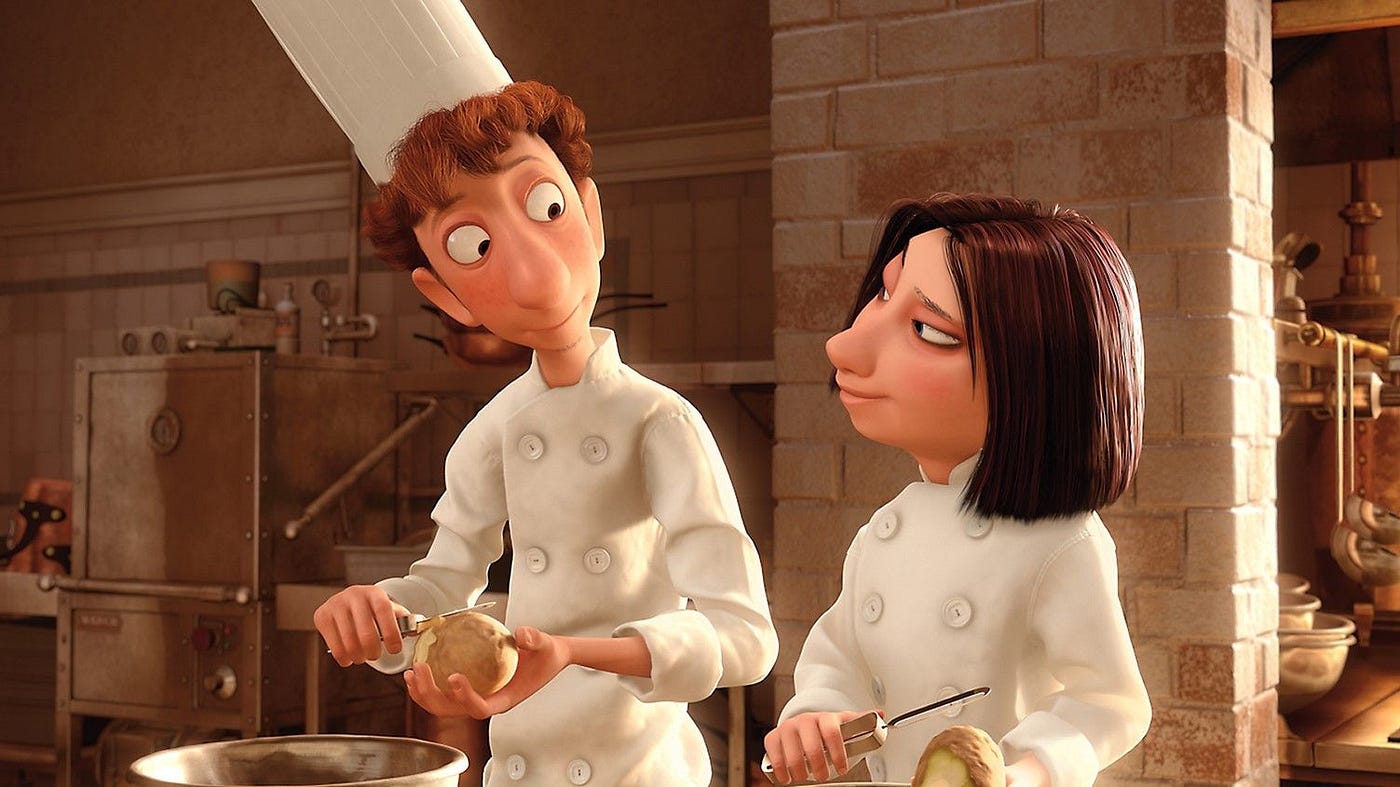
Image from Collider
At first, to other characters in the film, Linguini seems to be the living embodiment of Gusteau’s most cherished belief that “anyone can cook.” As the kid hired to take the trash out, Linguini seems hardly capable of even doing that without causing a mess and spinning a klutzy path through the kitchen like Goofy preparing a Thanksgiving dinner. However, he eventually becomes world-renowned as the heir apparent to what was once France’s finest establishment and, under his stewardship, could be again. Of course, we know that Remy actually is this embodiment, but Linguini still serves as his human vessel.
Surrounding Linguini are a series of reluctant supporters but one staunch advocate in the form of Colette. In many stories of exceptionalism, Colette would be dismissed as the character holding the wunderkind back from the heights they could reach without being bogged down in pesky things like emotion and love. However, in Ratatouille, all perspectives are treated with respect. Colette becomes a champion of Linguini, and we can infer that she rises to this stature because, in her path to the kitchen, she had very few advocates of her own. Not accustomed to a position of power in life, Colette is reluctant to the potential that someone as endlessly praised as Linguini would actually heed her advice, but she finds herself growing closer and warmer to him while her abrasiveness fades in his presence. He listens to her. Eventually, Remy listens, too. To them, Colette is a reminder that other people have things we can learn from, too. The ideal member of a meritocracy recognizes that everyone has a valuable lesson we can utilize in life.
There are plenty of meritocratic nuances in Ratatouille, but since the story is still, at its core, Remy’s (and, by extension, Brad Bird’s), exceptionalism persists as the philosophy treated with the most intrigue and complicated precision. When we’re first introduced to Remy, his culinary intrigue is matched with an intrinsic ability to sniff the merit out of each ingredient. However, this gift is utilized by the other rats for practical purposes. Remy is ascribed the position of the colony’s poison sniffer for the food they scrounge from the garbage, rather than showcasing his talent for ingredients as a skill and a passion to develop gourmet eats for the people in his life. When one rat presents trash to him, Remy describes it as “close to godliness,” rather than simply stating “clean,” because the occupation is inherently boring to him. Of course, the other rats don’t get his wordplay in a manner similar to Emily Gilmore rolling her eyes at Lorelai, but it’s Remy’s own intellectual capacity to rise above the other rats that illustrates what Bird aims to say about exceptionalism in the movie: that some people are just better at things than others — and it’s okay.

Image from Pixar Studios
In this dichotomy, Remy struggles. It’s not that most rats are apathetic about what they eat, but there is a select cabal that has elevated taste buds; Remy is alone in the colony. He’s the only one who cares about taste. Even Émile can’t reach for any vivid vocabulary to describe his five senses in relation to food, but Remy cannot stop himself from waxing and articulating about the things he is exceptionally talented at. For Émile, he is at least more supportive of Remy’s idiosyncrasies than Django is. “He doesn’t understand me, but I can be myself around him,” Remy remarks about his brother. However, this comfort is perpetually dwarfed by the dismissal from others that Remy is just a pretentious kid who doesn’t fit in with the way things have always been. It’s a level of persecution typically reserved for obnoxious prep school siblings or Albert from ’Twas the Night Before Christmas, but Remy handles the discontent with aplomb.
“If you are what you eat,” Remy muses, “then I only want to eat the good stuff.” Yes, the other rats see this as a haughty mindset to have, but Remy is never putting others down. Confused by their apathy, sure, but Remy is driven way more by passion than condescension. For his entire life, he witnessed his family eating garbage for fuel and hating humans for how they treat rats like pests and vermin. But if Django is a wary King Triton archetype, then Remy is undoubtedly the Ariel of this story. He admires humans. He sees that they inspire and create. He is in awe of what they can do with food that no other species has ever considered. In a word, they live.
A part of life is to transform what could be seen as a simple method of survival into eternity. In the Gusteau ethos, another method of survival — communication — is turned into artistry. The acclaimed chef explains, “Good food is like music you can taste, color you can smell.” This synesthesia is a poetic example of how Remy and the exceptional people of the world will never be content with “cool” or “good” or “fine.” There is elevation to their artistry and in how it manifests linguistically and culinarily. That food can be music and that quality can matter because why else do we need to sustain ourselves? Food is so much more than survival. To Remy, the art of cooking is a way of love and a way of life, and it is taking care of others and sharing a human experience over one of the most time-honored traditions of our (and, apparently, many) species.

Image from Robin Rendle
To eat is to create art. It is true for Brad Bird, and it is true for Remy, and it is true for his pseudo-mentor, Gusteau. “Your only limit is your soul.” “Only the fearless can be great.” Sentiments like these permeate Remy’s mindset, as he listens to Gusteau on the television of the elderly woman in the French countryside. If Remy is going to eat, he only wants the good stuff, and the same is true of any advice he receives; he only wants for the best. These motivational statements could be read as treacly or cliché, but to Remy, they are everything. They are the life rafts to which he clings to so that he may prove he is important and that even the soul of a rat can matter in a world that so often doesn’t think so. But Gusteau speaks to him and to any of us willing to take the risk at turning our life into the artistic and the exceptional. The words he espouses dot Remy’s mindset, as he searches for saffron in his recipes, desperate for even a flicker of the feeling he got when he took a bite of cheese and a bite of a strawberry at the same time and technicolor exploded into streaked fireworks behind him. Here is eating as an art form. Who in the audience didn’t immediately try that food combination after Ratatouille? The exceptional can inspire the exceptional, too.
A key feature of these moments of experimentation for Remy is that he is taking an active role in the experience of life. Too often, recipe books and cooking programs on television encourage a passive experience and a reliance on the myth of the “celebrity chef.” But when Remy breaks away from these little flashes of others’ excellence, he delivers a superlative all his own. After the old woman threatens to exterminate every rat in the nest, he is separated from the group and chooses the wrong sewer tunnel. His colony is transported somewhere unknown, but after a tumultuous journey through pipes and street corners, Remy finds himself in Paris — at the heart of the city and on top of Gusteau’s.
From atop the glass ceiling overlooking the kitchen, Remy observes what he sees and shares what he’s learned about the practice and profession from his brief Gusteau-hosted interludes back home. “A real gourmet kitchen and I get to watch,” he says with reverence in his voice. However, a forward-facing paw on a tipsy panel deposits Remy directly into the action of the kitchen. Suddenly, Remy doesn’t have to watch anymore. Now, he’s in the show. Now, he’s face-to-face with a pot of soup that was meddled with by Linguini, the busboy whom Remy dismissed as a “nobody.” Gusteau, of course, countered that “anyone can cook,” but Remy waved him off and claimed that it didn’t mean “anyone should.” In this moment, he proved he internalized so many of Gusteau’s words, but he never understood the core motto of Gusteau’s life’s work.

Image from Animated Views
Sure, Linguini’s soup came out terribly, but it wasn’t always guaranteed to be that way. He could have made a great soup with the right touch. But Remy’s immediate dismissal robbed Linguini of the chance. People would treat a rat the same way in the kitchen! And yet, the exceptionalism wins out once again, as Remy cannot resist the simmering pot that is begging for an ingredient savant to step toward it and rescue its edible substance. Here, we relish in one of Ratatouille’s most iconic scenes as Remy finally puts the scope of his cooking abilities to work for the first time with the full weight of a kitchen at his disposal, dancing around the pot and tossing foods into the pot with whimsy and flair. It is magical to witness and so well-shot by the unsung profession of animation — cinematography — via the skills of Sharon Calahan and Robert Anderson.
It’s a breakthrough moment for Remy, who was threatened with a life of stagnancy before he left his colony, albeit inadvertently. Through this arc for Remy, a parallel and a parable are drawn from the themes of Ratatouille. Remy is not just a rat who was separated from his family. He moved away from his “small town” and left what he knew behind. Django argued, “We don’t leave our nests, we make them bigger.” Remy countered, “Maybe I’m a different kind of rat.” “Maybe you’re not a rat at all,” Django snapped. “Maybe that’s a good thing,” Remy claims. The worldview of Django has been narrowed by experience and hardship; he expresses an unwillingness to ever risk anything in life because risk can lead to death (regarding the dead rats in a Parisian shop window, Django states, “This is the way things are. You can’t change nature.” However, Remy argues, “Change is nature”). Remy wants to live without only considering death all the time. He wants to make things and, in turn, make the world his own. He wants to make his way through the world by going forward, not by standing still or accepting the status quo. It is the exceptional who can change the world; Ratatouille is a celebration of that.
Throughout the film, Brad Bird is interested solely in the greatness of his most precious characters. When Skinner aims to bastardize Gusteau’s by franchising the restaurant and the name recognition like the late chef is just another Bobby Flay, he lays his ambitions nakedly that he is interested solely in fame and money, rather than art and passion, and he is threatened by those who stand in opposition to food-for-profit, like Linguini, the alleged heir of Gusteau. To be fair to Skinner, he is consistently gaslit by Linguini over the presence of a talking rat, but it is a just punishment for an anti-exceptionalist in the eyes of Brad Bird, who empathizes with Remy that the greatest punishment any artist can endure is to make the equivalent of frozen food products out of sensational, French, fine dining dishes. Yes, they have their merit in some contexts, but Bird is not interested in the upside of the populist. Bird is singularly motivated by exploring the exceptionalist, who already drips with boundless upside.

Image from D23
With Bird at the helm, the sensation of a journey is paramount. The Iron Giant and The Incredibles proved that, with Bird, you’ll invest in the characters and accompany them on their quests of personal growth, so even when you’re uncertain about where the story could possibly be headed or what we have to learn from it all, you trust in Bird as his own version of an exceptionalist to take you somewhere enriching. Even in the opposition of the superlative talents, Bird still finds methods for Remy to rise anew. When Remy learns of Linguini’s genealogy, he outruns Skinner in a chase for Gusetau’s will as proof that the restaurant belongs to Linguini, rather than the Napoleonic chief. A triumphant rendition of “Le Festin” cascades over the scene, as Linguini rises to the task and becomes a celebrated proprietor of Guesteau’s, rather than simply the head chef/puppet. Yet, just as with the cooking, this shift was all Remy’s doing. Therefore, when Linguini begins ignoring Remy’s ideas for the restaurant and bucking up against his exceptionalism, Remy starts to feel pushed away. By falling in love with Colette, Linguini demonstrates both a preference for being happy than for being perfect and a fading interest in devoting every day to crafting the ideal meal. What’s the need when his relationship is so much more fulfilling to him than his career could be? However, Remy doesn’t see things the same way.
Remy keeps his focus on getting better and forcing customers to be in awe of his talents. The shock on their faces is the renewing proof for Remy that he is better than the competition and better than his own station in life. But when he is not consistently matched in terms of this drive by others who collaborate with him, it can lead to precipitous reminders of how the world actually sees him. The minute he and Linguini find themselves in opposition, he is dismissed as just being a rat who should be grateful he wasn’t killed, rather than an equal partner in a transformative endeavor. In this sense, Remy serves as a sort of allegory for people with impostor syndrome who earn prominent positions after rising from a shallow field. Within these people, there is always an urge to prove the doubters right so as to take away their leverage. Yet, Remy’s arc is ultimately to rise above and put in the daily effort to prove himself brilliant, rather than to prove the others wrong.
The only way Remy can follow this arc and thrive in an exploration of his talent is to venture on his own away from the colony. At first, the decision is made by fate, but once Remy grows comfortable in his work, it becomes his decision. “I can’t choose between two halves of myself,” Remy says, imploring his father to support him, as it is the only way for him to keep both passions in his life — his passion for adventure and his passion for love. But adventure is inherently unfamiliar, and the journey and the comfort of home can only coexist in the support of the family we love and who love us in return. Sure, Django thinks Remy is making a horrible decision, but he can see that Gusteau’s genuinely means everything to his son. Within this contrast, there is enough to derive from an imperfect acquiescence. Likewise, Linguini’s apartment isn’t very spacious or lavish, but it’s enough to dream. There, in the humble introduction to their relationship, Remy cooks Linguini a breakfast omelet with ingredients from a neighboring café. It’s a decision that results in Linguini lightly chastising Remy but agreeing to buy more ingredients, so Remy will not steal from others. And it’s the start of a collaboration and a bond built on trust and support that he never received from his family in his passions. As such, when Remy decides to return to his true calling, it is not to return to the colony; instead, he returns to Linguini and the kitchen because it’s the right thing for the kinship and for his own intrinsic ambition.

Image from Backlot Magazine
Still, there is the brief lapse and rift between Remy and Linguini, as the latter inflates his ego in the wake of being named the owner of Gusteau’s and never even considers ascribing credit to anyone else. And the former steals food for Émile and all his friends in a form of petty, impulsive revenge. Yet, it is not an apology that eventually reunites the collaborative pair who made food sing like the collaboration between John and Paul did for music. It is the renewed recognition of the meaning behind the work they crafted when they were together. As Colette espouses to Linguini when he is accepted as a member of the family (rather than a member of the kitchen), “We are artists, pirate. More than cooks are we.” In this instance, Linguini has become an artist, even if he never would have been able to without Remy, the pirate he accused. But it was Remy who opened his mind to the acceptance of Colette’s perspective in the first place. Basking in a still life image of cheese, grapes, and bread (at its most edibly pornographic with the “symphony of crackle”), Remy nearly forgets that he has a family and a colony, but when they return, he is right back to teaching them the value of art and the appreciation of food, rather than simply “horking” it down. Without each other, Linguini and Remy would’ve never been able to be “more than cooks” or even more than where they came from. The exceptional, like “the new” as Ego later elucidates, needs friends.
As a result, Linguini does eventually tell the truth. Remy never necessarily apologizes for stealing food (though, his body language indicates remorse). After all, he’s the one who is touched with greatness. Why would Brad Bird want to waste any time on Remy’s contrition when it was Linguini who threatened to stand in his way? But for Linguini, he seeks a redemptive act where Remy does not. By finally confessing the source of his abilities, Linguini evolves past his stuttering, klutzy demeanor. After the truth, Linguini assumes the role of a roller-skating waiter — and his motions are fluid! Furthermore, he can finally string sentences together without pausing or hemming, resulting in an attempt at a motivational speech in which Remy is the key subject.
Obviously, seeing that Linguini is in cahoots with a rat leads to most of the chefs, including Colette, leaving the kitchen without a word. Yet, Colette can’t bring herself to slap Linguini or abandon him altogether. Her reaction is one of pained reticence, in compliance with a blossoming finale to the film that is astonishing and moving and definitely what elevates it to an overall five-star film. (Unlike Gusteau’s, though, Ratatouille will never lose one.) The first person to internalize Gusteau’s “anyone can cook” mantra in the wake of the Remy reveal is her, as she pauses at a red light on her scooter and only decides to return to the kitchen when the light turns green, giving her permission to abandon any mental inhibition and give herself over to the new.
Image from Eater
Another major stroke of brilliance in the Ratatouille third act stems from the character who coins the support of “the new”: Anton Ego. It is always interesting to me when filmmakers position critics as such villains in their movies and television shows, but Bird is not content with such a reductive depiction of his lanky, Poe-esque food journalist. “I don’t like food, I love it,” Ego says, explaining his distinct point of view. “If I don’t love it, I don’t swallow.” We don’t doubt his intentions. He does not strive to be a professional hater, but he is still a professional and is still refined enough to have high standards. The adoration of food extends to his soul and infects his dialect, as he consistently verbalizes food in his sentences, (“overheated puffery” and a “well-seasoned perspective”). Ego regularly flexes his own haughty, arrogant power by treating food too seriously (he craves more than taste from it; he craves perspective), but the reverence he maintains for it is earned.
As a premiere food critic, Ego is every bit the exceptionalist in his field that Remy is in his. But when he is eventually served the ratatouille dish in his follow-up Gusteau’s review, it reminds him that food is supposed to of a quality taste, too. It’s supposed to be fun. To mean something. It reminds me of why I’ve taken this movie rewatch project on: to remind myself and the world of why, how, and when movies are amazing.
“Ratatouille?” Colette asks when Remy shares the recipe he wants to make for Ego. “It’s a peasant dish.” Yet, it’s the peasants who are rising here as a mass of rats are employed by Linguini, Colette, and the head chef to cook for Linguini (and the other diners, too). On the climactic night at Gusteau’s, both Skinner and the health inspector (Tony Fucile) return to the kitchen and have to be summarily restrained by the rats out of fear that the Anton Ego mission would be shuttered by them. (Fear not, every rat went through the dishwasher.) Yet, it’s okay that they’re eventually released from captivity when the night concludes because Remy’s goal is not to create an eternal five-star restaurant or to earn respect back from Ego. It’s not about profit or budget or employment or a review in a newspaper. It’s about providing the artistic creation that Ego desires without worrying what happens in an hour or a day or a year. Just make the thing.
[embed]
When that ratatouille dish is served to Anton Ego, the film’s finale jumps up yet another level. He takes one bite of the meal, and the scene transitions incredibly into wordless, visual storytelling. Ego’s world around him flashes back to his childhood in a dilapidated home where his mother cooks one of his first ratatouille dishes with all the care of a noble, adoring heart — if not any of the most lavish ingredients. The meal cooked by Remy isn’t just a quality meal. It is home. It is love. It is the meaning of life, to Anton Ego. It’s a brilliant moment of storytelling and juxtaposed so movingly against one of the most linguistic bouts of storytelling in the entire movie.
Wordless and words, depicted consecutively, is a masterstroke in Bird’s filmmaking to both show us how Ego felt about the meal and then have his review read in the form of narration to tell us directly from his savoring mouth. Since Ego’s food review served as the monologue I rehearsed and read in my high school public speaking course, I am duty-bound to present it below without revision.
“In many ways, the work of a critic is easy. We risk very little, yet enjoy a position over those who offer up their work and their selves to our judgment. We thrive on negative criticism, which is fun to write and to read. But the bitter truth we critics must face is that, in the grand scheme of things, the average piece of junk is probably more meaningful than our criticism designating it so. But there are times when a critic truly risks something, and that is in the discovery and defense of the new. The world is often unkind to new talent — new creations. The new needs friends. Last night, I experienced something new: an extraordinary meal from a singularly unexpected source. To say that both the meal and its maker have challenged my preconceptions about fine cooking is a gross understatement. They have rocked me to my core. In the past, I have made no secret of my disdain for Chef Gusteau’s famous motto: ‘Anyone can cook.’ But I realize, only now do I truly understand what he meant. Not everyone can become a great artist, but a great artist can come from anywhere. It is difficult to imagine more humble origins than those of the genius now cooking at Gusteau’s, who is, in this critic’s opinion, nothing less than the finest chef in France. I will be returning to Gusteau’s soon, hungry for more.”

Image from Slashfilm
It’s a magnificent piece of writing. Stirring and goosebumps-inducing. Even just reading the text, I can hear every inflection of O’Toole’s land-the-plane performance here. In the film, the monologue blankets a series of powerful scenes in which the characters internalize and process the review after Ego reacts stoically to the rats in the kitchen and silently thanks the staff for the dinner without commenting on any of the bizarre circumstance he was just exposed to, following hours of waiting for the restaurant to empty. I mean, “Not everyone can become a great artist, but a great artist can come from anywhere.” This is exceptionalism personified by Brad Bird and the thesis of a world built on meritocracy. Unfortunately, there are far too many great artists who could never overcome nurture topping nature, but in the world of Bird and in the purpose of Ego’s monologue, the exceptional will always rise to the stature at which they belong.
The final moments of the movie reveal this core belief of exceptionalism, too. Of course, Gusteau’s gets shut down in the wake of the health inspector’s report. It’d be too preposterous to think otherwise. But the talent is too valuable and too eternal to be relegated back to the Parisian streets. Instead, Remy, Linguini, Colette, and discredited critic-turned-investor Anton Ego open a new bistro named La Ratatouille, which involves France’s finest culinary talents in one last cinematographic pull-back above the Paris skyline while “Le Festin” soars about the goals achieved by our exceptional protagonists. It’s a perfect finish to the storytelling of the film and one that feels both authentically earnest to the film’s tone and Bird’s vision.
It’s a glamorously quaint ending to a movie that opened without a lick of the perfunctory. Ratatouille began in the space of Gusteau’s. The old-school television, the vintage cookbooks, the Julia Child-inspired classical aesthetic of a bygone chef’s conception of the French culinary scene. It’s all emblematic of a specific moment in cooking that is passing along with its forefather. In this opening, archival footage of Anton Ego dismissing Gusteau’s motto is shown, claiming that “not anyone can cook,” before Ratatouille cuts to the other dilapidated house in the movie (besides Ego’s childhood home): the elderly woman’s countryside abode. Not anyone can cook? Well, we’re going deep on the idea of “anyone” here, as a disheveled house in the pouring rain with narration from a rat belies the eventual business partner of the very critic who would’ve dismissed Remy even faster than he dismissed the faltering merit of Gusteau. Yet, as he finally understood in his nostalgic epiphany, greatness can come from anywhere, but it doesn’t mean that greatness doesn’t matter. It does. By the end, the formerly acclaimed chef, Linguini, is the proud waiter of La Ratatouille, but Remy is the head chef and remains as such forevermore. In the world, in the Brad Bird vision of Paris, in food, only the fearless can be great.
메타데이터
- post_id
- c3ffac5cd6b8
- slug
- 150-favorite-movies-26-ratatouille-c3ffac5cd6b8
- url
- https://medium.com/the-film-project-150-favorite-movies/150-favorite-movies-26-ratatouille-c3ffac5cd6b8
- canonical_url
- https://medium.com/the-film-project-150-favorite-movies/150-favorite-movies-26-ratatouille-c3ffac5cd6b8
- author_url
- https://medium.com/@davewheelroute
- status
- ok
- fetched_at
- 2026-08-15 23:48:29