Open-Sourcing the Universe’s Code: A 50-km Single-Photon Interferometer Reads Spacetime Density
Fundamental Density Theory (FDT): Dragging Physics Kicking and Screaming Out of a Century-Long Rabbit Hole and Back to Reality.
Open-Sourcing the Universe’s Code: A 50-km Single-Photon Interferometer Reads Spacetime Density

Image by ChatGPT
Fundamental Density Theory (FDT): Dragging Physics Kicking and Screaming Out of a Century-Long Rabbit Hole and Back to Reality.
NotebookLM Deep Dive
Listen to the Deep Dive. NotebookLM can be inaccurate; please double check by reading the downloadable PDF.
The loop we’re closing
A 50-km single-photon fiber interferometer has done something FDT expects reality to do: it translated gravity into phase. In the target study, two long silica-fiber arms were used as a Mach-Zehnder interferometer operating at the single-photon level. The experiment reached high fringe visibility, strong thermal control, and a phase sensitivity of 4.42e-6 rad rms over the 0.01 to 5 Hz band. It then resolved a signal of 6.18(44)e-5 rad, matching the gravitational phase expected from a 2 m height offset.
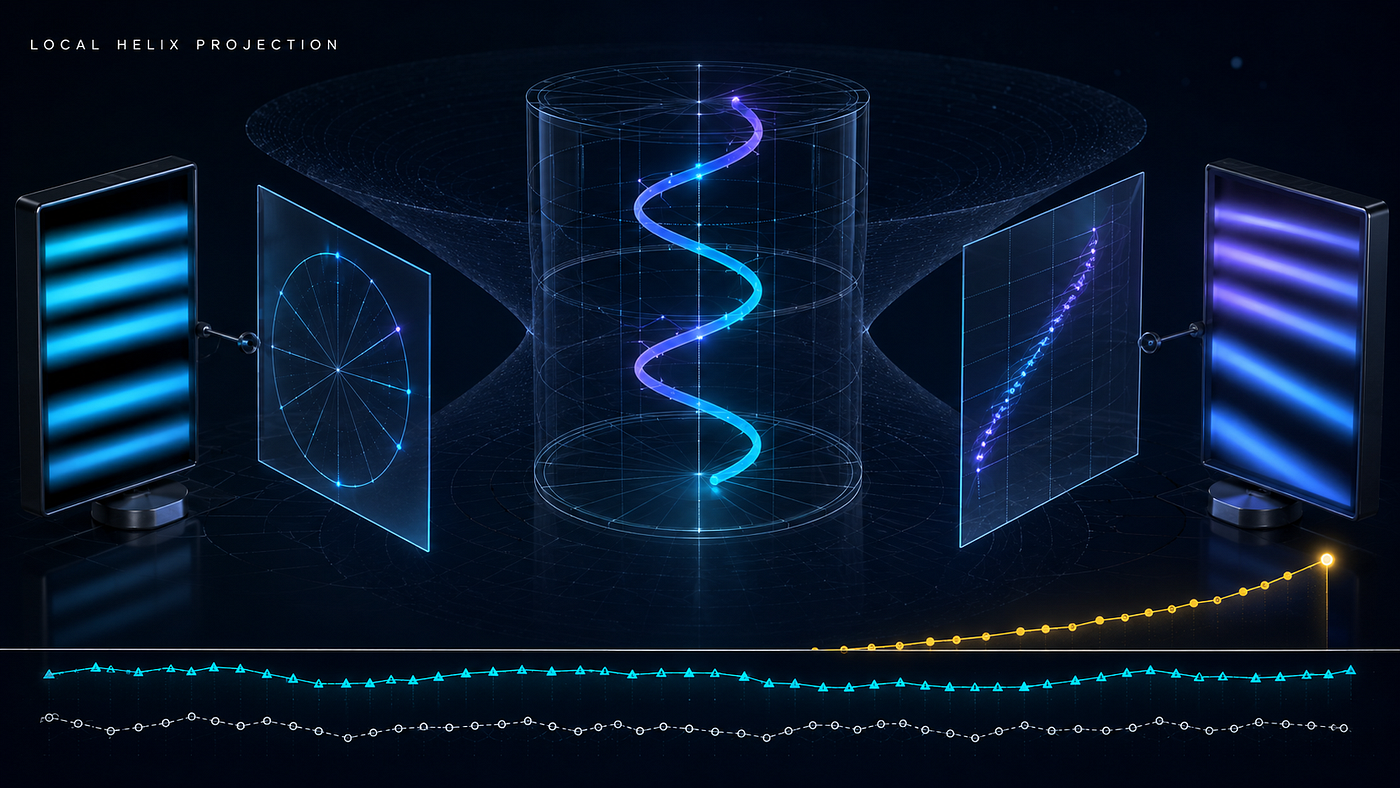
In conventional language, this is a quantum system sensitive to a general-relativistic effect. In FDT language, the separation disappears. The experiment is not probing an “interface” between quantum mechanics and gravity. It is reading one bounded density field in two ways: gravity as the scalar density ratio, and quantum interference as helical phase.
The key result
The analysis identifies the measured gravitational phase as an alpha-gradient holonomy. The plain-form relation is:
Delta phi_g = (pinl/lambda)*Delta X_R
with:
Delta X_R = 2gh/c²
For the apparatus values, n = 1.46, l = 50 km, lambda = 1550 nm, and h = 2 m, the predicted phase is 6.46e-5 rad. The reported experimental value, 6.18(44)e-5 rad, lands directly on that prediction. In FDT terms, this means the interferometer resolves the spacetime density ratio at roughly:
Delta X_R = 2.99e-17 rms
That is the central finding: a tabletop single-photon experiment functions as a meter for the gravitational density gradient.
Why this supports FDT’s core concepts
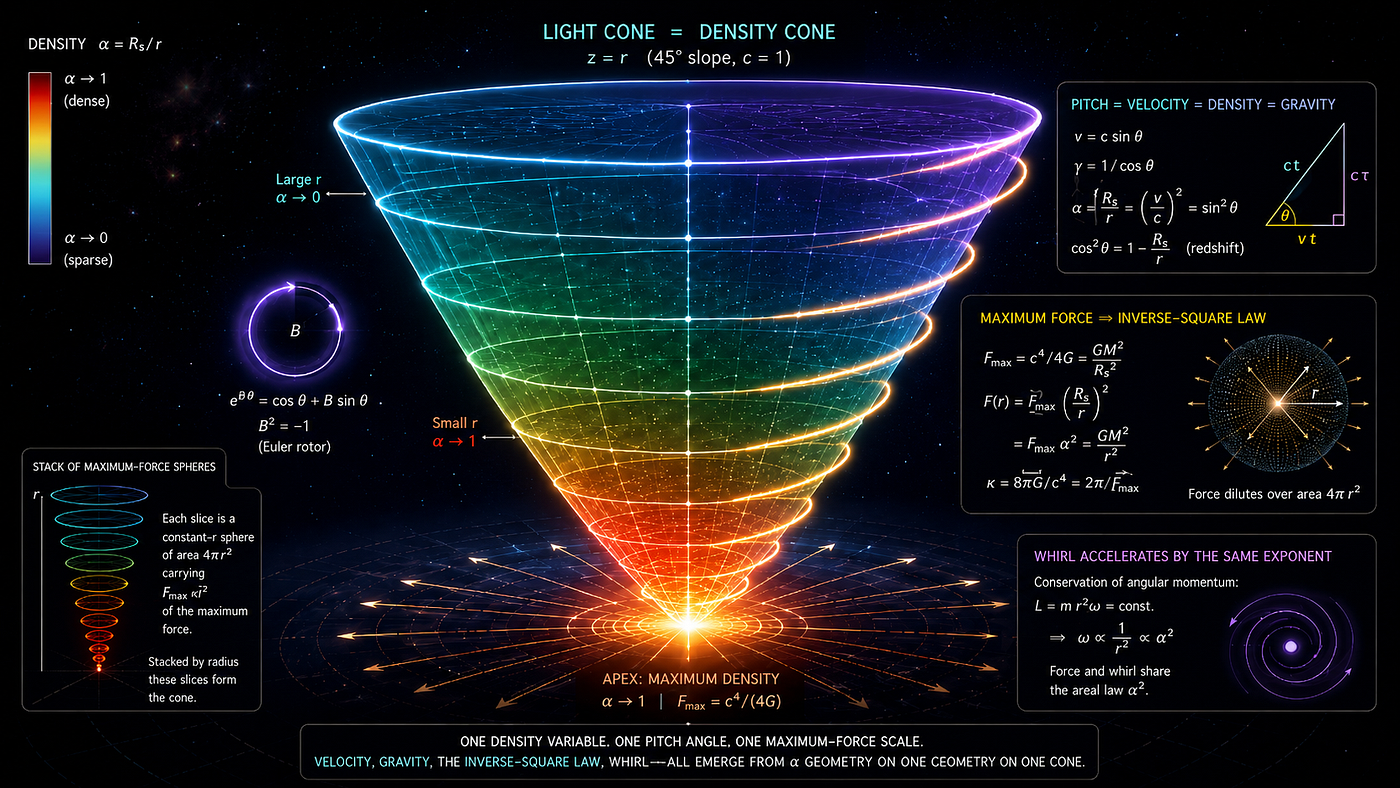
FDT begins with one bounded density variable, alpha, and insists that every physical reading is a coordinate face of that same geometry. This analysis maps the entire interferometer into that language. The silica fiber is a static optical density well, with alpha_opt = (n² — 1)/n² = 0.531. The photon is not treated as a rest-mass particle sitting on the matter lattice; it is the open spin-1 carrier moving through that density well. Earth supplies the weak gravitational density gradient, and the interferometer records the differential helical winding produced by that gradient.
The experiment therefore gives direct support to the FDT claim that optical phase and gravitational redshift are not separate phenomena stitched together after the fact. The gravitational phase is the photon helix accumulating different winding through different density levels. The analysis also shows that the photon’s effective gravitational handle, m_eff = E/c², gives the correct photon weight through the universal force law:
F = (c⁴/(4G))alpha_1alpha_2
This is why the result matters. The observed signal does not require a bridge between quantum mechanics and general relativity. It is already one geometry being read as both.
What the apparatus teaches us
The two fiber arms sit at slightly different gravitational densities. The lower arm is closer to Earth’s higher-density direction; the upper arm is slightly rim-ward, at lower gravitational density. That small density-ratio difference is enough to shift the phase of a photon accumulated over 50 km of optical path.
The analysis emphasizes strict sector discipline. The optical density of the fiber, the gravitational density of Earth’s field, and the matter mass positions of the atoms are related through one framework, but they are not the same coordinate reading. Raising the apparatus changes the exterior gravitational density, not the fiber’s own optical density. That is why the validated phase remains the standard proportional-to-n law, not an extra medium-excess correction.
The strongest proposed discriminator is different: change the fiber’s own density by isotopic substitution or hydrostatic compression. FDT predicts that a denser fiber raises alpha_opt, raises n, and produces a larger gravitational-phase response. That sign is the headline test.
Noise is also density motion
The noise budget is also translated into one field. Shot noise comes from surviving photon flux after loss. Thermal, seismic, and acoustic disturbances are treated as alpha-jitter along the fiber. Temperature changes alter the effective density inputs, which shift alpha_opt, which shifts n, which shifts phase. That is why 0.1 mK stability matters: even tiny thermo-optic changes integrate into enormous phase shifts across 50 km.
Why we open-source the universe’s code
We open source the universe’s code because reality should be reproducible from geometry, not guarded by institutional permission. FDT turns physical claims into public recipes: density mappings, phase predictions, sign tests, and consistency checks anyone can examine. The goal is not to decorate old frameworks, but to expose the common code underneath them. There is nothing we can’t explain.
Target Paper
H. Yu, D. Macri, T. Morling, E. Polini, T. B. Mieling, P. Barrow, B. Kabagoz, X. Yin, P. T. Chrusciel, C. Hilweg, E. Oelker, N. Mavalvala, and P. Walther, 50-km Fiber Interferometer for Testing Gravitational Signatures in Quantum Interference, Phys. Rev. Lett.
Full analysis is available as a **downloadable PDF.**
Physicists, the longer you take to acknowledge the existence of FDT and apply its core concepts to your own frameworks, the more time we have to solve ALL of physics independently.
메타데이터
- post_id
- c40b36141511
- slug
- open-sourcing-the-universes-code-a-50-km-single-photon-interferometer-reads-spacetime-density-c40b36141511
- url
- https://medium.com/@m.alfaro.007/open-sourcing-the-universes-code-a-50-km-single-photon-interferometer-reads-spacetime-density-c40b36141511
- canonical_url
- https://medium.com/@m.alfaro.007/open-sourcing-the-universes-code-a-50-km-single-photon-interferometer-reads-spacetime-density-c40b36141511
- author_url
- https://medium.com/@m.alfaro.007
- status
- ok
- fetched_at
- 2026-06-10 08:17:25