The Month-End Ritual Nobody Talks About Ending
Finance teams spend more time assembling data than analyzing it. That structural problem is now too expensive to ignore.
The Month-End Ritual Nobody Talks About Ending
Finance teams spend more time assembling data than analyzing it. That structural problem is now too expensive to ignore.

Key Takeaways
- Most finance teams spend a significant share of their working month on data consolidation, not analysis or decision support.
- The traditional FP&A software model was designed around monthly reporting cycles that no longer match how leadership teams expect to operate.
- Three pressures are converging at once: demand for continuous financial visibility, scenario modeling as a standing expectation, and serious AI adoption across finance functions.
- Moving beyond standalone planning tools is less a technology choice than an architectural one. The data layer matters more than the features.
- Platforms like Datarails FinanceOS exist specifically to address the data infrastructure gap, not just the analytical layer on top.
There is a specific kind of week that finance professionals recognize immediately. It usually happens just before the close. Someone in leadership needs a variance explained. A board deck needs refreshing. A scenario needs running. And before any of that work can begin, someone has to go get the data.
They pull from the ERP. They reconcile against the HRIS. They check the bank feeds. They build a version of the spreadsheet that accounts for entity eliminations and FX adjustments. Sometimes they discover, midway through, that a prior month’s figures have shifted. They start again.
This ritual is so embedded in how finance operates that most teams have stopped noticing it. The work of assembling data before analysis can begin has become invisible labor, filed under “just how it works.” But that framing is getting harder to sustain when leadership teams expect continuous financial visibility, not monthly updates, and when AI has entered the conversation as a real operational expectation rather than a talking point.
[embed]
The Gap Isn’t Where Most People Think It Is
When CFOs talk about moving slower than the business needs them to, the instinct is usually to look at the analytical tools. Maybe the planning model needs better scenario logic. Maybe the reporting suite needs a dashboard refresh. These are real improvements, but they tend to treat a downstream symptom rather than an upstream cause.
Research from FSN’s global finance survey found that manual consolidation alone accounts for up to 30% of a finance team’s monthly working hours. That is not a reporting problem. That is an infrastructure problem. A team spending nearly a third of its capacity on data assembly before any analysis begins is not a team that can credibly shift into the advisory and forecasting role that modern finance leadership now demands.
Deloitte’s CFO Signals data makes the trajectory clear. By Q4 2025, 87% of CFOs reported expecting AI integration in finance to be extremely or very important to their operations in 2026, and half of North American finance chiefs named digital transformation of the finance function as their single top priority for the year. Those numbers are not abstract. They reflect real pressure on finance leaders to deliver faster, more continuous, and more AI-enabled outputs with teams that are still, in many cases, running on architectures built for a slower world.
Why Standalone FP&A Tools Hit a Ceiling
FP&A platforms are capable tools for what they were designed to do. Multi-entity consolidations, structured planning hierarchies, variance analysis, and reporting templates are all things they handle well. The ceiling shows up when AI enters the picture.
Most planning tools were built around a document model: data assembled manually, fed into the system, processed into outputs. That model can coexist with AI visualization layers. What it cannot easily support is AI that generates substantive financial outputs — variance narratives, scenario summaries, board-ready commentary — because those require the underlying data to already be consolidated, governed, and trustworthy before the AI query is made. AI sitting on top of manually assembled exports does not eliminate the bottleneck. It decorates it.
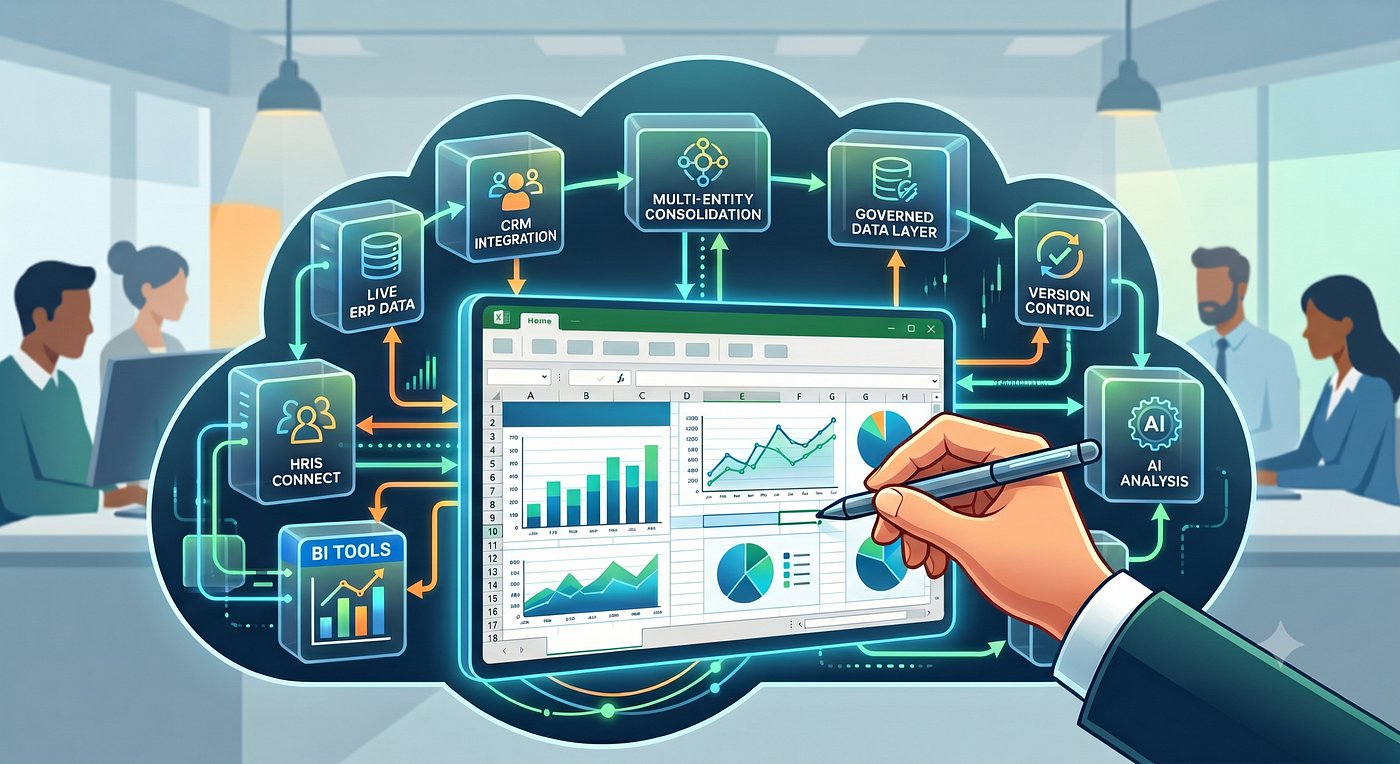
The shift that is actually happening inside forward-looking finance functions is architectural. Planning, close, and cash management moving to a shared data environment. Data sources connected and reconciled automatically rather than assembled by hand. And AI operates on a governed, validated layer of financial information rather than on exports that may or may not reflect current actuals.
What the Architecture Change Actually Looks Like
The clearest way to understand what this change involves in practice is to ask what an AI query against financial data actually requires to produce a trustworthy answer. It requires that the data be consolidated across source systems. It requires that entity eliminations, FX adjustments, and allocation logic have already been applied. It requires that the result be governed, with role-based access and audit trails that make every output traceable. And it requires that the semantic layer — the translation between raw database fields and the financial concepts an AI can reason about, like revenue by region or margin by business unit — be built and maintained by people who understand the business.
That is not a description of a feature set. It is a description of an infrastructure layer. The finance teams that are getting real AI output from their data have built that layer, either inside a platform designed for it or by connecting systems together in a way that approximates it.
One concrete illustration: La Fosse, a UK workforce solutions firm, connected Datarails FinanceOS to Claude via model context protocol (MCP) after operating across disconnected systems with no reliable single view of performance. When their CFO wanted to understand a marketing cost variance, he queried the live data directly. The response came back in ten seconds. His estimate for completing the same analysis manually was two hours. The team went on to generate a full quarterly business review from the same governed data environment.
The speed is a product of the infrastructure, not the AI model itself.
The Honest Evaluation Questions
When finance leaders look at platforms claiming to solve this problem, the questions that actually distinguish real architectural change from cosmetic AI layering are fairly specific.
Does the platform consolidate data from the full range of sources the business uses — ERP, CRM, HRIS, bank feeds, spreadsheets — without requiring custom integration work for each connection? Does implementation cost reflect realistic internal time, not just licensing fees? Is every AI output traceable back to a source system, or is the data layer opaque? And does the platform treat Excel as infrastructure to connect, or as a legacy habit to eliminate?
That last question matters more than it looks like it should. Finance functions have years of logic, assumptions, and exception-handling living inside spreadsheets. Platforms that can connect to that environment and govern it, rather than requiring a full migration away from it, tend to see faster adoption and fewer failed implementations.
What Decision-Makers Should Take Away
The case for moving beyond standalone FP&A tools is not primarily about AI features. It is about whether the finance stack’s underlying architecture can support the pace and complexity the business now requires.
For teams managing multi-entity consolidations, rolling forecasts, and leadership teams that expect live financial visibility, the structural gap between point solutions and integrated platforms is already consequential. The manual consolidation burden is real, measurable, and directly opposed to the advisory and analytical role finance is being asked to play.
For single-entity businesses with stable planning cycles and limited integration complexity, the switching cost may not yet be justified. The honest answer for that cohort is to wait until the complexity catches up, because it typically does.
For everyone else, the question is not whether to make the architectural shift. It is how far behind to fall before starting.
FAQ
What is actually causing the decline of standalone FP&A software?
The primary driver is structural rather than technological. Finance functions are now expected to deliver continuous visibility, rapid scenario modeling, and AI-generated analysis as standing capabilities, not quarterly deliverables. Standalone planning tools require significant manual data assembly upstream before any of that work can begin. Research consistently points to consolidation and data assembly consuming a disproportionate share of finance team capacity each month, which is time that is no longer available for the advisory work leadership now expects. The shift toward integrated platforms is a response to that bottleneck, not a reaction to AI hype.
How does an integrated finance platform differ from a planning tool with AI features?
The difference is in where the AI sits in relation to the data. A planning tool with AI features typically layers AI on top of data that has still been assembled manually, producing visualizations and summaries of exports. An integrated finance platform consolidates data from all source systems into a governed environment before AI queries are made, which means the outputs — variance narratives, scenario summaries, board commentary — are grounded in live, validated data rather than snapshots. The analytical capability of the AI model matters much less than the quality of the data it is operating on.
What should CFOs look for when evaluating platforms in this category?
The most diagnostic questions are whether the platform connects planning, close, and cash to a shared data environment without middleware; whether it can ingest data from the full range of sources the business uses; whether AI generates substantive financial outputs or only dashboards; and what implementation realistically costs in internal time, not just licensing. Excel compatibility deserves specific scrutiny — platforms that can govern existing spreadsheet logic tend to see faster adoption than those requiring a full migration away from it.
What does Datarails FinanceOS do differently from other finance platforms?
Datarails FinanceOS is built around the premise that the constraint in most finance functions is data infrastructure, not analytical capability. The platform connects to more than 600 data sources and applies consolidation logic — eliminations, FX adjustments, allocations — automatically rather than as manual steps. It exposes the resulting governed data layer to AI engines via a finance MCP server, meaning tools like Claude or Microsoft Copilot are operating on live, validated financial data rather than exports. The practical effect is that AI-generated outputs are faster to produce, more complete, and directly traceable to source systems in a way that satisfies the governance requirements most finance teams operate under.
[embed]
메타데이터
- post_id
- c42a258c2fd7
- slug
- the-month-end-ritual-nobody-talks-about-ending-c42a258c2fd7
- url
- https://medium.com/@the_variance/the-month-end-ritual-nobody-talks-about-ending-c42a258c2fd7
- canonical_url
- https://medium.com/@the_variance/the-month-end-ritual-nobody-talks-about-ending-c42a258c2fd7
- author_url
- https://medium.com/@the_variance
- status
- ok
- fetched_at
- 2026-07-09 13:32:43