The HR Perspective in a Technological Landscape — Overcoming the Silent Killers of Enterprise…
Bryan Lim Sian Yang
The HR Perspective in a Technological Landscape — Overcoming the Silent Killers of Enterprise Transformation
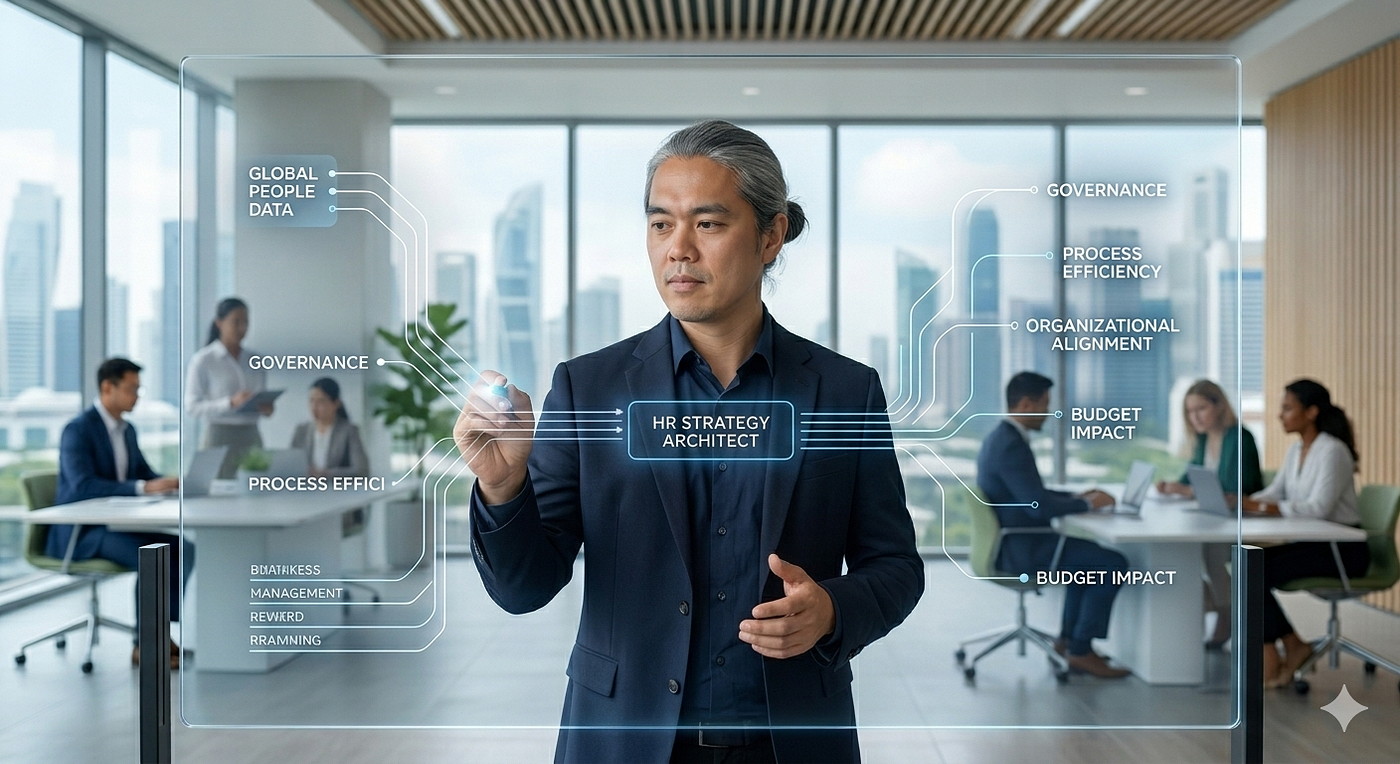
- Bryan Lim Sian Yang
On Day One of a major Human Capital Management (HCM) selection project, the mood in the boardroom is invariably electric. Glossy vendor slide decks promise a frictionless, AI-driven future where global data flows seamlessly, employee engagement skyrockets, and predictive analytics solve workforce planning at the click of a button. The investment is approved, champagne glasses clink, and the transformation journey officially begins.
Then comes Day 180.
By the time implementation hits the ground, that shiny vision often collides with a gritty, hyper-political reality. Timelines begin to slip. Configuration workshops stall. The customization budget explodes as various business units dig in their heels, demanding that the new cloud architecture bend to mirror their decades-old offline spreadsheets. Suddenly, the breakthrough transformation looks suspiciously like an incredibly expensive, cloud-based replica of the organization’s past inefficiencies.
When global HCM rollouts stagger or fail to deliver on their promised ROI, corporate post-mortems usually point to technical glitches, software limitations, or vague “change fatigue.”
But those are symptoms, not the cause.
The harsh reality of enterprise transformation is that HCM failures are rarely technological; they are structural governance deficits. When an organization treats a platform migration as a mere IT software swap rather than a fundamental re-engineering of People, Process, and Data, execution stalls before a single line of production code is even configured.
To break this cycle, HR leaders must move past the comforting language of traditional human resources and adopt the mindset of a Data Strategist and System Architect. By analyzing the implementation landscape through the rigorous lens of institutional readiness, we can expose — and neutralize — the three silent execution-killers that consistently derail enterprise technology long before the “go-live” date.
— -
1. The “Too Technical” Smoke Screen
It happens in almost every configuration workshop. The implementation team begins mapping a foundational data structure — perhaps a unified global position management framework, a standardized security role hierarchy, or an automated multi-tiered approval workflow. Ten minutes in, a senior functional stakeholder raises a hand, sighs, and delivers a familiar line: “Look, this is getting far too technical for us. We are HR and business leaders, not software developers. Let’s keep this high-level.”
On the surface, this feels like a reasonable plea for simplicity. In reality, it is one of the most dangerous, silent project-killers in enterprise transformation.
When a stakeholder claims a discussion is “too technical,” it is rarely a critique of the vocabulary being used. It is a psychological defense mechanism born out of cognitive friction — the mental strain experienced when a person faces a tool or concept that operates outside their established cognitive model. Faced with the rigid, systemic realities of modern cloud architecture, stakeholders experience a sudden loss of comfort and agency.
To regain control, they deploy the “too technical” label as a smoke screen. It is an active, defensive resistance mechanism designed to drag a strategic system discussion back down to the comforting familiarity of localized, operational tasks.
The trap closes when project teams accommodate this pushback by simplifying, watering down, or abstracting the architecture until it fits legacy comfort zones. When HR and business leaders abdicate their seats during deep structural data discussions, three critical failures occur:
• The Abdication of Business Logic: In a modern SaaS environment, business logic IS system architecture. If you do not explicitly define how data must flow, validate, and restrict across modules, you are not “keeping it high-level” — you are letting standard software defaults or external system integrators guess how your business operates.
• The Inevitable Workaround Explosion: When functional leaders refuse to engage with the system’s structural constraints during configuration, they inevitably discover later that the built solution doesn’t support their unstated operational nuances. The result? A massive, late-stage explosion of expensive offline spreadsheets and manual workarounds designed to bypass the very platform the organization spent millions to acquire.
• The Enforcement of Silos: Legacy systems allowed departments to operate as independent kingdoms. Modern HCMs require an interconnected data ecosystem. Avoiding the “technical” details means avoiding the hard, political work of breaking down those silos and standardizing data definitions across regional boundaries.
To survive this stage of an implementation, project architects must entirely reframe the complaint. Hearing “this is too technical” shouldn’t signal a need to simplify the slides; it should be flagged as a critical metric indicating a severe gap in organizational Desire or Change Readiness.
The solution is not to lower the technical bar, but to elevate the stakeholder’s accountability. We must stop treating system configuration as an IT project that requires business input, and start treating it as a core business redesign that utilizes technology as its ledger. If a business leader owns a process, they must own the underlying data structures that validate it. There is no middle ground.
— -
2. The Paradigm Trap — Tasks vs. Processes
The second silent killer of enterprise transformation lives in the design phase, hidden behind a fundamental misunderstanding of what a modern system actually does. It manifests as a persistent, aggressive demand from business units to customize the new Human Capital Management (HCM) platform so that it mirrors, button for button and step for step, the legacy workflows they are leaving behind.
This is the Paradigm Trap: the inability of an organization to distinguish between an isolated task and an end-to-end process.
Most legacy HR environments were built on task-oriented architectures. They functioned essentially as digitized filing cabinets. An HR administrator entered an employee record, a manager updated a job title on a separate screen, and a payroll specialist manually cross-referenced a spreadsheet to adjust a salary tier. Because these actions were decoupled, the system tolerated fragmented, highly localized, and inconsistent habits. The human operator was the manual bridge connecting the broken data points.
Modern tier-one cloud HCMs operate on a completely opposite philosophy. They are process-driven ecosystems built on highly integrated, global data models.
When an organization suffers from operational myopia — a state where individual contributors can only perceive their immediate, localized administrative checklist — they try to drag the new platform down into a task-oriented model. They look at a global, automated process and ask, “But where is the custom text field I use to write my personal notes?” or “Can we build an exception loop into this workflow just for our branch?”
Yielding to these demands triggers catastrophic configuration debt.
Modern SaaS HCM platforms are built on rigid, pre-configured best-practice frameworks designed to ensure stability, data integrity, and compliance across global regions. They are highly configurable, but they resist true customization (altering the underlying core code).
When an implementation team uses custom validation rules, brittle conditional routing, and artificial data tables to force a process-driven architecture to mimic a fragmented legacy task, the structural health of the system begins to decay:
• The Upgrade Wall: SaaS platforms provide continuous innovation through mandatory, bi-annual upgrades. When you layer heavy, unnatural configurations on top of the standard data model to appease localized task-thinking, those upgrades inevitably break. The organization finds itself trapped in a perpetual, costly cycle of regression testing and hot-fixing the same custom patches.
• Downstream Data Pollution: A transaction initiated in a process-driven system has immediate, cascading effects. An automated promotion workflow instantly recalculates compensation bands, adjusts tax profiles, updates regional headcount budgets, and alters security provisioning. When operational myopia introduces a customized “shortcut” or exception to satisfy a localized task habit, it pollutes the downstream data pool, resulting in payroll leakage or compliance failures that take months to trace.
To break out of the Paradigm Trap, transformation leaders must enforce a strict mandate of Business Process Re-engineering (BPR) before system configuration even begins.
The core philosophy of a true cloud transformation must be “Adopt, Don’t Adapt.” The objective is not to adapt the new software to accommodate the organization’s historical inefficiencies; it is to force the organization’s habits to adapt to the system’s global, standardized processes. If a legacy task cannot be mapped clean into the standard SaaS workflow, the task — not the software — is what needs to be retired.
— -
3. Winning the Argument, Losing the Budget
The final execution-killer takes place far from the technical design workshops, inside the quiet boardroom where capital is allocated. It is a recurring tragedy in enterprise transformation: the HR leadership team delivers a passionate, deeply moving business case for a new Human Capital Management (HCM) platform. They talk about transforming the employee experience, fostering a culture of continuous feedback, reducing friction in onboarding, and driving talent engagement. The presentation is flawless. Everyone nods in agreement.
Then the budget is slashed by forty percent, or the project is relegated to a secondary “IT software upgrade” with half the requested implementation resources.
HR wins the cultural argument, but they lose the strategic budget.
This failure occurs because of a profound misalignment between the qualitative language of traditional HR and the quantitative realities of the C-suite. When building a business case, HR frequently frames the value proposition around soft, qualitative outcomes. But the Chief Financial Officer (CFO) and Chief Information Officer (CIO) do not allocate capital based on sentiment. They speak the language of risk vectors, Total Cost of Ownership (TCO) optimization, data architecture, and capital efficiency.
At its core, losing the budget is a direct consequence of a Data Ownership Deficit. If HR cannot — or will not — treat human resource data with the same rigorous governance, absolute accuracy, and financial accountability that Finance treats a general ledger, the executive committee will never view an HCM implementation as a core infrastructure project. They will view it as an expensive administrative utility.
To secure the capital and executive sponsorship required for a true transformation, HR leaders must reframe their entire narrative around the hard fiscal impact of upstream data integrity:
• The Upstream Domino Effect: Human data is the absolute foundation of enterprise operations. A single employee record doesn’t just live in HR; it provisions security access keys in IT, dictates cost-center billing lines in Finance, drives regulatory compliance reporting in legal, and calculates commission structures in sales operations. When HR owns clean, unpolluted data upstream, it prevents operational friction downstream.
• Quantifying the Cost of Data Friction: To align with the CFO, HR must stop selling “experience” and start quantifying leakage. What is the actual financial cost of a 48-hour delay in onboarding a revenue-generating sales executive? What is the annual cost of payroll leakage caused by manual, retroactive data corrections? What are the potential international compliance and tax penalties associated with fractured employee classification structures across regional branches?
• Mitigating Systemic Risk: In an interconnected corporate ecosystem, bad data structure is an operational liability. If a company cannot instantly verify its global headcount, structural vacancies, or compliance certifications due to fragmented legacy systems, it is operating blind. HR must frame the new HCM platform as a risk mitigation engine that establishes a single, undeniable version of organizational truth.
When HR steps up and claims absolute ownership over the workforce data architecture, the boardroom dynamic shifts completely. The project ceases to be a “soft” HR initiative competing against revenue-generating business lines for peripheral funds. It becomes what it was always meant to be: an essential, non-negotiable infrastructure upgrade that secures the data integrity of the entire enterprise.
— -
4. The Strategic Blueprint for HR Architects
Diagnosing the silent killers of transformation is only half the battle. To actively steer an enterprise implementation away from these structural traps, HR leaders must pivot from passive stakeholders to active project architects. This requires transitioning out of traditional administrative comfort zones and deploying a rigorous, execution-focused blueprint across three critical pillars: Governance, Process, and Financial Narrative.
Pillar 1: Reframe “Technical Logic” as Business Governance
When a configuration workshop hits a wall because stakeholders dismiss data models or validation rules as “too technical,” project leaders must actively change the vocabulary of the room.
• Eliminate Abstract IT Language: Do not allow system integrators to present structural concepts purely in database jargon. Instead, explicitly translate every configuration choice into its operational real-world consequence.
• The Governance Rule: Establish a clear rule: If you own the business policy, you own the underlying system constraint. For example, security role hierarchies and multi-tiered approval rules are not technical settings — they dictate who has the actual financial authority to spend corporate funds. By framing configuration as a strict exercise in risk management and compliance, functional leaders can no longer abdicate their seats in design workshops.
Pillar 2: Enforce the “Adopt, Don’t Adapt” Mandate
To neutralize operational myopia and prevent the accumulation of crippling configuration debt, HR leadership must implement an uncompromising Business Process Re-engineering (BPR) strategy prior to configuring the new platform.
• Establish a Zero-Customization Default Policy: Institute a governance gate where any deviation from the standard, out-of-the-box SaaS process model requires formal approval from an executive steering committee. The burden of proof must be placed entirely on the business unit demanding the change. They must conclusively demonstrate that their localized legacy process drives a unique, quantifiable competitive advantage that cannot be achieved through standard global configuration.
• The “So What?” Challenge for Legacy Tasks: Systematically audit every historical, localized task by forcing stakeholders to defend its output, not its activity. If a team insists on a custom field to track manual notes, ask: What downstream automated process or executive analytical report consumes this specific data point? If the answer is “none,” the field is denied, and the legacy task is retired.
Pillar 3: Speak the Financial Language of the C-Suite
To ensure the implementation budget remains fully intact and prioritized, HR must completely overhaul how it presents the transformation business case to the CFO and CIO.
• Build a Financial Value Realization Model: Replace abstract “employee experience” metrics with hard operational calculations. Reframe process efficiency as a reduction in operational friction that eliminates manual data entry duplication and frees up administrative hours. Reframe data integrity as the elimination of payroll leakage by enforcing global position management limits. Finally, reframe risk and compliance as the automatic application of labor laws, eliminating manual compliance audit penalties.
— -
5. Conclusion — The New Mandate for HR Leadership
The ultimate measure of a successful Human Capital Management (HCM) transformation is not the arrival of the “go-live” date, nor is it a deployment that simply ticks the boxes of an on-time, under-budget IT schedule. The true measure is the realization of institutional agility, uncompromised process velocity, and absolute data integrity.
For too long, organizations have treated the human resources function as a purely qualitative domain — a soft enclave of culture, sentiment, and administrative tasks, safely insulated from the rigid, numbers-driven architecture of core business operations.
But as enterprise ecosystems become deeply interconnected, that insulation has completely dissolved.
The modern corporate landscape no longer has room for an HR leadership team that sits outside the technical circle, passively waiting for IT to deliver a tool or complaining that system conversations are “too technical.” Every strategic objective an enterprise pursues — from scaling a hybrid regional workforce to executing dynamic talent planning — is fundamentally dependent on the cleanliness, structure, and reliability of its upstream people data.
This realization brings with it a powerful new mandate. The modern HR executive must step up and confidently claim their role as a Data Strategist and System Architect.
To drive a business forward, you must understand that data structure IS corporate strategy. Designing a global position management hierarchy is not a software task; it is the literal codification of your organization’s operating model. Engineering automated, multi-tiered workflows is not an administrative chore; it is the construction of structural governance that protects capital and eliminates operational friction.
The era of HR winning the cultural argument but losing the budget is over. By treating workforce data with the same uncompromising governance, analytical rigor, and fiscal accountability that a Chief Financial Officer applies to a financial ledger, HR leaders reclaim the narrative.
When you sit at the executive table not just as a champion of people, but as the architect of the enterprise data foundation that drives the entire business machine, you don’t just ask for a seat at the table — you build the digital bedrock upon which the table stands.
HRIS #Digital Transformation #Change Management #HCM
메타데이터
- post_id
- c4331ffd0d63
- slug
- the-hr-perspective-in-a-technological-landscape-overcoming-the-silent-killers-of-enterprise-c4331ffd0d63
- url
- https://medium.com/@bryan-lim-sian-yang/the-hr-perspective-in-a-technological-landscape-overcoming-the-silent-killers-of-enterprise-c4331ffd0d63
- canonical_url
- https://medium.com/@bryan-lim-sian-yang/the-hr-perspective-in-a-technological-landscape-overcoming-the-silent-killers-of-enterprise-c4331ffd0d63
- author_url
- https://medium.com/@bryan-lim-sian-yang
- status
- ok
- fetched_at
- 2026-06-11 12:34:08