Opening a Business Bank Account in Malta from India: A Founder’s Real Journey
Most guides on this topic read like a checklist. This one reads like what actually happens, because the order things happen in matters just…
Opening a Business Bank Account in Malta from India: A Founder’s Real Journey
Most guides on this topic read like a checklist. This one reads like what actually happens, because the order things happen in matters just as much as what needs to happen.
Meet Aditi , a Bangalore-based product consultant who spent three years billing Indian clients before she picked up a handful of European ones. Within six months, currency conversion losses, delayed wire transfers, and clients confused by Indian invoicing formats convinced her she needed a EUR account and a Malta entity to operate through.
Her path from “I think I need this” to an active Malta business bank account is the roadmap for this article.
Read this guide: **How to Open a Business Bank Account in Malta**
Stage One: Realizing Incorporation Isn’t the Hard Part
Aditi assumed the difficult step would be registering her Malta company. It wasn’t.
Malta company formation, done through a licensed corporate service provider, took a few weeks and mostly involved sending documents back and forth.
The bank account was where things slowed down. She discovered quickly that a Malta company registration certificate alone doesn’t open doors banks and EMIs wanted to understand who she was, what her business actually did, and where the money moving through the account would come from.
If you’re at this stage, treat company formation as step one of two, not the finish line.
Stage Two: Learning the RBI Side Nobody Warns You About
This is where Aditi’s research hit a wall. Every article she found explained Malta’s KYC requirements in detail and said almost nothing about what she needed to do on the Indian side before sending money anywhere.
She learned about the Liberalised Remittance Scheme (LRS) — the route individual residents use to remit funds abroad for purposes including opening and funding a foreign bank account, without needing separate RBI approval as long as she stayed within the annual limit.
Since she was funding the account personally rather than through a registered Indian company, LRS was her route, not the Overseas Direct Investment (ODI) framework that applies when an Indian company funds a foreign entity.
She also learned the paperwork her own Indian bank would want before releasing funds: her PAN card, a KYC-compliant account to remit from, a completed Form A2, and the LRS declaration form.
This wasn’t optional prep her Indian bank held up the transfer for a week the first time because she hadn’t filled the LRS declaration correctly.
Her advice, in hindsight: talk to a CA who has actually processed LRS remittances before you touch the Malta application, not after your account is approved and you’re scrambling to fund it.
Stage Three: Choosing Between a Traditional Bank and an EMI
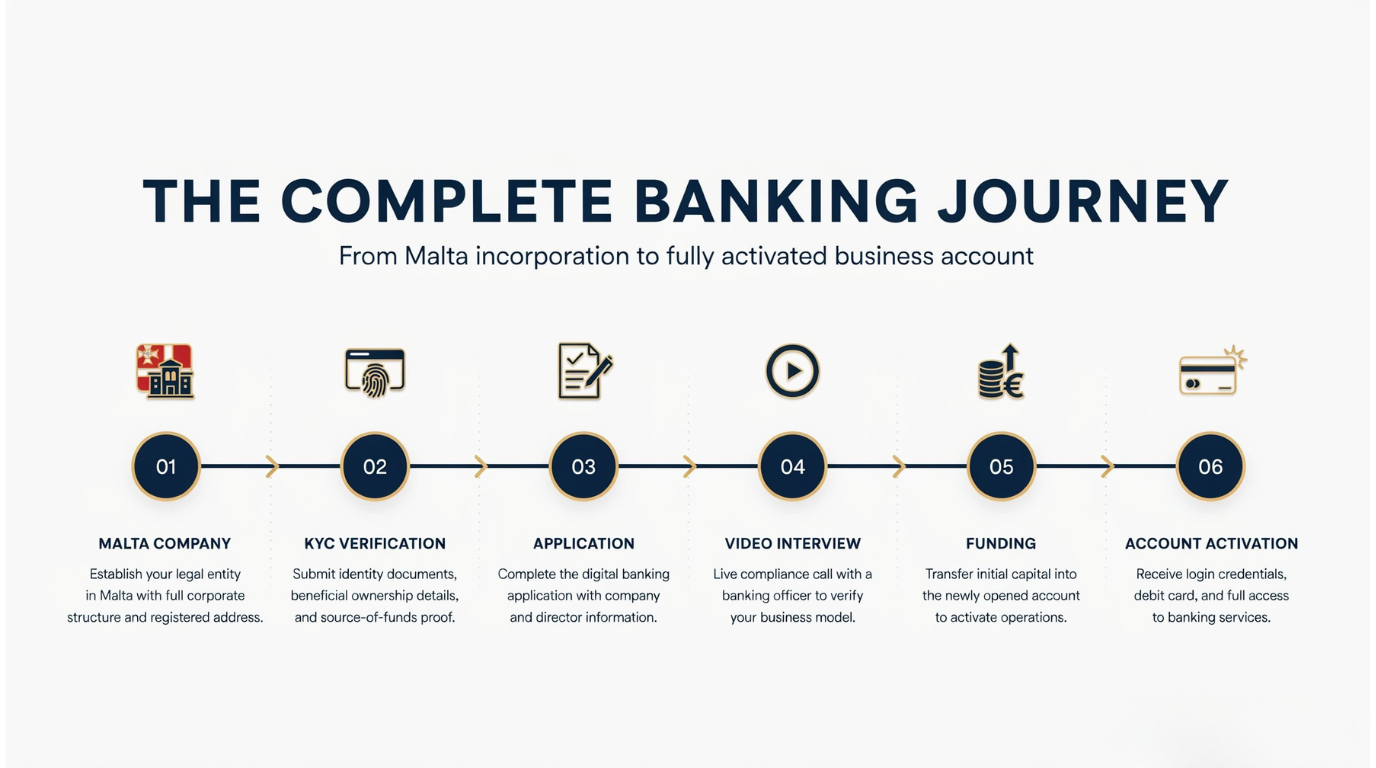
Aditi applied to two options in parallel a traditional Malta bank and a Malta-licensed EMI (Electronic Money Institution).
The EMI approved her in under two weeks with a fully remote video KYC process. The traditional bank took over six weeks, requested additional documents twice, and eventually asked for a video compliance interview before approving her.
Neither was wrong they’re just different products. The EMI got her operational fast with solid IBAN and payment functionality.
The traditional bank, once approved, gave her a broader relationship for future trade finance needs she didn’t need yet but wanted available.
If you’re choosing between the two, ask yourself honestly whether you need a full banking relationship now or just a working EUR account to start invoicing the answer changes which one to prioritize first.
Stage Four: The Compliance Interview
This step surprised her the most. She expected a document review. Instead, it was a genuine conversation: what does your business do, who are your clients, roughly what volume of transactions do you expect, and where is the initial funding coming from.
Founders who stumble here usually aren’t hiding anything they just haven’t rehearsed explaining their own business in plain, compliance-friendly language.
Vorx tip: before your call, write two sentences describing your business model and one sentence describing your funding source.
If you can’t say it simply, the compliance officer will ask more questions, not fewer.
Stage Five: Funding the Account and Going Live
Once approved, funding was almost anticlimactic — she remitted through her Indian bank under LRS, using the Form A2 and declaration she’d already prepared, and the funds landed in her new Malta account a few business days later.
What she didn’t expect: her Malta bank confirmed, matter-of-factly, that her account details would be shared with Indian tax authorities under the Common Reporting Standard (CRS) — standard practice for any cross-border account, not a red flag.
She now makes sure her Malta account is disclosed properly under Schedule FA when she files her Indian return, and treats that disclosure as routine bookkeeping rather than a risk to manage.
What Aditi Would Tell a Founder Starting Today
Register your Malta company first don’t try to shop for banks before you have an entity. Understand LRS versus ODI before you send a rupee, not after.
Apply to more than one bank type in parallel, because timelines vary wildly and you don’t want a single slow approval to be your only option.
Rehearse your compliance interview answers like you would a client pitch. And expect the whole journey company formation, bank approval, and first successful funding to take longer than any single step’s quoted timeline suggests, because the real bottleneck is usually the handoff between the Indian remittance process and the Malta approval process, not either one alone.
If there’s one thing her experience makes clear, it’s that the process isn’t complicated in any single step it’s just spread across two countries’ systems that don’t talk to each other, and the founders who move fastest are the ones who prepare for both sides from day one.
메타데이터
- post_id
- c4459c7eab8b
- slug
- opening-a-business-bank-account-in-malta-from-india-a-founders-real-journey-c4459c7eab8b
- url
- https://medium.com/@teammarketing_39552/opening-a-business-bank-account-in-malta-from-india-a-founders-real-journey-c4459c7eab8b
- canonical_url
- https://medium.com/@teammarketing_39552/opening-a-business-bank-account-in-malta-from-india-a-founders-real-journey-c4459c7eab8b
- author_url
- https://medium.com/@teammarketing_39552
- status
- ok
- fetched_at
- 2026-08-20 03:50:09