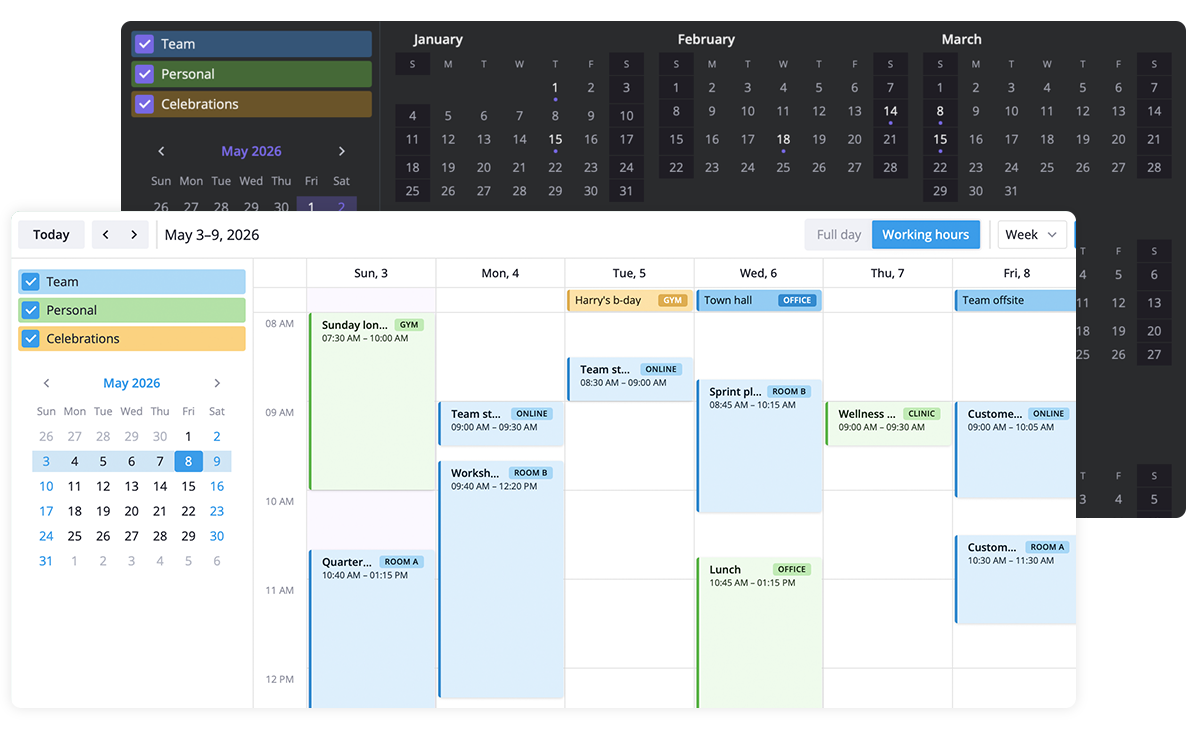
Is FullCalendar Still the Best Choice in 2026?
A practical comparison of FullCalendar and SVAR Calendar for modern React, Vue, and Svelte applications.
Is FullCalendar Still the Best Choice in 2026?
A practical comparison of FullCalendar and SVAR Calendar for modern React, Vue, and Svelte applications.
For many developers looking for a JavaScript-based calendar component, the first name that comes to mind is FullCalendar. Its flexible architecture, mature plugin ecosystem, rich feature set, and years of production use have made it one of the most trusted scheduling libraries — and for many teams, the default choice.
But frontend development has changed significantly over the past few years. Modern applications are increasingly built with React, Vue, and Svelte — see the State of JS 2025 statistics.
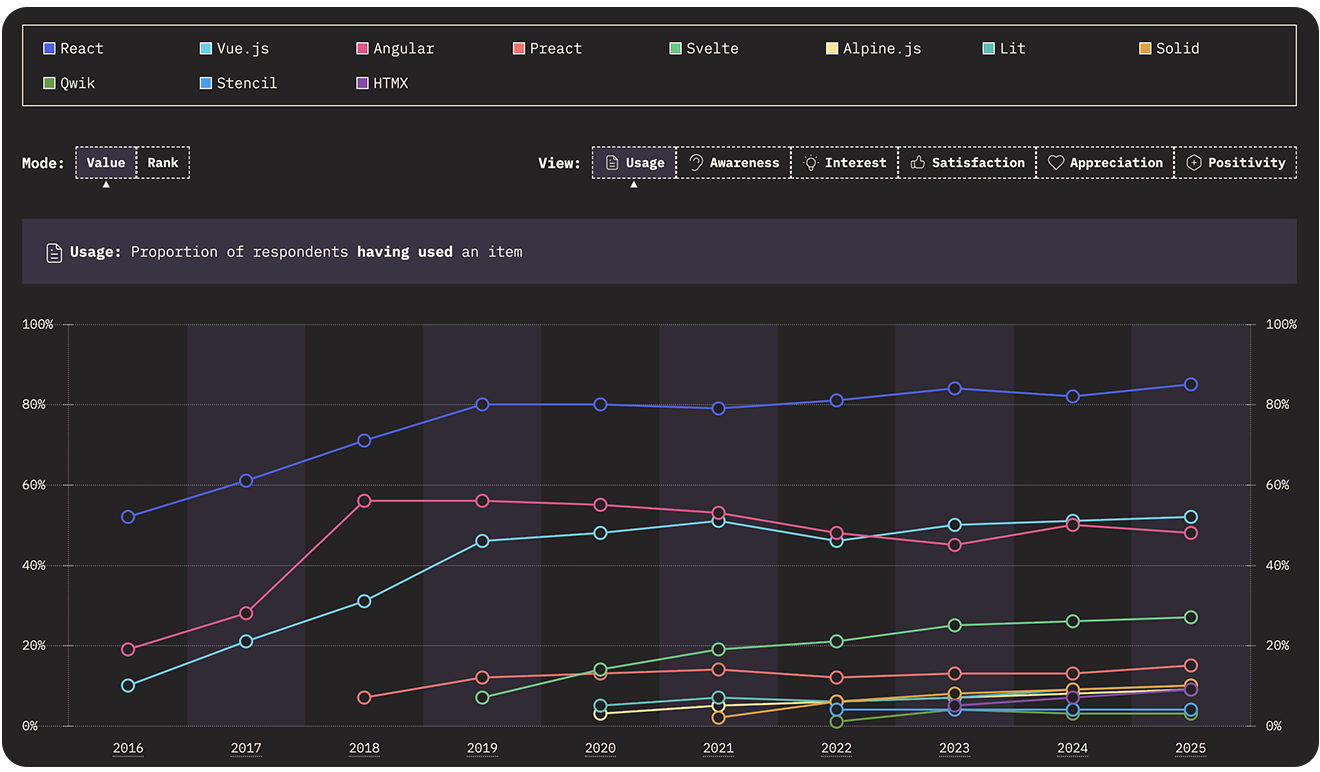
State of JS — Frontend frameworks ratios over time
For complex, data-intensive components like calendars, teams are moving away from framework-agnostic JavaScript libraries that rely on framework adapters. Instead, they are looking for components built specifically for their framework, with TypeScript-first APIs, predictable state management, minimal integration overhead, and an API that feels like a natural part of their application.
This raises a practical question: Is FullCalendar still the best fit for modern frontend development? And are there compelling alternatives worth considering?
Why Another Calendar?
At first glance, building another calendar library may seem like reinventing the wheel.
FullCalendar is a mature, well-maintained project used in thousands of production applications. It already solves most scheduling challenges and offers a rich ecosystem of plugins and extensions.
At the same time, expectations for calendar components have evolved. Developers need components that add real scheduling workflows without too much manual wiring. They expect the calendar library to have scheduling features out of the box, such as:
- Drag-and-drop scheduling
- Multiple calendar views
- Built-in event editing without creating custom forms or dialogs
- Recurring events support
- Event filtering
- Resource scheduling
- Straightforward UI customization
- Full TypeScript support
These capabilities, usually found in online schedulers like Google Calendar, have become the baseline for modern scheduling components. The real question is no longer whether a calendar library supports these features, but how it delivers them. That is where the differences between modern solutions begin to emerge.
Where FullCalendar Is Still Strong
FullCalendar remains one of the most established and well-recognized calendar libraries in the JavaScript ecosystem. The project continues to evolve through its open-source repository on GitHub. Its key strengths include:
- More than a decade of development
- A large and active community
- Extensive documentation and learning resources
- Vue, React, and Angular support through framework wrappers
- Wide adoption across real-world applications
FullCalendar supports multiple calendar views, drag-and-drop interactions, recurring events, and provides a solid foundation for production scheduling applications. Its core is available under the MIT license, while more advanced capabilities are offered as commercial extensions.
At the same time, newer libraries are taking a different approach — one that combines the core scheduling capabilities with a more modern developer experience.
SVAR Calendar as Alternative
SVAR Calendar is one of these alternatives. It delivers similar scheduling functionality required for modern applications. However, rather than adapting a framework-agnostic JavaScript library through wrappers, SVAR Calendar is built as a native component for React, Vue, and Svelte.
As a newer open-source project, SVAR Calendar is actively evolving and maintained on SVAR’s GitHub. It focuses on a modern developer experience with framework-native architecture, modern calendar UX patterns, and built-in workflows for common business scenarios.

SVAR Calendar vs FullCalendar
Different Design Philosophies
FullCalendar and SVAR Calendar have a lot in common. Both offer an MIT-licensed core, with more advanced scheduling capabilities available in their commercial editions.
Free versions cover the core calendar functionality developers expect: day, week, and month views, drag-and-drop scheduling, and TypeScript support. The differences become more visible when it comes to complete scheduling workflows.
With FullCalendar, event editing typically requires developers to build their own UI. Event filtering and calendar grouping also require custom implementation. More advanced capabilities, such as resource scheduling and timeline views, are available through premium features.
SVAR Calendar takes a more built-in approach. It includes an event editor, advanced event filtering, and calendar grouping as part of the component. Recurring events, resource scheduling, and timeline views are also available in the PRO edition.
What it means in practice:
- SVAR Calendar includes more of the common business workflows directly in the component.
- FullCalendar often relies on additional plugins or custom implementation.
Calendar Engine vs Complete Scheduling System
FullCalendar is primarily a calendar engine. It provides an extensible foundation that developers can customize through plugins, callbacks, and custom UI. This offers a high degree of flexibility, but common business workflows may require additional implementation.
SVAR Calendar takes a more all-in-one approach. It provides a calendar component together with built-in workflows such as event editing, filtering, and calendar grouping, reducing the amount of custom infrastructure required for common scheduling scenarios.

SVAR Calendar with built-in editor
What it means in practice:
- FullCalendar provides a powerful scheduling engine, but common business workflows often require additional plugins or custom implementation.
- SVAR Calendar is better suited for business applications that need common scheduling workflows available out of the box, with less integration overhead.
UI Customization
The two libraries also differ in how they approach UI customization.
FullCalendar emphasizes flexibility through its plugin architecture, rendering hooks, and callback APIs. This gives developers fine-grained control over the user interface and makes it possible to build highly customized scheduling experiences.
SVAR Calendar takes a more opinionated approach, aiming to reduce the amount of infrastructure developers need to build themselves. It relies on themes, CSS variables, and predictable component APIs, allowing most UI customizations to be implemented without deep overrides or custom rendering logic.
What it means in practice:
- FullCalendar prioritizes flexibility, giving developers complete control at the cost of additional complexity and implementation time.
- SVAR Calendar focuses on faster implementation by providing common scheduling workflows and UI customization mechanisms out of the box.
JavaScript Library vs Framework-Native Components
One of the biggest architectural differences appears during integration.
FullCalendar is built around a framework-agnostic JavaScript core with adapters for Vue, React, and Angular. These adapters work reliably, but they introduce an additional integration layer that requires more configuration and state synchronization as applications become more complex.
import FullCalendar from "@fullcalendar/react";
import dayGridPlugin from "@fullcalendar/daygrid";
import interactionPlugin from "@fullcalendar/interaction";
const events = [
{ title: "Kickoff", date: "2026–07–01" },
];
export default function App() {
return (
<FullCalendar
plugins={[dayGridPlugin, interactionPlugin]}
initialView="dayGridMonth"
events={events}
/>
);
}
SVAR Calendar, by contrast, is implemented as a native Vue, React, and Svelte component. Each version is built specifically for its framework, following its rendering model, component lifecycle, and state management patterns.
import { useRef } from "react";
import { Calendar, Editor, Willow } from "@svar-ui/react-calendar";
const date = new Date(2026, 4, 5);
const events = [
{
id: 1,
start: new Date(2026, 4, 5, 9, 0),
end: new Date(2026, 4, 5, 10, 0),
text: "Standup",
},
];
export default function App() {
const api = useRef(null);
return (
<Willow>
<Calendar ref={api} events={events} date={date} />
{api.current && <Editor api={api.current} />}
</Willow>
);
}
As a result, the calendar integrates naturally with the application and requires less integration overhead.
What it means in practice:
- With FullCalendar, you’re integrating an external JavaScript library through a framework adapter.
- With SVAR Calendar, you’re working with a component built specifically for Vue, React, or Svelte that behaves like any other native component in your application.
Conclusion: Which Calendar Component Should You Choose?
Both FullCalendar and SVAR Calendar are powerful scheduling libraries, but they’re designed with different development priorities in mind, and the right choice depends on the needs of your project.
FullCalendar is suitable when:
- You value a rich plugin ecosystem and a mature community.
- You need maximum customization flexibility.
- You want to use a vanilla JavaScript component.
- You need Angular support.
- You already have an existing integration centered around FullCalendar.
SVAR Calendar is suitable when:
- You are developing your application with Vue, React, or Svelte.
- You want to use a framework-native component.
- You value a built-in scheduling workflow, predictable integration, and minimal custom implementation.
- You want to use features such as event editing, filtering, calendar grouping, and resource scheduling with minimal additional implementation.
Explore the SVAR calendar component for your preferred framework:
Vue Calendar | React Calendar | Svelte Calendar
⭐ The open-source edition is available on GitHub, so please give it a star if you like it! Try SVAR Calendar in your projects and save time instead of building an event calendar from scratch.
메타데이터
- post_id
- c456b79ccd77
- slug
- is-fullcalendar-still-the-best-choice-in-2026-c456b79ccd77
- url
- https://medium.com/@SvarWidgets/is-fullcalendar-still-the-best-choice-in-2026-c456b79ccd77
- canonical_url
- https://medium.com/@SvarWidgets/is-fullcalendar-still-the-best-choice-in-2026-c456b79ccd77
- author_url
- https://medium.com/@SvarWidgets
- status
- ok
- fetched_at
- 2026-08-22 12:48:15