Deep Learning Series 10:- Weight Initialization Techniques
Previous Blog
Deep Learning Series 10:- Weight Initialization Techniques
Previous Blog
[embed]Deep Learning Series 09: Optimizers for Optimization Previous Blogmedium.com
In deep learning, weight initialization plays a crucial role in training neural networks effectively. Poor initialization of the model’s weights can lead to slow convergence, vanishing gradients, or even the failure of the training process.
On the other hand, good weight initialization can accelerate training, help avoid issues like exploding or vanishing gradients, and lead to faster convergence toward an optimal solution.
In this blog, we’ll explore what weight initialization is, why it matters, and how to choose the right initialization strategy for your model.
Photo by Bailey Zindel on Unsplash
Why Weight Initialization Matters
Weight initialization is crucial for the following reasons:
- Avoiding Symmetry Breaking: If all weights are initialized to the same value, every neuron in the network will compute the same output during the forward pass and update in the same direction during backpropagation. This results in symmetry, and the neurons will not learn different representations.
- Preventing Vanishing/Exploding Gradients: In deep networks, the gradients of the loss function can become very small (vanishing gradients) or very large (exploding gradients) as they are propagated back through the network. Poor initialization can exacerbate these issues, especially with deep or recurrent networks, leading to slow learning or unstable training.
- Faster Convergence: Proper weight initialization can help the network converge faster by ensuring that the gradients during backpropagation are of an appropriate size. This helps the optimizer take steps that are neither too small nor too large, leading to faster training times.
Types of Weight Initialization Techniques
Several weight initialization methods have been proposed over the years, each addressing different issues that arise in the training of deep networks. Below are some of the most common and effective initialization strategies:
1. Random Initialization (Uniform/Normal Distribution)
The most basic form of weight initialization involves assigning random values to weights drawn from either a uniform distribution or a normal distribution (Gaussian distribution). Typically, weights are drawn from a small range, such as [−0.01,0.01] for uniform or N(0,0.01) for normal.
- Problem: While this method can help avoid symmetry breaking, it can still lead to poor performance, especially in deep networks, because the scale of the weights might be too large or too small.
The Importance of Weight Initialization in Deep Learning
In deep learning, weight initialization plays a crucial role in training neural networks effectively. Poor initialization of the model’s weights can lead to slow convergence, vanishing gradients, or even the failure of the training process. On the other hand, good weight initialization can accelerate training, help avoid issues like exploding or vanishing gradients, and lead to faster convergence toward an optimal solution. In this blog, we’ll explore what weight initialization is, why it matters, and how to choose the right initialization strategy for your model.
What is Weight Initialization?
Weight initialization refers to the process of setting the initial values of the weights (or parameters) of a neural network before training begins. Neural networks are typically initialized with small random values so that the model doesn’t start with symmetric weights (which would prevent learning) or with the same values for all weights. However, the method used to initialize the weights can significantly impact the performance of the network.
When training deep networks, the goal is to optimize the model by adjusting the weights during backpropagation to minimize the loss function. If the weights are poorly initialized, it can hinder the network’s ability to converge, and sometimes it can even prevent learning entirely.
Why Weight Initialization Matters
Weight initialization is crucial for the following reasons:
- Avoiding Symmetry Breaking: If all weights are initialized to the same value, every neuron in the network will compute the same output during the forward pass and update in the same direction during backpropagation. This results in symmetry, and the neurons will not learn different representations, defeating the purpose of having multiple neurons.
- Preventing Vanishing/Exploding Gradients: In deep networks, the gradients of the loss function can become very small (vanishing gradients) or very large (exploding gradients) as they are propagated back through the network. Poor initialization can exacerbate these issues, especially with deep or recurrent networks, leading to slow learning or unstable training.
- Faster Convergence: Proper weight initialization can help the network converge faster by ensuring that the gradients during backpropagation are of an appropriate size. This helps the optimizer take steps that are neither too small nor too large, leading to faster training times.
Types of Weight Initialization Techniques
Several weight initialization methods have been proposed over the years, each addressing different issues that arise in the training of deep networks. Below are some of the most common and effective initialization strategies:
1. Random Initialization (Uniform/Normal Distribution)
The most basic form of weight initialization involves assigning random values to weights drawn from either a uniform distribution or a normal distribution (Gaussian distribution). Typically, weights are drawn from a small range, such as [−0.01,0.01][-0.01, 0.01][−0.01,0.01] for uniform or N(0,0.01)\mathcal{N}(0, 0.01)N(0,0.01) for normal.
- Problem: While this method can help avoid symmetry breaking, it can still lead to poor performance, especially in deep networks, because the scale of the weights might be too large or too small.
2. Zero Initialization
This technique involves initializing all weights to zero. While it may seem intuitive, it does not work well in practice because it leads to the problem of symmetry, as discussed earlier. All neurons will receive the same gradient, and thus, they will learn the same features during training.
- Avoid this: Never initialize the weights to zero for hidden layers in deep networks.
3. Xavier/Glorot Initialization
Named after its creator, Xavier Glorot, this initialization method aims to solve the problem of vanishing/exploding gradients. It is particularly effective for networks with sigmoid or tanh activation functions.
Xavier initialization draws weights from a uniform or normal distribution with the variance scaled according to the number of input and output units of the layer:
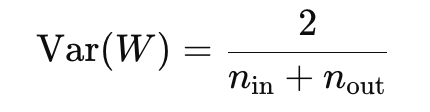
Where:
- n_in is the number of input units in the layer.
- n_out is the number of output units in the layer.
This scaling ensures that the variance of the activations and gradients remains approximately the same across all layers, preventing the gradients from vanishing or exploding.
- Use Case: Xavier initialization works best with sigmoid and tanh activation functions
4. He Initialization
He Initialization is similar to Xavier initialization but is specifically designed for ReLU (Rectified Linear Unit) and its variants. Since ReLU can cause dead neurons (where the output is always zero), it’s important to initialize the weights in such a way that the variance is larger, helping to prevent vanishing gradients and dead neurons.
The weights are initialized using a normal distribution with variance:
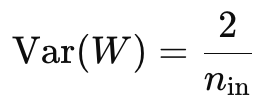
Where:
- n_in is the number of input units in the layer.
This larger variance helps maintain the magnitude of the activations and gradients throughout the network, making He initialization particularly effective for ReLU-based networks.
- Use Case: He initialization works best for ReLU and Leaky ReLU activation functions.
Up Next
메타데이터
- post_id
- c4604ef86bc7
- slug
- deep-learning-series-10-weight-initialization-techniques-c4604ef86bc7
- url
- https://medium.com/@yashwanths_29644/deep-learning-series-10-weight-initialization-techniques-c4604ef86bc7
- canonical_url
- https://medium.com/@yashwanths_29644/deep-learning-series-10-weight-initialization-techniques-c4604ef86bc7
- author_url
- https://medium.com/@yashwanths_29644
- status
- ok
- fetched_at
- 2026-06-25 07:00:49