Cracking the Code of Medical Image Segmentation: Meet DyCON, a Semi-Supervised Learning…
Medical image segmentation is a backbone of modern diagnostics — vital in tasks like detecting brain tumors, isolating organs, and…
Cracking the Code of Medical Image Segmentation: Meet DyCON, a Semi-Supervised Learning Game-Changer
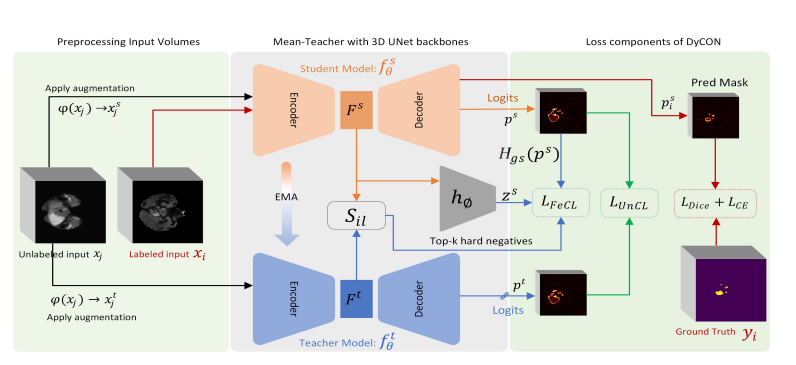
photo from paper DyCON: Dynamic Uncertainty-aware Consistency and Contrastive Learning for Semi-supervised Medical Image Segmentation
Medical image segmentation is a backbone of modern diagnostics — vital in tasks like detecting brain tumors, isolating organs, and outlining stroke lesions. But achieving pixel-perfect accuracy typically requires large volumes of annotated 3D scans, a resource as scarce as it is expensive.
Enter DyCON, a novel deep learning framework that could fundamentally change how we train segmentation models when labels are limited. Developed by researchers at Khalifa University, DyCON combines the best of uncertainty modeling, consistency learning, and contrastive learning, making semi-supervised segmentation smarter, sharper, and significantly more robust.
Why Medical Image Segmentation Is So Hard Imagine trying to find a faint tumor on a blurry MRI scan. Now, imagine doing that thousands of times. Medical segmentation is notoriously difficult due to:
Lesion variability: Lesions differ wildly in size, shape, and texture.
Class imbalance: Lesion voxels (pixels in 3D) are dwarfed by healthy tissue.
Limited labels: Annotated 3D scans require experts and time — both costly.
While semi-supervised learning (SSL) can help by learning from unlabeled data, existing SSL methods often ignore the most uncertain or imbalanced regions — precisely where the clinical action is.
DyCON: Learning from the Hardest Cases DyCON, short for Dynamic Uncertainty-aware Consistency and Contrastive Learning, breaks new ground by doing two things differently:
- Uncertainty-aware Consistency Loss (UnCL) Instead of filtering out uncertain voxels like previous models, DyCON embraces them.
Early Training: DyCON encourages the model to learn from uncertain areas (like fuzzy lesion borders) by reducing penalties.
Later Training: It gradually shifts focus to more confident predictions for refinement.
This is achieved through entropy-based weighting, where voxel contributions are scaled based on prediction uncertainty from both student and teacher networks.
- Focal Entropy-aware Contrastive Loss (FeCL) To handle class imbalance and hard-to-spot lesions, DyCON uses contrastive learning — but smarter.
Focal Mechanism: It emphasizes “hard positives” (similar patches that look different) and “hard negatives” (dissimilar patches that look the same).
Entropy Awareness: Weights are adjusted based on prediction uncertainty — prioritizing confusing or ambiguous patches.
Top-k Negative Mining: The model deliberately learns from the most confusing negative samples to sharpen feature discrimination.
The Results? Stunning. DyCON was tested on four diverse datasets: ISLES’22 (stroke), BraTS’19 (brain tumors), LA (left atrium), and Pancreas-NIH. Across all of them, DyCON consistently outperformed state-of-the-art methods, often by large margins.
On ISLES’22 (with only 10% labeled data), DyCON achieved 65.71% Dice score, beating the next best method by over 5%.
On BraTS’19, it reached 88.75% Dice with only 20% labeled data — rivaling fully supervised models.
It excelled in scattered and small lesions, where other methods struggled.
Translation: DyCON sees what others miss, especially when it matters most.
Beyond the Metrics What makes DyCON particularly impressive is its generalizability:
It works seamlessly with popular SSL frameworks like Mean Teacher.
It’s modular — you can plug UnCL and FeCL into existing pipelines.
It’s efficient — training time is comparable to existing methods, despite improved performance.
Final Thoughts: A Big Leap for Small Labels DyCON stands out by treating uncertainty and class imbalance not as nuisances to be filtered out, but as learning opportunities. This philosophical shift — from filtering out hard regions to embracing and weighting them — could reshape how semi-supervised segmentation is approached across medical AI.
If you’re working with limited labels in healthcare imaging — or just fascinated by how deep learning is maturing into real-world readiness — DyCON is a must-watch framework.
메타데이터
- post_id
- c461c2907cab
- slug
- cracking-the-code-of-medical-image-segmentation-meet-dycon-a-semi-supervised-learning-c461c2907cab
- url
- https://medium.com/@saba99/cracking-the-code-of-medical-image-segmentation-meet-dycon-a-semi-supervised-learning-c461c2907cab
- canonical_url
- https://medium.com/@saba99/cracking-the-code-of-medical-image-segmentation-meet-dycon-a-semi-supervised-learning-c461c2907cab
- author_url
- https://medium.com/@saba99
- status
- ok
- fetched_at
- 2026-07-20 02:51:28