Enterprise Architecture for Agentic AI Using AWS Bedrock
Designing Autonomous, Governed, and Scalable AI Systems for Financial Services
Enterprise Architecture for Agentic AI Using AWS Bedrock
Designing Autonomous, Governed, and Scalable AI Systems for Financial Services
1. Introduction
The emergence of large language models (LLMs) has fundamentally transformed enterprise AI from predictive analytics toward intelligent decision-making systems. However, most implementations remain constrained by rigid workflows and lack the ability to autonomously orchestrate complex tasks.
This gap has led to the rise of Agentic AI architectures — systems composed of autonomous agents capable of reasoning, planning, and executing multi-step workflows across heterogeneous enterprise environments.
For industries such as financial services, where systems are highly regulated, latency-sensitive, and mission-critical, adopting Agentic AI requires a carefully designed architecture that balances:
- Autonomy and governance
- Scalability and observability
- Innovation and regulatory compliance
This article defines a reference architecture for enterprise-scale Agentic AI systems using AWS Bedrock, enriched with domain-specific considerations for financial platforms such as payments, lending, and risk processing systems.
2. Evolution from Traditional AI to Agentic Systems
2.1 Limitations of Traditional Enterprise AI
Traditional enterprise AI solutions are typically:
- Pipeline-driven (ETL → model → output)
- Static in orchestration
- Highly dependent on manual intervention
- Limited in cross-functional adaptability
These architectures are insufficient for:
- Dynamic decision-making
- Multi-system orchestration
- Context-aware business processes
2.2 Agentic AI as a Distributed Decision System
Agentic AI introduces a paradigm shift:
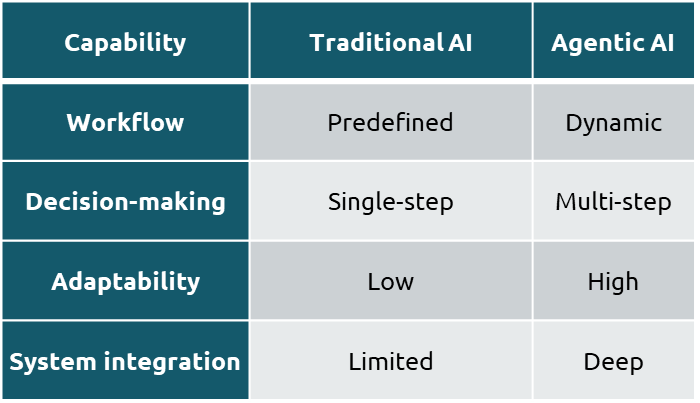
Agentic systems operate as distributed decision engines, where:
- Each agent performs a specialized function
- A central orchestration layer coordinates execution
- LLMs provide reasoning and contextual understanding
2.3 Financial Services Use Cases
Agentic AI is particularly relevant in:
Payments
- Intelligent routing and exception handling
- Real-time fraud evaluation
Lending
- Automated underwriting workflows
- Risk assessment using multi-source data
Compliance
- AML/KYC intelligent validation
- Regulatory reporting automation
3. Enterprise Reference Architecture
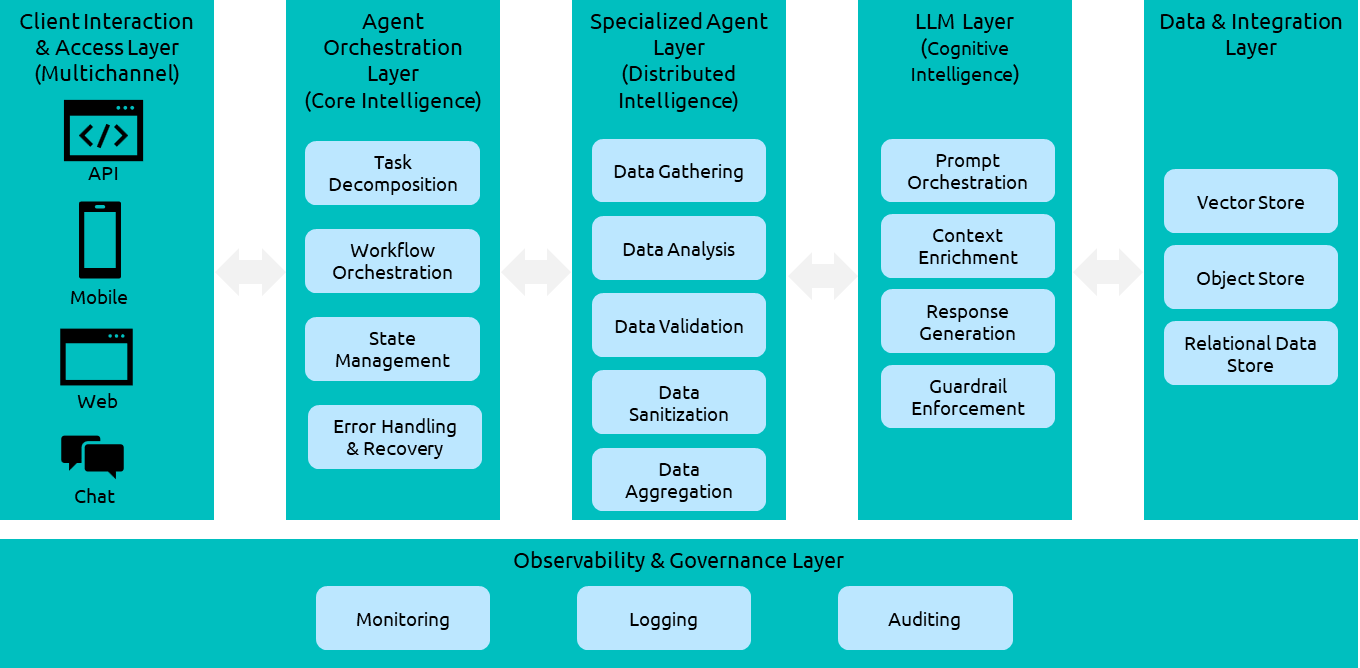
A robust Agentic AI system must follow a layered, decoupled architecture.
3.1 High-Level Architecture Overview
4. Detailed Architecture Components
4.1 Interaction & Access Layer
Handles multi-channel interaction:
- Web / Mobile / APIs
- Chat interfaces / conversational agents
Design considerations:
- Low latency
- Secure access (OAuth, IAM)
- Rate limiting
4.2 Agent Orchestration Layer (Core Intelligence)
This is the central nervous system of Agentic AI.
Responsibilities:
- Task decomposition
- Workflow orchestration
- State management
- Error handling and retries
Implementation (AWS):
- AWS Step Functions
- AWS Lambda
- EventBridge (event-driven workflows)
Example Flow:
Loan Application →
→ Document Parsing Agent
→ Fraud Detection Agent
→ Risk Scoring Agent
→ Decision Aggregation Agent
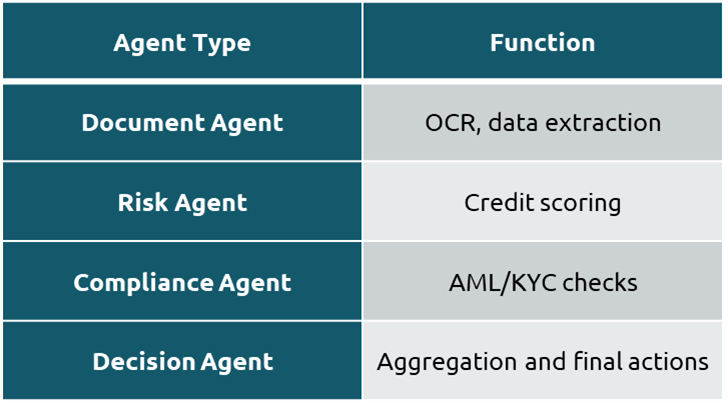
4.3 Agent Layer (Distributed Intelligence)
Each agent encapsulates a domain-specific capability with few examples below.
Design Patterns:
Stateless Processing
- Each invocation independent
Tool Invocation
- API calls
- DB queries
- External services
Agent Collaboration
- Output chaining
- Context propagation
4.4 LLM Layer (AWS Bedrock)
This is where reasoning and cognition occur.
Core Capabilities:
- Prompt orchestration
- Context enrichment
- Response generation
- Guardrails enforcement
Key AWS Bedrock Components:
- Foundation Models (Anthropic, Titan)
- Bedrock Agents
- Guardrails for safety and compliance
Example Prompt Flow:
Input → Context Injection → LLM Reasoning → Output → Validation
4.5 Data & Integration Layer
Critical for enterprise scalability.
Components:
- Structured data → Aurora, DynamoDB
- Unstructured data → S3
- Search → OpenSearch
Integration Patterns:
- Event-driven (Kafka / EventBridge)
- API-based integration
- Batch and streaming pipelines
4.6 Observability and Governance Layer
This is non-negotiable in financial systems.
Must include:
Monitoring
- CloudWatch
- OpenTelemetry
Logging
- Request / response traceability
- Agent decision logs
Governance
- Audit trail of AI decisions
- Explainability layer
Example Requirement:
Every decision made by an AI agent must be auditable for regulatory compliance
5. Key Design Patterns
5.1 Task Decomposition Pattern
Break complex workflows into modular steps:
Input → Decompose → Assign to Agents → Aggregate Results
5.2 Context Persistence Pattern
Use shared memory:
- Session store
- Vector DB (for embeddings)
5.3 Human-in-the-Loop Pattern
Essential for:
- Risk approvals
- Exception handling
5.4 Guarded Execution Pattern
Mitigates:
- Prompt injection
- Security risks
Implemented using:
- Bedrock Guardrails
- API validation layers
6. Domain-Specific Challenges (Financial Systems)
6.1 Regulatory Compliance
Must address:
- Data privacy (PII)
- Auditability
- Model explainability
6.2 Latency Constraints
Real-time systems require:
- Low response times
- Efficient orchestration
6.3 Security Risks
Risks include:
- Prompt injection
- Data leakage
- Unauthorized access
7. Implementation Best Practices
Design bounded use cases first
Avoid enterprise-wide rollout initially
Separate agent responsibilities
Avoid overlapping logic
Introduce governance early
Never retrofit compliance
Adopt serverless architecture
- Scalable
- Cost-efficient
Build reusable frameworks
Your biggest differentiator as an architect
8. Future Outlook
Agentic AI will redefine enterprise systems by:
- Enabling autonomous decision-making platforms
- Integrating tightly with business logic
- Transforming systems into adaptive ecosystems
For financial institutions, this evolution represents a shift toward:
- Intelligent automation
- Real-time decision systems
- Continuous regulatory alignment
9. Conclusion
Agentic AI is not merely an enhancement to enterprise systems — it is a foundational shift in system architecture.
Designing such systems requires:
- Deep understanding of distributed systems
- Awareness of domain-specific constraints
- Strong governance and compliance models
By leveraging AWS Bedrock and adopting modular, agent-based architectures, enterprises can build systems that are:
- Scalable
- Intelligent
- Autonomous
- Compliant
메타데이터
- post_id
- c49f7ca6a04e
- slug
- enterprise-architecture-for-agentic-ai-using-aws-bedrock-c49f7ca6a04e
- url
- https://medium.com/@rishab.ahuja/enterprise-architecture-for-agentic-ai-using-aws-bedrock-c49f7ca6a04e
- canonical_url
- https://medium.com/@rishab.ahuja/enterprise-architecture-for-agentic-ai-using-aws-bedrock-c49f7ca6a04e
- author_url
- https://medium.com/@rishab.ahuja
- status
- ok
- fetched_at
- 2026-06-13 00:08:42



