Streaming Platforms Are Quietly Becoming AI Companies
How personalization, behavioral intelligence, and recommendation architecture are redefining the future of streaming
Streaming Platforms Are Quietly Becoming AI Companies
How personalization, behavioral intelligence, and recommendation architecture are redefining the future of streaming
For most of the streaming era, success was measured by content.
The industry’s largest players competed aggressively for exclusive rights, original productions, global franchises, and sports programming. The assumption was simple: audiences would gravitate toward the platform with the strongest catalog.
For a time, that strategy worked.
The first phase of the streaming revolution was defined by scale. More content attracted more subscribers, which funded more content, creating a cycle of growth that transformed the entertainment industry. Streaming platforms became modern media giants by investing heavily in programming and distribution.
Yet as the market has matured, a different reality has emerged.
Today’s viewers have access to more entertainment than at any point in history. Virtually every major platform offers extensive libraries of films, television series, documentaries, live content, and original productions. The challenge facing audiences is no longer access. It is navigation.
When every platform offers thousands of viewing options, helping audiences discover the right content becomes just as important as creating the content itself.
This is where the industry is undergoing a significant transformation.
Many of the most important innovations in streaming are no longer happening exclusively within production studios or content acquisition departments. They are happening within recommendation engines, audience intelligence systems, predictive analytics platforms, and personalization frameworks that determine how viewers interact with content.
In many ways, streaming platforms are quietly becoming AI companies.
Content Is No Longer Enough
The streaming industry spent years fighting what many observers described as the “content wars.” Companies invested billions of dollars acquiring libraries and producing original programming in an effort to differentiate themselves from competitors.
However, content abundance has created an unintended consequence.
As catalogs expand, viewers often spend more time deciding what to watch than actually watching. Industry research has consistently highlighted the growing problem of content overload, where an abundance of choice creates friction rather than satisfaction.
The challenge is particularly evident among younger audiences. Modern viewers are accustomed to highly personalized digital experiences across social media, e-commerce, music streaming, and search. They increasingly expect entertainment platforms to understand their preferences with similar precision.
This shift has elevated discovery from a product feature to a strategic business priority.
The ability to help viewers find relevant content quickly is becoming a competitive advantage in its own right. A platform that successfully reduces decision fatigue can often generate stronger engagement than one with a larger catalog but weaker discovery tools.
As a result, streaming companies are investing heavily in systems designed to improve how content is surfaced, recommended, and consumed.
Recommendation Engines Have Become the New Distribution Layer
Historically, distribution determined success in entertainment.
Cable operators controlled channel placement. Broadcasters controlled airtime. Theatrical chains controlled local access to films. The companies that controlled distribution often controlled audience attention.
Streaming disrupted those traditional structures by making content accessible on demand. Yet a new distribution layer has emerged in their place.
Today, recommendation systems increasingly determine what viewers see first, what they choose to watch, and what they never discover at all. Algorithms influence viewing behavior at a scale that would have been impossible under traditional media models.
This represents a profound shift in how entertainment reaches audiences.
Content is no longer distributed solely through platform availability. It is distributed through intelligence.
A recommendation engine decides which titles appear on a homepage. It determines which content is highlighted after a viewing session. It identifies patterns across millions of users and uses those insights to shape future viewing journeys. The implications are enormous.
A recommendation system is no longer simply helping audiences navigate content. It is actively influencing content performance. In effect, recommendation engines have become the new gatekeepers of entertainment discovery.
The Rise of Behavioral Intelligence
Every streaming session generates data.
Every search query, pause, rewind, completion, abandonment, and rewatch provides insight into audience behavior. Collectively, these interactions create one of the most valuable assets available to modern streaming businesses: behavioral intelligence.
What makes this information particularly powerful is not the volume of data itself but the ability to interpret it.
Streaming companies increasingly use behavioral signals to understand not only what audiences watch, but how they watch, when they engage, and what influences retention over time.
These insights now influence decisions across multiple business functions, including:
- Recommendation and discovery strategies
- Audience retention initiatives
- Advertising optimization
- User experience design
- Content acquisition planning
The industry’s focus is shifting from descriptive analytics toward predictive intelligence. Rather than asking, “What did viewers watch last month?” companies are increasingly asking, “What are viewers likely to watch next?”
That transition fundamentally changes how streaming platforms operate.
Personalization Is Becoming the Product
For many consumers, a streaming platform appears to be a static product.
In reality, modern streaming experiences are becoming increasingly dynamic.
Two viewers opening the same application may encounter entirely different homepages, recommendations, promotional banners, and content pathways. The platform continuously adapts based on previous interactions, engagement history, and inferred preferences.
This level of personalization is becoming increasingly important as audience attention becomes more fragmented.
Viewers today navigate an ecosystem that includes streaming services, social media platforms, podcasts, gaming environments, creator communities, and short-form video feeds. Competition for attention is no longer limited to other streaming platforms. Entertainment businesses now compete against virtually every form of digital engagement.
In this environment, relevance becomes critical.
The faster a platform can connect a viewer with meaningful content, the greater the likelihood of sustained engagement.
This is one reason why AI-powered personalization has become such a significant area of investment across the industry. Personalization is no longer a supplementary feature. It is increasingly becoming part of the product itself.
The Industry Is Shifting From Scale to Engagement
The first decade of streaming was largely defined by subscriber growth.
Companies focused on expanding globally, acquiring customers, and increasing market share. Success was measured primarily through scale.
The next decade may be measured differently.
Increasingly, industry leaders are focusing on engagement quality rather than audience size alone. Metrics such as completion rates, viewing frequency, retention duration, session depth, and lifetime value are becoming more important indicators of platform health.
This reflects a broader understanding that not all audiences generate equal value.
A smaller audience with high engagement can often create stronger long-term outcomes than a larger audience with low retention. As competition intensifies, maintaining audience attention becomes increasingly important.
This shift explains why recommendation systems, behavioral analytics, and engagement optimization technologies have become strategic priorities.
The objective is no longer simply attracting viewers. The objective is creating reasons for them to return.
AI Is Becoming Infrastructure
One of the most interesting aspects of this transformation is that much of it remains invisible to consumers.
Artificial intelligence is increasingly influencing areas such as content tagging, metadata generation, audience segmentation, localization, advertising optimization, customer support, and content moderation. These systems rarely appear in marketing campaigns, yet they are becoming essential components of streaming operations.
The value of AI lies not in its visibility but in its integration.
Like cloud infrastructure or content delivery networks, AI is gradually becoming a foundational layer that supports multiple aspects of the streaming ecosystem simultaneously.
This is perhaps the clearest indication that streaming companies are evolving.
The most successful platforms are no longer simply content businesses. They are becoming intelligence businesses that happen to distribute content.
AI-Powered OTT Infrastructure: The Next Competitive Advantage
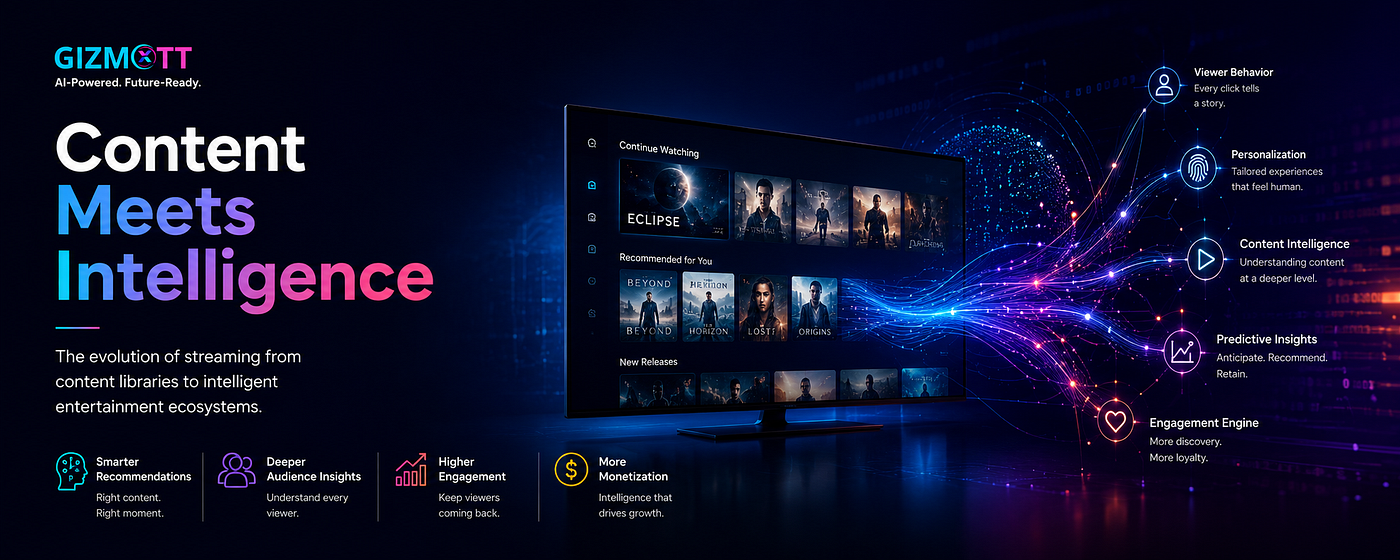
As streaming platforms become increasingly intelligence-driven, the underlying technology powering them must evolve as well. Through its AI Suite, GIZMOTT enables media companies and content owners to enhance content discovery, personalize viewer experiences, analyze audience behavior, and drive deeper engagement across their streaming ecosystems. The focus is not simply on adding AI features, but on embedding intelligence throughout the viewer journey — from discovery and retention to monetization and long-term audience growth.
The Future of Streaming Will Be Defined by Intelligence
Content will always matter.
Great storytelling remains the foundation of entertainment, and no technology can replace the emotional connection created by compelling narratives. However, content alone is unlikely to define the next generation of streaming leaders.
As competition intensifies and audience expectations evolve, intelligence is emerging as the industry’s next major differentiator.
Platforms increasingly require sophisticated recommendation systems, advanced analytics, personalized user experiences, predictive audience insights, and adaptive engagement frameworks capable of responding dynamically to viewer behavior. Modern OTT ecosystems, including platforms like GIZMOTT, are evolving alongside this shift by incorporating AI-powered discovery, audience intelligence, and engagement-focused capabilities into the streaming experience.
The larger trend, however, extends far beyond any single platform.
The streaming industry is entering a new phase of maturity — one where success is determined not only by what content a company owns, but by how effectively it understands its audience.
For years, streaming companies competed through content libraries. Increasingly, they are competing through intelligence. And that may prove to be the defining story of the industry’s next decade.
메타데이터
- post_id
- c4a5e8bf7751
- slug
- streaming-platforms-are-quietly-becoming-ai-companies-c4a5e8bf7751
- url
- https://medium.com/the-streaming-playbook/streaming-platforms-are-quietly-becoming-ai-companies-c4a5e8bf7751
- canonical_url
- https://medium.com/the-streaming-playbook/streaming-platforms-are-quietly-becoming-ai-companies-c4a5e8bf7751
- author_url
- https://medium.com/@Gizmott
- status
- ok
- fetched_at
- 2026-06-12 07:40:50