AI Agents for Cybersecurity Explained: A Practical Security Guide for Businesses
Cyberattacks have become faster, more sophisticated, and increasingly difficult to detect using traditional security systems. Modern…
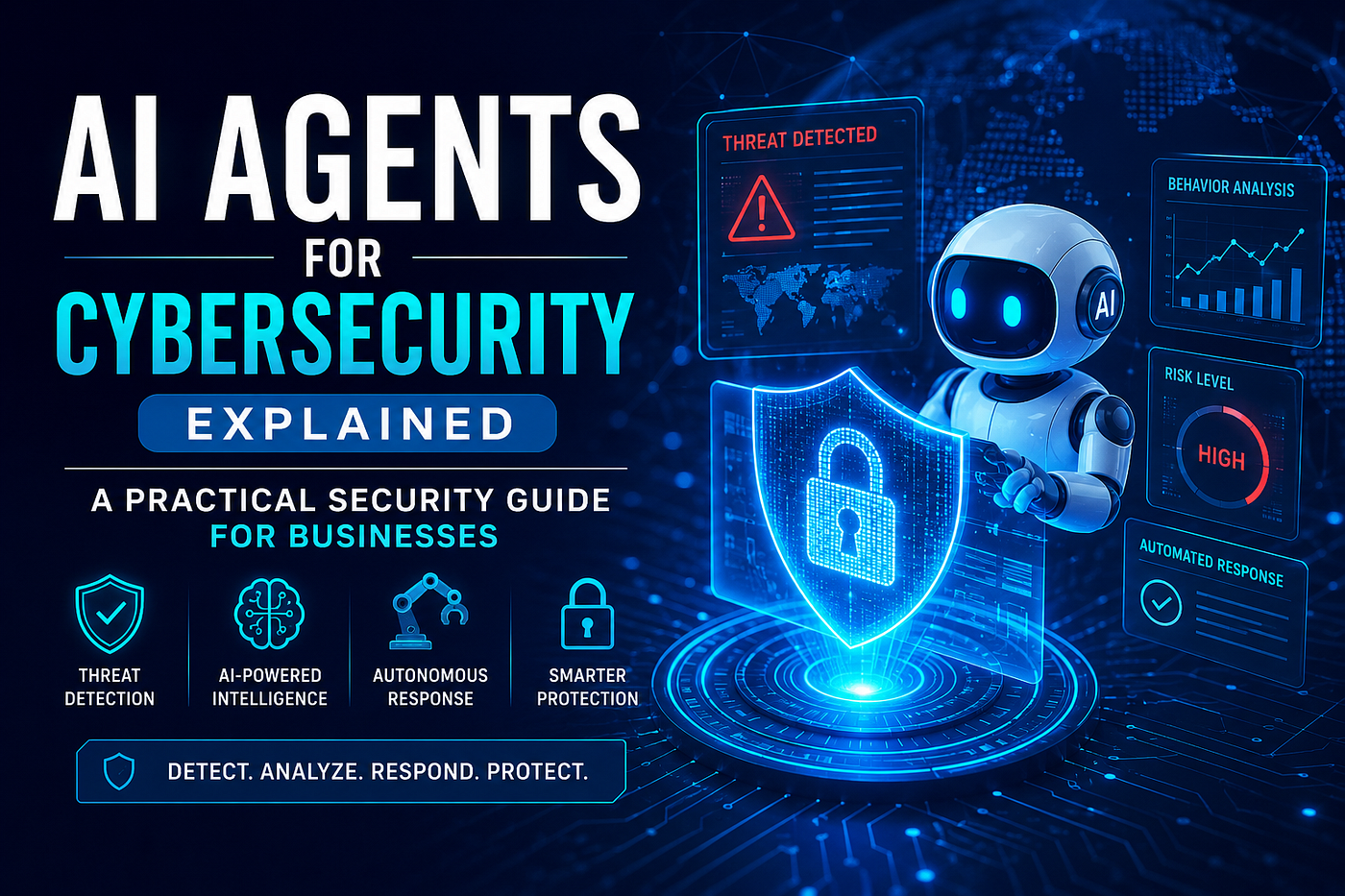
AI agents empower modern businesses with intelligent threat detection, autonomous response, and real-time cybersecurity protection against evolving cyber threats.
AI Agents for Cybersecurity Explained: A Practical Security Guide for Businesses
Cyberattacks have become faster, more sophisticated, and increasingly difficult to detect using traditional security systems. Modern businesses face ransomware, phishing, zero-day exploits, insider threats, and AI-generated attacks that demand intelligent and automated defense mechanisms. Artificial intelligence is transforming the cybersecurity landscape by enabling organizations to detect threats, respond instantly, and minimize security risks with greater accuracy.
This practical guide explains how AI agents are changing cybersecurity, the technologies behind them, real-world applications, and why businesses should adopt intelligent AI-driven security strategies for the future.
Why Traditional Cybersecurity Is No Longer Enough
Conventional cybersecurity tools rely heavily on predefined rules, signatures, and manual intervention. While these methods still provide value, they struggle against rapidly evolving cyber threats.
Common challenges include:
- Increasing number of sophisticated attacks
- Alert fatigue among security teams
- Slow incident response
- Shortage of cybersecurity professionals
- Limited visibility across cloud and hybrid environments
- Growing attack surfaces due to remote work and IoT devices
AI introduces automation, predictive intelligence, and adaptive learning that significantly improves cyber resilience.
What Are AI Agents in Cybersecurity?
AI agents are intelligent software systems capable of observing environments, analyzing security events, making decisions, and executing defensive actions with minimal human intervention.
Unlike conventional automation tools, AI agents continuously learn from new attack patterns, adapt to changing environments, and improve their decision-making capabilities over time.
These intelligent systems can:
- Analyze millions of security events every second
- Detect abnormal user behavior
- Predict possible attacks
- Automate investigation processes
- Coordinate multiple security tools
- Reduce response times dramatically
Their ability to combine machine learning, reasoning, planning, and autonomous execution makes them valuable for modern enterprise security.
How Intelligent Security Agents Work
Modern AI security systems typically operate through multiple intelligent layers.
Data Collection
AI gathers information from:
- Network traffic
- Cloud infrastructure
- Firewalls
- Endpoint devices
- Identity systems
- Email platforms
- APIs
- IoT devices
- Threat intelligence feeds
Behavioral Analysis
Instead of relying only on known malware signatures, AI studies normal behavior patterns and quickly identifies suspicious activities.
Examples include:
- Unusual login attempts
- Abnormal file transfers
- Privilege escalation
- Insider threats
- Data exfiltration attempts
Decision Intelligence
After analyzing risks, AI prioritizes alerts based on severity, business impact, and attack probability.
This helps security teams focus on genuine threats instead of thousands of false positives.
Autonomous Incident Response
Modern security systems no longer stop at detection.
Intelligent agents can automatically:
- Isolate compromised endpoints
- Block malicious IP addresses
- Disable suspicious accounts
- Quarantine infected files
- Trigger security workflows
- Notify incident response teams
Organizations investing in AI agent development can build customized autonomous defense systems tailored to their infrastructure and compliance requirements.
Advanced Technologies Behind AI Security
Several modern technologies power next-generation cybersecurity platforms.
Large Language Models
LLMs assist analysts by:
- Explaining security alerts
- Summarizing incidents
- Generating investigation reports
- Recommending remediation steps
Machine Learning
Machine learning detects evolving attack patterns without manually updating detection rules.
Graph Intelligence
Relationship graphs uncover hidden attack paths between users, devices, applications, and cloud resources.
Reinforcement Learning
AI continuously improves defensive strategies based on previous attack outcomes.
Multi-Agent Systems
Instead of relying on one intelligent model, multiple AI agents collaborate across different security domains to improve overall protection and faster decision-making.
Key Benefits of AI-Driven Cybersecurity
Businesses adopting AI gain several competitive advantages.
Faster Threat Detection
AI identifies suspicious activities within seconds rather than hours.
Lower Operational Costs
Automation reduces repetitive manual investigations.
Better Accuracy
Behavioral analytics significantly decrease false-positive alerts.
Continuous Monitoring
AI never stops monitoring critical infrastructure.
Improved Compliance
Security reports, audits, and risk assessments become more automated and accurate.
Organizations implementing AI-powered cybersecurity solutions can strengthen their defense posture while reducing operational complexity.
Practical AI Agent Use Cases Across Industries
Different industries leverage AI differently based on their security requirements.
Banking
- Fraud detection
- Transaction monitoring
- Identity verification
- Insider threat detection
Healthcare
- Patient data protection
- Medical device monitoring
- HIPAA compliance
- Ransomware prevention
Manufacturing
- Industrial IoT protection
- Operational technology monitoring
- Supply chain security
Retail
- Payment fraud detection
- Customer account protection
- API security
- Digital identity verification
Businesses exploring AI Agent use cases often discover opportunities beyond cybersecurity, including intelligent automation, customer service, predictive analytics, and business process optimization.
AI for Modern Security Operations Centers
Traditional SOC teams often struggle with overwhelming alert volumes.
AI enhances Security Operations Centers by:
- Prioritizing incidents
- Correlating multiple alerts
- Performing root cause analysis
- Generating investigation timelines
- Suggesting remediation actions
- Automating repetitive tasks
Organizations deploying AI agents for security operations experience faster response times and improved analyst productivity while handling increasingly complex cyber threats.
Agentic AI Is Redefining Enterprise Security
The next evolution goes beyond simple automation.
Agentic AI introduces autonomous reasoning capabilities where intelligent systems independently:
- Plan investigations
- Coordinate security tools
- Adapt to changing threats
- Execute defensive actions
- Learn continuously
As Agentic AI in CyberSecurity matures, enterprises will move toward self-defending digital infrastructures capable of preventing attacks before they cause damage.
Emerging Trends Shaping AI Security
Several innovations are expected to dominate enterprise cybersecurity over the coming years.
Predictive Cyber Defense
AI predicts attacks before exploitation occurs.
Autonomous Threat Hunting
Agents continuously search for hidden vulnerabilities without waiting for alerts.
AI-Powered Digital Twins
Virtual security environments simulate attacks to improve defense strategies.
Quantum-Ready Security
AI assists organizations in preparing encryption systems for future quantum computing threats.
Explainable AI
Transparent AI models improve trust, compliance, and regulatory acceptance.
Challenges Businesses Should Consider
Despite significant advantages, organizations should prepare for several implementation challenges.
- AI model bias
- Data privacy concerns
- Regulatory compliance
- Adversarial AI attacks
- Integration complexity
- Governance and monitoring requirements
A balanced strategy combining AI automation with expert human oversight delivers the best long-term security outcomes.
Choosing the Right AI Cybersecurity Partner
Successful AI implementation requires more than purchasing software.
Look for partners that offer:
- Enterprise AI expertise
- Cloud security integration
- Scalable architecture
- Regulatory compliance support
- Continuous model improvement
- Security automation consulting
Partnering with an experienced AI development company in the USA helps businesses deploy scalable AI security solutions aligned with industry standards and evolving cyber risks.
The Future of AI in Cybersecurity
The future belongs to intelligent, adaptive, and autonomous security ecosystems. AI will increasingly function as a proactive digital security analyst capable of learning, predicting, reasoning, and responding in real time. As cyber threats continue to evolve, businesses that invest in AI, AI agent technologies, and advanced AI development strategies will be better equipped to safeguard digital assets, maintain customer trust, and ensure long-term resilience in an increasingly connected world.
Conclusion
Cybersecurity is no longer just about responding to attacks it is about anticipating and preventing them. AI agents empower businesses with continuous monitoring, intelligent threat detection, autonomous response, and predictive defense capabilities that traditional systems cannot match. As organizations embrace advanced AI technologies, integrating an AI agent for cybersecurity into their security strategy becomes a critical step toward building resilient, future-ready digital infrastructures capable of defending against tomorrow’s cyber threats today.
메타데이터
- post_id
- c4f2f36f6b15
- slug
- ai-agents-for-cybersecurity-explained-a-practical-security-guide-for-businesses-c4f2f36f6b15
- url
- https://medium.com/@david.wilson.digital/ai-agents-for-cybersecurity-explained-a-practical-security-guide-for-businesses-c4f2f36f6b15
- canonical_url
- https://medium.com/@david.wilson.digital/ai-agents-for-cybersecurity-explained-a-practical-security-guide-for-businesses-c4f2f36f6b15
- author_url
- https://medium.com/@david.wilson.digital
- status
- ok
- fetched_at
- 2026-08-07 21:52:05