Service Design: Redesigning government-wide onboarding experience
How we approached redesigning the public officer onboarding journey
Service Design: Redesigning government-wide onboarding experience
How we approached redesigning the public officer onboarding journey
New hire onboarding from majid9muhammad
NOTE: This piece focused on the approach and transferrable lessons for service journey work.
Every organisation, every team, and every group of people you are designing for has its own constraints, culture, and history. What worked here may not work elsewhere, and that is the point.
It is important to note that a proposed future state is not a finished product. It is a starting point that should be revisited, stress-tested, and updated as the context evolves. The goal is never a one-time fix. It is a foundation that any organisation must continue to build on.
The signal. Why onboarding journey?
Whether someone feels welcomed, prepared, and like they made the right choice often comes down to what happens in those first few months.
Some agencies had structured programmes. Others assumed you would figure it out. Some assigned buddies. Others did not. If you had transferred from another agency, there was no shared foundation to build on. If you came from the private sector, there was even less to hold onto.
The signal was there in internal employee surveys. What was missing was a way to do something about it across the whole system.
In 2021, our team was asked to review the onboarding journey and establish a scalable framework.
Starting with the right question
The easy response to a brief like this is to jump straight to applying ‘band-aid’ solutions. Build an app. Create a checklist. Roll out a standard induction programme.
But before we designed anything, we needed to understand what really happening, agency by agency, for the people going through it.
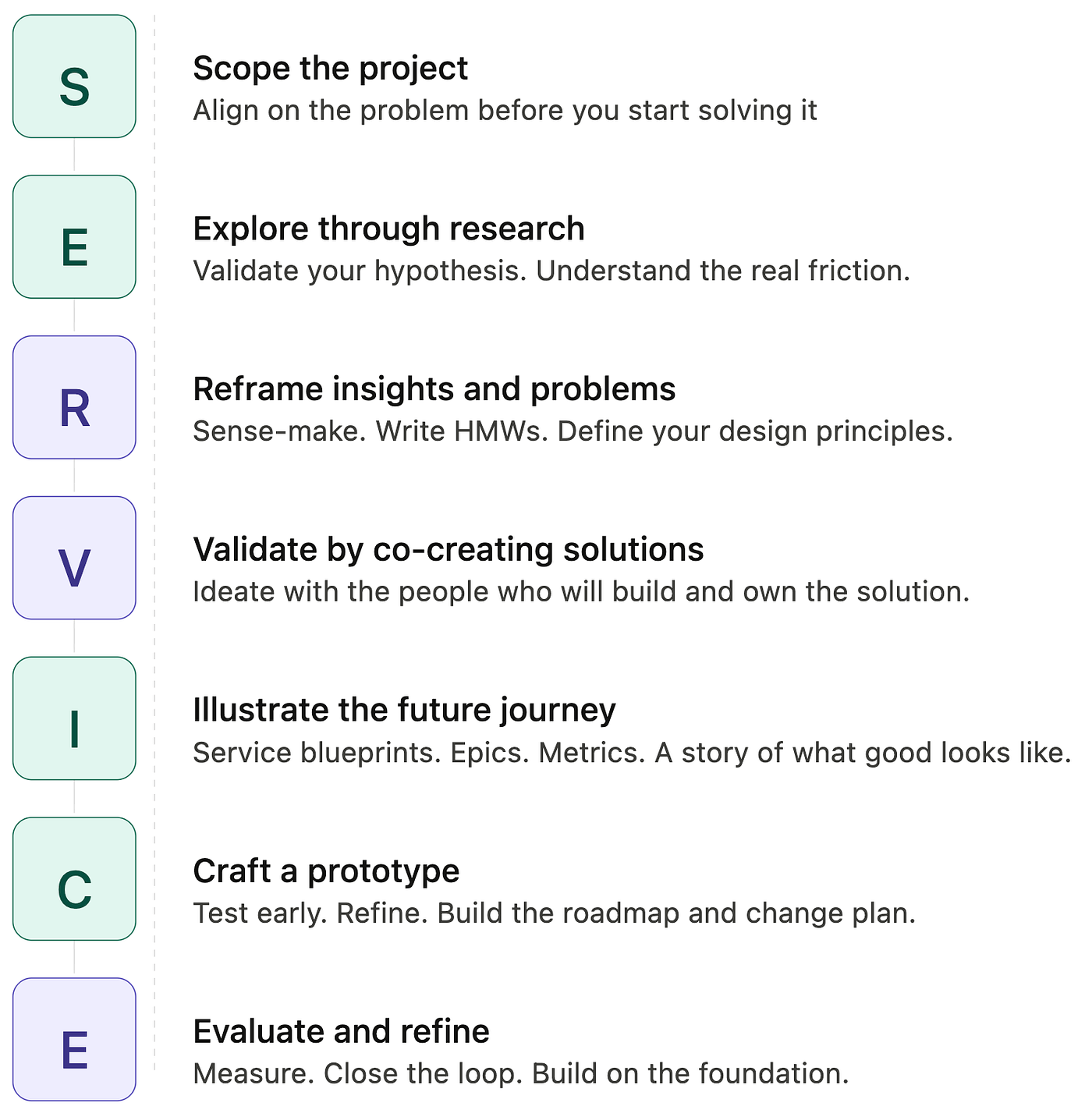
We followed a straightforward four-phase process: team launch, research, sense-making, and ideating a future state. It was not a traditional 4D design thinking process, but that was intentional. A simpler framing made it easier for stakeholders across government to follow, contribute to, and trust.

Four-phase process: team launch, research, sense-making, and ideating a future state.
We focused on three questions throughout.
- What did onboarding actually look like across government right now?
- Where were the real differences between different types of agencies?
- What were new hires actually trying to do in their first weeks?
That last question changed how we thought about the whole project. We were not trying to fill a gap in a process.
We were trying to understand what a new hire needed to feel, know, and be able to do to show up with confidence. Once we understood that, we could design for the actual need rather than just the obvious fix.
Partner your stakeholders early
Getting meaningful research across government agencies in a short timeframe sounds like it should be slow, complicated work. It did not have to be, because of one decision we made early on which was to treat our HR leads across agencies as partners.
- Through an existing HR partnership network, we brought HR leads from agencies across government into the process from the start.
- We walked them through what we were trying to understand and were direct about what we needed from them.
- They helped us reach new hires, buddies, people leaders, and IT contacts within their own agencies.
- They validated our hypothetical journey maps which showed us what was universal or specific to their context.
This is how you move at pace in a centre-of-government role. You are not building from zero. You have relationships, and the research moves as fast as those relationships allow.
By the end of the research phase, we had surveyed over 300 new hires, supervisors, buddies, and IT personnel. We conducted in-depth interviews and collected journey and process maps of onboarding from over 35 agencies.
We got a clear picture of what onboarding looked like across the system and the opportunity areas.
Design principles for the future state
When we looked across all the data, the headline findings were simple
- New hires needed to feel ready, equipped to do the job from day one. The data pointed to gaps at various stages, from the moment the contract was signed through to the first weeks on the job. It was about preparation, not capability.
- They needed to feel credible. Early visibility mattered. Most new hires had regular check-ins with their supervisors, but many said the quality could be better. They wanted conversations that covered both work and non-work matters, not just task updates. The anxiety of starting a new role is not really about whether you can do the work. It is about not knowing yet whether you belong.
- They needed to feel connected. Many felt connected to their immediate team, and most said it was also useful to be introduced to colleagues outside their team. Having a buddy, a people leader who checked in, and a few colleagues they could turn to was not a nice-to-have. It was what kept people engaged through the uncertainty of a new role.
- Onboarding could not rest on the shoulders of one person or one team. Every stakeholder, the hiring manager, the buddy, HR, and IT, had a role to play. When any one of them dropped the ball, the new hire felt it.
These needs became the four design principles to design the future state and solutions.
Proposed framework to package solutions thoughtfully
What works for a large agency does not automatically work for a smaller one. A framework that tries to prescribe the same experience everywhere will either be ignored or followed in name only.
So we designed for variability on purpose.

Establishing baseline, allowing room for contextualisation.
Tier 1 was the non-negotiable baseline. These were the things every new hire should experience, regardless of agency, role, or background. Assigning a buddy. Giving that buddy, the new hire, and their people leader a shared guide so all three knew what was expected of them. Providing baseline agency-level orientation and knowledge so new hires understood where they had landed, not just where their desk was. These were the minimum standards that should never be missing.
Tier 2 was localised practice, theirs to shape. Some agencies required all new hires to rotate across departments before settling into a role, because understanding the whole organisation was part of doing the job well. Others had specific security requirements, specialist inductions, or working norms unique to their context. Tier 2 gave agencies room to adapt the baseline to their reality without losing it.
Tier 3 were best practices. Things we had seen work well, inside and outside the public service, that agencies could choose to adopt if they had the appetite. Not every agency would get here. But for those that did, there was something worth reaching for.
Recommendations
We had clear insights and we knew exactly who needed to act on them. Some recommendations pointed to policy owners, others pointed to process leads or tech teams. We mapped this deliberately so the handover was targeted, not just a document drop.
That meant two things.
- Presenting the research in a way that built real buy-in. We shared what we had heard, what patterns came up across agencies, and what new hires had told us they needed. When the evidence comes from their own people, it is harder to set aside.
- Building a storyboard of the envisioned future state. Not a spec document or a list of requirements. A story of what joining the public service could feel like if this framework was in place. The journey started the moment a new hire signed their contract and ran through their first year. It showed what they would receive, what their buddy’s role could look like, and what a good first few months might feel like from the inside.
This was a proposed journey, not a delivered one. Our role was to define the problem clearly, ground the recommendations in evidence, and present a vision concrete enough for policy leads and implementation teams to act on. What happened next was theirs to shape.
The storyboard was what got leadership to say yes. It made the abstract concrete. It took a policy question and turned it into a human one.
Our team was recognised with an internal award in 2022 for this work when it was presented. For us, it was a signal that the approach had resonated. The research had been seen, the framework had been handed over, and the right people were in a position to take it forward.
What I learnt
- Speed in this kind of work does not come from moving faster. It comes from investing in the right relationships before you need them and making it easy for people to say yes.
- The HR leads who helped us reach over 300 research participants did not do it out of obligation. They did it because we brought them in early, took their knowledge seriously, and showed them how the work connected to problems they were already trying to solve.
- The solution owners who picked up the framework did it because they had seen the evidence, understood the need, and had a storyboard that helped them picture success before committing to build it. Our tech colleagues used the research as a baseline to assess current digital experience.
This was one approach in one context. What worked here may not work elsewhere, and that is the nature of service journey work.
A proposed future state is not a finished product. It is a starting point that needs to be revisited and built on. The goal is never a one-time fix.
The quality of what you hand over depends entirely on the quality of how you listened.
Credits to my team lead, Linyou, whose mentorship has taught me a lot about a good service design practice.
메타데이터
- post_id
- c4f36c11d4a3
- slug
- service-design-redesigning-government-wide-onboarding-experience-c4f36c11d4a3
- url
- https://medium.com/@murshidha-ishak/service-design-redesigning-government-wide-onboarding-experience-c4f36c11d4a3
- canonical_url
- https://medium.com/@murshidha-ishak/service-design-redesigning-government-wide-onboarding-experience-c4f36c11d4a3
- author_url
- https://medium.com/@murshidha-ishak
- status
- ok
- fetched_at
- 2026-06-09 14:34:10