Feeding Old Chinatown: Pioneer Grocers of San Francisco
Before old Chinatown could become the remembered district of restaurants, banquet rooms, herb shops, temples, association halls, theaters…
Feeding Old Chinatown: Pioneer Grocers of San Francisco
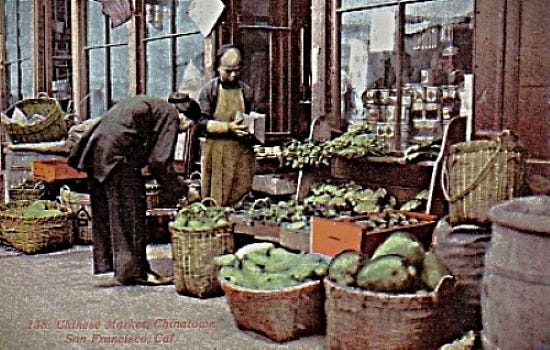
“Chinese Market, Chinatown, San Francisco, Cal.” color postcard, c.1915 (from a private collection). The card replicates a photo by an unknown photographer. A woman inspects produce items from a grocer’s sidewalk display. The man’s queue suggests that the underlying photograph may predate the 1911–12 fall of the Qing dynasty, although the postcard itself is later.
Before old Chinatown could become the remembered district of restaurants, banquet rooms, herb shops, temples, association halls, theaters, and tourist curiosity, it first had to solve the more basic problem of feeding itself. That work fell disproportionately to the Chinese grocery — the 雜貨舖 (jyutping: “zaap6 fo3 pou3”) — a business form that was at once market, pantry, import house, credit counter, labor exchange, and neighborhood meeting place.
This single article cannot pretend to present the full scope of Chinese economic activity visible in the pre-1906 photographic record (and separate articles about the markets along Sacramento Street, Dupont Street, and Washington Place in old Chinatown may be read elsewhere in this journal). The surviving images show a world of butchers, fishmongers, poultry sellers, vegetable vendors, tea and rice merchants, herbalists, provision houses, bakeries, restaurants, peddlers, importers, labor contractors, and general merchandise stores. That economy is too large for one article. The more modest purpose here is to introduce photos of grocers and market sellers, the locations of which have remained unidentified, and yet provide an entry point into the daily commercial infrastructure that made old Chinatown possible.

“J57. Chinese Market, San Francisco,” no date (but the man’s hairstyle possibly indicates pre-1911). Photographer unknown (from the collection of the Bancroft Library). The grocery storefronts of old Chinatown were not merely interior shops. Goods spilled outward into baskets, tubs, trays, and sidewalk displays, making the street itself part of Chinatown’s food economy.
The 1875 Bishop directory gives us a useful census point. In its “Alphabetical List of Chinese Business Houses in San Francisco,” a broad but textually grounded count shows 24 Chinese grocery-type businesses in the city. This count includes entries listed as “groceries,” “grocery,” “grocer,” “grocery dealers,” and mixed forms such as “groceries and butchers” or “grocery and fish.” A narrower count limited only to the exact plural word “groceries” would produce 14 entries, but that would understate how the directory itself described food retailing in practice. In old Chinatown, the grocery was rarely a clean modern category. It could shade into provisions, fish, butchering, produce, tea, rice, oil, dried goods, or imported Chinese merchandise.[1]
Although Bishop’s 1875 Chinese section should not be described as the first Chinese business directory overall, it remains valuable as an early Chinese business section embedded within a general San Francisco city directory. Wells, Fargo & Co. had already compiled Chinese business information by 1871: its April 1, 1871 directory listed principal Chinese merchants in San Francisco, in Chinese and English, for the guidance of Wells Fargo agents addressing letters.
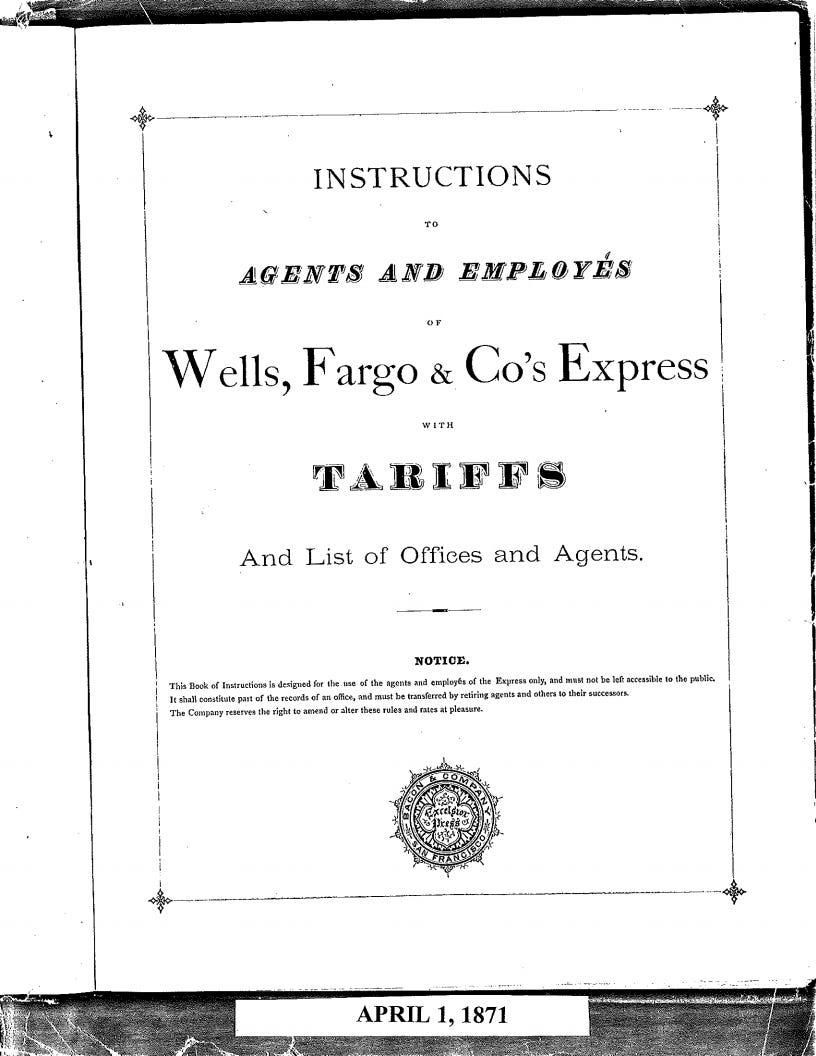


Wells Fargo & Co. directory for the “Address of Principal Chinese Merchants in San Francisco, . . .” of 1871
A later extant Wells Fargo directory of 1873 covered Chinese merchants in San Francisco and Sacramento, but it remained essentially a merchant-address directory rather than a trade-category census.


Wells Fargo “Address of Principal Chinese Merchants in San Francisco and Sacramento, 1873” (from the collection of the Bancroft Library)
By 1878, the Wells Fargo Directory of Chinese Business Houses had expanded to multiple cities, including San Francisco, Sacramento, Marysville, Portland, Stockton, San Jose, and Virginia City. Bishop’s distinct value for this article is therefore narrower but still important: it provides a publisher-compiled, pre-Exclusion census point within a general San Francisco city directory, allowing a street-by-street count of grocery-type Chinese businesses in 1875.[2]


The New city annual directory of San Francisco by D.M. Bishop & Co, 1875. Chinese business section provides a rare pre-Exclusion Act census point for Chinatown’s food-retail economy. Its grocery-type entries show a Dupont-Sacramento concentration, with Jackson Street and the alleys forming a secondary market web.
Using a broad food-retail definition — entries explicitly described as grocers, groceries, grocery dealers, or closely related food-retail/variety shops — the Bishop directory shows about two dozen grocery-type businesses. The revised distribution is nine on Dupont Street, six on Sacramento Street, five on Jackson Street, and four on other streets or alleys. If the two general “variety” entries are excluded, the stricter count falls to 22; if tea, rice, sugar, oil, and Chinese-provision wholesalers are included, the number rises well beyond two dozen. The count therefore should be treated as a working index of visible grocery-type retailing, not a strict occupational census of Chinatown’s food economy.
Sacramento Street entries included Act Lee; Chung Sing & Co.; Ogey Long; Quong Chong Long; Quong Hong Ching; and Wing Hop Long & Co.
Dupont Street entries included Fook Yuen & Co.; Goey Hing Kee & Co.; Hong On & Co.; Quon Ohu; Quong Marn Long; Quong Wing Lung & Co.; Shun Yik & Co.; Sing Ky; and Why Chong.
Jackson Street entries included Che Wa; Keng Wha; Ly Chong; Sing Yik; and Sung Wa, with Keng Wha and Sung Wa better understood as borderline “variety” businesses rather than narrowly labeled grocers.
Other locations included Ching Yuen on Prospect Place; Kwong Choy Yuen & Co. on Sal Alley; Quong Shong Chong on Washington Street; and Ye Chung on Jackson Alley.
The geography remains revealing even after the correction. Dupont led the narrow grocery-type count, while Sacramento remained close enough to confirm its continuing importance as an older commercial artery. Together, Dupont and Sacramento accounted for 15 of the 24 grocery-type entries, or roughly 63 percent. The pattern is therefore not simply one of displacement, but of expansion: Sacramento Street remained a foundational east-west corridor of Chinese commerce, while Dupont Street was becoming the north-south spine that later generations would know as Grant Avenue.
That transition matters because Sacramento Street was not merely another Chinatown street. Earlier work on Sacramento Street emphasized the observation of founding Chinese Historical Society of America historians Thomas Chinn and Phil Choy that early Chinese stores were concentrated on Sacramento Street between Kearny and Dupont, and that older Chinese still called Sacramento Street 唐人街 (tong4 jan4 gaai1) — “Chinese Street.” The earliest photographic views of San Francisco Chinatown confirm the point. Long before Grant Avenue became the iconic public face of the rebuilt district, Sacramento Street was where Chinese commerce first announced itself in storefronts, hanging signs, food shops, apothecaries, and import houses. [3]
By 1875, however, the Bishop directory shows that the grocery trade had expanded beyond Sacramento Street. Dupont was no longer merely adjacent to the older commercial center; it had become a major food-retail corridor in its own right. The later photographic record of Dupont — with its awnings, street-level displays, upper-floor balconies, and mixed Chinese and non-Chinese storefronts — shows the spatial result of that movement. Chinatown’s grocery geography therefore captures the district in transition: still anchored in the older Sacramento Street world, but increasingly organized around the Dupont corridor that would dominate the visual memory of old Chinatown before 1906.

“Chinatown vegetable market stall, San Francisco California, 1895.” Photograph by Wilhelm Hester (from the University of Washington Libraries, Special Collections). A woman stands in front of a San Francisco Chinatown sidewalk display of vegetables, possibly on Washington Place (a.k.a. Fish Alley). Her plain dress suggests domestic or working class status, but the image itself does not identify her role. The proprietor or store helper stands three steps above her and behind the display. Central to the image, a small boy stands at the top of the shop’s stairs, staring out onto the street. His presence is a reminder that children, including members of the small second generation, were part of Chinatown’s market streets, even though the image cannot identify his birthplace.
The 1875 grocery list gives names and addresses to what the photographs show more atmospherically. The map is not complete, but it is suggestive: Dupont and Sacramento formed the public corridors; Jackson and the alleys formed the connective tissue. The directory’s English labels are useful, but they are also limiting. They freeze businesses into single categories even when the visual record shows a more flexible food economy.
The photographic sampling should be read against that directory record. The storefronts spill outward into the sidewalk. Baskets sit at curb level. Vegetables, roots, melons, poultry, fish, dried goods, and meats occupy tables, tubs, hooks, and shallow display trays. Customers inspect goods in public view. Shopkeepers stand at the threshold between interior counter and street. These were not sterile Victorian shops. They were threshold businesses — half inside, half outside — in which the sidewalk itself became part of the store.

The proprietor of the 安棧 (jyutping: “On1 Zaan2”) grocery store, c.1890s. Photographer unknown (from a private collection). This image shows the “threshold” character of Chinese grocery retailing: produce, baskets, hanging goods, and shopkeepers arranged between the interior shop and the public sidewalk.
The Bishop directory also warns against letting English trade labels narrow the interpretation. A “butcher” might sell much more than meat. A “grocery” might also handle fish, provisions, preserved goods, or produce. A “merchant” might be an importer, wholesaler, retailer, and credit intermediary at the same time. Taber’s well-known “Chinese butcher and Grocery Shop” makes the point visually and textually. The image is often approached as a butcher-shop scene, but the shopfront display shows a broader market function: hanging meats, baskets, produce, and other provisions. The caption itself recognizes the hybrid nature of the establishment.[4]

“3111 Chinese butcher and Grocery Shop, Chinatown, S.F.,” c.1887. Photograph by Isaiah West Taber (from the Marilyn Blaisdell collection of the San Francisco Public Library and the San Francisco Museum of Modern Art). By adjusting the lighting of the image, some additional details of the interior of the shop become visible. The partially-obscured signage of “… ong Wo & co” appears in the store’s interior (above center in the photo), which other photos of this store confirm as “Cheong Wo.” (昌和; jyutping: “Coeng1 Wo4”) located at 847 Dupont Street at the southwest corner of Dupont and Washington. Directory cross-checking places Cheong Wo & Co. at this location from at least 1879 into the 1890s. This meat-and-provisions storefront shows why directory labels such as “butcher,” “grocer,” “provisions,” or “fish” should not be read too narrowly. Meat, vegetables, dried goods, baskets, and sidewalk displays often occupied the same commercial frame. The visible goods — hanging meats, baskets, produce, and provisions — show the hybrid business form that directories often compressed into one English trade label.

Washington Place or Alley (a.k.a. “Fish Alley”) Photograph by Wilhelm Hester (from the University of Washington Libraries, Special Collections). Chinatown residents referred to the alleyway as “Tuck Wo Gaai” (德和街; lit.: “Virtuous Harmony St.”; jyutping: “Dak1 Wo4 gaai1”). Washington Place was one of pre-1906 Chinatown’s best documented wet-market corridors.
Washington Place (renamed Wentworth Place after 1906), adds another layer. English-speaking photographers and writers often called it Washington Alley or “Fish Alley.” Chinatown residents knew it as 德和街 (jyutping: “dak1 wo4 gaai1”), after the Tuck Wo business located at or near the important Jackson Street end of the short passage. Fish Alley ran between Washington and Jackson, between Dupont and Stockton, and it became one of the most photographed alleyways of old Chinatown. Its images show the density of food commerce that directory categories can only partly capture: fish stalls, poultry sellers, meat markets, preserved goods, crates, baskets, scales, and curbside bargaining.[5]
G.B. Densmore’s 1880 description of Washington Place is useful precisely because it places poultry, dried fowls, preserved meats, fruit, oysters, gambling houses, and pawn activity along the same short block. Later newspaper accounts of health inspection in Fish Alley, however hostile and sensational in tone, confirm the intensity of food handling, storage, slaughterhouse connections, waste water, butcher shops, poultry coops, corned beef, and underground storage in the same built environment. The point is not to accept every anti-Chinese moral judgment embedded in those accounts. The point is that even hostile observers could not help but document how much food commerce was packed into old Chinatown’s alleys.[6]

Untitled, 1895. Photograph by Wilhelm Hester (from the University of Washington Libraries, Special Collections). Shoppers view produce at a Chinatown storefront. Food commerce in old Chinatown often drew hostile inspection and sensational description from non-Chinese observers, but the photographs also show a functioning neighborhood provisioning system. The crowded storefront, hanging goods, and sidewalk activity reveal a dense commercial environment that inspectors and reporters could condemn but not ignore.
The vegetable peddler — 菜販 (coi3 faan3) — belonged to the same system. The man carrying two suspended baskets from a shoulder pole was not an exotic accessory to Chinatown life. He was a moving extension of the grocery economy. Produce flowed from gardens, farms, wholesalers, and local suppliers into stores, then outward again through peddlers, boardinghouses, restaurants, and domestic kitchens. The pole-and-basket method, so often photographed as a racialized curiosity, represented a practical Chinese technology of urban distribution.

B5399 “Chinese Vegetable Pedler in San Francisco, Cal.” Photograph by Isaiah West Taber (from a private collection). The shoulder pole and suspended baskets were not picturesque accessories; they were practical tools of urban food distribution, linking gardens, wholesalers, shops, boardinghouses, restaurants, and domestic kitchens.
That practicality also explains why anti-Chinese regulation often targeted the ordinary mechanics of Chinese work. Laws aimed at carry poles, sidewalks, laundries, cubic air, queues, licensing, and food-handling spaces were not merely symbolic humiliations. They interfered with how Chinese people moved goods, earned income, occupied space, and sustained a community. In that context, the Chinatown grocery was an assertion of economic survival. It converted immigrant labor into small proprietorship. It turned imported and local food networks into neighborhood stability. It allowed people with few political rights, and often no security against exclusionist harassment, to build durable commercial institutions.

Vegetable gardens near Union and Pierce streets, San Francisco, c. late nineteenth century. Photographer unknown (from the collection of the California Historical Society at Stanford University). Chinese market gardening and peddling helped supply Chinatown’s groceries and food stalls, connecting the district’s sidewalk markets to a wider landscape of urban and peri-urban cultivation.
The grocer’s legal and social status was also complex. In the exclusion era, “merchant” became a more privileged legal category than “laborer,” but at street level the distinction was often artificial. A small grocer might own the shop, keep accounts, cut meat, wash vegetables, carry baskets, sleep upstairs, extend credit, and rely on kin or district networks for labor. He could be proprietor and worker at once. The grocery was therefore one of the places where Chinese immigrants attempted to cross the line between wage labor and commercial independence.
The 1875 Bishop directory count sharpens the point. Before the federal Chinese Exclusion Act of 1882, and before the later tourist fantasy of Chinatown fully hardened, Chinese food retailing had already claimed a major place in the district’s commercial order. The grocers of Dupont, Sacramento, Jackson, Prospect Place, Sal Alley, and Jackson Alley were feeding more than stomachs. They were sustaining language, taste, credit, habit, and belonging.
The 1906 earthquake and fire destroyed the physical fabric of old Chinatown, including the grocery storefronts whose names appear in the 1875 directory. But the institution survived because it answered a permanent community need. Rebuilt Chinatown could decorate its rooflines for tourists and civic respectability, but it still required the same practical foundation: rice, greens, meat, fish, tea, sauces, preserved goods, herbs, and the merchants who knew how to procure and sell them.
The pioneer grocers of pre-1906 San Francisco Chinatown should therefore be remembered not as background figures in old photographs, but as builders of Chinese American urban life. They stood at the intersection of food, labor, law, migration, and memory. Before Chinatown could perform culture for outsiders, it had to feed itself. The grocers made that possible.
Notes
[1] D.M. Bishop & Co., The New City Annual Directory of San Francisco (1875), “Alphabetical List of Chinese Business Houses in San Francisco,” printed pp. 1221–1228. The working count used here treats entries explicitly described as “groceries,” “grocery,” “grocer,” “grocery dealers,” and mixed forms such as “groceries and butchers” or “grocery and fish” as grocery-type listings. The broader index also includes a small number of closely related food-retail or variety entries discussed in the text. Excluding the two borderline variety entries would reduce the count to 22; including tea, rice, sugar, oil, and Chinese-provision wholesalers would raise the number well beyond two dozen.
[2] Wells, Fargo & Co., Instructions to Agents and Employés of Wells, Fargo & Co.’s Express, with Tariffs and List of Offices and Agents (April 1, 1871), includes a Chinese directory headed “Address of Principal Chinese Merchants in San Francisco, in Chinese and English, for the guidance of our Agents in Addressing Letters.” The 1871 list appears limited to San Francisco. The later extant Wells Fargo directory of 1873 covered principal Chinese merchants in San Francisco and Sacramento. By 1878, the Wells Fargo Directory of Chinese Business Houses had expanded to multiple cities, including San Francisco, Sacramento, Marysville, Portland, Stockton, San Jose, and Virginia City.
[3] Doug Chan, “Where We Began: Sacramento Street (唐人街),” Chinatown Streetscape & Urban Memory, Dec. 31, 2024. The article cites Thomas Chinn and Phil Choy on early Chinese stores being concentrated on Sacramento Street between Kearny and Dupont, and on older Chinese usage of 唐人街 for Sacramento Street. The article also notes that by 1850 Chinese businesses and residents had expanded from Sacramento Street to Dupont between Sacramento and Jackson, and to Jackson Street between Kearny and Stockton; it later describes the business pivot north on Dupont as part of the future Grant Avenue commercial corridor.
[4] Doug Chan, “Taber’s Butcher Shop Quadriptych,” Chinatown Streetscape & Urban Memory, Jan. 25, 2025. The article identifies Cheong Wo & Co. at 847 Dupont, discusses the visible 和 and 昌和 signage, and cross-checks the business through directories and later photographic evidence.
[5] Doug Chan, “Washington Place: Chinatown’s Fish Alley (德和街),” Chinatown Streetscape & Urban Memory, Feb. 3, 2025. The article identifies Washington Place/Fish Alley as 德和街 (“dak1 wo4 gaai1”) and describes its south-north axis between Washington and Jackson, between Dupont and Stockton.
[6] Chan, “Washington Place: Chinatown’s Fish Alley (德和街).” The article quotes G.B. Densmore’s 1880 description of Washington Place and excerpts the 1897 San Francisco Call account of a meat inspector’s visit to Fish Alley.
메타데이터
- post_id
- c4fe4f973a5c
- slug
- pioneer-grocers-of-old-chinatown-c4fe4f973a5c
- url
- https://medium.com/@dougchan/pioneer-grocers-of-old-chinatown-c4fe4f973a5c
- canonical_url
- https://medium.com/@dougchan/pioneer-grocers-of-old-chinatown-c4fe4f973a5c
- author_url
- https://medium.com/@dougchan
- status
- ok
- fetched_at
- 2026-06-20 20:29:01



