Curious Minds: The Architecture of 64 Squares: What Chess Actually Builds in Your Child
Quick Listen If you’d rather listen than read, here’s the podcast episode that covers the key points. Tune in! 🎧 Spotify | Apple Podcasts…
Curious Minds: The Architecture of 64 Squares: What Chess Actually Builds in Your Child
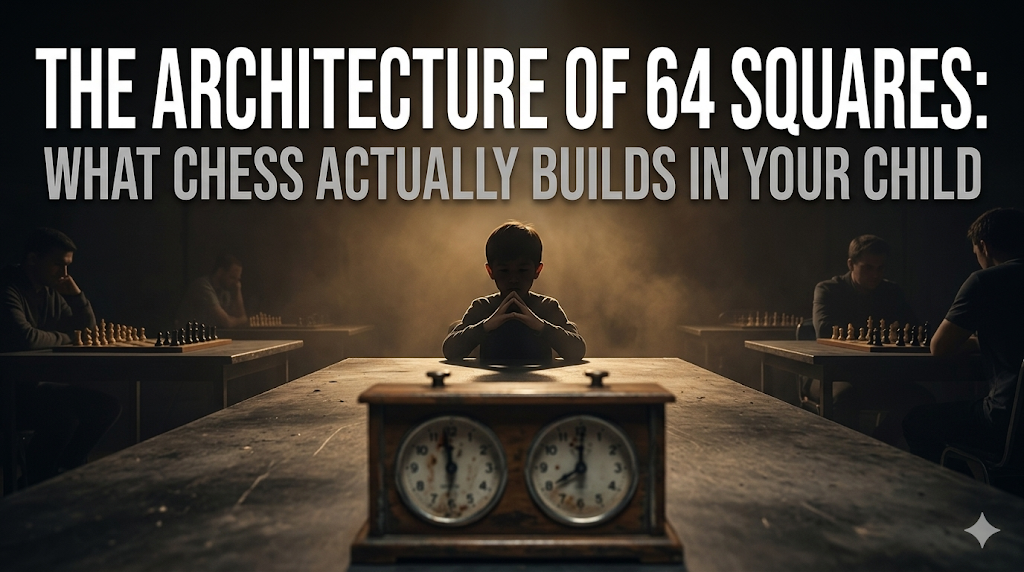
Created by Nano Banana Pro
Quick Listen If you’d rather listen than read, here’s the podcast episode that covers the key points. Tune in! 🎧 Spotify | Apple Podcasts | Amazon Music | YouTube
Picture a tournament hall filled with two hundred children. Instead of the chaotic symphony of shouts, moving chairs, and running footsteps, there is only a heavy, absolute silence, punctuated by the sharp, rhythmic click of digital clocks. In an era where a ten-year-old can barely look at a screen without instinctively opening fourteen other tabs, chess remains a rare, analog sanctuary. It forces the human brain to shut out the noise, anchor its undivided attention, and simply sit with itself.
It turns out the ultimate antidote to the TikTok doom-scroll is a carved wooden horse moving across a checkered board.
This exploration looks past the ticking clocks and the competitive rankings to reveal what mastering those 64 squares actually builds. It is not a factory for producing prodigies; it is a profound architectural framework for executive function, emotional resilience, and lifelong cognitive health.
🛑 The “Far Transfer” Illusion
At bustling academies all over the world, parents often drag their six-year-olds through the double doors, point at the board, and demand to know how long it will take for the child to become a Grandmaster or, at the very least, if the game will guarantee an A in advanced calculus.
This behavior is rooted in the widespread “Far Transfer” myth. While some localized studies have shown promising results regarding math learning, cognitive scientists strongly warn against the belief that training the brain in one highly specific task automatically transfers to general intelligence in completely unrelated fields. A 2018 study provided negative evidence regarding this broader, automatic transfer of cognitive skills.
What if this intense focus backfires? Could hyper-fixating on a board isolate a child socially or lead to severe burnout? The risk lies almost entirely in the external pressure applied by adults chasing trophies, not the mechanics of the game itself.
Chess is not math tutoring; it is a neurological gym. When a player suppresses the urge to grab an opponent’s piece immediately and forces themselves to search for a better move, they are literally lifting weights for their impulse control.
As cognitive researchers suggest, the game’s true power isn’t in creating human calculators, but in building “spatial memory and executive function.”
🏗️ Systems Over Genetics: The Blueprint of Brilliance
If discipline is the foundation, how does one explain the absolute titans of the game? Look toward the state of Tamil Nadu in southern India, which produces almost half of the country’s Grandmasters. There is no biological magic in the water in Chennai; there is merely flawless, systemic infrastructure.
Tamil Nadu built a culture where chess is treated with systemic reverence, embedding it into schools and fostering mentorship pipelines where older Grandmasters actively train the youth. This phenomenon scales globally. Historically, the Soviet Union dominated the 20th century by building state-sponsored “Pioneer Palaces” to catch talent early. Today, Saint Louis, Missouri, has transformed into a global chess capital simply by pouring funding into local clubs and school curriculums. Uzbekistan is currently producing a terrifyingly strong generation through heavy, state-backed youth programs.
Talent is merely a spark; structure is the fireplace that turns it into a roaring blaze.
Brilliance is rarely an accident; it is almost always the result of architecture.
As historical and modern global hotspots demonstrate, excellence does not rely on luck. It emerges because “once a system works, it compounds, and excellence becomes normal.”
💔 The “Losing Muscle”: A Masterclass in Accountability
Picture a seven-year-old boy who has been playing a grueling match for two hours. He moves a bishop, instantly realizes he blundered his queen, and freezes. His lower lip trembles, his eyes well up, but he doesn’t scream. When the inevitable checkmate arrives, he reaches a small hand across the board, looks his opponent in the eye, and accepts total responsibility.
This is the development of the “Losing Muscle” arguably the game’s greatest psychological benefit. It teaches children how to process crushing reality and survive failure with grace.
In most modern sports, there is a psychological safety net. If a football team loses, a player can blame the referee, the wet grass, or their teammates. In chess, there is no wind. There is no referee bias. Both players have the exact same information. When checkmate happens, there is nowhere to hide. It is 100% the player’s fault.
The board acts as an unforgiving mirror. Just as the ancient inventors of Chaturanga intended centuries ago, the game acts as a simulation that teaches leaders “how to manage resources, how to sacrifice for the greater good, and the heavy burden of consequence without spilling a single drop of blood.”
🛡️ The Inter-Generational Shield
The resilience built on the board does not stay in the tournament hall; it grows into an inter-generational currency. In the modern corporate world, the principles of the game act as an antidote to “Decision Fatigue.” It trains young adults to fall back on fundamental principles and avoid panic when their mental energy is depleted and the clock is ticking down.
For the older generation playing quietly in Sunday parks, chess is doing something incredible for their biology. By forcing the brain to continuously recognize complex visual patterns, calculate variations, and adapt to novel threats, it forces neuroplasticity. A seminal 2003 study linked board games like chess to a reduced risk of cognitive decline and dementia.
It is like watermarking a masterpiece; a human mind trained to focus possesses a signature resilience that cannot be replicated by a mass-produced digital feed. Society is witnessing a quiet, collective return to analog focus, reclaiming cognitive agency one deliberate move at a time.
♟️ The Next Move is Yours
In an era where supercomputers and neural networks like AlphaZero have effectively mastered the mathematics of the game through self-play, does human play still matter?
The machines may have conquered the math, but they will never understand what it feels like to lose. The human struggle over the board, two flawed, tired, brilliant minds wrestling with infinite possibilities remains profoundly beautiful.
If there is a child in your life exploring the game, do not ask them if they won. Ask them what they learned from the struggle. Harness their curiosity, provide the environment, and step back.
🗣️ Join the Conversation
Do you believe the discipline learned in analog childhood games translates to resilience in adult life? How do you manage “decision fatigue” when the clock is ticking? Share your stories and perspectives in the comments below!
Disclaimer: This article is for educational purposes based on verified scientific and historical information as of June 2026. It is designed to explore the cognitive and psychological impacts of chess and does not constitute formal psychological or educational advice.
✅ Sources
- Nature Human Behaviour (2018). “Does far transfer exist? Negative evidence from chess, music and working memory training.”
https://www.nature.com/articles/s41562-018-0401-y - SAGE Open (2020). “Does playing chess improve math learning? Promising results from Italy.”
https://journals.sagepub.com/doi/10.1177/2158244020943038 - BBC News (2022). “How Tamil Nadu became India’s chess capital.”
https://www.bbc.com/news/world-asia-india-62332693 - Wikipedia / Chess Base Archives. “The Soviet School of Chess.”
https://en.wikipedia.org/wiki/School_of_chess - The Wall Street Journal (2021). “How St. Louis became the chess capital of the U.S.”
(https://www.wsj.com/articles/how-st-louis-became-the-chess-capital-of-the-u-s-11621535496) - New England Journal of Medicine (2003). “Leisure Activities and the Risk of Dementia in the Elderly.”
https://www.nejm.org/doi/full/10.1056/NEJMoa022252 - Science (DeepMind, 2018). “Mastering Chess and Shogi by Self-Play with a General Reinforcement Learning Algorithm.”
https://www.science.org/doi/10.1126/science.aar6404
메타데이터
- post_id
- c505da56fcb0
- slug
- curious-minds-the-architecture-of-64-squares-what-chess-actually-builds-in-your-child-c505da56fcb0
- url
- https://medium.com/the-geopolitical-economist/curious-minds-the-architecture-of-64-squares-what-chess-actually-builds-in-your-child-c505da56fcb0
- canonical_url
- https://medium.com/the-geopolitical-economist/curious-minds-the-architecture-of-64-squares-what-chess-actually-builds-in-your-child-c505da56fcb0
- author_url
- https://medium.com/@balajeev7
- status
- ok
- fetched_at
- 2026-06-15 20:49:13