Designing for the 3 AM Network Partition: Building Systems that Gracefully Degrade
Circuit breakers, bulkheads, and the degradation ladder every distributed system needs before the network splits.
Designing for the 3 AM Network Partition: Building Systems that Gracefully Degrade
Circuit breakers, bulkheads, and the degradation ladder every distributed system needs before the network splits.

created by Gemini
Your pager goes off at 3:07 AM. Region A can’t talk to Region B. Nobody caused this — a BGP route flapped, a fiber cut in a datacenter you’ve never heard of, a load balancer had an opinion. In the next ninety seconds, your system is going to decide, on its own, whether it fails safely or fails loudly. You will not be awake enough to help it decide. This is why that decision has to be made now, in daylight, in code — not at 3 AM, in a Slack thread, by whoever’s on call.
💥 Master Any Skills in 3 Months
- 📚 Up to 50% OFF Premium Courses ⏰ Limited-Time Offer [👉 **Enroll Now & Start Learning](https://trk.udemy.com/zz4NBO)***

Most teams never make this decision on purpose. They inherit it from whatever a try/catch block happened to do the first time someone wrote it. That's the real subject of this article: not "how do I get more nines," but how do you make sure that when the nines run out, your system fails in a way a half-asleep human can reason about.
The Uptime Trap
Availability is the wrong north star, and most reliability engineering literature buries this. Chasing five nines pushes teams toward monolithic all-or-nothing failure modes: retries that hammer a struggling dependency until it falls over completely, or synchronous call chains where one slow leaf node takes down the whole tree. A system optimized purely for “never go down” has a strong incentive to just… not check whether it’s healthy, and hope. That’s not resilience. That’s denial with better marketing.
The more useful question isn’t “can we avoid failure?” It’s “when we fail — and we will — what’s the smallest, most predictable thing that breaks?” A system designed around that question doesn’t need heroics at 3 AM. It needs an on-call engineer who can glance at a dashboard, see which rung of the ladder it’s standing on, and go back to sleep.
CAP, Off the Whiteboard
Every distributed systems course covers CAP theorem in the abstract — consistency, availability, partition tolerance, pick two. Almost none of them tell you what that means for the code your team ships on Tuesday. Partition tolerance isn’t optional in a system with more than one network hop, so the real choice engineers make, usually by accident, is between consistency and availability during a partition.
The problem is that this choice gets made implicitly, per code path, by whatever the timeout handler happens to do. Your payments service might fail closed (reject the write, preserve consistency) while your recommendations service fails open (serve stale data, preserve availability) — and nobody decided that on purpose. It’s worth an actual design review, service by service: if this dependency is unreachable, do we serve something wrong, or do we serve nothing? Write the answer down. Put it in the service’s README, not just in the exception handler.
The Degradation Ladder
The core idea that makes graceful degradation tractable is that “up” and “down” aren’t the only two states. Build an explicit ladder of intermediate states, and design each rung deliberately instead of letting the system free-fall through them.
Rung 5 — Full service:        all features, fresh data, all dependencies healthy
Rung 4 — Reduced feature set:  non-critical features (recs, personalization) disabled
Rung 3 — Read-only / stale:    writes rejected or queued, reads served from cache
Rung 2 — Last-known-good:      serving a stale snapshot with a visible staleness marker
Rung 1 — Static fallback:      pre-baked default response, no dependency calls at all
Rung 0 — Honest failure:       clear error, no partial or silently wrong data
The rule that makes this work: never skip from Rung 5 straight to Rung 0. And never silently serve Rung 2 data while claiming to be at Rung 5 — a stale price or an out-of-date inventory count returned with a 200 OK is a worse failure than an honest 503, because it corrupts a downstream decision instead of stopping one.
The Patterns That Make It Possible
Circuit breakers: fail fast, not fail slow
A circuit breaker stops your service from repeatedly hammering a dependency that’s already struggling — which, left unchecked, turns one slow service into a cascading outage.
CLOSED  ──(failure rate > threshold)──▶  OPEN
  ▲                                        │
  │                                (timeout elapses)
  │                                        ▼
  └──(trial request succeeds)──── HALF-OPEN
                                          │
                                (trial request fails)
                                          ▼
                                       OPEN
class CircuitBreaker:
def __init__(self, failure_threshold=5, reset_timeout=30):
self.failures = 0
self.state = "CLOSED"
self.opened_at = None
self.failure_threshold = failure_threshold
self.reset_timeout = reset_timeoutdef call(self, fn, fallback):
if self.state == "OPEN":
if time.time() - self.opened_at > self.reset_timeout:
self.state = "HALF_OPEN"
else:
return fallback()
try:
result = fn()
if self.state == "HALF_OPEN":
self.state = "CLOSED"
self.failures = 0
return result
except Exception:
self.failures += 1
if self.failures >= self.failure_threshold:
self.state = "OPEN"
self.opened_at = time.time()
return fallback()The part teams skip is the fallback argument. A circuit breaker without a real fallback just converts a slow failure into a fast one — which is progress, but it's not degradation, it's still an outage. The fallback is where the degradation ladder actually lives in code.
Bulkheads: contain the blast radius
Named after ship compartments that keep one hull breach from sinking the whole vessel. In practice: separate connection pools, thread pools, or rate-limit buckets per downstream dependency, so a slow or partitioned dependency exhausts its own pool of resources and not the shared one every other code path depends on. Without bulkheads, a single misbehaving dependency starves threads that unrelated, perfectly healthy requests also needed.
Timeouts and retries: the quiet cascade-failure machine
Retries are the pattern most likely to turn a partial outage into a total one. A dependency degrades, gets slower, every caller times out and retries simultaneously, and the retry traffic — arriving in a synchronized burst — finishes the job the partition started. Two fixes are non-negotiable:
- Exponential backoff with jitter. Fixed-interval retries synchronize across thousands of clients into a thundering herd; jitter spreads them out.
- A timeout budget, not a timeout-per-call. If a request touches five downstream services in sequence, each with its own 2-second timeout, the worst case is 10 seconds, not 2. Set one budget for the whole request path and let each hop draw down against it.
Load shedding and backpressure
When a partition means part of your fleet is suddenly serving traffic that used to be split across two regions, the answer isn’t to let every request queue up and time out together. It’s to reject the least valuable requests early and cheaply, so the ones you can serve get served well. Priority queues by request type — checkout above product-page-view, above background analytics pings — turn an undifferentiated overload into a controlled one.
Fallback caches and stale reads
Serve the last-known-good response with an explicit staleness marker rather than nothing. A stale: true, as_of: <timestamp> field costs you almost nothing to add and gives every downstream consumer — human or automated — the information it needs to decide whether stale is good enough for their purpose.
Feature flags as kill switches
The fastest rollback in an incident isn’t a deploy — it’s a flag flip. Non-critical, dependency-heavy features (recommendations, “customers also bought,” live inventory counts) should have a flag that a human can flip in seconds to drop the system down a rung of the ladder, without a code push, without a build pipeline, without waiting for CI.
Idempotency: because retries and partitions guarantee duplicates
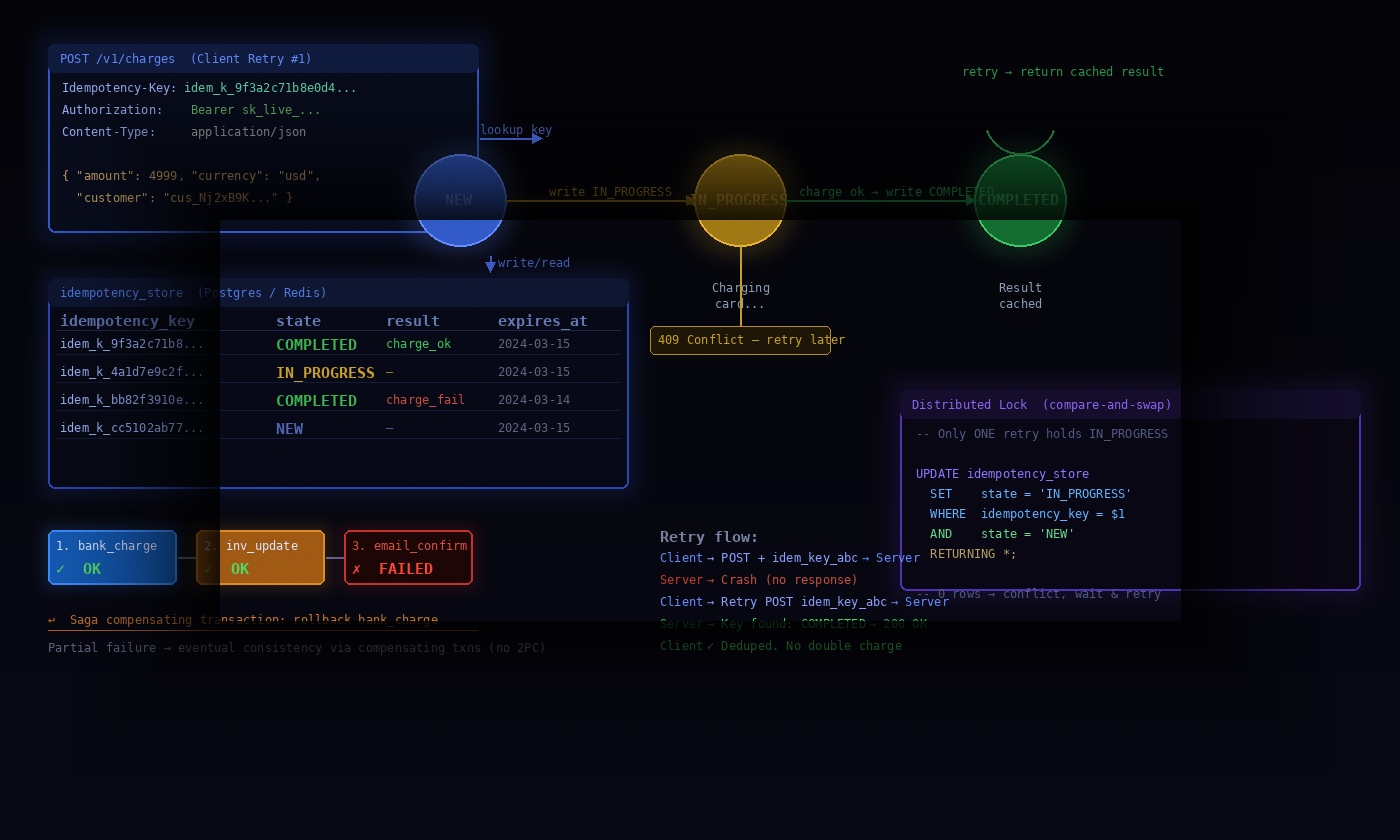
Any retry strategy plus any partition guarantees that some request eventually gets executed twice. If “charge the customer” isn’t idempotent, a network partition doesn’t just degrade your system — it doubles someone’s bill. Idempotency keys, deduplicated at the write layer, are what let you retry aggressively without retrying recklessly. This is the same underlying discipline that durable execution frameworks lean on for long-running agent workflows — the work needs to survive a crash or a partition and resume exactly once, not zero or two times.
Observability Built for Partial Failure
Most dashboards are built around a binary: is the service up or down. That’s the wrong shape for a system designed to degrade. What you actually need to see, at a glance, at 3 AM:
- Which rung of the degradation ladder each service is currently standing on
- Circuit breaker state per dependency (closed/open/half-open), not just error rate
- SLOs defined per capability, not per endpoint — “checkout succeeds” matters more than “the recommendations endpoint returns 200”
- Staleness of any cached or fallback data currently being served, and to how much traffic
A dashboard that only shows “99.2% uptime” tells the on-call engineer nothing about which rung they’re standing on, or what to do next. A dashboard built for degradation tells them exactly that in the first five seconds.
Rehearsing the Failure Before It’s Real
None of this works if the first time your fallback path executes is during an actual partition. Chaos engineering earns its keep here — not as a novelty, but as the only realistic way to find out that your “fallback” cache was never actually populated, or that your circuit breaker’s fallback function has its own unhandled exception. Inject the partition on a Tuesday afternoon, with the team watching, and fix what breaks. Do it again next quarter. The goal of a game day isn’t to prove the system survives — it’s to make failure boring before it happens for real.
The Organizational Layer
The degradation ladder is a technical artifact, but it only survives contact with 3 AM if the organization around it supports it. Blameless postmortems that ask “why did the system make that decision” instead of “who broke it” are what keep engineers building honest failure paths instead of hiding degraded states behind green dashboards. Error budgets that treat a graceful Rung 3 degradation as a success — not a violation — are what make engineers willing to build Rung 3 in the first place instead of quietly retrying until Rung 0.
The Real Goal Isn’t Zero Downtime
It’s zero surprise. A system that degrades predictably turns a 3 AM incident from a panic into a checklist: identify the rung, confirm the fallback is serving correctly, decide if it’s safe to wait for morning. That’s a fundamentally different experience for the engineer holding the pager — and a fundamentally different risk profile for the business, whether or not anyone outside the incident channel ever notices anything happened at all.
The partition is coming. It always does. The only real design decision is whether your system already knows what to do when it arrives.
Thank you for being a part of the community
Before you go:

👉 Be sure to clap and follow the writer ️👏️️
👉 Follow us: **Linkedin| [Medium](https://medium.com/codetodeploy)**
👉 CodeToDeploy Tech Community is live on Discord — **Join now!**
Disclosure: This post includes affiliate and partnership links.
메타데이터
- post_id
- c516efb154ce
- slug
- designing-for-the-3-am-network-partition-building-systems-that-gracefully-degrade-c516efb154ce
- url
- https://medium.com/codetodeploy/designing-for-the-3-am-network-partition-building-systems-that-gracefully-degrade-c516efb154ce
- canonical_url
- https://medium.com/codetodeploy/designing-for-the-3-am-network-partition-building-systems-that-gracefully-degrade-c516efb154ce
- author_url
- https://medium.com/@inprogrammer651
- status
- ok
- fetched_at
- 2026-07-23 04:11:16