The Man Who Wasn’t Supposed to Be Famous: How Hollywood Erased the Real Sundance Kid
He was a quiet horse breaker from Pennsylvania who served eighteen months for stealing a horse and a saddle. He never wanted to be a…
The Man Who Wasn’t Supposed to Be Famous: How Hollywood Erased the Real Sundance Kid
He was a quiet horse breaker from Pennsylvania who served eighteen months for stealing a horse and a saddle. He never wanted to be a legend. He never wanted to be a movie star. And he certainly never expected to be played by Robert Redford.
This article separates the man from the myth. Harry Alonzo Longabaugh — the real Sundance Kid — was not the charming, reluctant outlaw Hollywood sold you in 1969. He was a working cowboy who drifted north to Canada hoping for a fresh start, became a bank robber by necessity, and ended his life in a Bolivian gunfight that historians still debate today.
Why should you care about a 120-year-old outlaw whose story was hijacked by Hollywood? Because the truth is more interesting than the fiction. A man who hated being photographed. A fugitive who tried to go straight on a Patagonian ranch. A mystery that took a 2008 exhumation to partially solve.
By the end of this article, you’ll understand how a Pennsylvania farm boy became a Wild Bunch legend — and why the 1969 film got almost everything wrong.
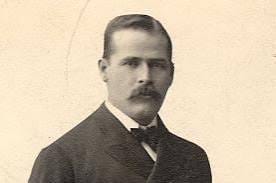
Harry Longabaugh
The full documentary on the Voices of Wisdom channel traces this journey from beginning to end. But first, let’s meet the real Harry Longabaugh.
“Dead outlaws make great legends. You bet. Better to get it from the horse’s mouth than some horse’s ass.” — Attributed to Etta Place
The First Lie: How a Horse Thief Got His Name
Harry Longabaugh was born in 1867 in Phoenixville, Pennsylvania — about as far from the Wild West as you could get. His family was poor. His options were limited. At fifteen, he moved to Colorado to homestead with a cousin.
The year was 1887. The West was closing. The open range was being fenced. And Longabaugh made a mistake that would define his life: he stole a horse and a saddle.
The small crime that became a legend:
A. The sentence — Eighteen months in the Crook County Jail in Sundance, Wyoming. He was twenty years old. He was not a hardened criminal. He was just a kid who needed a horse.
B. The nickname — Jail cells are small. Inmates talk. Longabaugh told stories about his life. When he was released, he was no longer just Harry. He was “the Sundance Kid.”
C. The irony — He hated the name. It was a reminder of his worst mistake. But Hollywood would make it the most famous thing about him.
D. The reset — After jail, Longabaugh drifted north to Canada. He hoped for a clean start. He was a horse breaker at the Bar U Ranch in Alberta. His coworkers described him as “a thoroughly likable fellow… a splendid rider and a topnotch cow hand.”
The 1891 Canadian census captured him in that moment. He was a “lodger,” a “horse breaker,” literate, healthy, and working for wages. He was not yet a legend. He was just a man trying to rebuild his life.
The documentary includes a detailed breakdown of the Canadian census records — showing the exact moment the Sundance Kid was still just Harry Longabaugh, working for a paycheck.
The Wild Bunch: When the Trains Started Falling
Longabaugh drifted back to the United States in the mid-1890s. He met Robert Leroy Parker — Butch Cassidy — and joined the Wild Bunch.
The gang was not a formal organization. It was a loose confederation of criminals who paired off for specific robberies. They operated out of Hole-in-the-Wall in Wyoming, Brown’s Hole near the Utah-Colorado-Wyoming border, and Robbers’ Roost in Utah.
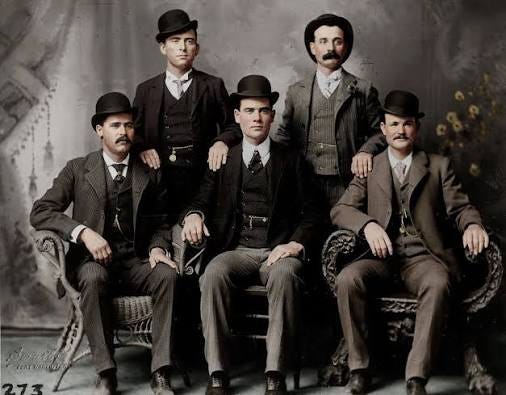
The Wild Bunch
What the Wild Bunch actually was:
A. The robberies — On June 2, 1899, Cassidy, Sundance, Harvey Logan, and Elzy Lay robbed a Union Pacific train near Wilcox, Wyoming, stealing between $30,000 and $60,000. On August 29, 1900, they robbed another Union Pacific train at Tipton, Wyoming. Less than a month later, they raided the First National Bank of Winnemucca, Nevada, stealing $32,640.
B. The no-kill myth — Cassidy boasted of never killing anyone. It wasn’t true. Kid Curry alone killed nine lawmen. Other members killed civilians and lawmen alike. The Wild Bunch was not noble. It was violent.
C. The Pinkertons — The Pinkerton Detective Agency hunted them relentlessly. By early 1901, Cassidy, Sundance, and Sundance’s girlfriend Etta Place fled to Argentina. The Wild Bunch was finished.
The gang’s success was built on speed, planning, and a network of sympathetic ranchers who supplied fresh horses and information. But the future was coming. Trains were faster. Detectives were better. The open range was disappearing.
The documentary reconstructs the Wilcox and Tipton robberies using historical records — showing how the Wild Bunch operated, and why they eventually had to run.
Etta Place: The Woman Who Vanished
Etta Place is the great mystery of the Sundance story.
What we know — and don’t know — about her:
A. The basics — She was Sundance’s common-law wife. She accompanied him and Cassidy to South America in 1901. She was a skilled horse rider and markswoman. She was well-educated and beautiful.
B. The speculation — Some believe she was a schoolteacher or a prostitute before meeting Sundance. There is no hard evidence for either claim.
C. The timeline — She returned to the United States around 1905, visited San Francisco, and was last seen in 1909. After that, she vanished.
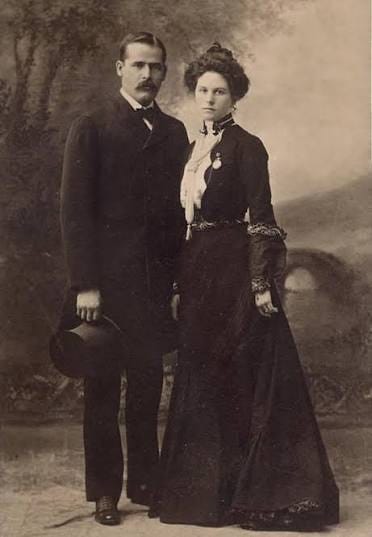
Harry Longabaugh and Etta Place
D. The theories — Some believe she reinvented herself as a brothel owner named Eunice Gray in Fort Worth, Texas. Recent photographic evidence refutes that theory. Others believe she lived a quiet life under a new name.
The documentary explores the Etta Place mystery in detail — including the theories about her life before and after Sundance.
The South American Dream That Died
In 1901, Cassidy, Sundance, and Etta Place arrived in Argentina. They homesteaded a ranch in the Cholila Valley in Patagonia. They tried to go straight.
The attempt at a new life:
A. The ranch — The three lived as settlers. They bought livestock. They built a home. They tried to escape their reputations.
B. The reality — It didn’t last. By 1905, they were back to robbing banks. Historian Thom Hatch notes they sold out and fled to Chile after authorities sought to detain them for a robbery they apparently didn’t commit.
C. The turning point — Etta left. She returned to the United States. Sundance and Cassidy stayed in South America.
The Patagonian experiment proved something important: these men were not built for quiet lives. They had been outlaws for too long. The law was still hunting them. And they had no other skills.
The documentary includes newly uncovered documents from the period, including police records and letters, that show the outlaws’ struggles in South America.
The Final Stand in Bolivia (Or Did They Escape?)
On November 3, 1908, a courier for the Aramayo Franke y Cia silver mine was attacked and robbed by two masked American bandits near San Vicente Canton, Bolivia. They were cornered by authorities in a rooming house.
What happened next:
A. The shootout — A gunfight erupted. One soldier was killed, another wounded. The two men fought until dark. Later that night, townspeople heard screams and two shots.
B. The bodies — In the morning, authorities found both dead. Both had been shot in the head. Researchers Daniel Buck and Anne Meadows believe Cassidy shot Sundance, then himself.
C. The uncertainty — The bodies were never positively identified. There are no photographs of the corpses. This allowed decades of speculation that one or both men escaped.
D. The exhumations — In 1991, forensic anthropologist Clyde Snow searched for the graves but did not find remains matching DNA from living relatives of Parker or Longabaugh. In 2008, the remains of William Henry Long were exhumed in Duchesne, Utah. Some believed Long was actually Sundance, who had escaped and lived until 1936. Anthropologist John McCullough compared photographs and called the match “almost too good.” The DNA results? The remains did not match DNA obtained from a distant relative of the Sundance Kid.
Despite the evidence, the mystery persists. Historian Jim Dullenty told the Los Angeles Times in 1996: “This is still an unsolved mystery… I would say the evidence is beginning to weigh more on the side of them dying in South America.”
The Hollywood Alchemy: How a 1969 Film Created a Myth
William Goldman’s screenplay for Butch Cassidy and the Sundance Kid (1969) is brilliant. It is also mostly fiction.
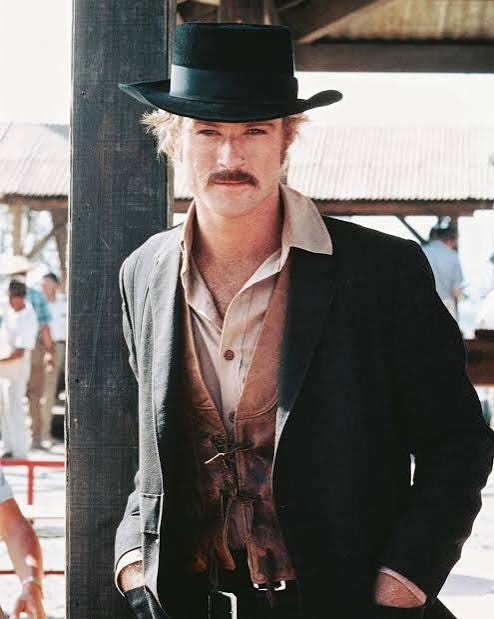
Robert Redford as The Sundance Kid
What the movie got right — and wrong:
A. The friendship — Butch and Sundance were indeed close friends. They died together. That part is true.
B. The personality — Sundance was not a reluctant, charming romantic. He was quiet, competent, and never sought fame. He was a working cowboy who became an outlaw by circumstance.
C. The romance — Etta Place was a real person. But her story is more mystery than romance.
D. The ending — The film freezes on Butch and Sundance charging into a hail of gunfire. It’s perfect cinema. It’s also inaccurate. According to Wild West magazine, a mere three soldiers, not hundreds, put an end to the fabled outlaws.
The movie’s success overshadowed the truth. Paul Newman and Robert Redford became the faces of Butch and Sundance. The real men — Robert Leroy Parker and Harry Alonzo Longabaugh — were relegated to footnotes.
The documentary compares the Hollywood version to historical records, showing exactly what the filmmakers changed — and why.
Why the Real Story Matters
Harry Longabaugh wasn’t a movie star. He was a horse thief who grew up poor, made mistakes, and tried to escape them. He rode with outlaws because it was the only life he knew.
Three reasons to care about the real Sundance:
A. The myth vs. reality — The movie version is more romantic. The truth is more tragic. A man who never wanted fame became a legend he would have hated.
B. The mystery — Did Sundance die in Bolivia? Did he escape to Utah? The debate continues. The exhumations and the South American documents all point to the same conclusion — but they haven’t ended the speculation.
C. The lesson — The old West was not a Hollywood set. It was a harsh, unforgiving place where men like Longabaugh made desperate choices. His story is a reminder that the West was built by flawed people, not heroes.
The full documentary on the Voices of Wisdom channel traces this journey from beginning to end — from the Pennsylvania farm to the Bolivian grave (or was it?). Watch it and decide for yourself.
[embed]
The truth is more interesting than the myth. And the myth is more fun. Both are worth your time.
Sources & Further Reading
- Sundance, My Uncle by Donna B. Ernst (1992) — A biography by a descendant of the Longabaugh family, presenting documents that verify the shootout and the deaths
- The Last Outlaws: The Lives and Legends of Butch Cassidy and the Sundance Kid by Thom Hatch (2013) — Carefully researched biography that separates fact from fiction
- Daniel Buck and Anne Meadows — Husband-and-wife researchers who exhumed long-lost Argentine police files on the outlaws’ South American years
- University of Utah exhumation report (2008) — Anthropologist John McCullough’s analysis of the William Henry Long remains
- Wild West magazine (February 1997) — Detailed account of the outlaws’ South American years
- U.S. National Park Service — Historical records of the Wild Bunch
- Utah State Historical Society — Archives on Butch Cassidy and the Sundance Kid
- The Pinkerton Detective Agency — Historical files on the pursuit of the Wild Bunch
Meta Description & Tags
Sundance Kid true story documentary. Harry Longabaugh, Wild Bunch outlaw, Butch Cassidy. Hollywood myth vs historical reality.
SundanceKid #WildBunch #OldWestHistory #ButchCassidy #TrueCrimeHistory
3 Alternate Titles:
A. The Man Who Wasn’t Supposed to Be Famous: How Hollywood Erased the Real Sundance Kid
B. Horse Thief to Hollywood Icon: The Sundance Kid’s 120-Year Identity Crisis
C. Did He Die in Bolivia or Utah? The Sundance Kid Mystery That Won’t Die
메타데이터
- post_id
- c53d8314ae11
- slug
- the-man-who-wasnt-supposed-to-be-famous-how-hollywood-erased-the-real-sundance-kid-c53d8314ae11
- url
- https://medium.com/@voicesofwisdom2025/the-man-who-wasnt-supposed-to-be-famous-how-hollywood-erased-the-real-sundance-kid-c53d8314ae11
- canonical_url
- https://medium.com/@voicesofwisdom2025/the-man-who-wasnt-supposed-to-be-famous-how-hollywood-erased-the-real-sundance-kid-c53d8314ae11
- author_url
- https://medium.com/@voicesofwisdom2025
- status
- ok
- fetched_at
- 2026-07-19 20:47:15