The War That Sold Solar Panels
An oil-addicted empire bombed the present to defend the past, and accidentally built the future. But does the fire need to be this large?
The War That Sold Solar Panels
An oil-addicted empire bombed the present to defend the past, and accidentally built the future. But does the fire need to be this large?

The War That Sold Solar Panels (by author)
The Strait is closed. Tankers sit on the wrong side of it, hundreds of them, riding low and going nowhere. Iran says it will keep its uranium and its waterway. The US says hand both over. The price of a barrel has already doubled and the analysts cannot agree on where it stops. At gas stations, the lines come back. A governor floats rationing by license plate: odd numbers fill up on odd days, even on even, and the pumps in some towns cannot physically display a price that high because nobody built them for a world where fuel costs this much.
It was 1979, though it all sounds very much like the headlines you have been half-reading since March.
The Shah had just left for Egypt. Khomeini was three weeks from landing in Tehran. Iranian output fell by a little under five million barrels a day, about seven percent of world production, and the actual physical shortage that reached the US was smaller still, four to five percent after other producers opened their valves.
All it took was a small drop in supply, and the richest country on earth started acting like it was running out completely. Gas stations hung colored flags to signal whether they had fuel, and people argued over odd-even license plate rules just to get a turn at the pump. Panic buying more than doubled the real shortage. There was still oil out there. What ran out first was confidence that more would arrive tomorrow, and that loss of confidence was what really sent prices flying.
Carter went on television and proposed a windfall profit tax. He stood up the Synthetic Fuels Corporation to manufacture an alternative to imported oil. For one frightened year, an empire that had built itself on cheap fuel looked straight at its own dependence and swore it would never be caught like this again.
Then the price came down, and the empire went into the prescribed amnesia.
It forgot in 1973, the first time. It forgot in 1979. It forgot after 1990, after 2003, after 2008, after 2022. Add it up and the pattern is almost comical. Since the first oil embargo, there have been fourteen shocks. Eight of them were so big they pushed prices up more than thirty percent in a single year. An oil shock every four years, on average, each followed by more than a year of economic pain, each followed by the same vow ‘We can’t let this happen again,’ and then, as soon as prices settle, everyone goes back to forgetting.
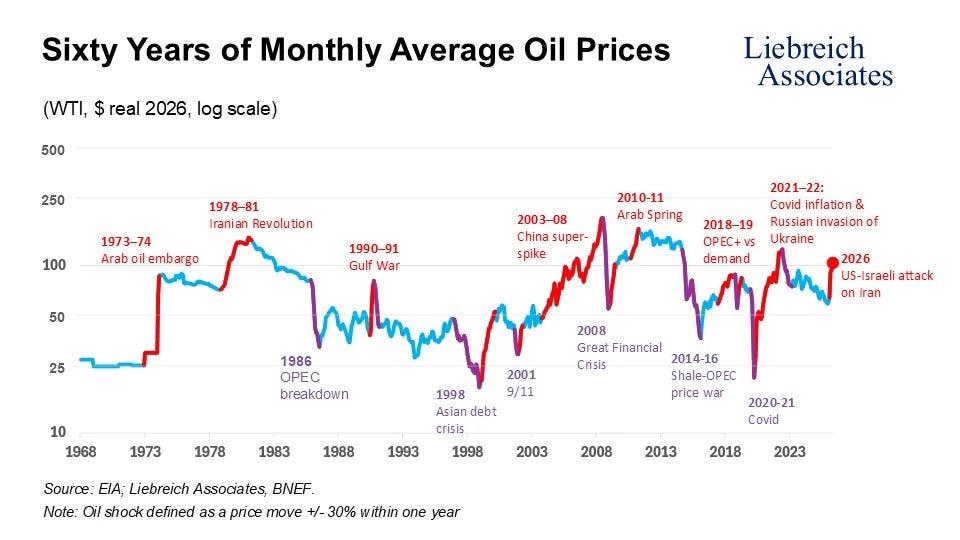
Source
The lesson was always right there. It just never stuck because every time the system looked at the alternative, it was more expensive than the thing it was supposed to replace.
It feels like we have seen this movie before. But this time, the basic math of the sacred economy running the world is telling a much different story.
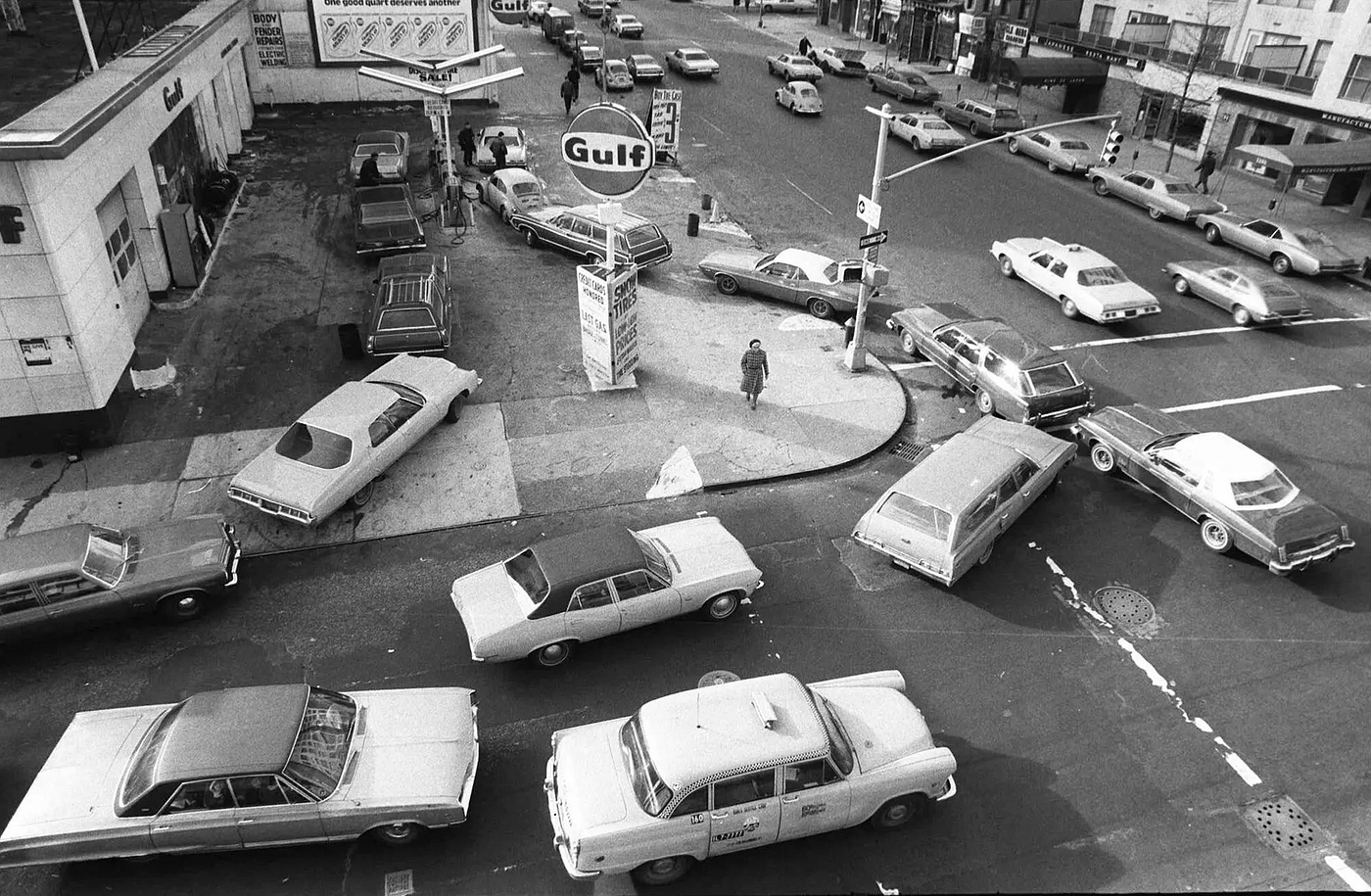
The 1973 oil embargo led to panic buying, and long lines at gas stations. While that isn’t likely now in the United States, the price shock is likely to reverberate through the economy. (Source)
Run That Curve Long Enough
On February 28, a US and Israeli coalition attacked Iran, and within weeks the Strait of Hormuz, the narrow chokepoint that carries a fifth of the world’s seaborne oil, started to seize up. Thirteen million barrels a day went missing, twenty times the hole Russia punched in the market when it invaded Ukraine. The head of the International Energy Agency, Fatih Birol, called it the biggest energy security threat in history.
Yet the president who ordered the strikes called the price spike a very small price to pay for safety and peace — the exact old line a defense briefing produced in 1953, in 1973, in 1979, in 1991, in 2003, every year an oil-importing empire decided that bombing the present was cheaper than building the future. Except this time every extra dollar at the pump acted like a coupon for the technologies meant to replace oil.
In the same month the coalition hit Iranian gas facilities, China’s exports of solar panels, batteries, and EVs reached $21.9 billion, up seventy percent from the year before. In Europe, EV sales jumped from a quarter of new cars to half. People may tune out climate speeches, but they pay close attention to the number on the gas station sign.
A worldwide population will sleep through a decade of climate speeches and wake up instantly to the number on a gas station sign. Birol’s own institute now expects the war to drag peak fossil fuel use forward to before 2030.
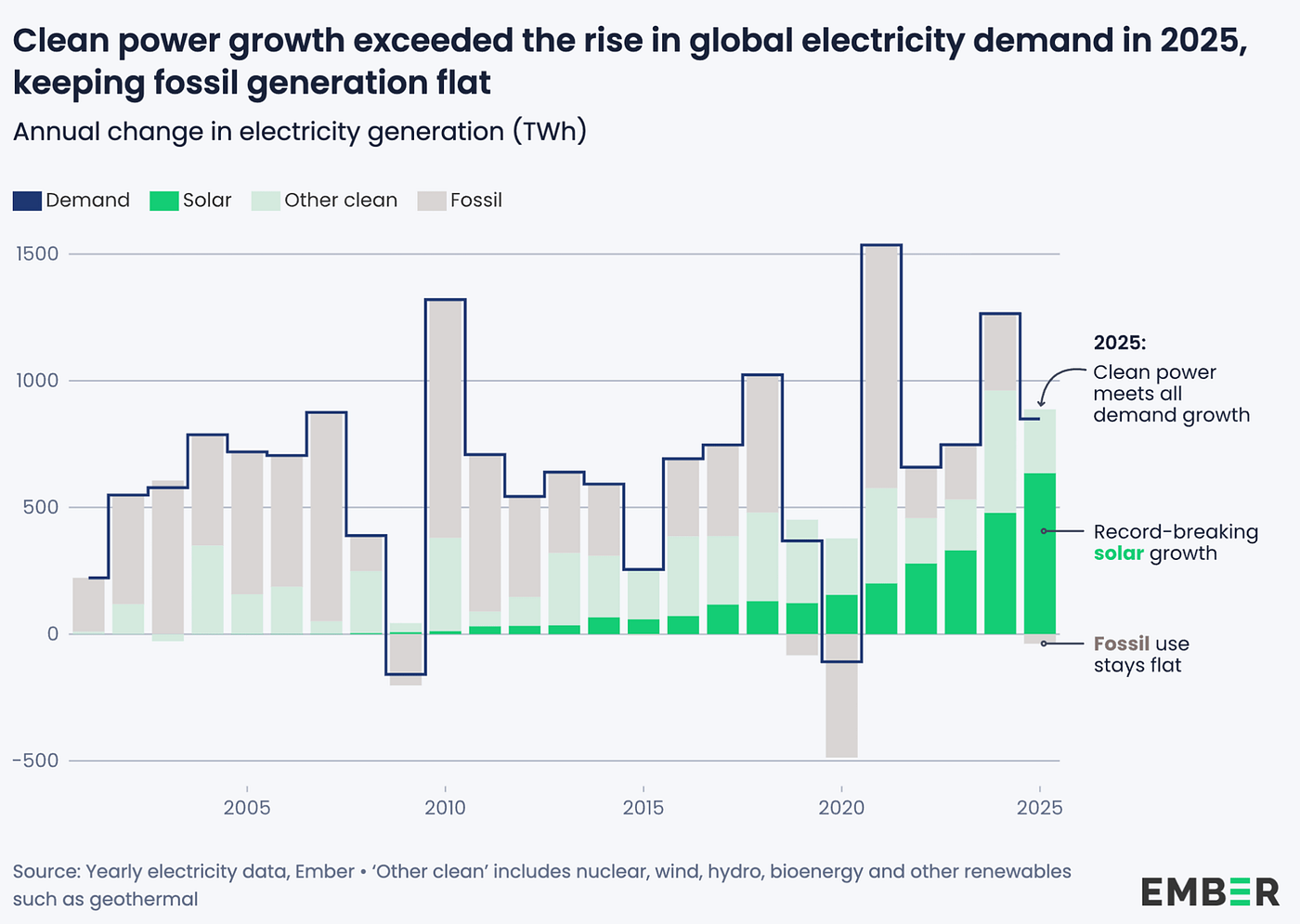
Change in annual global electricity demand and the amount met by fossil fuels, solar power, and other clean sources between 2000 and 2025 (Source: Ember)
None of that would have happened in 1979, because in 1979 the alternative was a science project. What changed is a single line on a graph that has started to feel inevitable. Every time the world doubles how many solar panels it makes, the price drops by about a quarter. And it has done that for fifty years straight — no lockdown exception years.
Run that curve long enough and you arrive where we now stand: sunlight at a good site delivers power for a cent or two a kilowatt-hour, less than half what the cheapest fossil plant charges. So when people say the transition means paying more, they are usually working off an old price sheet. The other missing piece was storage, and that is dropping fast too. In 2025, batteries fell to around $70 per kilowatt-hour, down 45% in a single year. Put it together and the cheapest new grid you can build in many places is simple: collect sunlight during the day, and store it in batteries for the night.
In 2025, for the first time in recorded history, global generation from fossil fuels fell even as the economy kept growing. Not by much, about two-tenths of one percent. But every prior decline in the history of burning things happened when the world hit the brakes: a financial crash in 2008, a global shutdown in 2020. The smoke cleared because the world stopped moving.
Last year the world did not stop. Demand climbed, renewables met almost all of the increase, and the fire shrank anyway, beaten on cost. For the first time since 1919, the year before a plane had crossed the Atlantic, coal supplied a smaller share of the world’s electricity than renewables did.
Let’s run the math on what closing the Strait actually does to gas versus what it does to oil, and you’ll see this clearly.
Close the Strait and oil gets painful fast and for years, because the world’s cars take two decades to replace and there is no quick substitute for gasoline. Even a huge EV boom takes a long time to dent the amount of oil moving through Hormuz.
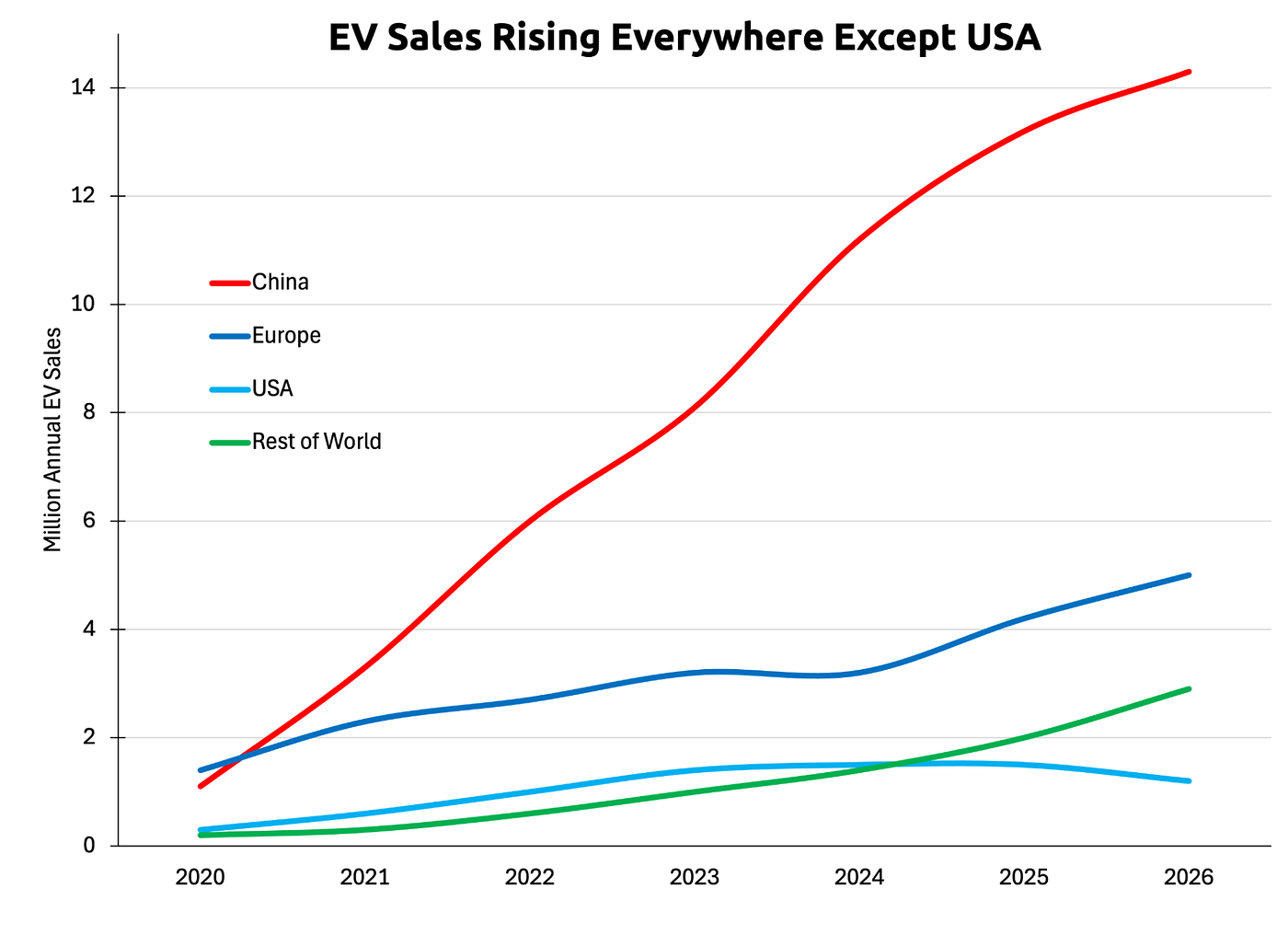
Annual electric vehicle sales in China (red), Europe (dark blue), the U.S. (light blue), and the rest of the world (green). (Source: International Energy Agency)
But the same blockade barely touches gas, and the math is almost insulting in how lopsided it runs. All the liquefied gas that passed through Hormuz in 2025 (about 110 billion cubic meters) would have generated roughly 600 terawatt-hours of electricity. Wind and solar added more than that last year, just as a matter of routine. So if we simply double the build rate using factories that already exist, we can replace the entire lost Gulf gas flow in about nine months.
Nine. Months.
That is the number the fossil system has no answer for, because it answers everything the fossil system relies on: the blockade, the closed waterway, the production ceiling, the embargo. It cannot be owned by anyone upstream of whoever points at the sky.
So the war meant to defend the old fire wrote the new one its finest advertisement, in the only language this system has ever respected: price. A man reaching for the oil weapon, closing on the trigger, and finding its own foot underneath.
It would feel like a clean win, if “clean” actually meant what the ads make it sound like.
Running Through The Same Bloodstream
A solar panel that catches the unblockable sunlight is not made of sunshine. It is made of polysilicon, silver, aluminum, copper — materials have to be dug up, processed, shipped, and assembled, often in places and conditions you will never see in a glossy brochure. Batteries are the same story. They rely on lithium, nickel, and cobalt, and a lot of the world’s cobalt comes from the Democratic Republic of Congo, where some of it is still mined in hand-dug pits that involve children who will not feel a single watt of the grid their hands are helping to build.
So “clean” can end up meaning “out of sight.” It is a word that lets a supply chain with real harm attached to it get rebranded as a moral upgrade.
We can call it cleaner. Cleaner than coal. Cleaner than oil. Cleaner than the price-shock loop that keeps whiplashing economies. But it is not clean. “Clean” makes it sound like the mess disappears, when a lot of it just moves somewhere else. We should stick to renewables: the source refills every day, not like the millions of years that fossil fuels need.
The companies that spent decades telling us *“don’t worry about climate” are not going to simply fade out as oil fades out. The five biggest oil firms have pulled in nearly half a trillion dollars since Russia invaded Ukraine. And when the Iran war flared, some of their stock prices jumped the same morning. That is a lot of fresh cash landing in the hands of groups with a long history of spending money to stall change. The same shock that pushes the world toward cleaner* energy is also stuffing the wallets that can bankroll the next wave of pushback.
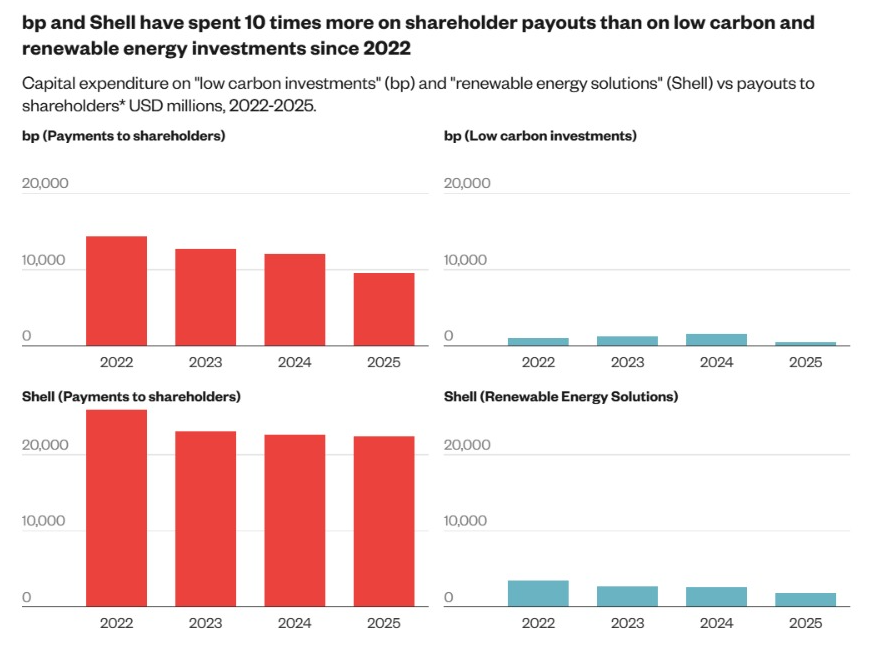
(Source: Oil supermajors’ profits reach nearly half a trillion dollars since Russia’s Ukraine invasion)
The body that is healing and the infection are running through the same bloodstream.
And meanwhile, the system’s appetite has barely changed. The word “demand,” sitting so neutral in the energy reports, is the bureaucratic name for the same old belief that “wanting more” automatically means “deserving more.”
The Question That Built The Crisis
There’s a future where the world runs on panels instead of platforms, where the Strait could stay shut for a decade and it would mostly be an inconvenience, not a catastrophe. That world is starting to arrive.
The fossil fire is going out slowly, and later than it should, and it is not “clean” in the fairytale sense. The mining and factories still have real human costs. But the direction is real. This is the biggest shift in how we power daily life since the first coal fires, and it is happening on a cost curve no president can sign away.
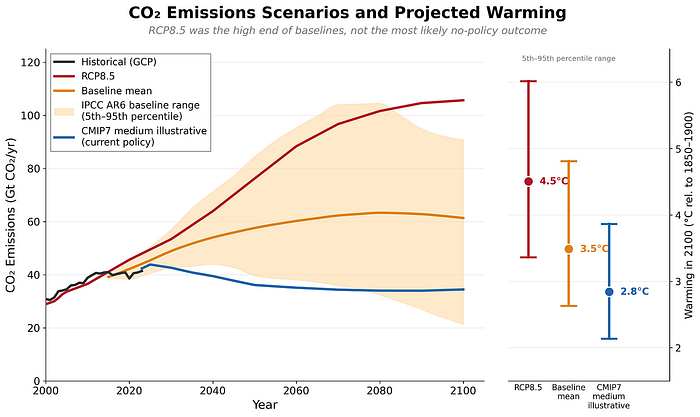
Global CO2 emissions (left) and 2100 warming relative to preindustrial (right) for RCP8.5, the range of IPCC AR6 WG3 baseline scenarios, and the new CMIP7 medium illustrative scenario from van Vuuren et al. Future warming ranges based on FaIR model calculations. (Source)
Now, what if we keep living the same way — same spending, same growth, same waste. In that case, we have done something important but incomplete. We have changed the fuel. We have not changed the engine.
That is the problem the charts cannot solve. Most of the reports I’ve linked measure the supply side. They track how electricity gets made, how fast cleaner tech scales, and how quickly it gets cheaper. Almost none of them measure the other side: the hunger the system is built to feed.
The transition is a magnificent answer to the question of what we burn. It is silent on the harder question of “How much do we actually need?” — the question that built the crisis in the first place.
Renewables are necessary, but they were never sufficient. If consumption keeps rising, the fuel may change, but the direction stays the same. And direction has always mattered more than the source.
We have spent fifty years and a fortune learning to feed the fire something cleaner. We have not spent an afternoon asking whether the fire needs to be this large.
May the northern lights guide you, M.
If the story resonated, I’d really appreciate a repost.
If something’s on your mind, reach out. [My inbox is always open.](mailto: martinah.awanderer@gmail.com)
메타데이터
- post_id
- c54efac48031
- slug
- the-war-that-sold-solar-panels-c54efac48031
- url
- https://medium.com/southern-winds/the-war-that-sold-solar-panels-c54efac48031
- canonical_url
- https://medium.com/southern-winds/the-war-that-sold-solar-panels-c54efac48031
- author_url
- https://medium.com/@martinah.awanderer
- status
- ok
- fetched_at
- 2026-06-12 18:14:10