RAG vs Fine-Tuning vs Prompt Engineering vs CAG: Pick the Wrong One, and You’ll Waste Months
The four ways to make LLMs smarter, when each one actually makes sense, and the decision that most teams get wrong
RAG vs Fine-Tuning vs Prompt Engineering vs CAG: Pick the Wrong One, and You’ll Waste Months
The four ways to make LLMs smarter, when each one actually makes sense, and the decision that most teams get wrong
Most teams spend three months fine-tuning a model for a problem that a well-written prompt would have solved in a week.
Some build a full RAG pipeline with a vector database for a document collection that would have fit in the context window from the start. Others write increasingly elaborate prompts when what they actually need is a model retrained on their domain.
Every wrong choice looks reasonable at the time. That is what makes it expensive.
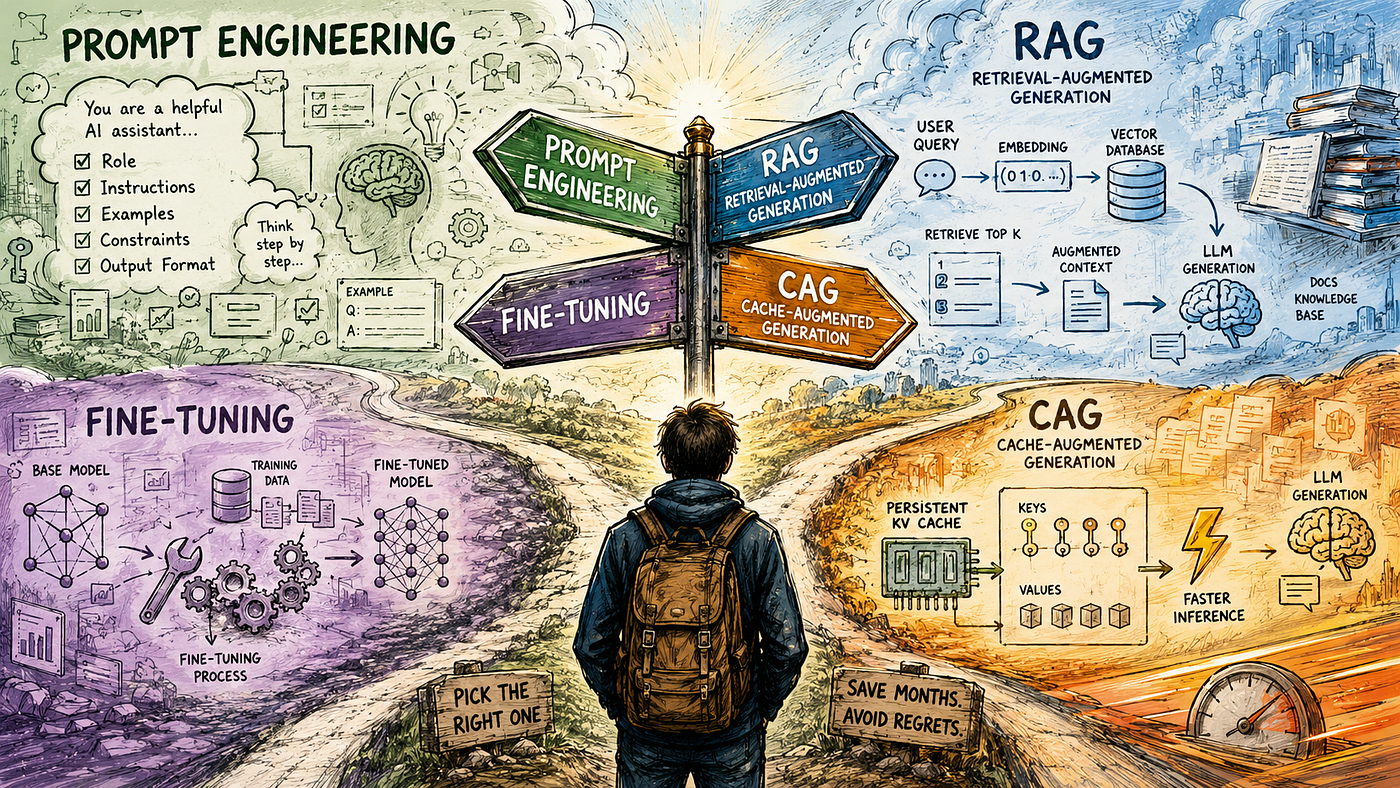
There are four main ways to make an LLM smarter and more useful:
- Prompt engineering,
- RAG,
- CAG
- Fine-tuning
Each one solves a different problem. None of them is universally better. And picking the right one depends entirely on understanding what failure mode you are actually trying to fix.
This article explains all four from first principles, with honest tradeoffs and a decision matrix at the end.
Let’s end the confusion once and for all.
If you want more such information about AI, consider subscribing to my newsletter, where you will get noise-free information every week
Link for the newsletter: Newsletter
The Core Problem Each One Solves
Before any technique, here is the root issue they all address:
A language model knows what it learned during training.
- It does not have access to your company’s internal data.
- It does not know what happened last week.
It cannot consistently follow a specific format without guidance. It may not understand your domain’s vocabulary deeply enough to be reliable.
Context is a scarce resource for the model, and using the wrong technique can cost you many months of unnecessary work.
The question is not “which technique is best?”
The question is “which specific gap am I trying to close?”
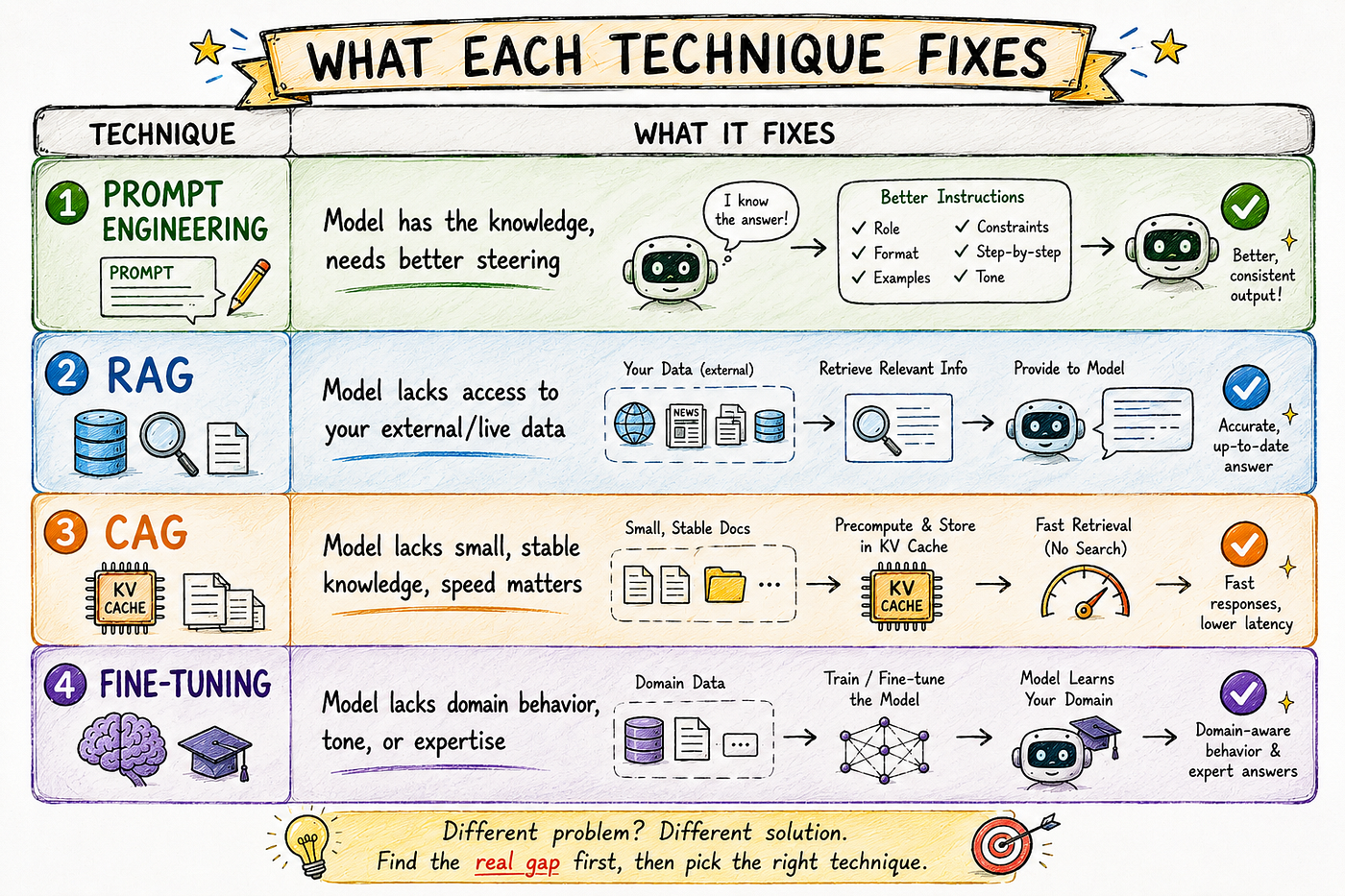
Each technique addresses a different root cause. Applying the wrong one does not fix the problem. It just makes the system more complicated.
And often, a complicated system fails on the first day of production.
1. Prompt Engineering: Steer Before You Build
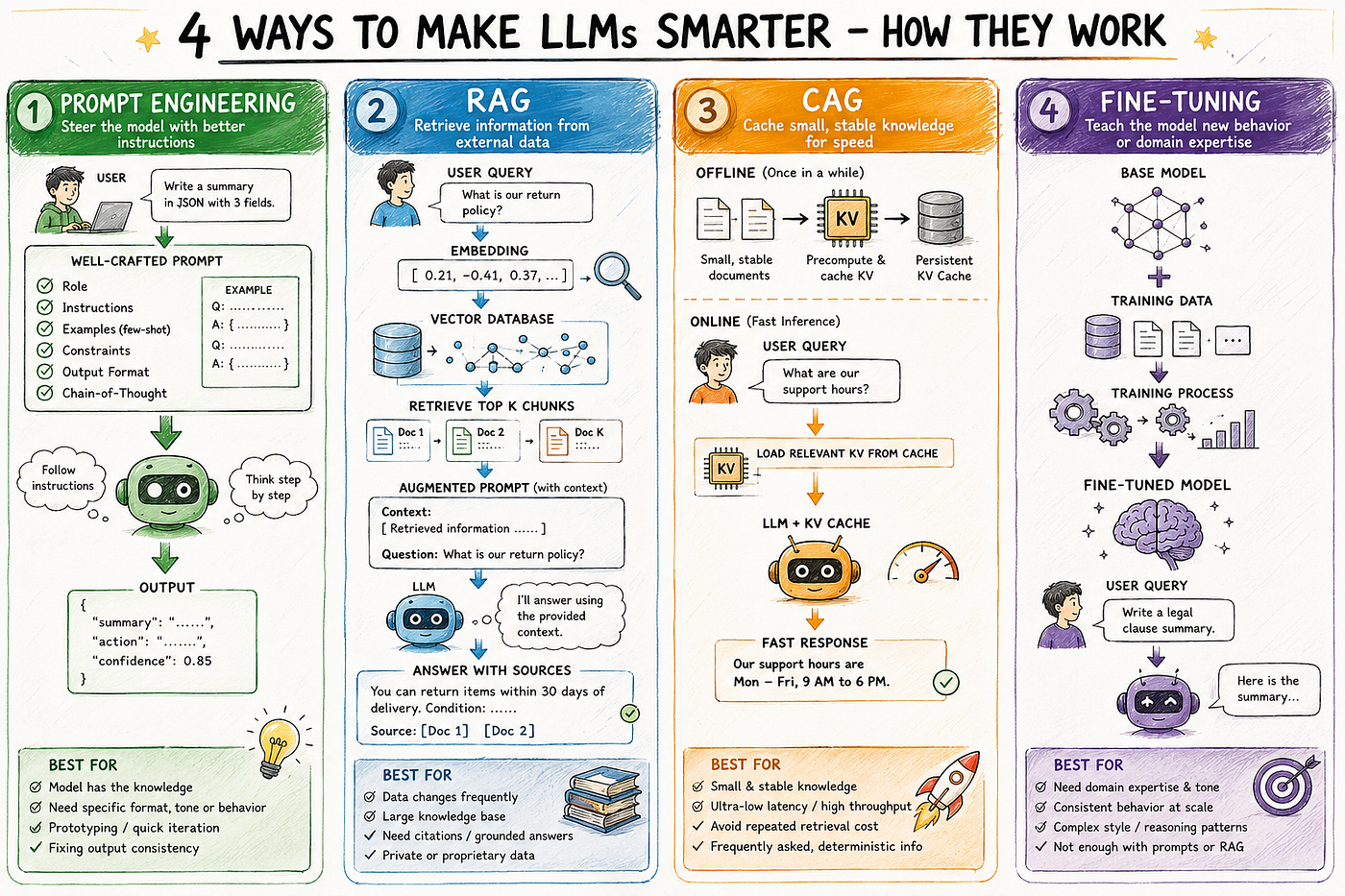
Prompt engineering is writing better instructions. That is the plain version. The less obvious version: it is the technique you should try first, before any other investment.
Good prompt engineering covers:
- Role assignment: “You are a senior financial analyst who responds only based on provided data.”
- Output format: “Respond in JSON with three fields: summary, action, confidence score.”
- Examples (few-shot): Show the model two or three examples of what a good output looks like.
- Constraints: “If you do not know the answer, say ‘insufficient data’ rather than guessing.”
- Chain-of-thought: “Think step by step before giving your final answer.”
Prompt engineering optimizes input prompts to steer a model toward better outputs. It does not change the model. It changes what you put in front of it.
When prompt engineering is the right choice:
- The model already has the relevant knowledge
- You need specific formatting, tone, or behavior
- You are prototyping before committing to heavier infrastructure
- You need to fix output consistency issues
When prompt engineering is not enough:
- The model consistently lacks the specific factual knowledge it needs
- You are hitting a ceiling on quality despite prompt improvements
- The knowledge changes frequently and you cannot update prompts fast enough
- The domain is so specialized that the model simply does not have it in its weights
“Prompt engineering is the fastest feedback loop in AI engineering. Use it first. Exhaust it before reaching for anything heavier.”
Honest limitation: Prompts degrade under pressure. A model that follows your careful instructions in testing will eventually diverge in production, especially as conversation length grows and the system prompt gets further from the attention window’s focal point.
2. RAG: Connect the Model to What It Doesn’t Know
RAG stands for Retrieval-Augmented Generation. The concept is simple enough to fit in one sentence: before generating a response, retrieve the relevant information from your data and give it to the model.
Instead of relying on training knowledge alone, the system fetches fresh, relevant context at the moment of each query.
How it works:
User Query
    ↓
Query converted to vector (embedding)
    ↓
Vector database searched for semantically similar content
    ↓
Most relevant chunks retrieved
    ↓
Chunks injected into prompt as context
    ↓
LLM generates a grounded, accurate response
Think of it as giving the model a reading list before it answers. It did not get smarter. It got better information.
RAG strictly bounds the LLM to provided facts, reducing hallucinations. It requires zero model fine-tuning. RAG data and the vector database can be updated without touching the LLM.
When RAG is the right choice:
- Your data changes frequently (product catalog, support docs, news)
- You have private data the model was not trained on
- You need answers with citations to specific sources
- Your knowledge base is large (millions of documents)
When RAG is the wrong choice:
- Your data is small and stable: just put it in the context window directly
- You need consistent tone, behavior, or style: retrieval does not teach that
- Your queries do not fit a search paradigm — RAG works best for static or slowly changing knowledge bases
Honest limitation: RAG is highly dependent on the quality of the embedding model and chunking strategy. Lexical or semantic mismatch can cause silent retrieval failures. The vector database introduces additional infrastructure overhead and state management complexities.
RAG is not a chatbot strategy. It is a retrieval strategy. If retrieval is poor, the generation will be wrong regardless of how good the model is.
3. CAG: Cache It Once, Use It Always
CAG stands for Cache-Augmented Generation. It is newer, less widely known, and genuinely useful for a specific class of problems.
The idea was introduced in the 2024 paper “Don’t Do RAG: When Cache-Augmented Generation is All You Need for Knowledge Tasks.” CAG preloads a static knowledge base into the model’s internal attention cache (the KV cache) and reuses that memory during inference.
Instead of embedding and retrieving documents at runtime like RAG, CAG processes and stores them ahead of time. The result is faster, retrieval-free responses.
How it works:
Setup (done once):
  Full knowledge base → formatted into large prompt
  LLM processes it → stores as KV cache
Query time:
User question + KV cache → model generates response
No retrieval step. No vector search. No external calls.Documents are formatted into a large prompt that fits within the model’s context window.
The LLM processes this input and stores an internal representation in the KV cache. When a user submits a query, the KV cache and query are passed into the LLM, which generates a response based on the stored knowledge.
Why CAG is fast: No retrieval step at query time. The model already has everything. CAG dramatically reduces generation time compared to standard in-context learning, where the reference text is provided dynamically during inference and requires real-time KV-cache computation.
When CAG is the right choice:
- Your knowledge is small (fits in the model’s context window)
- Your data is stable and does not change often
- You need low latency and cannot afford retrieval overhead
- You are operating in environments where external database access is restricted
- You want simple architecture without vector database management
When CAG is the wrong choice:
- Your data is large: if it does not fit in the context window, CAG cannot help
- Your knowledge changes frequently: the cache needs to be invalidated and rebuilt
- The limitations of CAG are being addressed by models with longer context windows, but for very large, dynamic knowledge bases, RAG remains more appropriate
CAG vs RAG in plain terms:
- RAG searches when it needs to answer
- CAG already has everything loaded when the question arrives
CAG trades flexibility for speed. For the right problem, it is the simpler and faster choice. For the wrong problem (large or frequently changing data), it becomes a maintenance problem.
4. Fine-Tuning: Change the Model Itself
The first three techniques work around the model. Fine-tuning changes the model.
Fine-tuning takes a pre-trained model and continues training it on a smaller, task-specific dataset. The model’s weights are updated to improve its performance on your domain specific task.
A fine-tuned model is retrained on a focused set of external data to improve performance in specific use cases. It trains LLMs with domain-specific datasets to increase performance in downstream tasks.
What fine-tuning actually does:
- Teaches the model a specific tone, voice, or persona
- Injects domain vocabulary and terminology it uses reliably
- Improves formatting consistency without lengthy prompt instructions
- Builds expertise in a narrow domain (medical coding, legal contracts, specific APIs)
- Reduces the size of prompts needed to get quality output
When fine-tuning is the right choice:
- You have hundreds or thousands of high-quality labeled examples
- You need consistent behavior the model cannot achieve through prompting alone
- Latency is critical and you need a smaller, specialized model
- You need domain-specific language baked in, not retrieved
When fine-tuning is the wrong answer:
- You have fewer than a few hundred examples: not enough signal
- You just need accurate factual answers: RAG is cheaper and easier to update
- Your requirements change frequently: retraining every time is expensive
- You have not exhausted prompt engineering first
The most common fine-tuning mistake: Teams reach for it too early. Prompt engineering should be the first optimization method tried, followed by RAG if factual grounding is needed, before committing to fine-tuning. Fine-tuning is expensive in time and money. Most teams that reach for it first would get 80% of the result from a better-structured prompt.
Honest limitation: Fine-tuned models go stale. The world changes. Your training set reflects a point in time. A fine-tuned model cannot update itself when your policies, products, or domain evolves. You need a retraining plan from day one.
How They Compare Side by Side
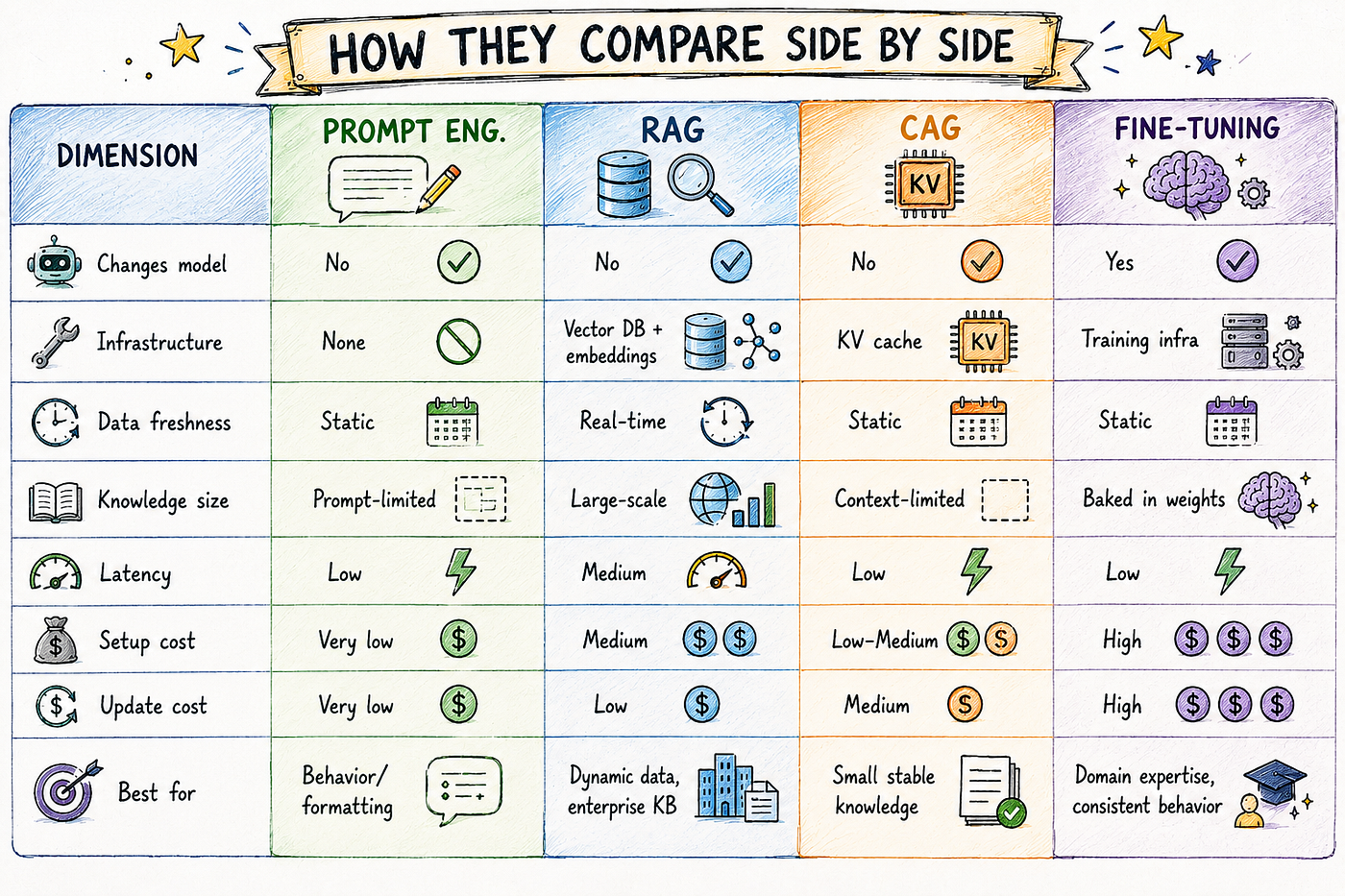
The Techniques Are Not Mutually Exclusive
This is the part most articles miss.
In production, most serious AI systems combine multiple techniques:
Prompt engineering + RAG: Almost always. You write the prompt that instructs the model how to use retrieved context.
Fine-tuning + RAG: A domain-specific model that is also connected to a live knowledge base. The fine-tuning teaches the model your domain’s vocabulary and reasoning style. RAG provides current facts.
CAG + Prompt engineering: A stable knowledge base preloaded, with a careful system prompt controlling behavior.
Fine-tuning + Prompt engineering: A fine-tuned model still needs a good system prompt to control output format and constraints.
The question is not “which one?” It is “which combination, in which order of implementation?”
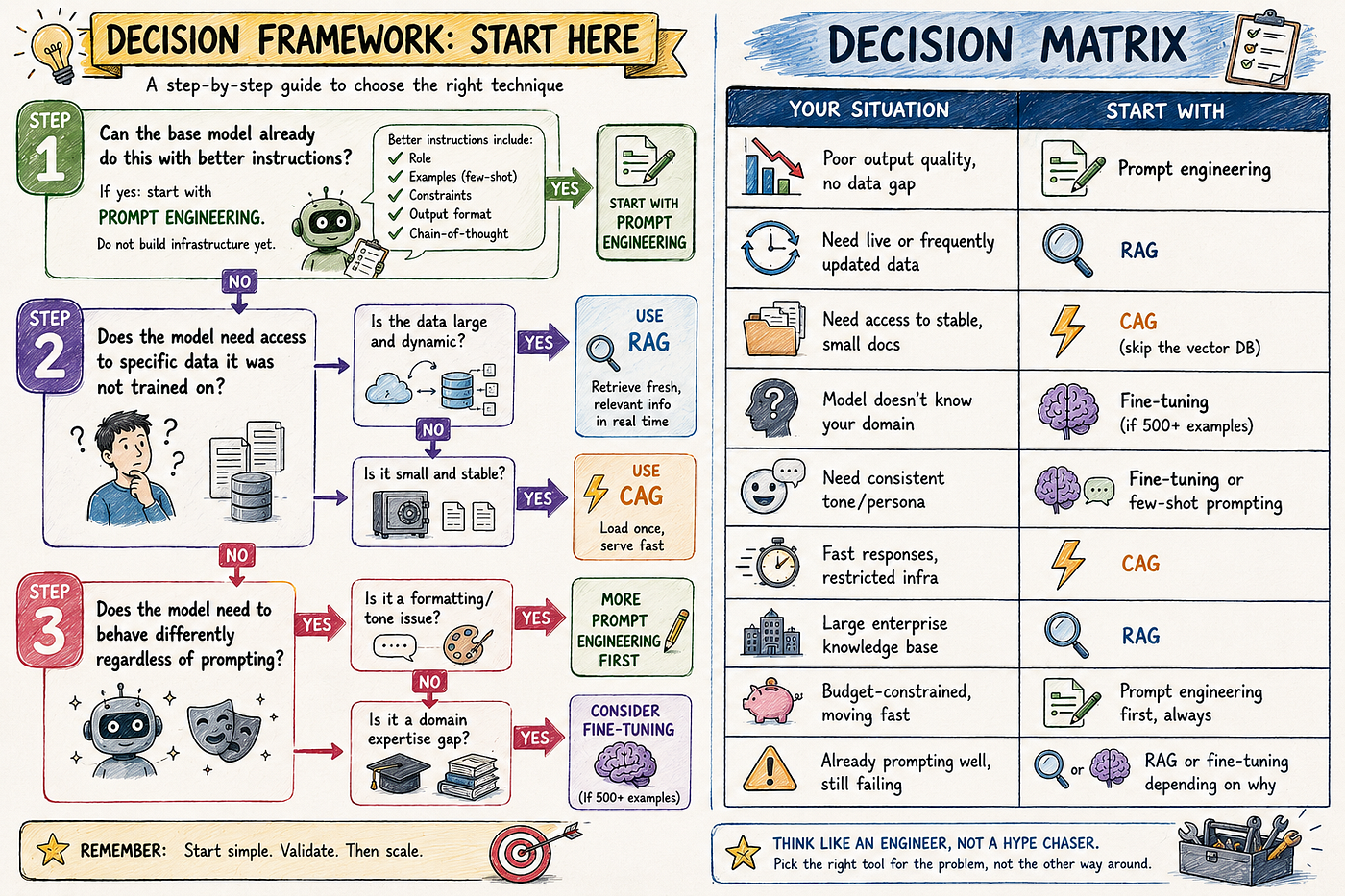
Decision Framework: Start Here
Step 1: Can the base model already do this with better instructions? If yes: start with prompt engineering. Do not build infrastructure yet.
Step 2: Does the model need access to specific data it was not trained on? If yes: is the data large and dynamic? Use RAG. Is it small and stable? Use CAG.
Step 3: Does the model need to behave differently regardless of prompting? If yes: is it a formatting/tone issue? More prompt engineering first. Is it a domain expertise gap? Consider fine-tuning.
One Hard Truth
Most AI failures are not model failures.
They are architectural failures.
Teams blame the model when the real problem is:
- They are using RAG when the data would have fit in the context window
- They are fine-tuning when a well-constructed prompt would work
- They are using prompt engineering for a factual grounding problem
- They built CAG for a knowledge base that changes weekly
The technique selection is the most important decision before any implementation begins. Get it wrong, and you build the wrong thing very efficiently.
Start simple. Prompt engineering is five minutes of work. and if it does not work. Then ask whether you actually need retrieval or training. Most of the time, the simpler answer works if applied correctly.
“The best AI system is the simplest one that actually solves the problem. Complexity is not a feature.”
메타데이터
- post_id
- c56247fc9252
- slug
- rag-vs-fine-tuning-vs-prompt-engineering-vs-cag-pick-the-wrong-one-and-youll-waste-months-c56247fc9252
- url
- https://medium.com/ai-engineering-simplified/rag-vs-fine-tuning-vs-prompt-engineering-vs-cag-pick-the-wrong-one-and-youll-waste-months-c56247fc9252
- canonical_url
- https://medium.com/ai-engineering-simplified/rag-vs-fine-tuning-vs-prompt-engineering-vs-cag-pick-the-wrong-one-and-youll-waste-months-c56247fc9252
- author_url
- https://medium.com/@yadavdivy296
- status
- ok
- fetched_at
- 2026-06-15 20:49:13