The Afrikaner Pattern
Moraira, the Dutch, and the gentrification nobody names for what it is
The Afrikaner Pattern
Moraira, the Dutch, and the gentrification nobody names for what it is
I walked into a shop in Moraira a few months ago and the man behind the counter said something I didn’t understand. It wasn’t a mistake on his part. It was the natural assumption that I spoke Dutch, that Dutch was the language spoken there, and that if I didn’t understand, the problem was mine. There was no intent to offend. There didn’t need to be. The most efficient kind of offense is the one that doesn’t need to try.
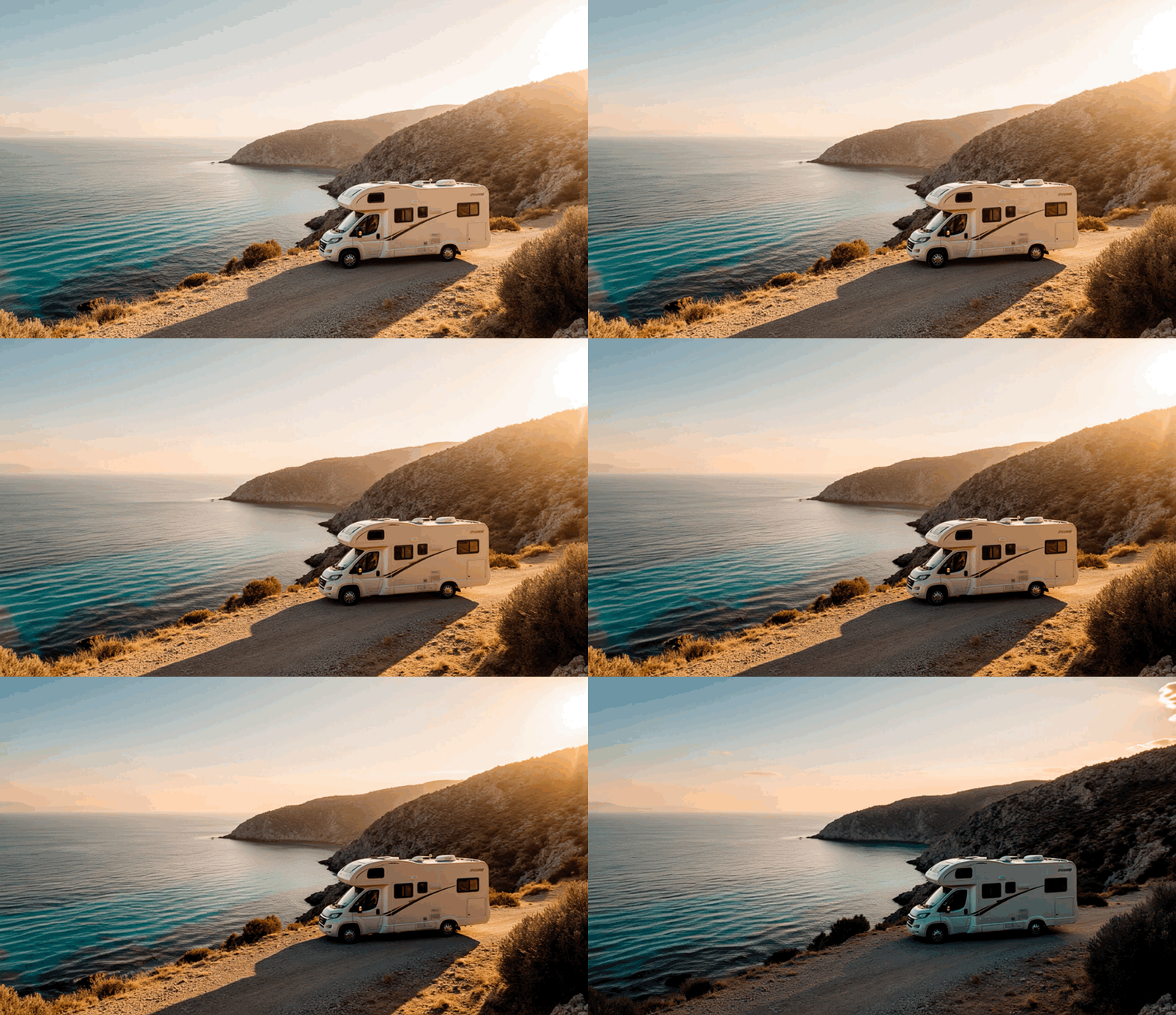
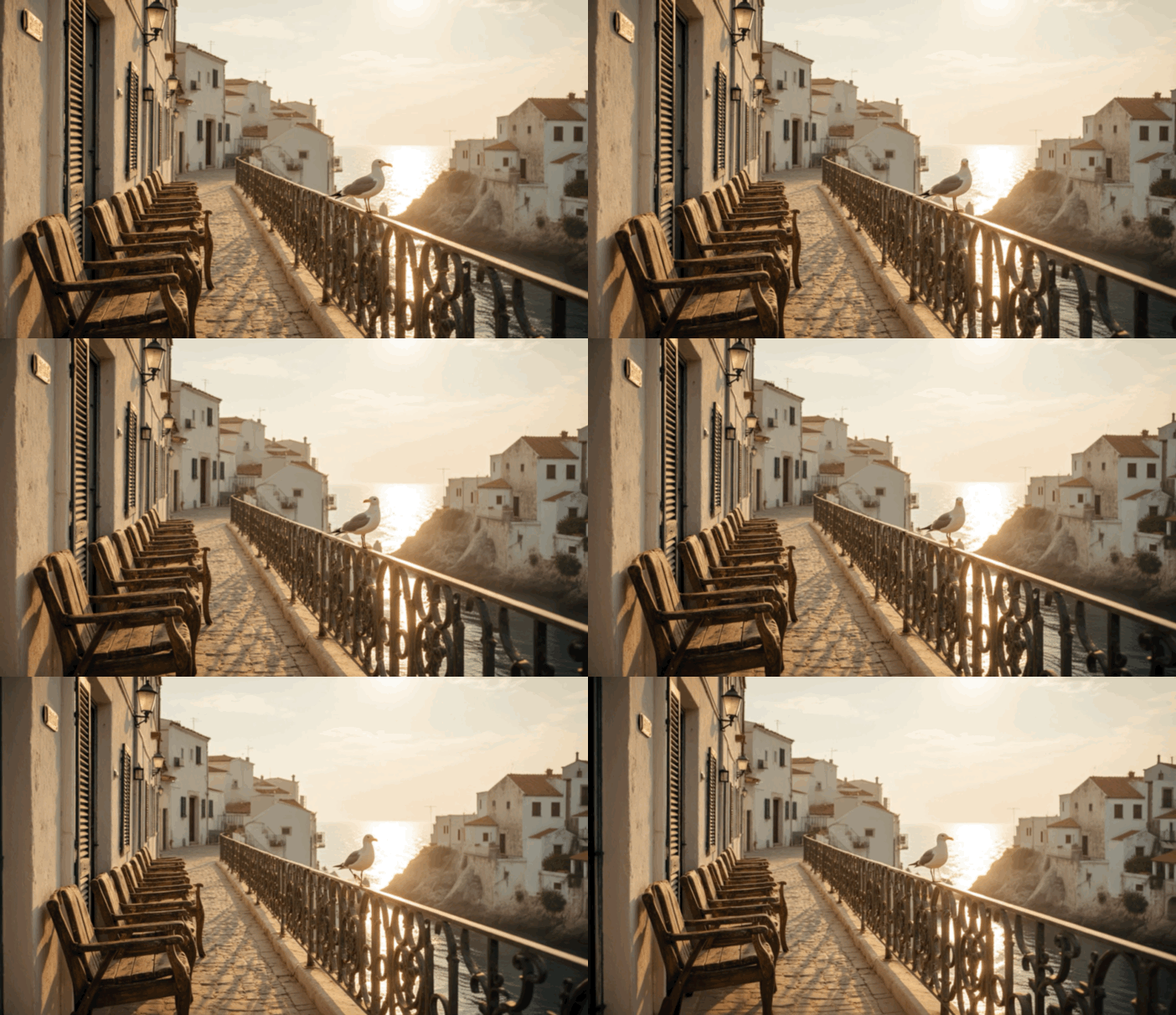
We have spent long stretches over the past few years between Moraira and Calpe. We like the area: the sea, the pace, the human scale, the quality of late-afternoon light in winter that is hard to find anywhere else. Moraira is a small town on the Valencian Costa Blanca, between Calpe and Jávea, with the kind of Mediterranean beauty that looks unreal in tourism brochures and turns out to be exactly as promised. It has clean coves, a fishing port that still functions, whitewashed houses, and that slow rhythm the north of Europe has been coming south to find for decades. But in recent years something has shifted in a way that’s hard to name at first. The shops have signs in a language that is neither Spanish nor Valencian nor the tourist English you’d expect. The terraces are full of people talking among themselves without mixing with anyone else. There are parties, gatherings, restaurants, complete social circuits where the Dutch person who just arrived never needs, at any point, to cross over into what’s local. And the local, on the other side, can’t get in either. The bridge doesn’t exist because nobody built it. Nobody needed it.
We know families who go to the Waldorf school in Jávea, and the comment that comes up in every one of those conversations is the same. It doesn’t change. “The number of arrogant Dutch.” Not Dutch. Arrogant Dutch. The distinction matters. Waldorf schools are, by philosophy, the kind of space where this shouldn’t happen: mixed ages, experiential learning, a deliberately porous atmosphere between children of different backgrounds. But what those families describe is something else: most of the children are Dutch, they naturally group together, speak their language, form their circles, and the mass has grown large enough that even the teachers are having difficulty interacting normally. It isn’t a problem of bad intentions. It’s a problem of proportion. When one part becomes large enough, the whole reorganizes itself around it. That’s how mass works, including in schools, including in towns.
Moraira is a small town on the Valencian Costa Blanca, between Calpe and Jávea, with the kind of Mediterranean beauty that looks unreal in tourism brochures and turns out to be exactly as promised. It has clean coves, a fishing port that still functions, whitewashed houses, and that slow rhythm the north of Europe has been coming south to find for decades. But in recent years something has shifted in a way that’s hard to name at first. The shops have signs in a language that is neither Spanish nor Valencian nor the tourist English you’d expect. The terraces are full of people talking among themselves without mixing with anyone else. There are parties, gatherings, restaurants, complete social circuits where the Dutch person who just arrived never needs, at any point, to cross over into what’s local. And the local, on the other side, can’t get in either. The bridge doesn’t exist because nobody built it. Nobody needed it.
The first time you notice it, it seems like a curiosity. The Dutch have always been around the Mediterranean: in Catalonia, in Andalusia, in the islands. Quiet travelers, people who tend to move well through the world, who generally have no trouble switching languages or adapting to their surroundings. But what’s happening in Moraira isn’t that. It’s something else. And when you look at it directly, you recognize the structure. Not because you’ve lived through it personally before, but because you’ve read about it, seen it in historical photographs, found it in places that seemed to have nothing to do with a small town on the Costa Blanca.
The Afrikaners are the descendants of the Dutch settlers who arrived in southern Africa in the seventeenth century. They built a distinct identity there, powerful, closed in on itself, with its own language, its own churches, its own institutions. Over time, that identity hardened into what we know as apartheid: an institutionalized system of racial separation where the supremacy of the group that had arrived from outside became law, architecture, geography. Apartheid was dismantled thirty years ago, but what made it possible, that specific mindset of arriving somewhere and acting as though the place is already yours, as though what existed before is inferior or irrelevant, that mindset didn’t disappear with any law. It’s a behavioral pattern. A way of relating to an environment that can come from any origin and doesn’t need explicit violence to function. It only needs enough mass, and the conviction, conscious or not, that you don’t need to adapt.
It’s worth being precise here, because the easiest mistake would be to confuse what’s being criticized. The Dutch, as a people, have a well-earned reputation for openness and flexibility. They are, in general, people comfortable with other cultures, capable of moving through the world without needing to carry their world with them. What is arriving in Moraira is not that. It’s a specific subset with a recognizable attitude: the kind that doesn’t come to learn but to reproduce what it already has at home, that treats the local with a polished distance that is, underneath, condescension, that builds the ghetto not because it’s excluded but because it prefers exclusion, that uses the word “community” to describe something that functions more like a fortress. That attitude isn’t Dutch. It’s Afrikaner, in the most precise sense of the word: the attitude of someone who arrives somewhere that isn’t theirs and acts from day one as if it is.
Torrevieja, less than an hour south, went through something similar with the Germans. They arrived first as tourists, then as residents, then in enough mass to stop needing anyone else. There came a point when the local businesses started orienting toward them because that’s where the money was, and the businesses that had served the locals started closing or moving to wherever the rent was still manageable. The municipal councils and business associations talked about economic dynamism, quality tourism, high-spending visitors. That was true, in a certain sense. It was also true that the people who had lived there their whole lives were losing the ability to pay rent, that the restaurants they went to no longer existed, that the spaces where their children had grown up no longer belonged to them in any functional way, even if they still appeared on the map with the same names as always.
There’s something I’d rather say before going further. We aren’t locals in Moraira either. We arrive in a campervan, with the freedom to stay or leave as we please, with the financial capacity to pay what it costs to live in an area that no longer has fishing-village prices. In some sense, we are part of the same phenomenon we’re describing. Not with the attitude of the group that arrives, occupies, and doesn’t mix, that I don’t recognize as ours. But with the weight of being outsiders who consume a place without having contributed to building it. That discomfort doesn’t invalidate the argument. But it doesn’t make sense to write this article without mentioning it.
This is what makes the process so resistant to any correction: the people who have the tools to slow it down are exactly the same people who benefit from not using them. A municipal council that attracts high-spending residents can point to numbers, to investment, to an international profile. The fracturing of the local social fabric doesn’t show up in any management indicator. Young people leaving because they can’t afford to live where they grew up doesn’t appear as a failure in any balance sheet. They call it transformation. They call it modernization. They call it success, and they have data to prove it, because the data they chose to measure is precisely the data that comes out well. The other data, the kind that speaks to what’s being lost, nobody collects.
There is an irony at the center of all this that almost nobody mentions. What attracts these groups to a place like Moraira is not the Dutchification of Moraira. It’s Moraira itself: the sea, the pace, the human scale, the price, the light, something that felt authentic before they arrived to buy it. When they arrive in enough mass to replace what existed with a replica of what they have at home, they destroy exactly what they came for. The process consumes itself. The original charm disappears business by business, rental by rental, local family by local family, and what’s left in the end is just the frame: the sun, the sea, and the names on the map, but none of what made that place that place and not another.
The tools to manage this exist. They aren’t simple or politically comfortable, but they do exist. Some European municipalities have explored limits on short-term rental licenses by neighborhood or by percentage of available housing stock, to prevent speculation from hollowing out permanent residential fabric. Others have established minimum integration requirements for commercial licenses, or have tied certain fiscal and planning benefits to active participation in the local community. Residential rent regulation, attempted with uneven results but genuine political will in cities like Berlin or Amsterdam, could slow the silent displacement of those who have always lived there. None of this solves the underlying problem, because the underlying problem isn’t a missing law but an economic logic that rewards exactly this kind of transformation. But there would be room to slow the pace, to make the process less invisible, to force the numbers being measured to include what’s being destroyed as well.
The relevant question isn’t whether the tools exist. The question is why the people who could use them prefer not to. And the answer, when you look at it without too much complication, is fairly simple: because the success they can sell with the data they have is more comfortable than the failure they would have to admit with the data they don’t collect. Because the disappearance of a town doesn’t make noise, doesn’t have a date, doesn’t have a named responsible party to point to. It happens slowly, party by party that nobody else can enter, conversation in Dutch that nobody else understands, Waldorf school where even the teachers can no longer interact normally. And when someone finally notices, when someone walks through a place where they used to know every face and recognizes nothing, it’s already too late to call it something else.
That’s why we’ve decided not to come back for long stretches anymore. It isn’t a protest or a statement. It’s simply that this no longer feels like our place in the way it used to. We’ll come to see the friends who are still here, and there are fewer of them on this stretch of the Costa Blanca each year. But finding somewhere else to settle for months at a time, somewhere where the balance still exists, that decision is already made.
Only the frame remains.
메타데이터
- post_id
- c58043f445a8
- slug
- the-afrikaner-pattern-c58043f445a8
- url
- https://medium.com/@nemexxis/the-afrikaner-pattern-c58043f445a8
- canonical_url
- https://medium.com/@nemexxis/the-afrikaner-pattern-c58043f445a8
- author_url
- https://medium.com/@nemexxis
- status
- ok
- fetched_at
- 2026-06-28 14:26:31