Major Airlines Vanished in a Decade: Lessons and How to Avert the Losses
The disappearance of major airlines over the past decade has exposed a structural weakness in global aviation: passenger demand can grow…
Major Airlines Vanished in a Decade: Lessons and How to Avert the Losses
The disappearance of major airlines over the past decade has exposed a structural weakness in global aviation: passenger demand can grow while airlines remain financially fragile. From Jet Airways and WOW air to Alitalia, Thomas Cook Airlines, Flybe and Spirit Airlines, carriers have collapsed under combinations of debt, fuel costs, weak liquidity, changing markets and inflexible fleet structures. For Africa, where airline profits remain exceptionally thin, the lesson is becoming urgent: survival will depend not only on more passengers, but on stronger financial, leasing and aviation-service ecosystems.
An airline may disappear on a particular day, but its financial problems normally develop over several years. Debt accumulates, aircraft become expensive to operate, fuel prices rise, routes underperform, and lease obligations continue even when revenues weaken. By the time aircraft are grounded, or creditors intervene, management may have very few options left. The pattern is visible across the airlines examined in the supplied aviation review. Spirit Airlines, Magnicharters, AlpAvia, European Cargo, Air Mountain, Jetflite, Royal Air Philippines and Dove Airlines were among carriers identified as having exited the market in 2026, with different combinations of financial distress, fuel costs, weak demand and operational pressures behind their failures. The broader warning is straightforward: airline revenue can be enormous while the margin protecting that revenue remains extremely small.
Africa illustrates this contradiction particularly sharply. The International Air Transport Association (IATA) initially projected African airlines would generate about $200 million in net profit in 2026, equivalent to a 1% margin, despite strong passenger-demand growth. IATA described African aviation as a market with above-average demand but persistent structural challenges. (IATA)
The outlook subsequently deteriorated.
In its June 2026 industry update, IATA cut the projected profit for African airlines to approximately $100 million, with the regional net margin falling to just 0.2%. At the same time, passenger demand was still expected to grow by around 10%, according to the updated industry outlook reported by aviation media. (IATA)
That creates Africa’s central aviation paradox:
The continent is generating more demand for air travel than its airlines are generating financial resilience.
The implication is important. Increasing passenger numbers alone will not solve the problem if airlines continue to face high operating costs, foreign-exchange exposure, expensive financing, and limited fleet flexibility.
India’s Jet Airways provides one of the clearest examples of how aircraft financing can become intertwined with an airline’s survival.
The carrier had expanded rapidly before falling into severe financial distress. As its liquidity deteriorated, payments to aircraft lessors became a major issue, with aircraft progressively grounded as lease obligations went unpaid.
That created a damaging cycle: fewer aircraft meant fewer flights; fewer flights meant less revenue; and less revenue made it harder to meet financial obligations. The Jet Airways experience demonstrates why fleet planning cannot be separated from financial planning.
An aircraft is not simply a machine that generates revenue. It is also a major financial commitment, and the structure used to acquire or lease it can determine how much flexibility an airline has when market conditions change.
Spirit Airlines offers the most recent major example.
Reuters reported that the US ultra-low-cost carrier ceased operations in May 2026 after creditors failed to support a proposed $500 million government-backed rescue package. The airline had already struggled through two bankruptcy proceedings, while the sharp increase in jet-fuel prices linked to the Iran war intensified its financial problems. (Reuters)
The shutdown ended Spirit’s 34-year history and represented the largest US airline liquidation in two decades, according to Reuters.
The significance of Spirit’s collapse goes beyond the airline itself. Its ultra-low-cost model depended heavily on keeping fares low while maintaining sufficient aircraft utilisation and cost discipline.
Once fuel costs surged, there was little room to absorb the additional expense.
The lesson for African carriers is clear: a resilient airline must be able to absorb an external shock before that shock becomes a liquidity crisis.
Italy’s Alitalia provides another lesson.
The long-established national carrier ceased operations in 2021 after years of financial difficulties and repeated restructuring and rescue attempts. ITA Airways subsequently began operations as its successor.
The Alitalia experience illustrates the limits of government intervention.
A national airline may have strategic importance for tourism, trade, diplomacy, and connectivity, but national importance does not automatically produce commercial sustainability.
For African governments, this distinction matters. Public ownership can provide strategic support, but a national carrier ultimately needs a business model capable of generating sustainable cash flow.
The airlines that disappeared were not identical, but their stories reveal recurring weaknesses. Five warning signs:
- Thin margins
Airlines operate with little room between revenue and cost. IATA’s June 2026 global outlook again highlighted the industry’s structural vulnerability, with return on invested capital remaining below the industry’s estimated cost of capital. (IATA)
- Heavy financial obligations
Debt and aircraft leases continue to require payment even when passenger demand weakens.
- Fleet rigidity
An airline that cannot adjust capacity quickly can find itself operating expensive aircraft on weak routes or lacking aircraft when demand suddenly rises.
- Foreign-exchange exposure
Aircraft, engines, fuel, insurance and many maintenance services are priced internationally, while much of an African airline’s revenue may be generated in local currencies.
- Excessive dependence on passenger revenue
Cargo, MRO, training and ground services can provide additional income and reduce dependence on passenger fares.
These vulnerabilities make the structure of aircraft ownership and leasing particularly important for Africa.
One of the biggest shifts in modern aviation finance is the separation of aircraft access from aircraft ownership.
Airlines do not necessarily need to purchase every aircraft they operate. Leasing allows carriers to obtain productive aircraft while spreading or restructuring the financial commitment associated with fleet acquisition.
The global leasing market has consequently become a major source of aircraft finance.
For Africa, the opportunity is larger than simply leasing individual aircraft. A mature aviation-leasing ecosystem could support fleet renewal, regional expansion, cargo development, and temporary capacity requirements while reducing the need for airlines to finance every aircraft through outright purchases.
The strategic question should therefore change from:
“How many aircraft can we buy?”
to:
“How can we secure reliable access to the aircraft we need at a financing structure our airline can sustain?”
Ethiopian Airlines offers Africa’s strongest counter-example to the airline-collapse narrative.
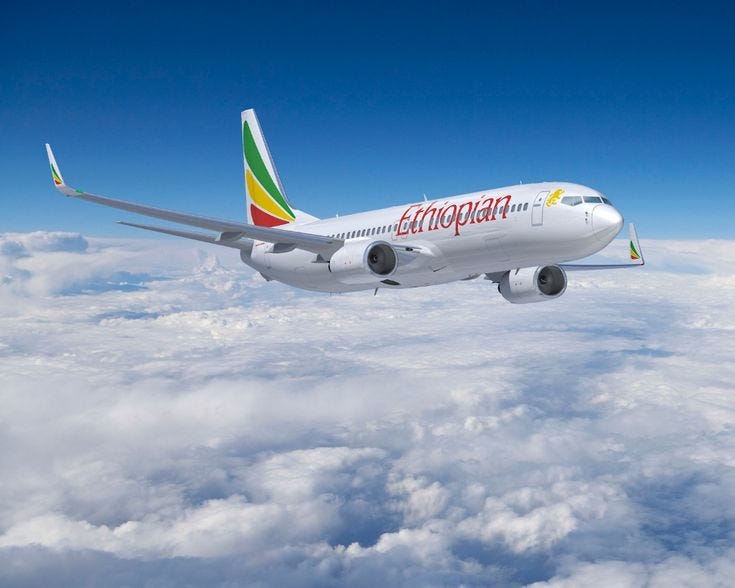
Rather than building its business solely around passenger tickets, Ethiopian has developed a wider aviation ecosystem involving passenger services, cargo, MRO, training and other aviation activities.
Its fleet strategy also combines different forms of aircraft access.
In March 2026, Ethiopian Airlines announced that it had signed lease agreements with AerCap for two Boeing 777–300ERSF converted freighters. AerCap separately confirmed that the aircraft are scheduled for delivery in the second quarter of 2028 and will be the first aircraft of that type to operate in Africa. (CorporateWebsite)
The significance is greater than two additional aircraft.
Ethiopian is using leasing as part of a long-term fleet and cargo strategy. The arrangement allows the airline to expand its freighter capability while deploying capital across a wider aviation ecosystem.
This is precisely where leasing becomes strategic rather than merely transactional.
A more immediate African example can be seen in Uganda.

According to a May 13, 2026 report by Daily Monitor, Uganda Airlines received the first of two newly leased Boeing 737–800 aircraft under a wet-lease arrangement involving Ethiopian Airlines. The newspaper reported that the aircraft were received at Entebbe on May 12 as the national carrier sought to strengthen its fleet and address regional capacity pressures. (Monitor)
The significance of the arrangement lies in its structure.
A wet lease, or ACMI arrangement, allows one airline to provide an aircraft together with key operating inputs such as crew, maintenance and insurance. For an airline facing a temporary fleet gap, this can provide capacity much faster than waiting for a new aircraft purchase or delivery.
The Daily Monitor report on Uganda Airlines’ leased Boeing 737–800s therefore offers a practical example of how African carriers can use leasing to maintain operations while developing longer-term fleet strategies.
It also illustrates the potential of African airline partnerships.
Instead of every national carrier attempting to build every capability independently, regional aviation groups can potentially share aircraft, technical capacity, training, and operational expertise.
But leasing alone does not explain Ethiopian’s resilience.
The more important lesson is diversification.
Ethiopia’s model extends beyond passengers into cargo, MRO, training and other aviation services, creating several sources of economic value around the airline.
Its MRO investment is particularly significant.
The airline has continued expanding its maintenance capabilities, including new component workshops, warehouse facilities, and maintenance infrastructure. The strategy reduces dependence on external maintenance providers while creating an aviation-services business in its own right.
This creates a reinforcing economic cycle.

More aircraft create demand for maintenance. More cargo capacity creates logistics opportunities. More destinations create demand for ground services and training. A larger aviation ecosystem creates more opportunities to generate revenue beyond passenger tickets.
That is a fundamentally different model from simply buying aircraft and hoping passenger fares cover the cost.
Leasing can buy an airline time
One of the most valuable functions of aircraft leasing is often overlooked.
Leasing can buy an airline time.
A carrier facing an immediate capacity shortage does not necessarily have to wait years for new aircraft. It can use a lease or ACMI arrangement to maintain services while developing a permanent fleet solution.
The Uganda Airlines arrangement reported by Daily Monitor demonstrates precisely this principle. (Monitor)
The same logic applies to airlines entering new markets.
Instead of making an irreversible aircraft purchase before demand is proven, a carrier can use a more flexible fleet arrangement, test the market, and then determine whether permanent capacity is justified.
For airlines operating in volatile markets, that flexibility can be financially valuable.
This may be the most important lesson Africa can take from the global aviation market.
The conventional aviation debate often asks:
How many aircraft should the national airline own?
A more sophisticated question is:
How should the airline combine owned, leased, and temporary capacity to achieve the lowest sustainable risk?
The distinction matters.
Ownership can provide long-term control and asset value. Leasing can provide flexibility. ACMI arrangements can provide immediate operational capacity. A diversified fleet strategy can combine all three.
The objective should not be maximum ownership.
It should be maximum productive aircraft access at sustainable financial risk.
Build regional aircraft-financing platforms
African airlines need greater access to competitive aircraft leasing and aviation finance.
Development-finance institutions, commercial banks, pension funds, insurers, institutional investors and specialist aviation financiers could play complementary roles in building deeper aviation-finance markets.
Develop African leasing capability
Africa should not remain primarily an end-user of aircraft leasing.
Over time, the continent could develop specialist aviation-finance vehicles and leasing platforms capable of acquiring aircraft and making them available to African carriers under commercially sustainable structures.
Expand MRO Capacity
Aircraft maintenance should increasingly be treated as an industrial opportunity.
African MRO hubs can reduce aircraft downtime, retain foreign exchange within the continent, develop technical skills, and create another revenue stream around aviation.
Integrate cargo into national aviation strategies
Cargo can provide an important counterbalance to passenger demand.
Agriculture, pharmaceuticals, manufacturing, e-commerce, and regional trade all create potential demand for air freight.
Ethiopia’s continued investment in freighter capacity demonstrates how cargo can become a strategic pillar rather than a secondary business.
Strengthen airline governance
No leasing structure can save an airline whose underlying business model is unsustainable.
Fleet decisions must therefore be supported by route profitability analysis, cash-flow forecasting, realistic passenger projections and disciplined management.
Africa has spent years discussing the need for more national and regional carriers.
The more urgent question is whether existing and future airlines can survive the financial pressures that have destroyed carriers elsewhere.
The supplied aviation review reaches a similar conclusion, identifying disciplined cost control, diversified revenue, long-term strategy, and management willing to make difficult decisions before a crisis as key differences between struggling airlines and those that survive.
It needs better aviation economics.
The airlines that disappeared over the past decade should be studied as financial case studies rather than simply corporate failures.
Spirit shows how a fuel shock can finish an already weakened carrier. Jet Airways illustrates how aircraft financing obligations can become operational constraints. Alitalia demonstrates that national importance cannot permanently substitute for commercial sustainability.

Ethiopian Airlines offers the counterpoint.
Its strategy combines fleet growth, cargo, MRO, training, partnerships, and aircraft leasing. Its AerCap agreement for two Boeing 777–300ERSF freighters demonstrates that even a successful African carrier uses leasing as part of a sophisticated fleet strategy. (CorporateWebsite)
The Daily Monitor’s report on Uganda Airlines provides another practical illustration: leasing can help an African carrier address an immediate fleet requirement without waiting for a long-term aircraft acquisition programme to mature. (Monitor)
The central question for African aviation is no longer simply whether passenger demand will grow.
It will.
The bigger question is whether African airlines can convert that demand into sustainable businesses.
IATA’s profitability forecasts demonstrate how narrow the financial margin remains, while Ethiopian Airlines’ development shows what becomes possible when fleet strategy is combined with diversification, cargo, MRO, and long-term planning. (IATA)
The lesson from the airlines that vanished is therefore clear: waiting for a financial crisis before restructuring the fleet, financing model, or business strategy is too late.
Africa needs to build resilience before the next shock arrives.
And the emerging formula is increasingly visible:
aircraft leasing + disciplined fleet management + aviation finance + cargo + MRO + regional connectivity + strong governance.
The real aviation game changer may not be the aircraft itself.
It may be the financial and industrial ecosystem that keeps that aircraft flying.
Originally published at https://www.linkedin.com.
메타데이터
- post_id
- c5b556eb67b2
- slug
- major-airlines-vanished-in-a-decade-lessons-and-how-to-avert-the-losses-c5b556eb67b2
- url
- https://medium.com/@anslema6/major-airlines-vanished-in-a-decade-lessons-and-how-to-avert-the-losses-c5b556eb67b2
- canonical_url
- https://medium.com/@anslema6/major-airlines-vanished-in-a-decade-lessons-and-how-to-avert-the-losses-c5b556eb67b2
- author_url
- https://medium.com/@anslema6
- status
- ok
- fetched_at
- 2026-08-19 23:41:11