Why Structural Audits and Durability Testing Are Essential for Extending Building Life
Buildings are often judged by what people can see.
Why Structural Audits and Durability Testing Are Essential for Extending Building Life
Buildings are often judged by what people can see.
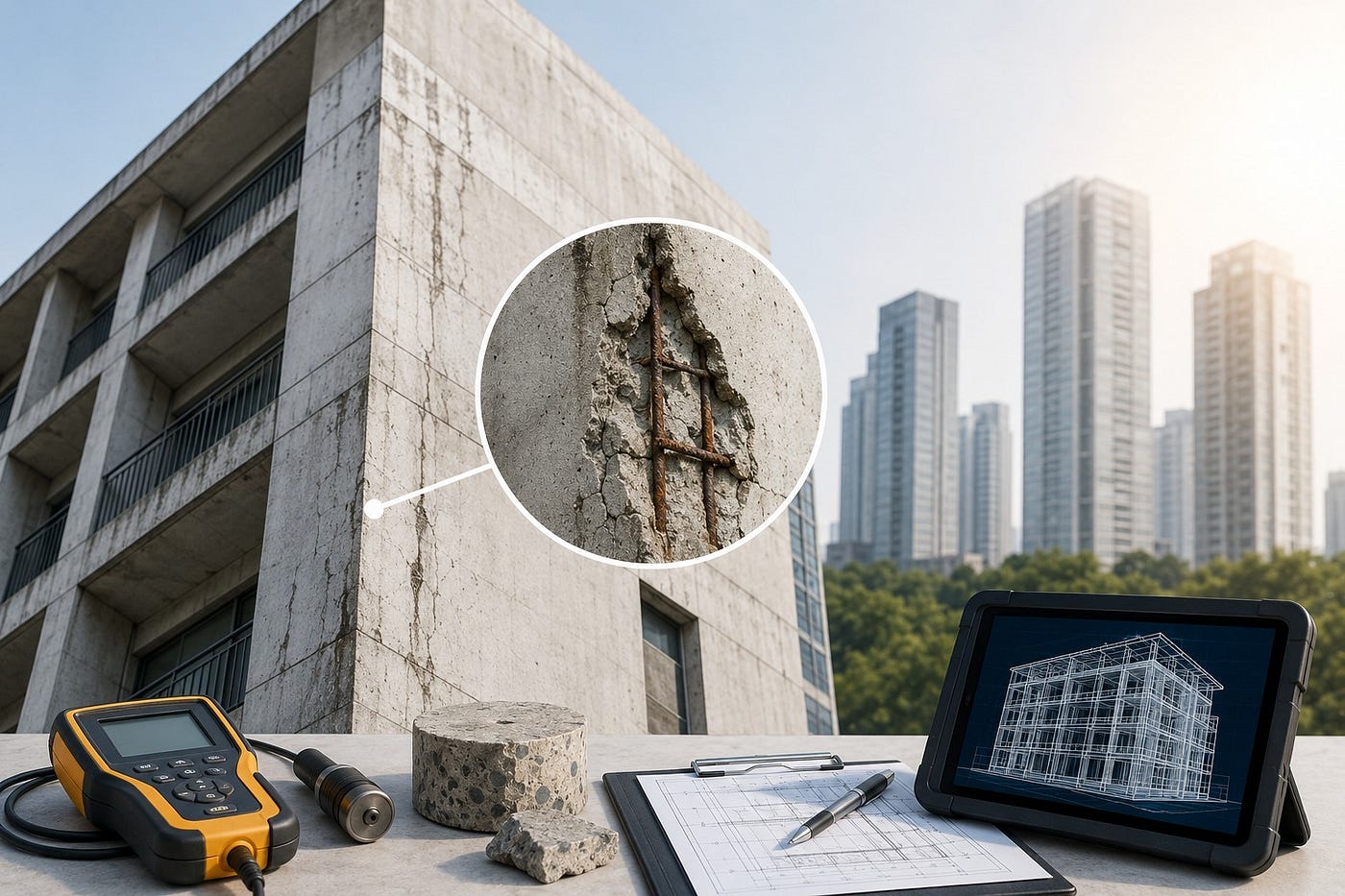
Fresh paint, renovated interiors, and attractive facades create an impression that a structure is in excellent condition. Yet some of the most serious threats to a building’s safety and longevity develop where they are least visible — inside concrete, beneath protective coatings, and within structural elements that quietly endure decades of environmental exposure and loading.
Across India, a significant portion of residential, commercial, industrial, and institutional buildings are approaching or have already crossed critical age milestones. While many of these structures continue to function normally, age alone does not guarantee structural reliability. Over time, environmental conditions, corrosion, material deterioration, moisture ingress, and changing usage patterns can gradually affect a building’s performance.
This is why structural audits and durability assessments have become indispensable tools in modern asset management. Rather than waiting for visible signs of distress or costly failures, property owners and facility managers are increasingly adopting preventive evaluation strategies to understand the true condition of their assets.
For organisations seeking to maximise building lifespan while ensuring safety and compliance, engaging experienced **structural audit consultants India** has become a critical step toward informed decision-making.
The Hidden Cost of Delayed Structural Assessment
One of the most common misconceptions about buildings is that visible damage is the first indication of a problem.
In reality, structural deterioration often begins years before surface-level symptoms appear.
Concrete may lose its protective properties. Reinforcement may start corroding. Moisture can penetrate structural components. Environmental exposure may gradually weaken materials. Small cracks may develop into larger durability concerns.
By the time these issues become visible, the extent of damage can be far more significant than anticipated.
What most property owners don’t realise is that early-stage deterioration is often easier and more economical to address than advanced structural damage. A timely assessment can help identify concerns before they evolve into expensive repairs, operational disruptions, or safety risks.
Understanding Structural Audits
A structural audit is a systematic engineering evaluation of a building’s structural condition, safety, and overall performance.
Unlike routine maintenance inspections, structural audits go beyond visual observations to assess how a structure is behaving and whether it continues to meet expected performance standards.
The objective is not merely to identify defects but to understand their causes, implications, and recommended corrective measures.
What Does a Structural Audit Typically Assess?
Depending on the building type and condition, a structural audit may include:
- Visual condition assessment
- Crack mapping and distress evaluation
- Structural stability review
- Load path assessment
- Water ingress and seepage evaluation
- Material condition assessment
- Reinforcement corrosion indicators
- Non-destructive testing (NDT)
- Review of repairs and alterations
- Serviceability and safety observations
The outcome is a comprehensive understanding of the building’s current condition and future maintenance requirements.
Why Structural Audits Are Becoming Increasingly Important
Several factors are driving the growing demand for structural audits across India:
Aging Building Stock
Many residential societies, commercial buildings, industrial facilities, and public structures have been in service for decades. Age-related deterioration requires periodic evaluation to ensure continued safety and performance.
Increased Occupancy and Usage Changes
Buildings are often used differently than originally intended. Additional equipment, renovations, occupancy changes, and infrastructure upgrades can alter loading conditions and affect structural behaviour.
Regulatory and Compliance Requirements
Many municipal authorities and governing bodies now require periodic structural assessments for ageing structures as part of public safety initiatives.
Risk Management
A proactive audit helps stakeholders identify vulnerabilities before they become liabilities.
Why Durability Matters as Much as Structural Strength
When discussing building health, structural strength often receives the most attention.
However, durability is equally important.
A structure may be strong today but vulnerable to deterioration mechanisms that gradually reduce its performance over time.
Durability refers to a building’s ability to resist environmental, chemical, and physical factors that contribute to degradation throughout its service life.
Understanding durability is essential because it directly influences maintenance costs, repair frequency, safety, and long-term asset value.
The Role of Durability and Corrosion Testing
One of the most significant threats to reinforced concrete structures is corrosion.
Concrete protects embedded steel reinforcement by creating an alkaline environment. However, factors such as moisture, chlorides, carbonation, and environmental exposure can gradually compromise this protection.
Once corrosion begins, the consequences can include:
- Concrete cracking
- Reinforcement expansion
- Delamination
- Reduced load-carrying capacity
- Accelerated structural deterioration
This is where **durability and corrosion testing in Thane** and other urban environments play a crucial role in preventive infrastructure management.
What Does Durability Testing Evaluate?
Durability assessments help engineers understand how resistant a structure is to future deterioration.
These investigations may include:
Carbonation Testing
Carbonation occurs when carbon dioxide penetrates concrete and reduces its alkalinity, increasing the risk of reinforcement corrosion.
Testing helps determine the depth of carbonation and potential exposure risks.
Chloride Content Analysis
Structures exposed to marine environments, de-icing salts, or industrial contaminants may experience chloride ingress, which significantly accelerates corrosion activity.
Concrete Quality Assessment
Engineers evaluate concrete properties to understand its strength, density, permeability, and long-term performance characteristics.
Half-Cell Potential Testing
This technique helps identify areas where reinforcement corrosion may already be active, even when no visible damage is present.
Cover Meter Surveys
These investigations determine reinforcement location and concrete cover thickness, helping assess the level of protection available to embedded steel.
In our experience, durability testing often reveals hidden vulnerabilities that visual inspections alone cannot detect. Understanding these conditions allows stakeholders to take corrective action before deterioration becomes extensive.
How Structural Audits Extend Building Life
The primary goal of a structural audit is not simply to identify defects — it is to extend the useful life of the structure.
A well-executed audit provides a roadmap for maintenance, repair, and future asset management.
Early Detection of Problems
Minor deterioration can be addressed before it develops into significant structural distress.
Targeted Repairs
Rather than undertaking widespread repairs, stakeholders can focus resources on the areas that genuinely require intervention.
Improved Maintenance Planning
Building owners gain a clear understanding of short-term, medium-term, and long-term maintenance requirements.
Enhanced Safety
Potential hazards can be identified and mitigated before they affect occupants or operations.
Increased Asset Value
Buildings with documented structural health assessments often retain greater value and inspire more confidence among occupants, investors, and stakeholders.
The Importance of Expert Engineering Interpretation
Advanced testing technologies generate valuable data, but data alone does not provide solutions.
Here’s where engineering expertise becomes essential.
Test results must be interpreted within the context of structural behaviour, environmental conditions, construction practices, material performance, and asset usage patterns.
An experienced team of **structural consultants in India** can evaluate not only what the data reveals today but also what it indicates about future performance risks.
This engineering judgment enables the development of practical, cost-effective recommendations that balance safety, durability, and long-term maintenance objectives.
Moving from Reactive Repairs to Preventive Asset Management
Historically, many building owners have adopted a reactive approach to maintenance.
A crack appears, and it is repaired.
A leakage develops, and waterproofing is applied.
Concrete begins spalling, and patch repairs are undertaken.
While these actions may address immediate concerns, they often fail to identify the underlying causes of deterioration.
Modern asset management takes a different approach.
By combining structural audits, durability assessments, corrosion studies, and condition monitoring, stakeholders can understand the root causes of deterioration and implement solutions that protect the structure for years to come.
This shift from reactive maintenance to preventive engineering is one of the most effective ways to maximise building lifespan while controlling long-term costs.
Conclusion
Buildings are long-term assets, but their longevity cannot be taken for granted. Environmental exposure, ageing materials, corrosion, moisture ingress, and evolving usage demands can all influence structural performance over time.
Engaging experienced **structural audit consultants India enables property owners and infrastructure stakeholders to gain a clear understanding of a building’s condition before problems become critical. When combined with specialised [durability and corrosion testing in Thane](https://www.vijna.com/Durability-and-Advanced-Corrosion-Study.html)** and other high-exposure environments, these assessments provide valuable insights into both current health and future risks.
Supported by knowledgeable **structural consultants in India**, structural audits and durability evaluations help transform maintenance from a reactive expense into a strategic investment — one that improves safety, enhances reliability, and significantly extends the life of valuable assets.
메타데이터
- post_id
- c5bcb07d8b7e
- slug
- why-structural-audits-and-durability-testing-are-essential-for-extending-building-life-c5bcb07d8b7e
- url
- https://medium.com/@vijnaconsulting/why-structural-audits-and-durability-testing-are-essential-for-extending-building-life-c5bcb07d8b7e
- canonical_url
- https://medium.com/@vijnaconsulting/why-structural-audits-and-durability-testing-are-essential-for-extending-building-life-c5bcb07d8b7e
- author_url
- https://medium.com/@vijnaconsulting
- status
- ok
- fetched_at
- 2026-08-06 18:17:54