ERP Systems Are Becoming the Starting Point for AI Adoption
AI adoption is moving into a harder phase. The question is no longer whether companies can access AI tools. Most already can. The real…
ERP Systems Are Becoming the Starting Point for AI Adoption
AI adoption is moving into a harder phase. The question is no longer whether companies can access AI tools. Most already can. The real question is whether their internal operations are structured enough for AI to produce reliable business outcomes.
This is why AI-ready ERP is becoming a practical foundation for enterprise AI. Before AI can automate workflows, recommend decisions, or support managers in real time, it needs clean data, clear processes, permission logic, and a system that reflects how the business actually runs.
Why AI-ready ERP matters more than another AI tool
The easiest mistake in AI adoption is treating AI as a software purchase. A company adds a chatbot, connects an analytics assistant, or tests an automation tool, then assumes it is becoming AI-driven. That may improve productivity in isolated tasks, but it does not prepare the business for AI at the operating level.
McKinsey’s 2025 State of AI report makes this gap clear. AI adoption is expanding, yet the transition from pilots to scaled impact remains difficult for most organizations. The companies seeing stronger value are not only deploying AI. They are redesigning workflows, strengthening data practices, changing operating models, and improving governance around AI implementation. (McKinsey)
That matters because most enterprise AI use cases depend on the quality of the systems underneath. If employee data is in one HR tool, finance approvals are tracked in spreadsheets, customer updates sit in CRM, and internal requests happen through chat, AI has to work with fragmented context. It may still generate summaries or suggestions, but those outputs become difficult to trust when they affect real business decisions.
The data problem is already measurable. Precisely’s 2025 Data Integrity Trends and Insights found that 64% of organizations named data quality as their top data integrity challenge, up from 50% in the previous year. The same research reported that 67% of organizations do not completely trust the data they use for decision-making. (Precisely)
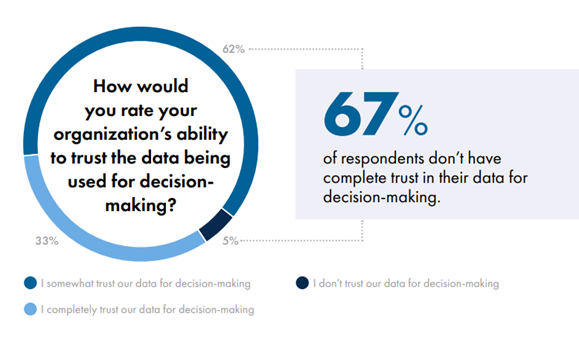
Enterprise data trust gap affects AI readiness (Source: Precisely)
For AI adoption, this is not just a reporting issue. Poor data quality weakens anomaly detection, forecasting, workflow automation, approval recommendations, and decision support. If the system cannot define the business clearly, AI cannot reason about the business reliably.
An AI-ready ERP addresses this problem from the foundation. It does not begin with the question, “Which AI feature should be added?” It begins with a more important question: “Is the business structured enough for AI to understand what is happening?”
That is the real difference between using AI and becoming ready for AI.
How AI-ready ERP turns operations into AI infrastructure
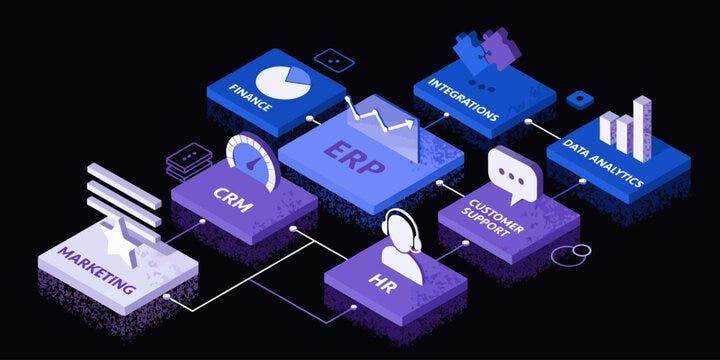
ERP used to be understood mainly as a system of record. It stored employee profiles, financial activity, CRM data, approval requests, inventory, projects, and reports. In an AI adoption roadmap, that definition is too narrow.
An AI-ready ERP becomes the operating layer where data, workflows, roles, and approvals are organized in a way AI can actually use. This matters because AI is moving closer to enterprise applications. Gartner predicted that up to 40% of enterprise applications will include integrated task-specific AI agents by 2026, compared with less than 5% in 2025. (Gartner)
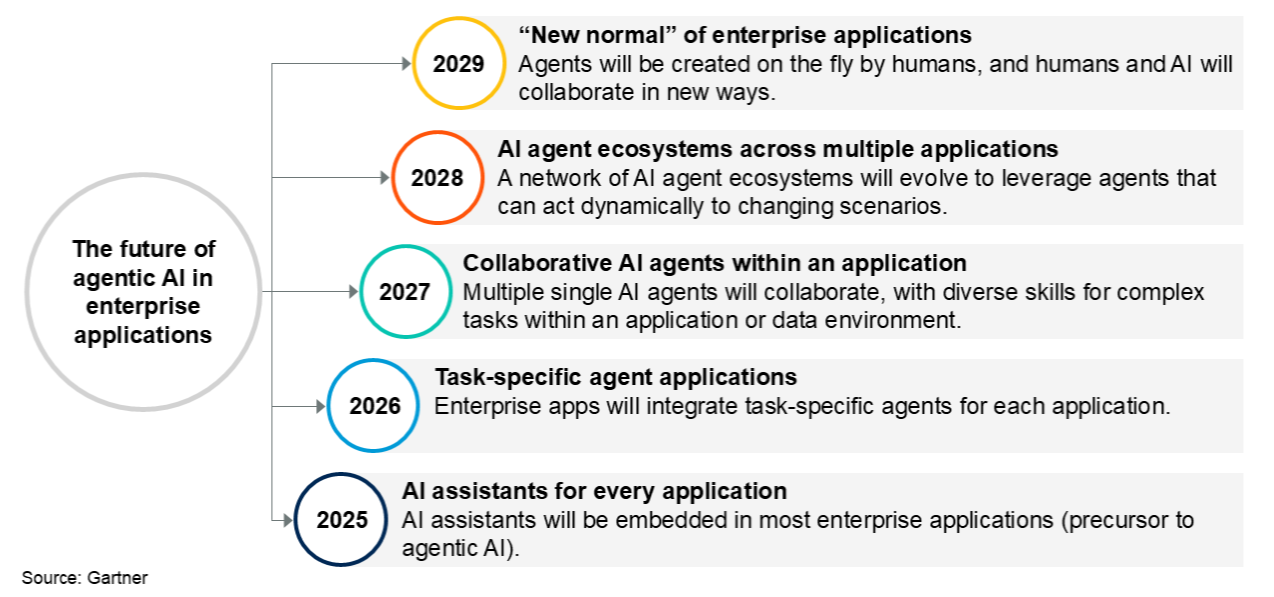
Gartner roadmap for agentic AI in enterprise applications (Source: Gartner)
That shift means AI will increasingly live inside the systems where work happens. ERP is one of the most important systems in that category because it sits near the core of daily business operations.
1. Standardized data gives AI a clearer view of the business
AI becomes useful when it can interpret business context consistently. In many companies, that context is still messy. Sales may define customers one way. Finance may use different revenue categories. HR may maintain department names that do not match project structures. Managers may update work status manually in separate files.
These inconsistencies may look small, but they create a major barrier for AI. An AI assistant cannot accurately flag unusual expenses if cost categories are inconsistent. It cannot recommend CRM follow-ups if pipeline stages are poorly maintained. It cannot summarize team performance if tasks, owners, and deadlines are scattered across tools.
An AI-ready ERP reduces this problem by creating shared definitions for operational data. Employees, departments, roles, customers, deals, projects, expenses, approval levels, and workflow status follow one system logic. The result is not perfect data, but usable data. That distinction matters because AI does not need every business to become a data science company before adoption. It does need enough structure to avoid working from confusion.
This is where ERP becomes more than administration. It becomes the data foundation for automation.
2. Workflow automation becomes measurable
Many businesses say they want automation, but their workflows are not visible enough to automate well. A manager approves a request through chat. Finance tracks payment status in a spreadsheet. Sales follow-ups depend on individual memory. HR requests move through scattered messages. These processes can work when the company is small, but they become hard to scale and harder for AI to support.
Workflow automation ERP changes the operating model. A request is created. An owner is assigned. A manager reviews it. A deadline is missed. A status changes. A handoff happens. Each step becomes part of the system record.
Once workflows are visible, AI can support them with real context. It can summarize pending approvals, detect bottlenecks, flag missing information, suggest the next action, and show where delays keep repeating. This is more valuable than simple task automation because the business gains visibility into how work actually moves.
A useful way to evaluate this is to ask whether ERP can make these workflow questions answerable:
- Which approvals are delayed, and why?
- Which department creates the most manual follow-up?
- Which requests are repeatedly missing information?
- Which customer or finance workflows need manager intervention most often?
If the system cannot answer these questions, AI automation will likely stay shallow. It may send reminders or generate summaries, but it will struggle to improve the process itself.
3. Decision-ready context turns AI from assistant into operating support
A disconnected automation tool can move data between apps or trigger a notification. That is useful, but it is not the same as decision support.
An AI-ready ERP gives AI the business context behind an action. It can show who made the request, which department owns it, what approval rule applies, whether the budget is available, what happened in similar cases, and whether the user has permission to proceed. This context is what allows AI to support decisions rather than only execute tasks.
The risk of skipping this layer is becoming clearer as companies rush into AI agents. Gartner predicted that over 40% of agentic AI projects will be canceled by the end of 2027 because of escalating costs, unclear business value, or inadequate risk controls.
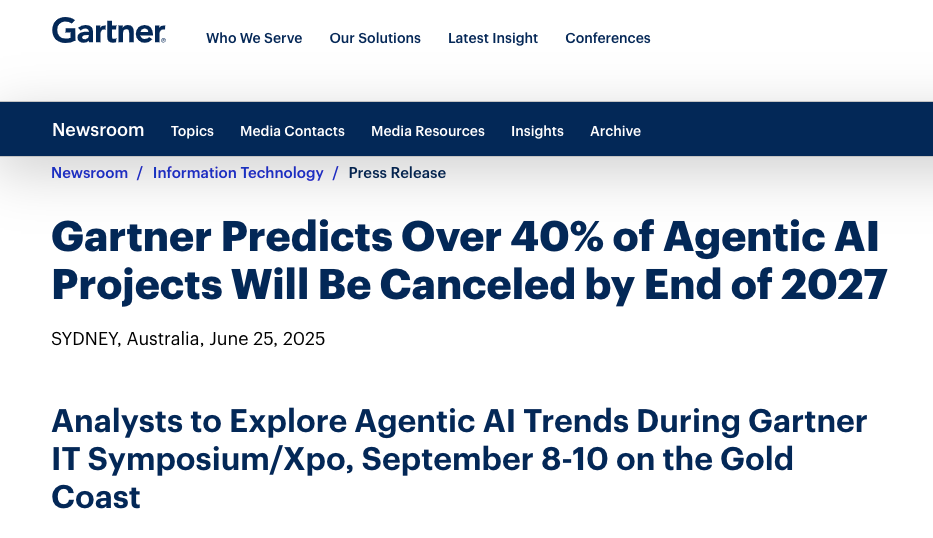
Gartner predicts agentic AI project cancellation risk (Source: Gartner)
That warning is highly relevant to ERP. AI agents can only deliver sustainable value when they are connected to clean data, mapped workflows, and governed systems. Without that foundation, agentic AI becomes expensive experimentation layered on top of operational disorder.
This is where Twendee ERP fits into the AI adoption journey. The value is not simply adding AI features to an ERP screen. The deeper value is helping businesses standardize core data and workflows across HR, finance, CRM, approvals, and internal operations. Once that foundation is in place, AI can be integrated into ERP in practical ways: generating operational summaries, routing requests, supporting approval decisions, detecting exceptions, and helping teams act on structured business data.
What makes an ERP system truly AI-ready
A traditional ERP is often judged by whether it can manage daily operations. An AI-ready ERP should be judged by whether it can prepare those operations for intelligent automation.
The difference shows up in design choices. A rigid ERP may store information, but it may not adapt well to how different companies operate. A disconnected ERP may manage one department, but it may not provide enough cross-functional context for AI. A system without clear permissions may speed up work, but it also increases risk when AI is introduced.
An AI-ready ERP needs several qualities working together:
- Flexible data model: Business data should be structured enough for AI, but flexible enough to reflect different operating models.
- Configurable workflows: Approval flows, request types, roles, and handoffs should be adjustable without breaking system logic.
- Role-based governance: AI should respect access levels, permission boundaries, approval rules, and audit trails.
- Integration readiness: ERP should connect with CRM, finance, HR, analytics, email, and other business systems where needed.
- Practical AI use cases: AI should solve workflow pain points before chasing advanced automation concepts.
Governance deserves special attention because ERP contains sensitive business data. Employee records, financial activity, sales pipelines, contracts, and internal approvals cannot be exposed to AI without control. A 2025 data governance report found that while 50% of organizations embed governance into workflows, only 28% tie governance to team OKRs, and just 6% prioritize employee training. (2025 State of Data Governance report by G2)
That gap shows why governance must be operational, not theoretical. In an AI-ready ERP, governance appears inside the workflow through access control, approval levels, audit logs, and escalation rules. AI should know what it can read, what it can suggest, and where human approval is required.
The strongest ERP-based AI use cases are often practical rather than flashy. Automatic report generation, approval reminders, CRM follow-up suggestions, expense anomaly detection, HR request routing, internal policy Q&A, and workflow summaries can create real business value because they remove daily friction.
This is also why ERP implementation should be treated as an operating upgrade, not just a software setup. The goal is to make the business easier for both people and AI to understand.
Conclusion
AI adoption does not truly start with AI. It starts with the systems that make business data clear, workflows visible, and decisions easier to govern.
That is why AI-ready ERP is becoming a practical foundation for companies preparing for automation and AI-assisted decision-making. By helping businesses standardize data, clarify workflows, and integrate AI into real operating processes, Twendee ERP supports the part of AI adoption that matters most: turning AI from a tool into a reliable business capability.
Book a call: Calendly
Read latest blog: Why Many AI Projects Fail Before Reaching Production Systems
메타데이터
- post_id
- c5ceea3df752
- slug
- erp-systems-are-becoming-the-starting-point-for-ai-adoption-c5ceea3df752
- url
- https://medium.com/@marketing_39301/erp-systems-are-becoming-the-starting-point-for-ai-adoption-c5ceea3df752
- canonical_url
- https://medium.com/@marketing_39301/erp-systems-are-becoming-the-starting-point-for-ai-adoption-c5ceea3df752
- author_url
- https://medium.com/@marketing_39301
- status
- ok
- fetched_at
- 2026-06-24 18:57:25