The CAGR of Your Circle
Think about the friend who handed you a book that changed how you saw money. Or the co-founder who asked the question you’d been avoiding…
The CAGR of Your Circle
nimishshrivastava.com
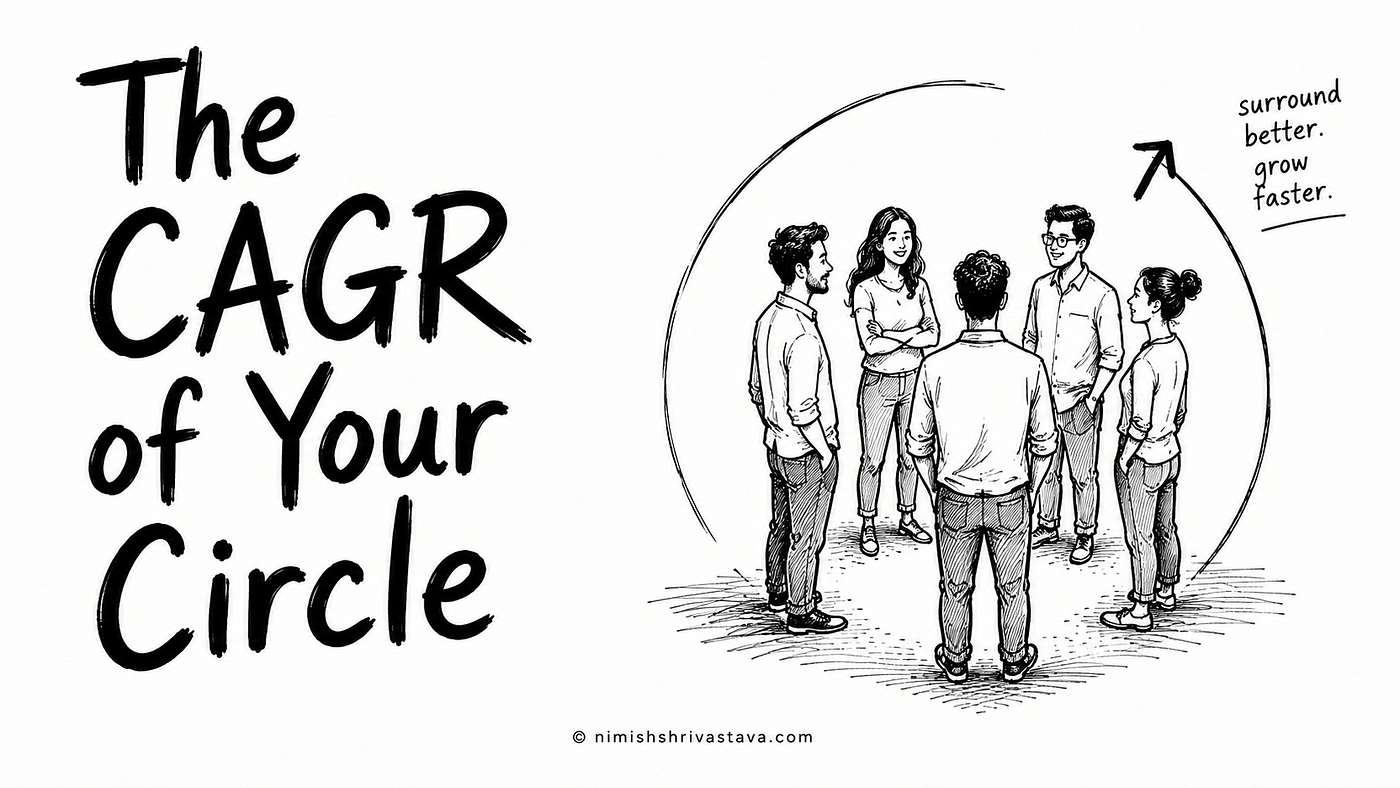
Think about the friend who handed you a book that changed how you saw money. Or the co-founder who asked the question you’d been avoiding for six months. Or the person whose messages, even now, make you rethink something you were sure about. That relationship has a better CAGR than most of your stock picks. I’ve been sitting with this idea on Friendship Day, and I think it deserves to be taken seriously — not as a warm metaphor, but as a genuine framework for how we choose the people around us.
Every Relationship Either Appreciates or Depreciates
There are friendships that energize you. After every conversation, you leave with a new idea, a sharpened perspective, a book you hadn’t heard of, or a question you’re genuinely excited to think through. These are the compounding ones. And then there are friendships that drain you. Not because the person is unkind — they often aren’t. But you leave feeling smaller, more cynical, or just tired. Nothing in you moved forward. We rarely name this honestly. It feels cold to evaluate relationships through what they give or take. But it’s worth being clear-eyed: not all relationships compound. Some depreciate. And the mix of people around you shapes your trajectory in ways that are slow, invisible, and enormously powerful.
The Portfolio Parallel
Warren Buffett once said that you become the average of the five people you spend the most time with. It’s a well-known observation — but what’s underappreciated is the compounding dimension of it. Year one of a compounding friendship barely feels different from any other. You share a meal, an idea, a book. Nothing dramatic. But year three, year five, year ten — the divergence is significant. The person who kept you intellectually honest, who challenged your assumptions, who introduced you to someone you’d never have found on your own — that relationship, held long, changes the trajectory of your thinking in ways that are difficult to reverse-engineer. The mistake: we track returns on our investments obsessively and almost never evaluate the returns on our relationships.
What Makes a Friendship Compound
It’s not the person who agrees with you most. It’s not the person who makes you feel best. The compounding quality is something more specific: someone who makes you uncomfortable in the right direction. Who surfaces the question you were avoiding. Who sees a blind spot you didn’t know you had — and says something about it clearly, without making it dramatic. Intellectual generosity is the other marker. Compounding friends share ideas without keeping score. They forward an article without expecting a favour. They remember what you’re working on three months after you mentioned it. They introduce you to someone not because there’s anything in it for them, but because they genuinely think it will help. This sounds basic. But what passes for generosity in most rooms is actually a kind of performance — signalling what you know, not giving away what’s useful. The real thing is rarer than it sounds.
A Note on Composition Changing
There’s a version of this framework that turns transactional if taken too far, so I want to name a limitation. Compounding friendships also change. Someone who accelerated your thinking at twenty-five may grow in a different direction at thirty-five. That’s not a failure — it’s just life. Conviction portfolios also change composition over time, and that doesn’t make the earlier holdings a mistake. They were right for that season. The point isn’t to coldly audit your relationships and exit the ones that don’t deliver returns. It’s to be intentional about where you invest your time and attention — and to not let inertia be the only force keeping people in your circle.
Where the Metaphor Breaks Down
I want to be careful here, because the portfolio framing can harden into something cold if you’re not watching it. You don’t invest in people for returns. You invest in people because relationships are how you become more fully yourself — how you’re challenged, shaped, stretched, and occasionally saved from your own worst instincts. The compounding is a byproduct, not the goal. If you approach friendships as transactions — what’s the CAGR on this person? — you’ve already lost the thread. The people who compound your thinking the most are usually the ones you’re not calculating anything about. You just notice, years later, that something shifted — and trace it back to them.
On Friendship Day
This is a day people mark by celebrating the friendships that brought the most joy. That’s worth celebrating. But I’d add a second question worth sitting with: who made you better this year? Not more comfortable. Not more entertained. Better — in the sense of thinking more clearly, acting more honestly, building more intentionally. That’s the circle worth building. And unlike most things worth building, it tends to compound on its own once you start paying attention to it. People compound. Choose yours the way you’d build a conviction portfolio — few, intentional, long-term. The return will surprise you.
Nimish Shrivastava Author of “Compounding Secrets” | Singer | Co-founder of The Banyan Tee Follow my work at nimishshrivastava.com
메타데이터
- post_id
- c5de8dafeb2a
- slug
- the-cagr-of-your-circle-c5de8dafeb2a
- url
- https://medium.com/@i.nimish.shrivastava/the-cagr-of-your-circle-c5de8dafeb2a
- canonical_url
- https://medium.com/@i.nimish.shrivastava/the-cagr-of-your-circle-c5de8dafeb2a
- author_url
- https://medium.com/@i.nimish.shrivastava
- status
- ok
- fetched_at
- 2026-08-17 11:23:13