Ecology and Life Around Volcanoes
Introduction Hawaii’s volcanic landscapes are not just dramatic geological features — they also host unique ecosystems. From barren lava…
Ecology and Life Around Volcanoes
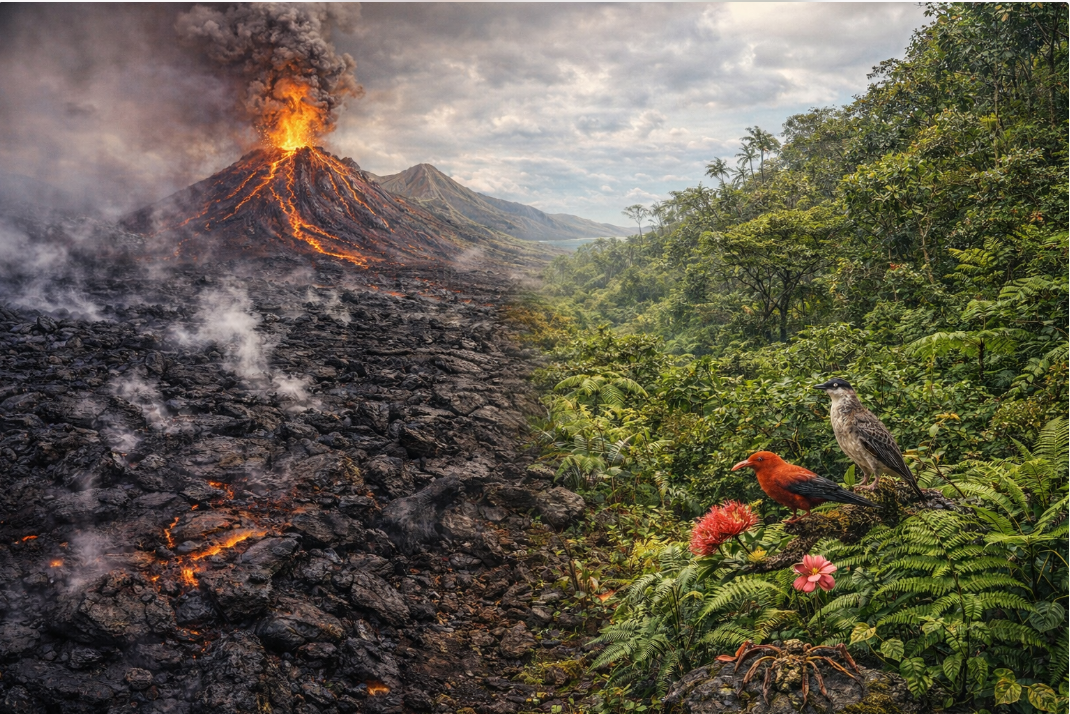
From barren lava fields to thriving ecosystems — life around Hawaii’s volcanoes tells a story of resilience and adaptation.
Introduction
Volcanoes are often associated with destruction — eruptions, lava flows, ash clouds, and seismic activity. Yet in Hawaii, volcanic landscapes also represent one of the most powerful engines of life and ecological renewal on Earth. Beneath the apparent harshness of lava fields and steaming vents lies a complex and dynamic web of organisms that have adapted to extreme conditions.
Hawaii’s volcanoes provide scientists with a rare opportunity to study how life begins, adapts, and flourishes in newly formed environments. From microscopic bacteria to towering rainforest trees, volcanic ecosystems reveal the remarkable resilience of nature. Understanding ecology around volcanoes offers valuable insights into biodiversity, ecological succession, climate resilience, and long-term environmental recovery.
The Volcanic Landscape as an Ecological Laboratory
Hawaii’s volcanic terrain is constantly evolving. Fresh lava flows coexist alongside centuries-old forests, creating a mosaic of habitats at different stages of development. This diversity allows researchers to observe ecological processes in real time.
Volcanic landscapes are characterized by:
- Rapid geological change
- Nutrient-rich but initially barren substrates
- Extreme temperature and moisture gradients
- Isolation that promotes endemism
These factors make Hawaii one of the world’s most important natural laboratories for ecological research.
Plant Life on Volcanic Soil
Pioneer Species and the Birth of Ecosystems
New lava flows appear lifeless at first glance. However, within years — or even months — life begins to take hold. Pioneer species such as lichens, mosses, and algae are often the first colonizers.
These organisms:
- Attach directly to bare rock
- Withstand extreme temperatures and limited water
- Slowly break down lava through chemical and biological processes
As they die and decompose, they create the first thin layers of soil, paving the way for more complex plant life.
Ferns, Shrubs, and Forest Formation
Once soil begins to develop, ferns and grasses establish themselves. Over time, shrubs and native trees follow, including species such as ʻōhiʻa lehua, which plays a crucial role in forest development.
Volcanic soils are:
- Rich in iron, magnesium, and other minerals
- Highly fertile once weathered
- Capable of supporting dense vegetation
This process can take decades to centuries, depending on climate, elevation, and lava composition.
Volcanic Soil and Agriculture
Hawaii’s volcanic soils support productive agriculture, including:
- Coffee plantations
- Tropical fruit orchards
- Sugarcane and taro cultivation
Farmers benefit from mineral-rich soils, but must also manage challenges such as uneven terrain and variable soil depth.
Animal Life in Volcanic Ecosystems
Birds and Avian Endemism
Hawaii is famous for its endemic bird species, many of which depend on volcanic forests for survival. Species such as the ʻIʻiwi and the Nēnē (Hawaiian goose) have adapted to volcanic landscapes through:
- Specialized feeding behaviors
- Nesting in rugged terrain
- Migration across elevation zones
Unfortunately, many native birds face threats from habitat loss, invasive species, and climate change.
Insects, Reptiles, and Mammals
Insects are among the most successful colonizers of volcanic environments. They occupy niches in:
- Lava cracks
- Volcanic soil layers
- Forest understories
Small mammals and reptiles adapt to volcanic slopes and lava tubes, which provide shelter and stable temperatures.
Microbial Life and Extreme Environments
Life at the Edge
Volcanic regions host extraordinary microbial communities capable of surviving extreme heat, acidity, and sulfur-rich conditions.
These thermophilic and extremophilic microorganisms:
- Thrive near lava flows and geothermal vents
- Play a role in mineral cycling
- Provide insight into the limits of life on Earth
Scientific and Astrobiological Importance
Studying volcanic microbes helps scientists:
- Develop new medical and industrial applications
- Understand early life on Earth
- Search for life on other planets, such as Mars
Volcanic ecosystems serve as analogs for extraterrestrial environments.
Ecological Succession on Volcanic Landscapes
Primary Succession After Eruptions
Volcanic eruptions can destroy existing ecosystems, but they also reset the ecological clock. The process of primary succession begins on newly formed rock without soil.
Stages include:
- Microbial colonization
- Lichens and mosses
- Ferns and grasses
- Shrubs and trees
- Mature forest ecosystems
Each stage prepares the environment for the next.
Resilience and Long-Term Recovery
Although lava flows can be devastating, Hawaiian ecosystems demonstrate remarkable resilience. Over time, biodiversity returns, often creating landscapes richer than before the eruption.
Studying these processes helps scientists understand:
- Ecosystem recovery after natural disasters
- Climate resilience
- Long-term biodiversity patterns
Human Interaction with Volcanic Ecosystems
Tourism and Education
Volcanic ecosystems attract millions of visitors annually. National parks and protected areas offer:
- Educational programs
- Guided ecological tours
- Opportunities for scientific outreach
Responsible tourism helps raise awareness while supporting conservation.
Conservation and Protected Areas
Protected regions such as Hawaiʻi Volcanoes National Park aim to balance human activity with ecological preservation.
Conservation efforts focus on:
- Protecting endangered species
- Controlling invasive plants and animals
- Preserving native habitats
These efforts are essential for maintaining Hawaii’s unique biodiversity.
Cultural and Ecological Connections
Volcanoes hold deep cultural significance in Hawaiian tradition. They are viewed as living entities, deeply connected to land, ancestry, and identity.
Ecological conservation aligns closely with cultural values that emphasize respect for nature and balance between humans and the environment.
Global Lessons from Hawaiian Volcanic Ecosystems
The study of life around volcanoes extends far beyond Hawaii. Lessons learned here apply to:
- Ecosystem recovery after wildfires or floods
- Conservation in extreme environments
- Climate change adaptation strategies
Hawaii’s volcanic ecosystems offer a model for understanding resilience in a rapidly changing world.
Conclusion
Volcanoes in Hawaii are far more than geological phenomena — they are living ecosystems shaped by fire, time, and adaptation. From microscopic bacteria to complex forests and endemic wildlife, life flourishes in environments once thought uninhabitable.
By studying and protecting these ecosystems, scientists and communities gain valuable insight into resilience, biodiversity, and the profound ability of nature to recover and thrive. In Hawaii, volcanoes are not symbols of destruction alone — they are foundations of life.
메타데이터
- post_id
- c5f1e37b9c1a
- slug
- ecology-and-life-around-volcanoes-c5f1e37b9c1a
- url
- https://medium.com/@xristided/ecology-and-life-around-volcanoes-c5f1e37b9c1a
- canonical_url
- https://medium.com/@xristided/ecology-and-life-around-volcanoes-c5f1e37b9c1a
- author_url
- https://medium.com/@xristided
- status
- ok
- fetched_at
- 2026-06-09 15:37:30