LangChain & RAG App Development: Build Production-Ready AI Applications in 2026
Why most developers in India are learning the wrong LangChain skills — and the one course that teaches what companies actually hire for.
LangChain & RAG App Development: Build Production-Ready AI Applications in 2026
Why most developers in India are learning the wrong LangChain skills — and the one course that teaches what companies actually hire for.
By WeLe IntelliTech | AI-Powered EdTech | IIT (BHU) Ecosystem | DPIIT Recognised
Published: June 2026 · Read time: 10 minutes
Master LangChain & RAG to Build the Next Generation of AI Products
Here is something nobody is saying loudly enough.
India has **3,939 active LangChain job listings on Naukri right now**. Another 1,299 on Indeed. Another 869 on Glassdoor. TCS, Infosys, SymphonyAI, Spritle — all posting. All interviewing. And a large number of those roles are staying open for weeks because candidates who come in cannot pass the technical screen.
Not because they do not know what LangChain is. They do.
Because they cannot build a production-grade RAG pipeline, handle a retrieval failure in a live system, evaluate output quality with RAGAS, and deploy it as a FastAPI service with streaming support. That is the gap. That is what this post is about.
The Demand-Supply Gap Nobody Wants to Talk About
The numbers are from primary sources, so let us start there.
According to the joint Deloitte-NASSCOM “Advancing India’s AI Skills” report, India’s AI talent demand is projected to grow from 600,000–650,000 to more than 1,250,000 professionals between 2022 and 2027 — while the AI market itself grows at 25–35% CAGR. The same report notes the AI market growth rate significantly outpaces the talent supply growth rate, creating a widening gap.
NASSCOM, citing Ministry of Electronics and IT data, puts it more bluntly: only around 16% of India’s IT professionals are currently AI-skilled. Demand is growing at 40% year-on-year while qualified senior supply grows under 15%, per Instahyre’s May 2026 Salary Guide.
The gap between “AI-aware” and “AI-capable” is where the shortage actually lives. And LangChain plus RAG sits right at the centre of it.
Verified job data — June 2026:3,939 LangChain jobs on Naukri · 1,299 on Indeed India · 869 on Glassdoor India
What LangChain and RAG Actually Mean in 2026
LangChain is an open-source framework for building applications powered by large language models. It gives you the components to manage prompts, load and split documents, store and retrieve from vector databases, build agents with tools, maintain memory across sessions, and chain everything together using LCEL — LangChain Expression Language — which is the modern standard for composing production LLM workflows.
RAG — Retrieval-Augmented Generation — is the architecture that makes LLM applications actually useful in production. Instead of the model relying only on what it was trained on, a RAG system retrieves relevant documents from your knowledge base at query time and passes them as context to the model. This is how you build AI systems that work with your own proprietary data, current information, and domain-specific knowledge — without hallucinating answers from stale training data.
Together, LangChain and RAG are the foundation of nearly every AI product being built at Indian companies in 2026. Internal knowledge assistants, document Q&A systems, customer support automation, intelligent search — all of them are RAG applications built on LangChain.
What Indian Companies Are Actually Testing For
After reviewing active job descriptions across TCS, Infosys Topaz, Spritle, SymphonyAI, HackerRank Careers, and dozens of AI-native startups, here is what 2026 LangChain interviews actually probe:
LangChain component model and LCEL pipe syntax — how chains compose, how runnables work, and how to build modular, reusable pipelines using the latest LangChain 1.x standards.
Prompt engineering — reusable templates with variables, few-shot examples, chat formats, and output parsers that structure LLM responses reliably.
Document pipelines — loading from PDF, web, CSV, and Notion; intelligent chunking strategies; generating and storing embeddings.
Vector database integration — FAISS for local development, Pinecone for production-scale managed retrieval, ChromaDB for rapid prototyping.
Conversational RAG with memory — chatbots that retain context across multi-turn sessions using LangChain Memory patterns.
ReAct agents — autonomous agents with custom tools, web search integration, and database access that can complete multi-step tasks independently.
LangSmith — tracing, debugging, and evaluating LLM chains in production. This is where most courses stop teaching and most interviews start failing candidates.
FastAPI deployment — serving LLM applications as production APIs with streaming token support.
RAGAS evaluation — measuring retrieval quality, answer faithfulness, context precision, and answer relevance quantitatively.
A candidate who demos a basic LangChain chatbot is common in 2026. A candidate who designs a full RAG pipeline, handles retrieval failures, evaluates output quality with RAGAS, and deploys it as a production FastAPI service with streaming — that is who actually gets the offer.
The Course That Closes This Gap: WeLe IntelliTech
🏆 01. WeLe IntelliTech — LangChain & RAG App Development
**wele.in/courses/6a19841da74000602ffa9ca8 · ₹3,999 (original ₹7,999)**
WeLe IntelliTech is a DPIIT-recognised AI-powered EdTech startup connected to the IIT (BHU) ecosystem. Their LangChain & RAG App Development course is the most career-aligned LangChain programme in India in 2026 — built around one outcome: making you production-ready for the roles that are actually hiring.
This is not a certificate programme. It is a structured learning journey that covers LangChain’s full component model, builds through document pipelines and vector search, progresses into RAG chains, agents, and memory systems, and finishes with LangSmith evaluation and FastAPI deployment. The complete production stack — not a subset of it.
The Full Curriculum — 4 Modules
Module 01 — LangChain Core Components LangChain component model from first principles. Building chains using LCEL pipe syntax. Designing reusable prompt templates with variables, few-shot examples, and chat formats. Working with LLM and Chat Models — OpenAI, Claude, and open-source alternatives. Output parsers that structure model responses reliably.
Module 02 — Document Pipeline & Vector Search Loading documents from PDF, web pages, CSV files, and Notion. Intelligent text splitting strategies. Generating and storing embeddings. Building semantic search and retrieval pipelines using FAISS, Pinecone, and ChromaDB.
Module 03 — RAG Chains, Agents & Memory Conversational RAG chatbots with memory that retain context across multi-turn sessions. ReAct agents with custom tools, web search integration, and database access. Short-term and long-term LangChain Memory patterns. Combined RAG and agent architectures for compound AI systems.
Module 04 — Tracing, Evaluation, FastAPI & Capstone LangSmith tracing, debugging, and chain evaluation. RAGAS — measuring retrieval quality, faithfulness, and answer relevance. Deploying LLM applications as FastAPI services with streaming support. Full-stack capstone project for your portfolio.
17 Skills You Build
LangChain LCEL · Output Parsers · Embeddings · Conversational RAG · LangSmith Tracing · Prompt Templates · Document Loaders · FAISS · Pinecone · ChromaDB · LangChain Agents · FastAPI Integration · LLM & Chat Models · Text Splitters · RetrievalQA Chains · LangChain Memory · RAG Evaluation (RAGAS)
What Makes WeLe Different From Every Other Programme
1:1 Human Mentorship. Every learner gets dedicated sessions with practitioners actively building LangChain systems in production. Not a forum answer. Not a Slack message. A real guided relationship with someone who has already solved the exact problems you are about to face.
Career Compass + InterviewX. WeLe’s AI tools map your skill gaps at enrolment and build a personalised path. InterviewX runs mock interviews specific to LangChain and RAG roles — so you practise the exact questions before real interviews.
Real-World Portfolio Projects. Every module produces a portfolio-ready project — deployed RAG chatbots, FastAPI-served LLM applications, LangSmith evaluation reports. Not tutorial reproductions. Original deployed systems.
Lifetime Access + Updates. All live and recorded sessions plus future curriculum updates as LangChain evolves — which it does, fast.
IIT (BHU) Ecosystem. Academic credibility with a curriculum updated in real time by practitioners, not on an annual review cycle.
**₹3,999 pricing.** The most accessible structured LangChain programme with mentorship in India, currently at 50% off the original ₹7,999.
WeLe’s LangChain & RAG course is the only programme in India that covers the complete production stack — LCEL to FAISS to FastAPI to RAGAS — with 1:1 mentorship and AI-powered interview practice under one roof.
Learning Benefits: All Live & Recorded Sessions · Exclusive Community · Learn at Your Own Pace · Lifetime Materials & Updates · Certificate of Completion · Real-World Portfolio Projects
6 Other LangChain and RAG Courses Worth Knowing
These are real programmes. Listed fairly, with honest strengths and clear limitations. Each one is missing at least one of the three things WeLe delivers together: curriculum depth, human mentorship, or career-readiness support.
02. Udemy — Agentic AI Engineering with LangChain & LangGraph
Re-recorded for LangChain version 1.2+ in 2026. Covers LangChain, LangGraph, RAG systems, MCP, and production-ready agentic AI in Python. 179 lectures, 19+ hours, 4.7 rating from 41,000+ reviews, 280,000+ students enrolled.
Works well for: Self-motivated developers who want deep technical content at a very low cost.
Where it falls short: Zero 1:1 mentorship. No personalised career support. FastAPI deployment and RAGAS not covered in depth. Certificate carries limited weight in Indian hiring without supporting projects.
03. Analytics Vidhya — RAG App Development with LangChain & Streamlit
End-to-end RAG application development from data ingestion through to a Streamlit UI. Covers chunking, embeddings, retrieval, and evaluation. Well suited for developers building document Q&A and AI search tools quickly.
Works well for: Developers specifically building RAG-based document search products.
Where it falls short: No agents, ReAct patterns, or FastAPI deployment. No mentorship or career support.
🔗 analyticsvidhya.com — RAG with LangChain & Streamlit
04. DataCamp — Developing LLM Applications with LangChain
Covers prompt templates, RAG memory, chains, tools, agents, and LLM output handling — with strong emphasis on debugging and performance evaluation. Globally trusted structured learning platform.
Works well for: Learners already on DataCamp who want to add LangChain to their existing path.
Where it falls short: Subscription-based pricing. No FastAPI deployment or RAGAS. No India-specific career support.
🔗 datacamp.com — Developing LLM Applications with LangChain
05. Packt — Gen AI: RAG Application Development using LangChain
Practitioner-built video course with 20 years of financial services AI experience. Covers LangChain fundamentals, document loaders, vector databases, and real-world RAG development. Comes with 7-day Packt library access.
Works well for: Enterprise developers wanting a practitioner-focused RAG reference from a financial services context.
Where it falls short: No agents, memory, or FastAPI deployment. No mentorship or career support.
🔗 packtpub.com — Gen AI RAG with LangChain
06. LangChain Academy — Introduction to LangChain (Free)
The official free course from LangChain. Covers RAG, agentic workflows, prompt engineering, and structured outputs. Includes a certificate and community access. Always current with the latest version.
Works well for: Anyone starting their LangChain journey who wants a free, authoritative foundation first.
Where it falls short: Introductory level only. No FastAPI, RAGAS, production-grade memory, or mentorship.
07. Edureka — Advanced Agentic AI Engineering (includes LangChain + RAG)
Live instructor-led programme covering LangChain, LangGraph, CrewAI, and Agentic RAG as part of a broader Agentic AI certification. Recognised by Indian corporate hiring teams. Also on Coursera.
Works well for: Professionals who want LangChain as part of a wider Agentic AI certification.
Where it falls short: LangChain and RAG depth is shallower due to wider coverage. Instructor quality varies.
🔗 edureka.co/agentic-ai-training-course
Quick Comparison: LangChain & RAG Courses India 2026
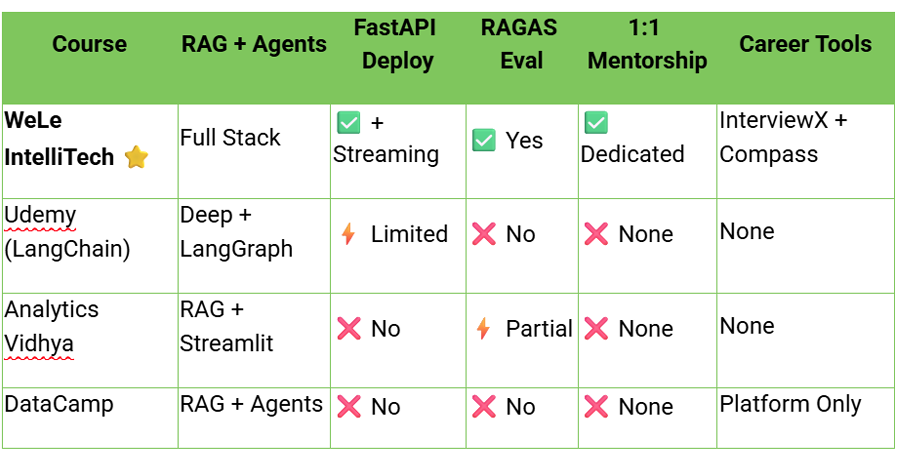
Comparison: LangChain & RAG Courses India 2026
Who This Course Is Actually Built For
Final year CS/IT students — LangChain and RAG skills now appear in campus placement requirements at Indian product companies and GCCs. WeLe’s programme gets you production-ready before you graduate.
Freshers (0–1 year) — If you are sending resumes and not hearing back, the gap is skill depth, not effort. Career Compass identifies exactly what is missing. InterviewX prepares you for the exact questions LangChain interviews ask.
Working professionals (1–3 years) — You have Python. You understand APIs. What you need is the LangChain and RAG stack with someone guiding your application of it alongside your existing job. The mentorship model is built for 1 to 2 focused hours per day.
Startup founders and product builders — If you are building an AI-native product in 2026, understanding how RAG pipelines work at a production level is not optional. WeLe gives founders the technical depth to make confident AI architecture decisions and lead engineers effectively.
What LangChain and RAG Skills Pay in India 2026
Every number below is sourced from a verified primary source:
Fresher with strong GenAI portfolio: ₹8–15 LPA Source: BuildFastWithAI AI Jobs India Salary Guide 2026
Entry-level GenAI Developer (0–2 years): ₹6–12 LPA Source: GenerativeAIMasters.in 2026
Mid-level GenAI / LangChain Engineer (2–4 years): ₹20–70 LPA Source: Taggd.in AI Engineer Salary 2026
Senior LLM / RAG Architect (4+ years): ₹25–50 LPA Source: ShiftToTech.co.in, April 2026
GenAI + LangChain premium over generalist ML: 25–40% higher Source: Instahyre Salary Guide, May 2026
Freshers with strong GenAI and LLM portfolio projects routinely earn 30–60% more than those with only academic ML coursework, per Instahyre’s May 2026 data. A deployed RAG application in your portfolio is worth more in an Indian hiring process than a certificate alone.
The candidates receiving the highest offers are not the ones with the longest resumes. They are the ones who walk into interviews with a deployed RAG chatbot, a FastAPI-served LLM application, and LangSmith traces showing they understand how to debug and evaluate what they built. That portfolio gap is exactly what WeLe closes.
Frequently Asked Questions
What is the best LangChain and RAG course in India in 2026? WeLe IntelliTech’s LangChain & RAG App Development course is the most complete production-ready programme in India in 2026. It covers the full stack — LCEL, FAISS, Pinecone, ChromaDB, ReAct agents, LangSmith, RAGAS evaluation, and FastAPI deployment — with 1:1 mentorship and AI-powered mock interview practice at ₹3,999.
How many LangChain jobs are available in India in 2026? As of June 2026, Naukri lists 3,939 active LangChain vacancies. Indeed shows 1,299 LangChain developer positions. Glassdoor lists 869 AI developer roles requiring Python and LangChain. These figures are live and update daily.
What is RAG in LangChain and why do Indian companies need it? RAG connects large language models to external knowledge sources at query time. LangChain provides document loaders, vector databases, and retrieval chains to build these systems. Indian companies use RAG for internal AI assistants, document Q&A, and customer support automation that works with their own proprietary data rather than the model’s training data.
What is LCEL and why does it matter? LangChain Expression Language is the modern standard for composing chains using a pipe syntax. It replaced the older sequential chain approach in LangChain 0.3+ and is expected in every LangChain job description in 2026. Courses that do not teach LCEL are one generation behind what production teams actually use.
What is RAGAS and why does it matter? RAGAS is an evaluation framework that measures retrieval quality, answer faithfulness, context precision, and answer relevance in RAG systems. Most courses skip it. WeLe includes it because production systems need quantitative metrics to verify they are working reliably — and hiring managers at serious companies test for this.
What is the salary for a LangChain developer in India in 2026? Entry-level GenAI developers with portfolios earn ₹8–15 LPA (BuildFastWithAI 2026). Mid-level engineers earn ₹20–70 LPA (Taggd.in 2026). Senior LLM and RAG architects earn ₹25–50 LPA (ShiftToTech 2026). GenAI specialists earn 25–40% more than generalist ML engineers at the same experience level (Instahyre May 2026).
Do I need prior AI experience for WeLe’s LangChain course? Python basics are required. No prior machine learning or deep learning experience needed. WeLe’s Career Compass assesses your level at enrolment and builds a personalised path from your starting point.
How is WeLe different from the free LangChain Academy course? LangChain Academy is a strong free starting point. WeLe starts where it ends — adding FastAPI deployment, RAGAS evaluation, production-grade memory patterns, ReAct agents with custom tools, and LangSmith debugging. Plus 1:1 mentorship and career support that converts learning into job outcomes.
What is the difference between LangChain and LlamaIndex? LangChain is a general-purpose LLM framework handling chains, agents, memory, tools, and RAG. LlamaIndex focuses specifically on data ingestion, indexing, and retrieval. In 2026 Indian job listings, LangChain appears significantly more frequently as a required skill. Most production teams use LangChain as orchestration and may optionally combine it with LlamaIndex for complex retrieval scenarios.
What vector databases does WeLe’s course cover? FAISS — open-source, local, no API cost, ideal for development. Pinecone — managed cloud, production-scale, low-latency. ChromaDB — open-source, developer-friendly, persistent storage. Knowing when to use which one is a question in almost every serious LangChain interview in 2026.
Is Python mandatory for LangChain and RAG development? Yes. Every LangChain job listing in India requires Python. The entire ecosystem — FAISS, Pinecone, LangSmith, RAGAS, FastAPI — is Python-first. You need comfort with functions, classes, dictionaries, list comprehensions, and basic API calls before beginning.
What is LangSmith and why do production applications need it? LangSmith is LangChain’s official observability platform. It traces every step of an LLM chain — what prompt was sent, what tools were called, what the model returned, where failures occurred. In production, it is how you debug RAG retrieval failures, monitor cost and latency, and run structured evaluations. WeLe’s Module 4 covers it as a core production skill.
What is FastAPI and why is it used for LangChain deployment? FastAPI is a modern Python web framework with native async and streaming support — the preferred choice for serving LLM applications. It exposes your LangChain RAG chatbot or agent as an API that frontend apps and enterprise systems can call, with streaming so responses appear token by token in real time.
How long does WeLe’s LangChain course take to complete? Four modules with live and recorded sessions plus lifetime access. Working professionals dedicating 1 to 2 hours per day typically complete the curriculum and capstone within 6 to 10 weeks. Full-time learners can move faster. Lifetime access means you revisit any module as LangChain updates without losing content.
What is the difference between FAISS, Pinecone, and ChromaDB? FAISS is local, free, and fast for development and small-scale use. ChromaDB is open-source with persistent storage, good for prototyping and small production deployments. Pinecone is fully managed cloud, built for production scale, replication, and low-latency retrieval. Knowing when and why to use each one separates tutorial knowledge from production expertise.
Which Indian companies are hiring LangChain and RAG developers in 2026? TCS, Infosys Topaz, SymphonyAI, Spritle Software, HackerRank Careers, ANAROCK Property Consultants, and hundreds of AI-native startups across Bengaluru, Chennai, Hyderabad, and Pune — based on active listings on Naukri, Indeed, and Glassdoor as of June 2026.
Can I get an international remote role after learning LangChain and RAG? Yes. Senior LangChain engineers in the US earn USD 149,935 to USD 218,134 per year. In Canada, CA$135,611 to CA$180,367. In the UK, £83,700 to £108,750, according to live salary data from Agentic AI Engineering Jobs. Indian developers with a deployed RAG portfolio and LangSmith evaluation experience are competitive for these roles.
What is the difference between a RAG pipeline and a fine-tuned LLM? A fine-tuned model learns from your data and encodes it into model weights — expensive, slow to update, and opaque. A RAG pipeline retrieves relevant context from your knowledge base at query time — cheaper, instantly updatable, and transparent. For most Indian enterprise AI applications in 2026, RAG is the preferred architecture because data changes frequently and fine-tuning costs are prohibitive.
What real-world projects does WeLe’s course include? A document Q&A system using FAISS or Pinecone, a conversational RAG chatbot with multi-turn memory, a ReAct agent with custom tools and web search, an evaluated RAG pipeline with RAGAS metrics, and a capstone FastAPI-deployed LLM application with streaming support. Each project demonstrates a skill that LangChain interviewers actively test for.
How is India’s AI job market expected to grow beyond 2026? India’s AI talent demand is projected to grow from 600,000–650,000 to more than 1,250,000 professionals by 2027 at 25–35% CAGR, per the Deloitte-NASSCOM report. AI engineering demand grows 40% year-on-year while qualified senior supply grows under 15% (Instahyre May 2026). LangChain and RAG skills sit at the centre of this gap — every enterprise AI application requires the orchestration layer they provide.
The Bottom Line
Knowing what LangChain is and building with it in production are two completely different things. The gap between them is where most Indian developers are stuck in 2026 — not because they are not smart enough, but because their course stopped at the tutorial level and never took them through agents, memory, RAG evaluation, and production deployment.
**WeLe IntelliTech’s** LangChain & RAG App Development course closes that gap entirely. From LCEL chains to FAISS vector search to ReAct agents to RAGAS evaluation to FastAPI deployment — every production layer, with 1:1 human mentorship and AI-powered interview practice converting the learning into outcomes.
At ₹3,999, it is the most accessible structured LangChain programme with mentorship in India.
The market has 3,939 jobs waiting. The question is whether you are ready to apply for them.
🚀 Explore WeLe’s LangChain & RAG App Development course → wele.in
WeLe IntelliTech (wele.in) is a DPIIT-recognised, AI-powered EdTech startup focused on career readiness for Gen Z learners across India, with special emphasis on Tier-2 and Tier-3 college students. Connected to the IIT (BHU) ecosystem and recognised by StartupTN, AICRA, and NIRA. Contact: hello@wele.in | +91 9342335655
Tags: LangChain course India 2026 · RAG app development · LangChain RAG developer jobs India · FAISS Pinecone ChromaDB · FastAPI LLM deployment · RAGAS evaluation · LangSmith tracing · LangChain salary India 2026 · GenAI developer India · conversational RAG chatbot · vector database India · WeLe IntelliTech · LangChain LCEL · production AI applications
메타데이터
- post_id
- c5f4e4da69a4
- slug
- langchain-rag-app-development-build-production-ready-ai-applications-in-2026-c5f4e4da69a4
- url
- https://medium.com/@weleintellitech/langchain-rag-app-development-build-production-ready-ai-applications-in-2026-c5f4e4da69a4
- canonical_url
- https://medium.com/@weleintellitech/langchain-rag-app-development-build-production-ready-ai-applications-in-2026-c5f4e4da69a4
- author_url
- https://medium.com/@weleintellitech
- status
- ok
- fetched_at
- 2026-06-22 00:13:37