The Irreducible Core of the Palindromic Geopolitical Theory (PGT)
The Irreducible Core of the Palindromic Geopolitical Theory (PGT)

Apply the PAL-8 template and anticipate the system — access here: ∞ → PAL-8 Basic Template ← ∞ Identify Region, Resources, Routes, and Networks in seconds
✍️ Apolítik0. Creator of the Palindromic Geopolitical Theory (PGT)
∞ → ← ∞
A Structural Formalization of Reversible Power
Abstract
The Palindromic Geopolitical Theory (PGT) proposes a structural framework for the analysis of global power based on the reversible interaction of fundamental strategic axes. This article introduces, for the first time in explicit form, the Irreducible Core of the PGT: a minimal set of theoretical invariants whose removal would compromise the identity of the model. Unlike previous developments focused on operational mechanisms, variables, or empirical applications, this text exclusively delineates the ontological architecture of the theory. Its purpose is to fix its structural principles, establish its analytical limits, and provide a canonical reference for future empirical validations and methodological extensions.
∞ → ← ∞
1. Introduction
In recent decades, geopolitical analysis has oscillated between territorialist models, systemic approaches, and hegemonic transition narratives. While these perspectives have contributed to describing partial dynamics of global power, an integrative framework formalizing strategic reversibility as a structural principle remains absent.
The Palindromic Geopolitical Theory (PGT) emerges in response to this limitation by conceiving power not as a linear trajectory, but as a cyclical system characterized by phases of equilibrium, displacement, and inversion. However, the progressive development of the PGT — through operational formulations, analytical templates, and case studies — has dispersed its essential foundations across multiple texts.
This article has a specific purpose: to explicitly formalize the Irreducible Core of the PGT. This core does not describe mechanisms, variables, or equations; rather, it defines the minimal architecture that sustains the theory. Its formalization allows a distinction between permanent structural principles and evolving methodological tools, thereby strengthening the model’s internal coherence and academic defensibility.
∞ → ← ∞
2. Theoretical Positioning
The PGT is situated within the field of structural geopolitics, yet it distances itself from both classical territorial determinism and linear competitive realism. While certain approaches privilege unilateral power accumulation and others emphasize historical cycles without symmetrical formalization, the PGT introduces a palindromic logic: every strategic configuration contains, in latent form, the possibility of its inversion.
In this sense, the PGT does not propose a new taxonomy of power, but a relational architecture in which equilibria emerge, saturate, and reverse as a result of systemic interactions. This positioning situates the theory as an integrative model capable of dialoguing with existing frameworks without being reducible to them.
∞ → ← ∞
3. Formal Definition of the PGT
The Palindromic Geopolitical Theory is a structural model of global power that postulates that geopolitical dynamics are organized around interdependent strategic axes and evolve through reversible cycles of defense and appropriation.
Within the PGT, power is not conceived as permanently accumulative, but as a dynamic equilibrium subject to displacement. Such displacement occurs when state or non-state actors alter the configuration of the fundamental axes, generating phases of asymmetry that, rather than constituting final states, represent transitional moments within an underlying symmetrical architecture.
The PGT maintains that these transformations follow palindromic patterns: processes that advance, saturate, and return under inverted configurations, thereby inaugurating new strategic cycles.
∞ → ← ∞
4. Principle I — Structural Axes (ERE)
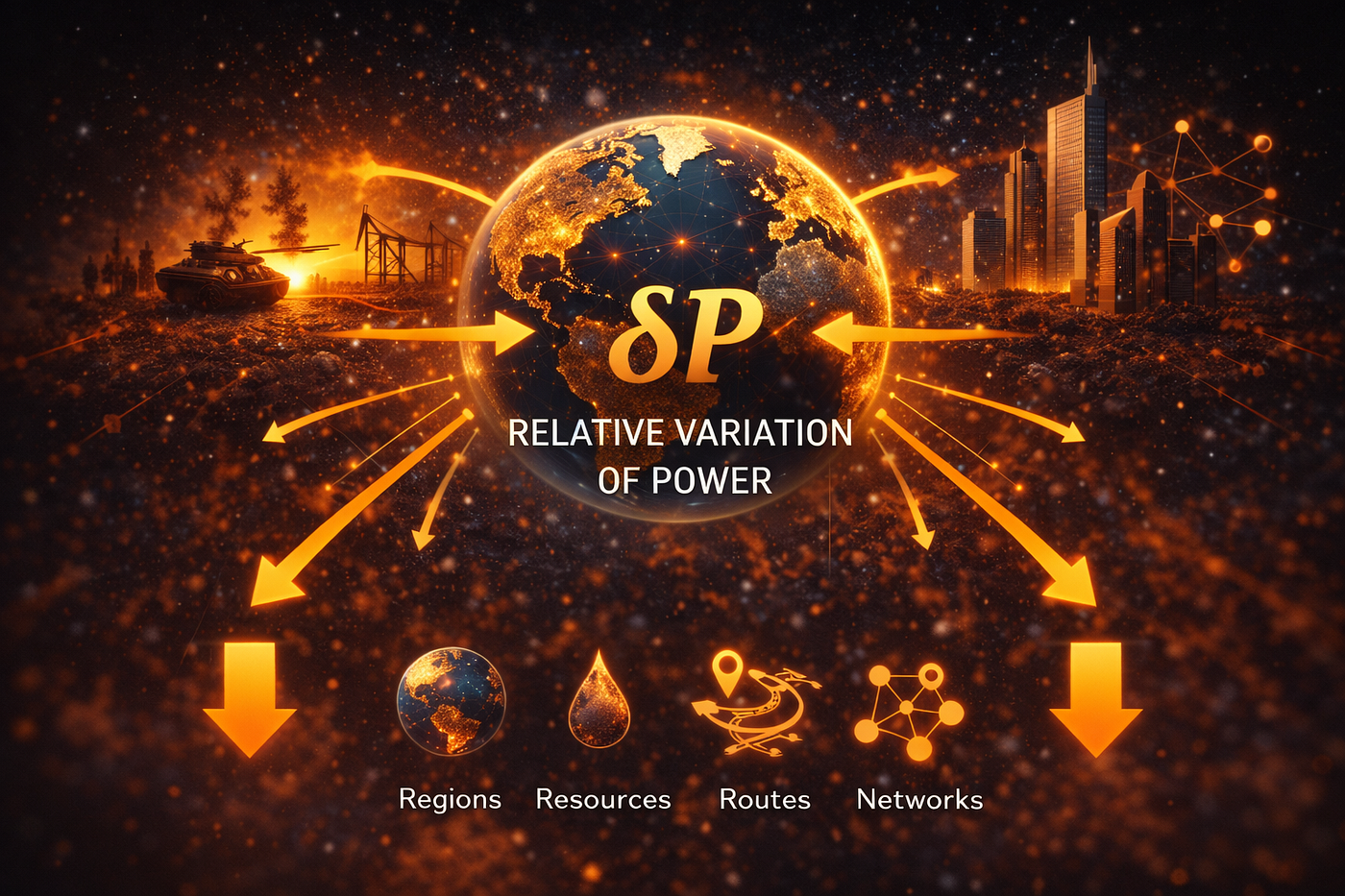
The PGT posits that geopolitical power is articulated through four fundamental strategic axes: Region, Resources, Routes, and Networks (ERE). These axes do not operate in isolation or in hierarchical order, but as an interdependent system whose configuration determines the balance of power within a given space and time.
Region defines the territorial and geographical framework within which strategic dynamics unfold. Resources represent the material and energetic capacities that sustain power projection. Routes constitute the physical and logistical channels that enable the circulation of goods, forces, and influence. Networks encompass the relational, technological, financial, and informational infrastructures that connect actors and territories.
Within the PGT, these axes form a systemic architecture: a significant alteration in one generates tensions in the others, producing shifts in strategic equilibrium. No axis holds permanent primacy; its relevance is contextual and contingent upon the state of the geopolitical cycle.
∞ → ← ∞
5. Principle II — Strategic Reversibility
The second principle establishes that every configuration of power is inherently reversible. The PGT conceptualizes this reversibility as a continuous process of defense and appropriation, through which actors seek either to preserve or to reconfigure control over the ERE axes.
Defense manifests as the set of actions aimed at maintaining an existing equilibrium, whereas appropriation entails attempts at structural reordering. These processes coexist permanently and do not constitute mutually exclusive phases, but simultaneous components of the system.
From this perspective, no strategic domain is definitive. Every hegemony contains the vectors of its own erosion, and every loss of influence opens possibilities for reconfiguration. Reversibility is not an exceptional event, but the normal condition of the geopolitical system.
∞ → ← ∞
6. Principle III — Palindromic Symmetry
The PGT introduces the notion of palindromic symmetry to describe the deep structure of power dynamics. This symmetry does not imply equality of capabilities among actors, but structural correspondence between opposing phases of the geopolitical cycle.
Observable asymmetries — military, economic, or technological superiorities — represent transitory states within an underlying symmetrical framework. Such states emerge, intensify, and eventually invert, giving rise to reflected strategic configurations.
The palindromic logic describes this process as a sequence of advance, saturation, and return, in which the roles of defenders and appropriators may interchange. Thus, symmetry operates as a structural principle, while asymmetry constitutes a temporary operational condition.
∞ → ← ∞
7. Principle IV — Cyclical Dynamics of Power
The PGT maintains that geopolitical power evolves through structural cycles characterized by phases of emergence, stabilization, saturation, and displacement. These cycles do not follow a linear progression nor a historical determinism, but rather result from the continuous interaction of the ERE axes under changing conditions.
Each cycle begins with a relatively stable configuration of strategic equilibrium. As actors intensify their processes of defense or appropriation, systemic tensions accumulate, leading to states of saturation. Such states increase the probability of equilibrium inversion, giving rise to new configurations of power.
Within this framework, geopolitical transitions do not constitute abrupt ruptures, but progressive reorderings derived from structural accumulations. Cyclical dynamics thus describe a recurrent pattern of power reorganization in which no equilibrium is permanent and every stability contains its potential for transformation.
∞ → ← ∞
8. Principle V — Analytical and Prospective Character
The PGT does not limit itself to offering a retrospective description of geopolitical processes; it establishes an analytical framework with prospective capacity. By identifying the configuration of the ERE axes and the state of the strategic cycle, the model enables the anticipation of possible trajectories of power displacement.
This capacity does not imply deterministic prediction of specific events, but rather the delineation of plausible scenarios grounded in structural patterns. Prospective analysis within the PGT emerges from the observation of cumulative imbalances and the identification of saturation points, providing a tool to assess risks, opportunities, and dynamics of inversion.
In this way, the PGT integrates analysis and anticipation within a single conceptual framework, combining structural explanation and strategic projection.
∞ → ← ∞
9. The Irreducible Core of the PGT
Based on the preceding principles, the Irreducible Core of the Palindromic Geopolitical Theory is defined by the following invariants:
Invariant 1. Geopolitical power is structured around interdependent axes (Region, Resources, Routes, and Networks).
Invariant 2. Every configuration of power is reversible through simultaneous dynamics of defense and appropriation.
Invariant 3. Strategic transformations follow a palindromic logic, in which opposing phases of the cycle maintain structural correspondence.
Invariant 4. Power evolves through cycles of equilibrium, saturation, and displacement.
Invariant 5. The architecture of the model enables structural analysis and the construction of prospective scenarios.
The removal of any of these invariants would compromise the identity of the PGT as a theoretical framework. These principles constitute the minimal architecture necessary to understand the palindromic dynamics of global power.
∞ → ← ∞
10. Analytical Limits and Falsifiability
The PGT does not seek to explain the totality of political phenomena nor to replace historical, cultural, or legal approaches. Its scope is confined to the structural analysis of geopolitical power and to the dynamics of strategic reconfiguration associated with the ERE axes.
The model is limited in contexts where no significant interactions exist among these axes, or where actors lack the capacity for meaningful structural influence. Likewise, the PGT does not aim to predict discrete events, but to identify systemic patterns.
The theory is falsifiable insofar as empirical cases may be observed in which:
- cycles of equilibrium and displacement do not manifest,
- power configurations remain indefinitely static,
- or no reversibility exists between opposing strategic phases.
The sustained empirical persistence of such scenarios would refute the central postulates of the model.
∞ → ← ∞
11. Differentiation from Existing Frameworks
Although the PGT engages with classical geopolitical traditions, systemic approaches, and hegemonic transition theories, it distinguishes itself by explicitly introducing reversibility as a structural principle and by formalizing a symmetrical architecture underlying observable asymmetries.
Unlike models centered on linear power accumulation or descriptive historical cycles, the PGT proposes an integrative framework in which strategic axes operate as an interdependent system and equilibrium inversions constitute inherent moments of the geopolitical process.
This combination of structural axes, palindromic logic, and prospective capacity constitutes a differentiated approach to the study of global power.
∞ → ← ∞
12. Function of the Core within the PGT Research Program
The Irreducible Core establishes the ontological foundation of the PGT and serves as a canonical reference for its subsequent developments. Upon this architecture are articulated:
- operational principles,
- methodological tools,
- applied models,
- and empirical studies.
By explicitly separating structural invariants from analytical implementations, the PGT preserves the stability of its theoretical framework while allowing the evolution of its instruments.
The core thus functions as the foundation of the research program, ensuring internal coherence and conceptual continuity.
∞ → ← ∞
Conclusion
This article has formalized the Irreducible Core of the Palindromic Geopolitical Theory, delineating the minimal principles that define its identity as a structural model of global power. By explicitly stating its invariants, the PGT consolidates its theoretical architecture and establishes a reference point for future empirical validation and methodological extensions.
The clarification of this core enables geopolitical analysis from an integrated perspective, in which reversibility, symmetry, and cyclical dynamics constitute central elements for understanding and anticipating transformations within the international system.
∞ → ← ∞
∞ → Based on the Palindromic Geopolitical Theory (PGT), created by Apolítik0. All rights reserved.
✍️ Apolítik0
📖 Discover the full vision in the book: Amazon — Palindromic Geopolitical Theory (PGT) ← ∞
∞ → The Balance decide ← ∞
∞ → ← ∞
**This article is also available in Spanish on my Substack**
**El Núcleo Irreductible de la Teoría Geopolítica del Palíndromo (TGP)**
∞⟷∞
Official Prompt PAL-8 | PGT
Apply the PAL-8 Protocol of the Palindromic Geopolitical Theory (PGT) to the following case: -CASE-
Develop the analysis according to the following sequence:
- Identification of the strategic node
- Power axes involved (Region, Resources, Routes, and Networks — ERE)
- Actors and capabilities
- Systemic pressure
- Friction or emerging disequilibrium
- Dynamics of control or dispute
- Risk of rupture or escalation
- Prospective scenario of reversibility or stabilization
Maintain a structural, strategic, and replicable approach.
Avoid descriptive or journalistic analysis.
Prioritize systemic logic, power relations, and patterns of strategic reversibility.
메타데이터
- post_id
- c6016a463d91
- slug
- the-irreducible-core-of-the-palindromic-geopolitical-theory-pgt-c6016a463d91
- url
- https://medium.com/palindromic-geopolitical-theory/the-irreducible-core-of-the-palindromic-geopolitical-theory-pgt-c6016a463d91
- canonical_url
- https://medium.com/palindromic-geopolitical-theory/the-irreducible-core-of-the-palindromic-geopolitical-theory-pgt-c6016a463d91
- author_url
- https://medium.com/@apolitik0
- status
- ok
- fetched_at
- 2026-06-15 20:49:13