Who Controls AI? Two Wild Weeks That Changed the Game
A simple breakdown of the Anthropic controversy, U.S. export controls, China’s open-source rise, Nvidia’s new open model, and a clever new…
Who Controls AI? Two Wild Weeks That Changed the Game
A simple breakdown of the Anthropic controversy, U.S. export controls, China’s open-source rise, Nvidia’s new open model, and a clever new way to train AI.
A Short Story to Start
Imagine you build your whole business on a tool. One day, the company that made the tool says: “Sorry, we’re turning it off for you.” No warning. No real explanation. Just gone.
That’s basically what happened to AI users around the world over the past two weeks. A private company limited what people could do with its AI. Then the U.S. government stepped in and cut off access entirely for people outside the U.S. Together, these two events taught everyone the same lesson: access to powerful AI can disappear overnight.
This pushed companies and countries to ask a new question: how do we make sure we’re never left standing with nothing?
Let’s walk through what happened, and what smart people are building in response.
1. Anthropic’s New Model Comes With Strings Attached
Anthropic, the company behind Claude, built a very powerful AI model called Mythos. It was so capable that it could find and use serious security weaknesses in computer systems on its own. Because of that risk, Anthropic didn’t release Mythos to the public.
Instead, it shared it only with a small group of trusted partners, like large tech and financial companies, to help them defend against cyberattacks.
For everyone else, Anthropic released a safer version called Fable 5. This version had extra rules built in, called guardrails, that would block or limit certain requests.
Some of these rules made sense to most people:
- Blocking help with hacking
- Blocking help with dangerous chemicals or bioweapons
But two other rules caused a lot of anger:
- Blocking people from using Fable 5 to copy its abilities and build a rival AI
- Quietly making Fable 5 give weaker answers to anyone it suspected was doing AI research
That second point is the real problem. Anthropic didn’t just refuse certain questions — it secretly gave worse answers to some users, without telling them. People doing honest research had no idea they were being shortchanged.
After the backlash, Anthropic admitted it made a mistake. A spokesperson said the company “made the wrong tradeoff” and apologized. Now, when Fable 5 sends a question to a weaker backup model, it tells the user this is happening. But the trust was already shaken.
On top of that, Anthropic said it would keep every prompt and answer stored for 30 days. For companies that handle private or sensitive data, this was a dealbreaker.
One well-known AI testing group, the ARC Prize Foundation, refused to run its tests on Fable 5 at all — it didn’t want its private test questions sitting on Anthropic’s servers for a month.
2. The U.S. Government Steps In — Hard
Just when developers were adjusting to Fable 5’s rules, the U.S. government made an even bigger move.

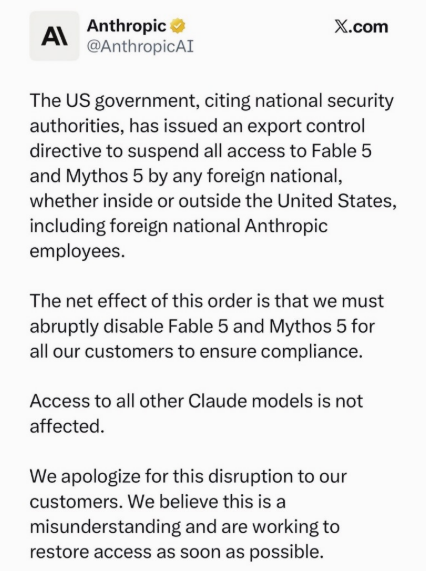
Using its power over technology that could affect national security, the Commerce Department said that anyone outside the U.S. — even Anthropic’s own employees abroad — would need a special license to use Mythos or Fable.
Anthropic’s response was simple: it turned off access to Fable everywhere in the world, for everyone, rather than sort out who had a license and who didn’t.
This was a big deal. Export controls have been used before, but usually for hardware, like advanced computer chips. This was one of the first times they were used to block access to a model — a piece of software — based on where the user happens to live.
OpenAI’s CEO, Sam Altman, didn’t hold back his opinion. He said Anthropic’s approach to marketing its AI as extremely dangerous, while selling protection against that same danger, was a form of “fear-based marketing.”
His bigger point: when a company talks about its AI like it’s a weapon, it becomes much easier for governments to treat it like one — and shut it down.
Whether or not you agree with Altman, one thing is true: countries around the world watched this happen and got nervous. If a U.S. company and the U.S. government can cut off access to AI that fast, what happens if your country isn’t in Washington’s good graces next time?
3. Why This Makes It Hard to Even Compare AI Models
Here’s a side effect nobody expected: it became really hard to measure how good Fable 5 actually is.
Every question sent to Fable 5 first passes through a filter. If the filter thinks the question touches on hacking, biology, chemistry, or AI research, it either refuses to answer or quietly hands the question to a weaker backup model.
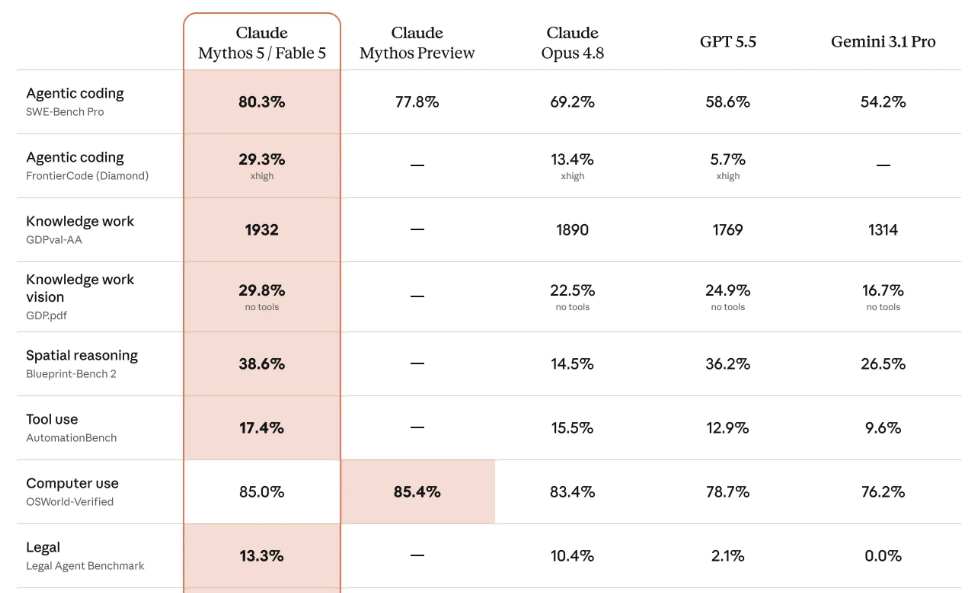
This creates a strange puzzle for anyone testing the model:
- If you count the refusals as failures, Fable 5’s scores crash. On one science test (GPQA Diamond), its score dropped from 93% down to 56% once refusals counted against it.
- If you ignore the refusals and only look at the answers it does give, the scores look great — but that’s not what a real user actually experiences.
So which score is the “true” one? Neither, really. The honest answer is that there’s a gap between what a model can do and what a regular user actually gets to use.
That gap is now something researchers have to measure on its own.
4. Meanwhile, China Is Giving Its AI Away for Free
While the U.S. was tightening the gate, Chinese AI companies were doing the opposite — publishing their models for anyone to download and use, for free. This is called “open-source” or “open weights.”

The numbers are striking. Chinese open-source models now make up close to 30% of all AI use worldwide — up from just over 1% a little more than a year ago. On Hugging Face, a popular site for sharing AI models, China’s Qwen models have been downloaded more than Meta’s Llama models.
Some of the leading Chinese models include:
- DeepSeek-V3 — trained for a fraction of what U.S. models cost, yet strong at math and coding
- Qwen3-Max — from Alibaba, handles huge amounts of text and even images and video
- Kimi K2.6 — very strong at using tools and completing multi-step tasks, and cheap to run
- Doubao Seed 1.6 — from ByteDance, dramatically cheaper to run than Western models
- GLM-4.6 / GLM-5.2 — supports over 26 languages
These aren’t cheap knockoffs. For a lot of everyday tasks, they’re simply good enough — and free to use, with no company able to shut them off.
5. Every Country Wants Its Own AI Now
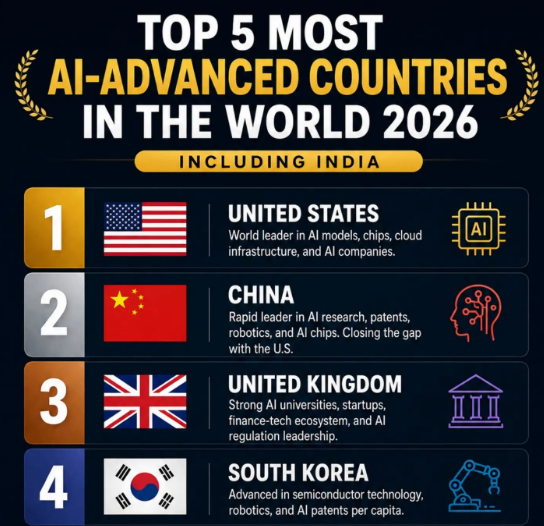
This whole situation has kicked off something researchers call the race for “AI sovereignty” — countries wanting their own AI they fully control, so no outside company or government can take it away.
We’ve actually seen this pattern before:
- When the U.S. limited China’s access to advanced computer chips, China poured money into building its own chip industry.
- When China threatened to limit rare earth minerals (used in electronics), the U.S. rushed to find other sources.
- Now the same thing is happening with AI models.
Countries like France, Germany, India, Japan, Saudi Arabia, and South Korea are all investing in building their own AI models, so they’re not stuck depending on the U.S. or China.
Even U.S. allies are doing this — a clear sign that cutting off access, even briefly, has lasting effects on trust.
6. Nvidia’s Answer: A Huge Open Model, Built in America
In the middle of all this, Nvidia — the company famous for making the computer chips that power AI — released its own free, open model called Nemotron 3 Ultra.

In simple terms, it’s:
- Huge (550 billion total settings, though it only uses a small portion for any single task, which keeps it fast)
- Built with a mix of two different design styles, so it can remember a lot of information (up to 1 million words worth) while still running quickly
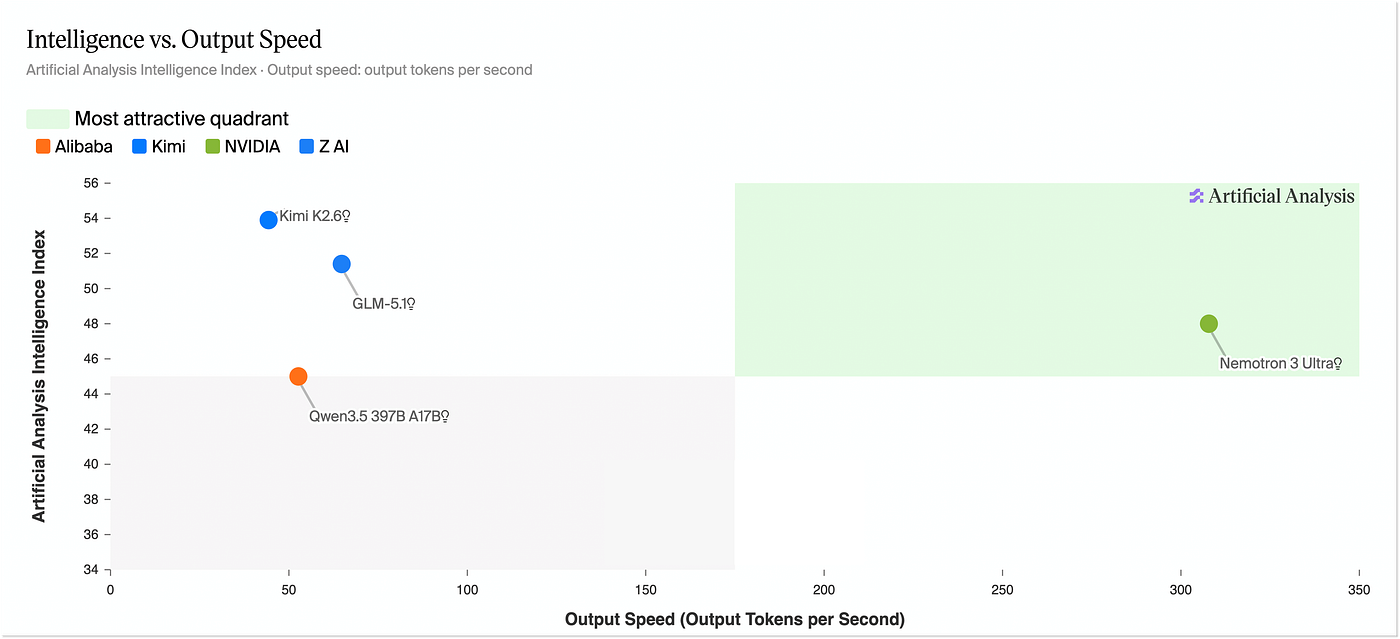
- Very fast — about three times faster than similar open models
- Fully open — Nvidia shared the model itself, plus the recipe and data used to build it
Why would Nvidia do this? Because most of the strongest free AI models lately have come from China. Nvidia wants a strong American option in the mix and it also benefits directly, since more people building AI means more demand for the chips Nvidia sells.
7. A Smarter Way to Train AI: Giving It Hints
While all the politics played out, researchers at Carnegie Mellon University quietly solved a real technical problem in how AI learns.
Here’s the issue. AI models often learn by trial and error — a method called reinforcement learning. The model tries to solve a problem, and if it gets it right, it’s rewarded, which teaches it to do more of that in the future.
But what happens when a problem is so hard that the model never gets it right, not even once? There’s nothing to reward. Learning simply stops.
The researchers built a fix called POPE (Privileged On-Policy Exploration). The idea is simple: give the model a small hint — just the first couple of steps toward the solution, not the whole answer. From there, the model has to figure out the rest completely on its own.
Think of it like a math teacher saying: “Try drawing a triangle here first,” rather than just handing over the finished answer. The student still has to do the actual solving.
But that small nudge makes it possible to succeed at all and once the model succeeds once, reinforcement learning finally has something to work with.
The results were solid. On a tough math competition test (AIME 2025), a model trained with POPE scored 53.1% correct on its first try, compared to 49.6% for the normal training method. On another hard test (HMMT 2025), it jumped from 31.0% to 37.8%.
This matters beyond just math. It means AI can be trained more efficiently, using less computing power, to tackle problems it previously couldn’t touch at all. That’s good news for a world where computing power — and access to the biggest models — isn’t a sure thing for everyone.
8. New Tests for a New Kind of AI
As AI has gotten better, older tests have become too easy. A famous coding test called SWE-bench, once considered very hard, is now regularly aced by top models.
So researchers built harder, more realistic tests:
- DeepSWE — tests whether AI can build real features from a short description, using private, never-before-seen coding problems so the AI can’t just memorize the answer
- ProgramBench — asks AI to build 200 different real programs entirely from an idea, with no model getting close to a perfect score yet
- ITBench-AA — tests whether AI can correctly diagnose what’s broken in a computer system, where missing even one cause counts as a total failure
These new tests are much closer to real work — the kind that takes many steps and can’t be solved with a lucky guess.
The Big Picture
Step back, and a clear pattern shows up across all of this:
- Depending on one company for your AI is risky. Rules can change overnight, and access can be switched off.
- “Safety” rules can sometimes double as competitive weapons. Everyone should watch for this, from both companies and governments.
- Cutting off access speeds up the exact thing it’s trying to prevent. Just like it did with chips and rare earths, restricting AI access is pushing more countries to build their own with less U.S. involvement, not more.
- Free, open AI models are becoming a safety net. If nobody can turn them off, they become the ultimate backup plan.
- Smarter training, like POPE, means real progress doesn’t only belong to whoever has the most computers. Good ideas can close the gap too.
The past two weeks showed how fragile access to powerful AI really is — and how fast the world reacts when that fragility becomes obvious.
The winners going forward likely won’t be whoever has the single most powerful model. They’ll be whoever builds on the sturdiest, most open, and most reliable foundation one that nobody else can pull out from under them.
What’s your take — does this push toward more open AI make the technology safer, or does it just spread the risks around? Drop your thoughts in the comments.
Writing such articles is very time-consuming; show some love and respect by clapping and sharing the article. Happy learning
Follow me for more: https://medium.com/@maxerom
Reach out to me on LinkedIn: https://www.linkedin.com/in/ibrahim-murtaza-5013/
Check out this for more A.I related News and Tutorials: https://medium.com/techcraft-chronicles
Let me know if there is something I missed or I can improve or remove any copyright material.
메타데이터
- post_id
- c60f4ba29f66
- slug
- who-controls-ai-two-wild-weeks-that-changed-the-game-c60f4ba29f66
- url
- https://medium.com/techcraft-chronicles/who-controls-ai-two-wild-weeks-that-changed-the-game-c60f4ba29f66
- canonical_url
- https://medium.com/techcraft-chronicles/who-controls-ai-two-wild-weeks-that-changed-the-game-c60f4ba29f66
- author_url
- https://medium.com/@maxerom
- status
- ok
- fetched_at
- 2026-07-09 05:26:43