Why Automotive Suppliers Are Consolidating Around Complexity
What recent deals say about where the Automotive Tier 1 supplier industry is heading
Why Automotive Suppliers Are Consolidating Around Complexity

What recent deals say about where the Automotive Tier 1 supplier industry is heading
First came Magna & Veoneer, then AAM & GKN became Dauch, now Dana and Eaton. The recent wave of automotive supplier M&As feels less like random consolidation and more like a response to a tougher reality. The supplier business is carrying more technology, more capital burden, more compliance exposure, and more uncertainty than it did a decade ago. Dauch and GKN. Magna and Veoneer Active Safety. Dana and Eaton Mobility. Different companies, different portfolios, different strategic situations. But looking at the pattern of them coming together, I see the same pressure building across the industry. Automotive suppliers are being forced to rethink what they can carry on their own.
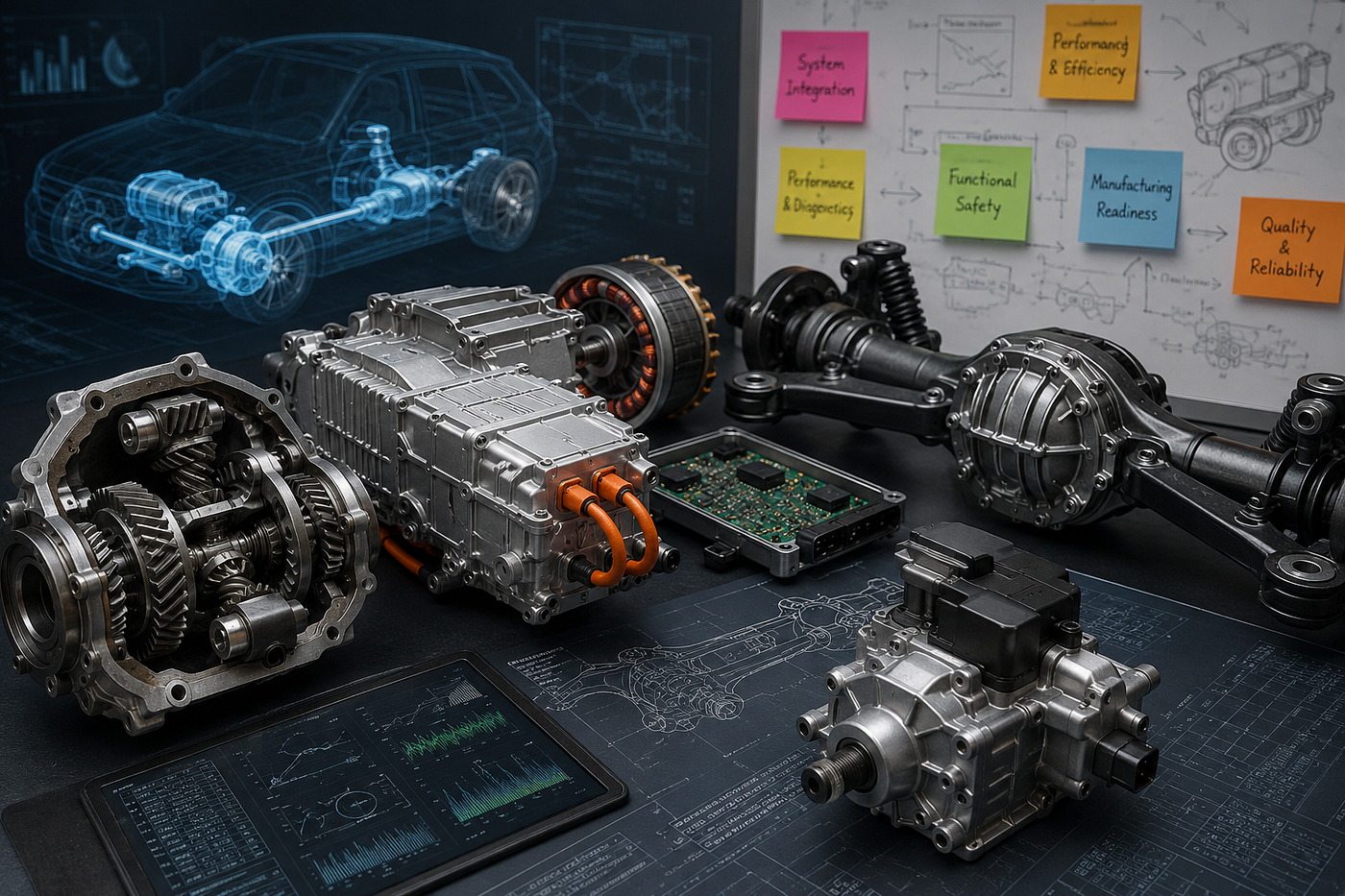
For years, suppliers could win by being excellent in a defined product area. A driveline supplier could focus on driveline. A safety supplier could focus on safety. A powertrain supplier could focus on its own product set. The integration burden was real, but the boundaries were easier to understand. But now, vehicles are more connected across domains. Mechanical, software, electronics, power conversion, thermal behavior, cybersecurity, functional safety, SOTIF, Machine Learning, validation, manufacturing quality, and regulatory evidence all interact. A decision in one area can affect performance, cost, compliance, warranty risk, or customer trust somewhere else. That changes the economics of being a supplier. It is harder to compete with a narrow product view when customers increasingly need system understanding, launch discipline, software maturity, global execution, and the ability to absorb volatility.
Consolidation as a response to pressure
Most acquisitions explained through scale, and scale is part of the story. Larger suppliers can spread fixed costs, negotiate better with suppliers, carry broader engineering investment, and support customers globally.
But what pressure is pushing the industry toward that scale.
A larger balance sheet helps when electrification timing is uneven. It helps when OEM volumes shift. It helps when tariff exposure, inflation, labor cost, and capital requirements are all moving at the same time. It also helps when suppliers need to fund both current programs and future capabilities without knowing exactly how fast the market will transition. They suggest that automotive suppliers are not only trying to grow. They are trying to reposition themselves for a period where uncertainty is expensive.
The EV transition added new complexity
Several years ago, electrification was often described as a simplification of the vehicle. Fewer moving parts. Less mechanical complexity. Cleaner architectures. But the reality is electrification reduced some forms of complexity and introduced even more complexity. High-voltage systems, inverters, e-drives, thermal management, charging behavior, battery interfaces, software controls, safety analysis, cybersecurity, and supplier coordination created new technical and operational burdens. Some EV programs moved quickly. Others slowed. Hybrids regained attention. Commercial vehicles followed a different path. Off-highway and industrial applications moved at their own pace. Internal combustion did not disappear on the schedule some people expected.
For suppliers, that creates a difficult capital allocation problem. They have to support today’s business while investing in tomorrow’s capability. They may need to serve ICE, hybrid, EV, and commercial platforms at the same time. They have to decide where to invest, where to partner, what to acquire, and what to stop funding.
Capability is becoming harder to build quietly
The Magna and Veoneer Active Safety deal is a good example of where the industry is going. Active safety is not only about having sensors or software. It is about integration, validation, system behavior, customer trust, and the ability to support increasingly complex requirements. Those capabilities are expensive to build organically. They require talent, process maturity, tools, data, customer access, and time. Acquisitions can shorten that path, especially when the market is moving faster than internal development cycles.
And they are not and will not be the only ones to do so.
ADAS, safety-critical software, cybersecurity, electrification, thermal management, power electronics, and systems integration will continue to attract attention because they sit close to the future value of the vehicle. Companies that already have pieces of the puzzle will look for the missing ones. Companies with strong niche capability may become more attractive. Companies with good technology but weaker financial position may face pressure to partner, merge, or sell forcing them to adopt a strategy where they become more selective.
It is no longer enough to ask whether a company has revenue as you have to ask whether it owns a capability that will matter more over the next decade.
Portfolio choices are becoming more disciplined
The Eaton Mobility situation is also interesting for another reason. Eaton announced plans to separate its Mobility business to increase focus on Electrical and Aerospace, and then Dana and Eaton announced a transaction combining Dana with Eaton’s Mobility business. Large industrial companies are asking where their capital, leadership attention, and investor story belong. Some businesses may be good businesses, but not the right fit for the parent company’s next phase. Others may become stronger inside a company where they are more central to the strategy.
Companies will not only acquire but will also prune or spin off. They will simplify portfolios. They will move businesses to owners that have a stronger reason to invest in them. They will choose focus when diversification no longer creates enough advantage. In a market this complex, what a company chooses to exit can be as important as what it chooses to buy.
The supplier base is being reshaped by OEM pressure
OEMs are dealing with their own pressures: affordability, EV demand uncertainty, Chinese competition, software investment, regulatory expectations, and the cost of launching multiple propulsion strategies at once. We have seen it several times in one particular OEM. Chrysler becoming Daimler Chrysler then FCA and now Stellantis. That pressure moves down the supply chain. Suppliers feel it through pricing pressure, tougher commercial negotiations, companies diversifying the parts of the work instead of awarding everything to one supplier, or keeping costlier portions in house, volume uncertainty, delayed programs, changing requirements, and higher expectations for quality and compliance evidence. A supplier that is too narrow may struggle to absorb those shocks. A supplier with broader capability, stronger global reach, and better systems maturity may be more useful to customers trying to simplify their own supplier base.
It is the same principle as investors and financial advisors keep telling us. Diversify your portfolio to hedge the market risk.
OEMs do not want complexity without accountability. They want suppliers that can carry more of the system burden, bring credible engineering depth, and execute without constant rescue. That favors suppliers with scale, but only if the scale is matched by real operating capability.
Integration will decide whether these deals work
Every acquisition announcement talks about value creation. There are usually synergy targets, operational efficiencies, purchasing benefits, broader customer reach, or stronger technology positioning. The hard part comes after the announcement. Integration is where strategy becomes real. It is also where many deals lose momentum. Financial experts say 90–95% of M&As fail in integration and synergy creation.
If integration becomes only a cost exercise, companies can damage the capabilities they bought. If every decision is centralized too quickly, technical teams slow down. If processes are harmonized without understanding why they worked locally, the organization can lose speed and judgment. If leadership attention gets absorbed by structure instead of decision flow, the business becomes larger without becoming sharper.
The best integrations preserve what made the acquired capability valuable while removing the inefficiencies that prevent scale. It requires knowing which systems should become common and which areas need local expertise. It requires protecting customer trust while redesigning the operating model. It requires clarity on decision rights, technical ownership, program accountability, quality standards, and talent retention.
The human side matters more than people admit
Consolidation is usually discussed in terms of capital, markets, synergies, and technology. Inside the company, people experience it differently. Roles change. Reporting lines move. Decision rights shift. Some groups gain influence. Others lose proximity to leadership. Processes get renamed, merged, or replaced. People try to understand where they fit and what the new organization values. Of course there are employees on both sides either become worried about their jobs or disgruntled in the process by how things are managed and take with them expertise and in house knowledge, sometimes without sufficient documentation and knowledge transfer. Unfortunately as I discussed in an earlier articles, if the organization is not structure to make talent and leadership material shine correctly, they can be ones who suffer more and leave during such times.
If people become uncertain, decisions slow down. If talent becomes hidden, capability gets wasted. If technical experts are overloaded during integration, quality suffers. If middle leaders are not given clarity, they spend months interpreting the new structure instead of leading through it.
The companies that handle consolidation well will not only integrate systems. They will integrate purpose, decision flow, talent visibility, and operating discipline.
My view on the next phase
I would not be surprised if the next phase of supplier consolidation becomes more capability-led and more selective.
Some companies will look for electrification assets. Others will look for software, controls, safety, cybersecurity, thermal, power electronics, ADAS, or aftermarket strength. Some will use acquisitions to reduce customer concentration or improve regional manufacturing resilience. Others will sell businesses that no longer fit their investor story or capital priorities.
There will also be pressure on smaller suppliers with strong technical capabilities but limited financial strength. Some may remain independent by being highly specialized. Others may become targets because their capability is valuable but difficult to scale alone.
The middle of the market may become more uncomfortable.
Large suppliers can absorb complexity. Highly specialized suppliers can survive if they are truly differentiated. Companies in between may need to choose a clearer position.
What the recent deals suggest
The Dauch, Magna, Dana, and Eaton examples do not all tell the same story. That is what makes them useful to study.
One points toward driveline and metal-forming scale. One points toward active safety and integration capability. One points toward mobility portfolio combination. One points toward industrial portfolio focus. The supplier business is no longer only about winning programs and executing launches. It is increasingly about choosing the right portfolio, funding the right capabilities, managing uncertainty, and integrating complex systems without slowing the organization down.
The suppliers that do well will be the ones that turn size into sharper execution, not heavier bureaucracy. They will know where to centralize and where to preserve technical independence. They will protect expertise while improving operating discipline. They will manage cost without losing the capability customers actually value.
Automotive consolidation is a financial and an operating story and the operating story may be what decides who truly benefits.
메타데이터
- post_id
- c62a2d11b9f9
- slug
- why-automotive-suppliers-are-consolidating-around-complexity-c62a2d11b9f9
- url
- https://medium.com/@mhzaher83/why-automotive-suppliers-are-consolidating-around-complexity-c62a2d11b9f9
- canonical_url
- https://medium.com/@mhzaher83/why-automotive-suppliers-are-consolidating-around-complexity-c62a2d11b9f9
- author_url
- https://medium.com/@mhzaher83
- status
- ok
- fetched_at
- 2026-06-26 21:52:29