The “Kasur Kapuk” Cleanse: Why I Ditched My $2,000 Memory Foam Mattress for a $30 Indonesian Cotton…
For the past decade, the global wellness industry has been running a highly successful multi-billion-dollar campaign convincing us of one…
The “Kasur Kapuk” Cleanse: Why I Ditched My $2,000 Memory Foam Mattress for a $30 Indonesian Cotton Bed
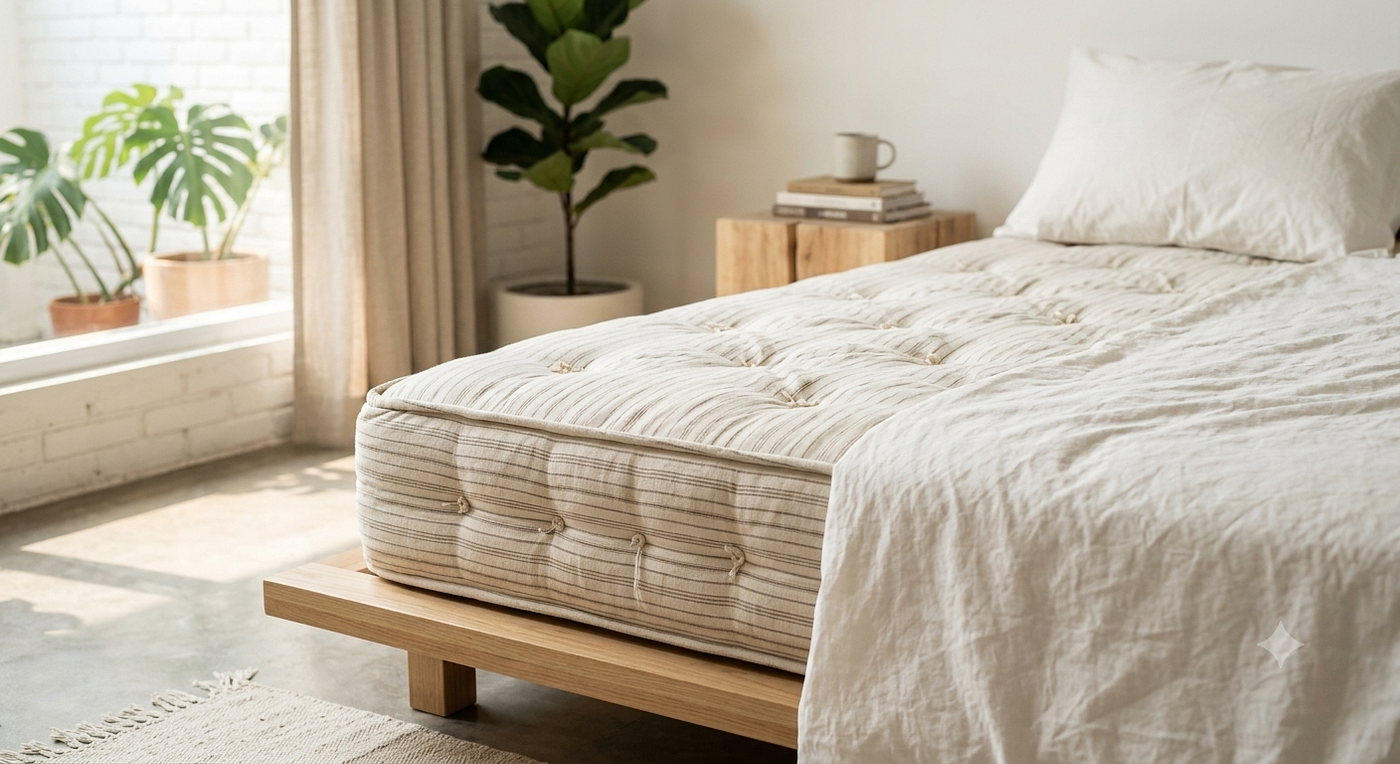
Traditional craftsmanship meets modern minimalism. Can a $30 organic mattress outperform a multi-billion-dollar synthetic industry?
For the past decade, the global wellness industry has been running a highly successful multi-billion-dollar campaign convincing us of one thing: if you want a good night’s sleep, you need space-age technology.
We bought into the hype. We lined the pockets of direct-to-consumer mattress startups. We eagerly brought into our homes heavy, vacuum-packed slabs of multi-layered memory foam, cooling gels, and proprietary polyurethane blends. I was one of those people. I spent nearly $2,000 on a premium, state-of-the-art mattress that promised to contour perfectly to my spine.
For a while, it felt like sleeping on a cloud. But a few years in, the cloud started to feel more like a swamp.
During humid summers, the cooling gel failed, trapping my body heat and leaving me waking up in a sweat. Then came the slight, chemical off-gassing smell that never truly went away. And finally, the realization of what happens to that heavy slab of synthetic chemicals when it eventually sags and needs to be replaced: it goes straight to a landfill, where it will sit for centuries.
Frustrated, I decided to run a radical experiment. I ditched the luxury foam and replaced it with a traditional Indonesian Kasur Kapuk — a humble, hand-tufted mattress stuffed with raw, organic tree cotton. Cost? Roughly $30 at a local market.
What started as a temporary experiment turned into a profound lifestyle shift. Here is the science, the philosophy, and the hard truth about why this $30 heirloom technology outperforms the modern mattress industry.
The Anatomy of Kapuk: Nature’s Micro-Engineered Fiber
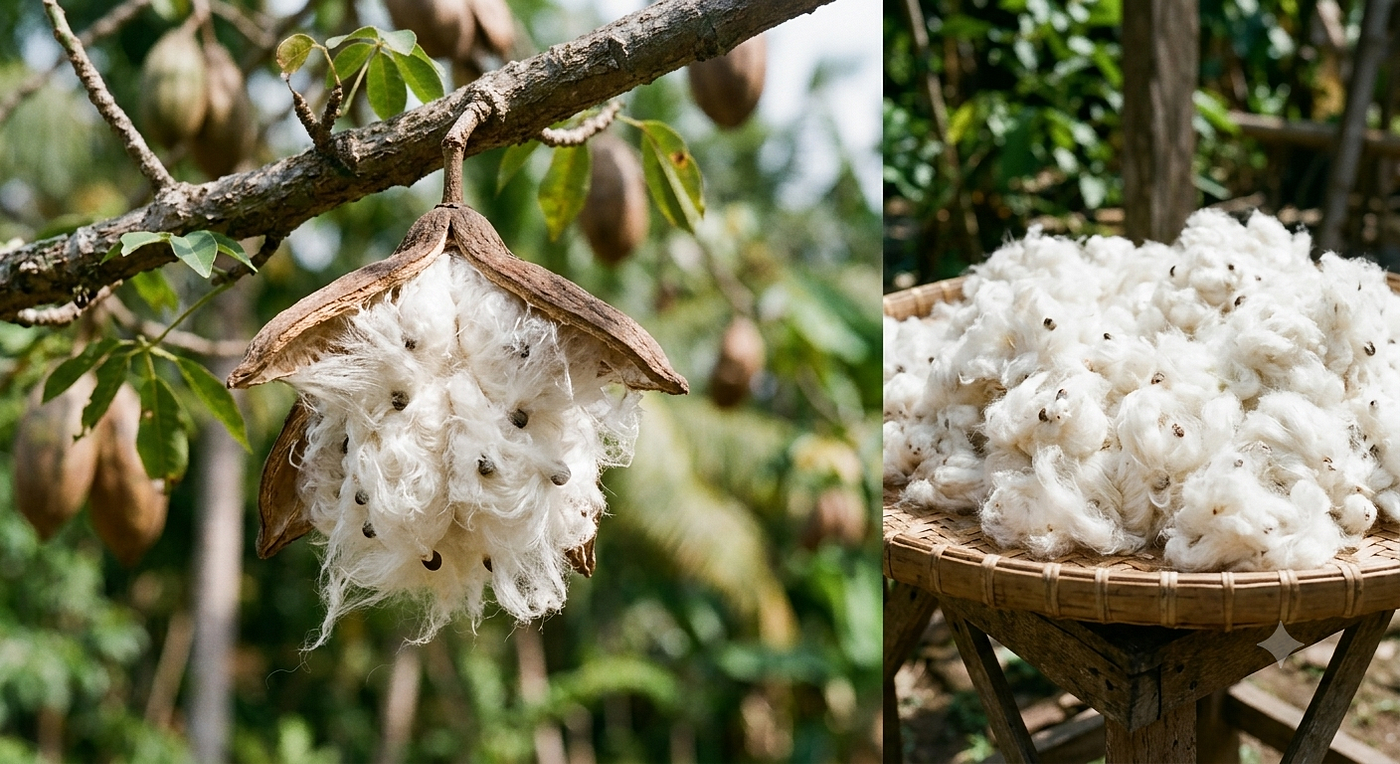
Naturally hollow and 86% air: The raw fiber of the Ceiba pentandra (Kapok) tree functions as a flawless, self-ventilating cooling system
To the untrained eye, a kasur kapuk looks basic, even rustic. But under a microscope, the fiber inside it derived from the pods of the Ceiba pentandra (Kapok) tree is a marvel of natural engineering.
Unlike industrial sheep’s wool or synthetic cotton, kapok fibers are hollow. They consist of about 86% air. This unique structure gives the material two distinct advantages:
- Total Thermal Regulation: Memory foam is notorious for heat retention. It relies on your body heat to soften and contour, effectively trapping that warmth around you. Kapok, being mostly air, acts as a natural ventilator. It breathes continuously, dissipating body heat and moisture instantly.
- Natural Hydrophobicity: Kapok fibers are naturally coated in a waxy substance that repels water. This means it doesn’t absorb sweat, making it highly resistant to mold, mildew, and the dampness that usually ruins synthetic bedding in tropical or humid climates.
The Toxic Elephant in the Bedroom
When we buy a modern mattress, we rarely ask what is inside it. The answer is usually a cocktail of petrochemicals. Polyurethane foam is inherently flammable, meaning most commercial mattresses are treated with chemical flame retardants like polybrominated diphenyl ethers (PBDEs).
While regulations have tightened, many foam mattresses still undergo “off-gassing” — the release of Volatile Organic Compounds (VOCs) into your bedroom air. If you’ve ever unboxed a new mattress and noticed a sharp, chemical odor that lingers for days, you’ve inhaled VOCs.
A kasur kapuk, by contrast, is entirely non-toxic. It requires no chemical treatments, no synthetic glues, and no fire-retardant sprays. It is quite literally grown on trees, harvested by hand, and stuffed into a cotton casing.
The Lifespan Paradox: 3 Years vs. 30 Years
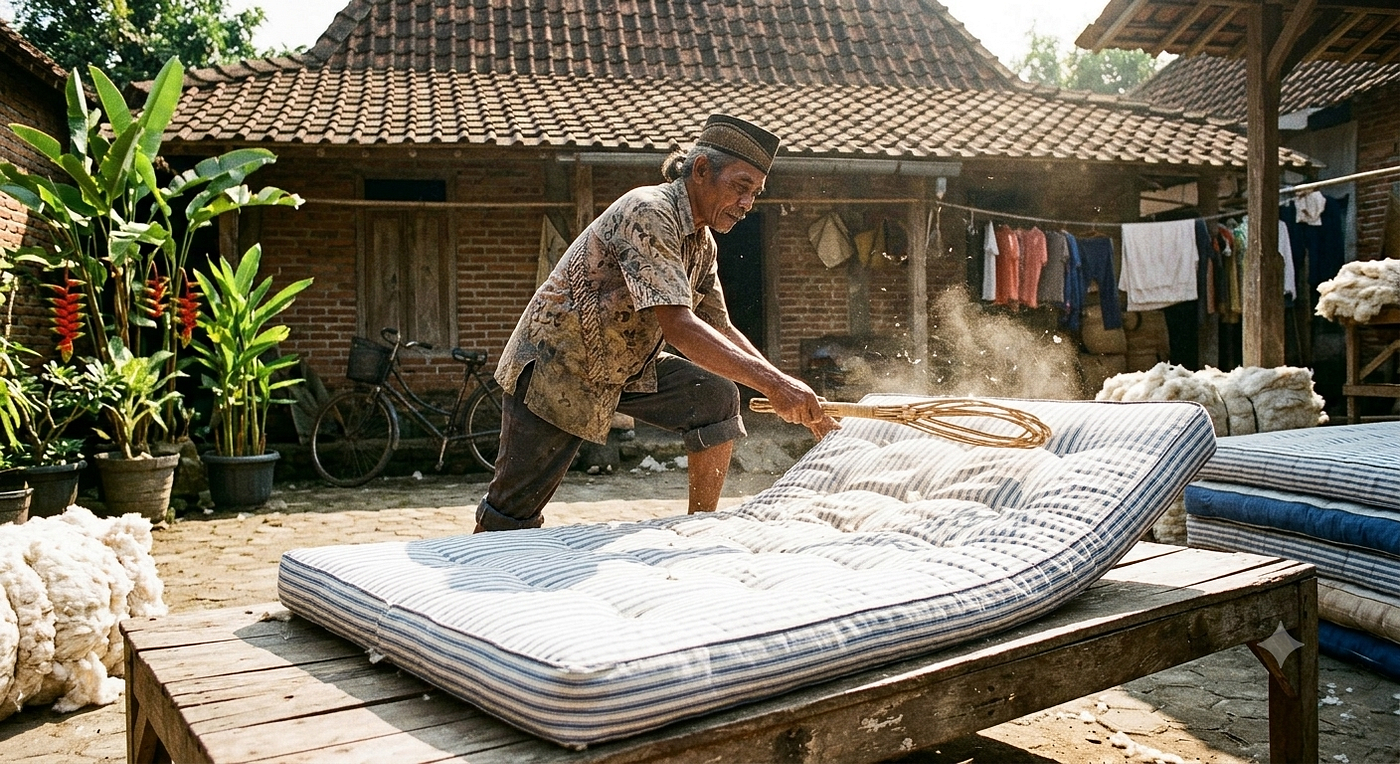
Built to be repaired, not replaced. The circular economy of a local Indonesian mattress artisan fluffing and restoring decades-old fiber.
The modern mattress model is built on planned obsolescence. Foam degrades, loses its elasticity, sags in the middle, and cannot be repaired. When a memory foam mattress dies, its journey ends in a landfill, contributing to the massive global crisis of synthetic waste.
A kasur kapuk follows a completely circular economy.
When a kapuk mattress begins to sag after a few years, you don’t throw it away. In Indonesia, there is a beautiful tradition of “remaking” the mattress. You take it to a local artisan who opens the casing, sun-dries the kapok fibers to restore their natural fluffiness, adds a little fresh kapok if needed, and sews it back up into a pristine, firm bed.
A single batch of kapok fiber can easily last 20 to 30 years, passed down through generations. And if you ever do decide to discard it? It is 100% biodegradable, returning to the earth without leaving a trace of microplastics.
The Adjustment Period: Moving Beyond “Softness”
I won’t romanticize the transition. Switching from memory foam to a kasur kapuk is a shock to the system.
Western sleep culture is obsessed with plush softness. A traditional kapuk mattress is distinctly firm. The first three nights, my body, conditioned to sinking deep into foam, resisted the rigid support.
But by week two, something interesting happened. The chronic lower back stiffness I usually felt in the mornings began to vanish. Because the mattress doesn’t sag under your heaviest parts (your hips), it forces your body into a natural, neutral alignment. It turns out that the “sinking” feeling we associate with luxury is often the very thing causing our muscles to strain overnight to keep our spines straight.
Redefining Luxury in the Modern Era
We have been conditioned to believe that luxury equals complexity, high price tags, and proprietary synthetic technology. But as our bedrooms become increasingly cluttered with plastics and electronic sleep trackers, perhaps true luxury lies in subtraction.
The kasur kapuk isn’t sleek. It doesn’t come in a sleek box delivered by a Silicon Valley unicorn startup. It requires you to occasionally flip it, take it outside, and let it bake under the afternoon sun — a simple ritual that naturally sanitizes the fibers and revives their loft.
But for $30, it offers something a $2,000 mattress never can: absolute chemical purity, superior thermal comfort, a multi-decade lifespan, and the peace of mind that your comfort doesn’t come at the expense of the planet.
What about you? Have we gone too far in prioritizing synthetic comfort over time-tested, natural alternatives? Would you ever trade your high-tech mattress for a traditional, organic bed? Let’s discuss in the comments below.
메타데이터
- post_id
- c62ec19b5a3e
- slug
- the-kasur-kapuk-cleanse-why-i-ditched-my-2-000-memory-foam-mattress-for-a-30-indonesian-cotton-c62ec19b5a3e
- url
- https://medium.com/island-stories/the-kasur-kapuk-cleanse-why-i-ditched-my-2-000-memory-foam-mattress-for-a-30-indonesian-cotton-c62ec19b5a3e
- canonical_url
- https://medium.com/island-stories/the-kasur-kapuk-cleanse-why-i-ditched-my-2-000-memory-foam-mattress-for-a-30-indonesian-cotton-c62ec19b5a3e
- author_url
- https://medium.com/@anisasetiawati
- status
- ok
- fetched_at
- 2026-07-16 03:23:07