What Is RAG (Retrieval-Augmented Generation)? How AI Chatbots Use Your Data
If you’ve ever wondered how tools like ChatGPT can answer questions about your company’s internal documents, your product manuals, or news…
What Is RAG (Retrieval-Augmented Generation)? How AI Chatbots Use Your Data
If you’ve ever wondered how tools like ChatGPT can answer questions about your company’s internal documents, your product manuals, or news that happened after they were trained, the answer usually comes down to one technique: Retrieval-Augmented Generation, or RAG.
In this guide, you’ll learn what RAG is, why it matters, how it works step by step, and where it’s used in the real world.
AI generated image
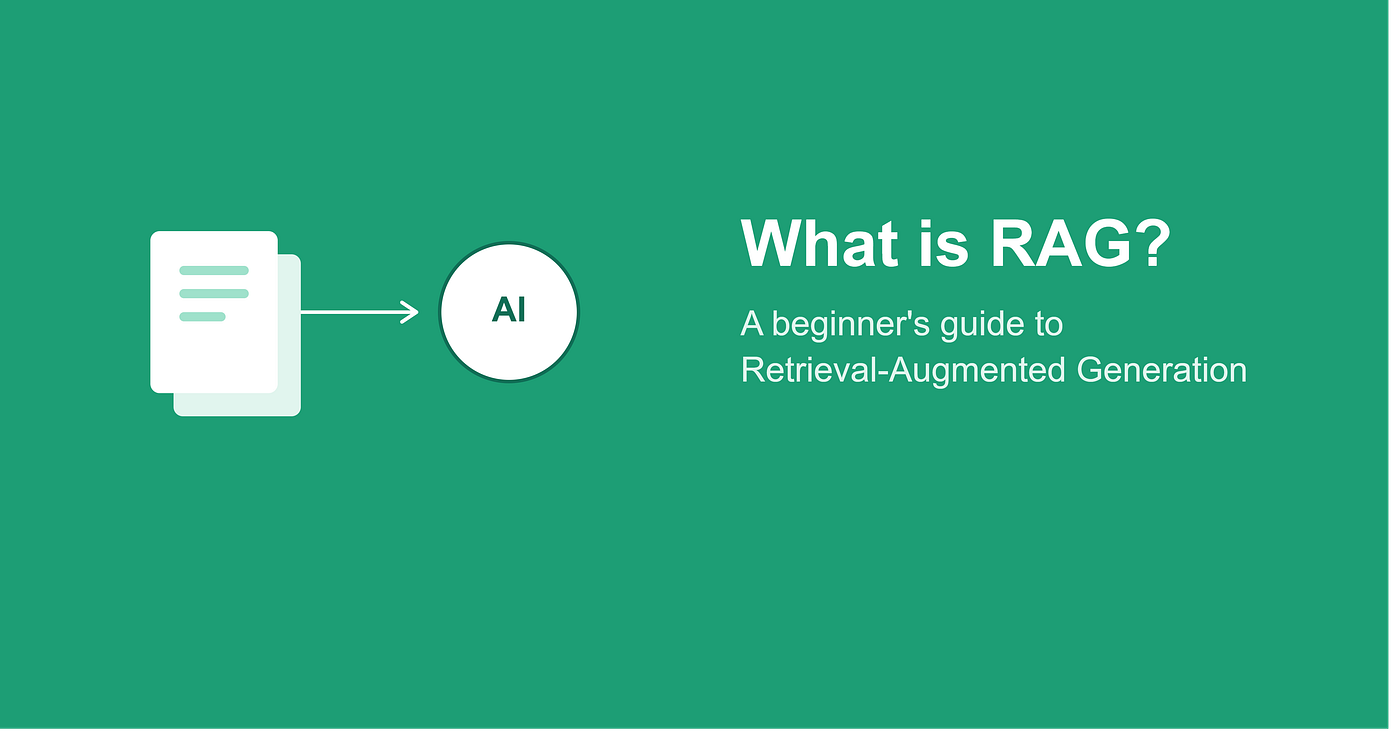
What Is RAG?
RAG stands for Retrieval-Augmented Generation. It’s a method that lets an AI language model look up relevant information before it answers a question, instead of relying only on what it memorized during training.
Think of the difference between a closed-book exam and an open-book exam:
- Without RAG, an AI model answers purely from memory whatever it learned during training.
- With RAG, the model is allowed to “open the book,” search for relevant facts, and then use those facts to write its answer.
This simple shift makes AI systems far more accurate, more current, and much better suited for answering questions about specific, private, or recently updated information.
Why Do AI Models Need RAG?
Large language models (LLMs) are impressive, but they have real limitations. Here’s why RAG has become so essential.
1. Training Data Gets Outdated
Every AI model is trained on a snapshot of data up to a certain point, known as its knowledge cutoff. Anything that happens afterward like a new product launch, an updated policy, a price change, a new regulation is simply unknown to the model unless it’s given that information some other way. RAG solves this by feeding the model fresh, up-to-date content at the moment a question is asked.
2. AI Doesn’t Know Your Private Data
A general-purpose model like ChatGPT has never seen your company’s internal wiki, HR policies, or customer support tickets that data was never part of its training. RAG lets the model search through your own private documents and use them to form an answer, without ever needing to retrain the underlying model.
3. It Reduces Hallucinations
AI models sometimes generate answers that sound confident but are factually wrong. This is called a “hallucination.” Because RAG grounds the model’s response in real source documents, the output tends to be far more reliable, and you can often trace an answer back to the exact document it came from.
4. It’s Cheaper and Faster Than Fine-Tuning
Retraining or fine-tuning a large model to learn new information is slow and expensive. RAG skips that entirely, you just add new documents to a searchable database, and the AI can use them right away. No retraining, no downtime, no massive compute bill.
How RAG Works: Step-by-Step
Let’s break down what actually happens behind the scenes when a RAG-powered system answers a question. We’ll use a simple example: an employee asking a company chatbot, “How many annual leave days do employees get?”
Step 1: Gather the Source Documents
The system starts by collecting documents that contain the answer things like employee handbooks, HR policy PDFs, or internal wikis. These can come from many places: PDFs, Word files, databases, SharePoint, Confluence, or public websites.
Step 2: Break Documents into Chunks
Long documents are split into smaller, bite-sized pieces called “chunks” often just a paragraph or a few sentences. Chunking matters because it’s much easier (and faster) to search through small, focused pieces of text than to scan an entire 50-page PDF every time.
Step 3: Convert Chunks into Embeddings
Each chunk of text is transformed into a list of numbers called an embedding. Embeddings capture the meaning of the text, not just the exact words. This is why a chunk mentioning “vacation days” can still be matched to a question about “annual leave” the system understands they’re conceptually related, even though the wording is different.
Step 4: Store Embeddings in a Vector Database
These embeddings are saved in a specialized storage system called a vector database popular examples include Pinecone, Chroma, Weaviate, Milvus, and FAISS. This database becomes the AI’s searchable knowledge base.
Step 5: The User Asks a Question
When someone types a question, that question is also converted into an embedding, using the exact same process as the document chunks.
Step 6: Semantic Search Finds the Best Match
The system compares the question’s embedding against every stored chunk embedding to find the ones that are closest in meaning. This is called semantic search, and it’s a big upgrade over old-fashioned keyword search, because it understands intent rather than just matching exact words.
Step 7: Relevant Context Is Added to the Prompt
The most relevant chunks are pulled out and inserted into the prompt that gets sent to the AI model, right alongside the original question. For example:
Context: Employees receive 24 annual leave days per year.
Question: How many annual leave days do employees get?
Step 8: The AI Generates a Grounded Answer
Finally, the language model reads both the context and the question, then writes a response based on the actual retrieved facts not just its own memorized training data. The result is an answer like: “Employees are entitled to 24 annual leave days per year, according to company policy.”
A Simple Visual of the RAG Pipeline

RAG Pipeline
Real-World Uses of RAG
RAG isn’t just a theoretical concept, it’s already powering many of the AI tools you interact with daily.
Customer support chatbots use RAG to pull answers from product manuals and FAQs, so responses stay accurate even as products change.
Enterprise knowledge assistants help employees quickly find internal information, like how to request time off or where to find onboarding materials, without digging through shared drives.
Healthcare applications use RAG to search medical research and clinical guidelines, helping professionals access current, reliable information faster.
Legal research tools apply RAG to scan contracts, case law, and regulations, saving lawyers hours of manual document review.
E-commerce platforms use RAG to answer detailed product questions like whether a laptop supports a certain amount of RAM — by retrieving accurate specs straight from the product catalog.
How Tools Like ChatGPT Use RAG with Your Data
When a business builds a custom AI assistant on top of a model like ChatGPT, they almost never retrain the model itself. Instead, they typically:
- Collect and organize their documents.
- Convert them into embeddings.
- Store those embeddings in a vector database.
- Retrieve the most relevant chunks whenever a user asks a question.
- Send that retrieved information to the AI model along with the question.
- Let the model generate a final, grounded answer.
This approach means the company’s data stays under its own control, new information can be added at any time, and there’s no need for costly retraining every time something changes.
Final Thoughts
RAG has quietly become one of the most important building blocks in modern AI applications. Instead of forcing a language model to rely only on what it memorized during training, RAG lets it look things up first much like a person using a search engine or flipping through a reference book before answering a question.
Whether it’s a customer support bot, an internal company assistant, a legal research tool, or a healthcare application, RAG makes it possible to combine the reasoning power of large language models with real, current, and private information.
For anyone starting to learn about AI systems, understanding RAG is a great first step - it’s the concept behind how modern chatbots go from “generally smart” to “actually useful for your specific data.”
메타데이터
- post_id
- c65b0ec1b7cc
- slug
- what-is-rag-retrieval-augmented-generation-how-ai-chatbots-use-your-data-c65b0ec1b7cc
- url
- https://towardsdev.com/what-is-rag-retrieval-augmented-generation-how-ai-chatbots-use-your-data-c65b0ec1b7cc
- canonical_url
- https://towardsdev.com/what-is-rag-retrieval-augmented-generation-how-ai-chatbots-use-your-data-c65b0ec1b7cc
- author_url
- https://medium.com/@isha372002
- status
- ok
- fetched_at
- 2026-07-15 13:22:43