Snowdon and N2 Ski Mountaineering San Juan Mountains, Colorado
David and I pulled up to the Andrews Lake Trailhead off Molas Pass, Colorado at 7:15 thinking we were in for a rough approach due to the…
Snowdon and N2 Ski Mountaineering San Juan Mountains, Colorado

David and I pulled up to the Andrews Lake Trailhead off Molas Pass, Colorado at 7:15 thinking we were in for a rough approach due to the late start. The temperature on the way up the pass showed 45 degrees, and morning sun was streaming into the basin. We decided to still head up the trail and assess the situation up close, and see if the planned ascent up the Naked Lady Couloir was still feasible. After some quick gear adjustments at the car, we donned our heavy packs and headed up the trail at an expedient pace.

After about 45 minutes crossing only a few small patches of snow and plenty of soggy subalpine tarn, we were able to make it to the rock glacier and debris apron below the peak and the start of more consistent snow. We breathed a sigh of relief as we started across the snow in trail runners and found it to be plenty firm to walk on without skis, as David had unfortunately forgotten his skins.

Within 10 minutes we were throwing on our ski boots and crampons at the bottom of the couloir, and starting upwards. We were making good time and found the American crampon technique to be most efficient in the ~45-degree lower reaches of the shady couloir on firm snow.

In the upper reaches of the gully, the slope steepened to about 55 degrees. On this thin coverage icy 200’ of gully, we brought out our second tools and intermittently “high daggered” up to the headwall. A second ice axe wasn’t mandatory by any means, but allowed for a bit more speed and confidence.


From here, a short class 3 scramble in ski boots and crampons brought us to an airy ridge, and into a small dihedral to the summit ridge. I expected this section to be a bit tougher, but that is highly dependent on snow coverage and the climber’s comfort level with exposure and scrambling in crampons. I had to admit I was a bit rusty!

The summit offered expansive panoramas of the heart of the Weminuche Wilderness, including the Grenadiers, Chicago Basin, and the snowy north slopes of the Twilight Group. The air was still and the sun beaming. Deciding that the ice and poor skiing conditions in the couloir weren’t worth skiing, we didn’t allow much time to linger and decided to get across to N2 before the snow softened too much on the traverse or the descent. The ridge fortunately was almost completely melted out and provided excellent conditions for scrambling the remainder of the route.


David scrambling up the far side of notch 1 (l) and Kurt following up the same line (r).
Coming into notch number one, we opted to stay true to the ridge before following an obvious descent line slightly eastward and into the gully, then ascending an airy gendarme (class 3–4). From here to the second notch was easy low exposure talus.

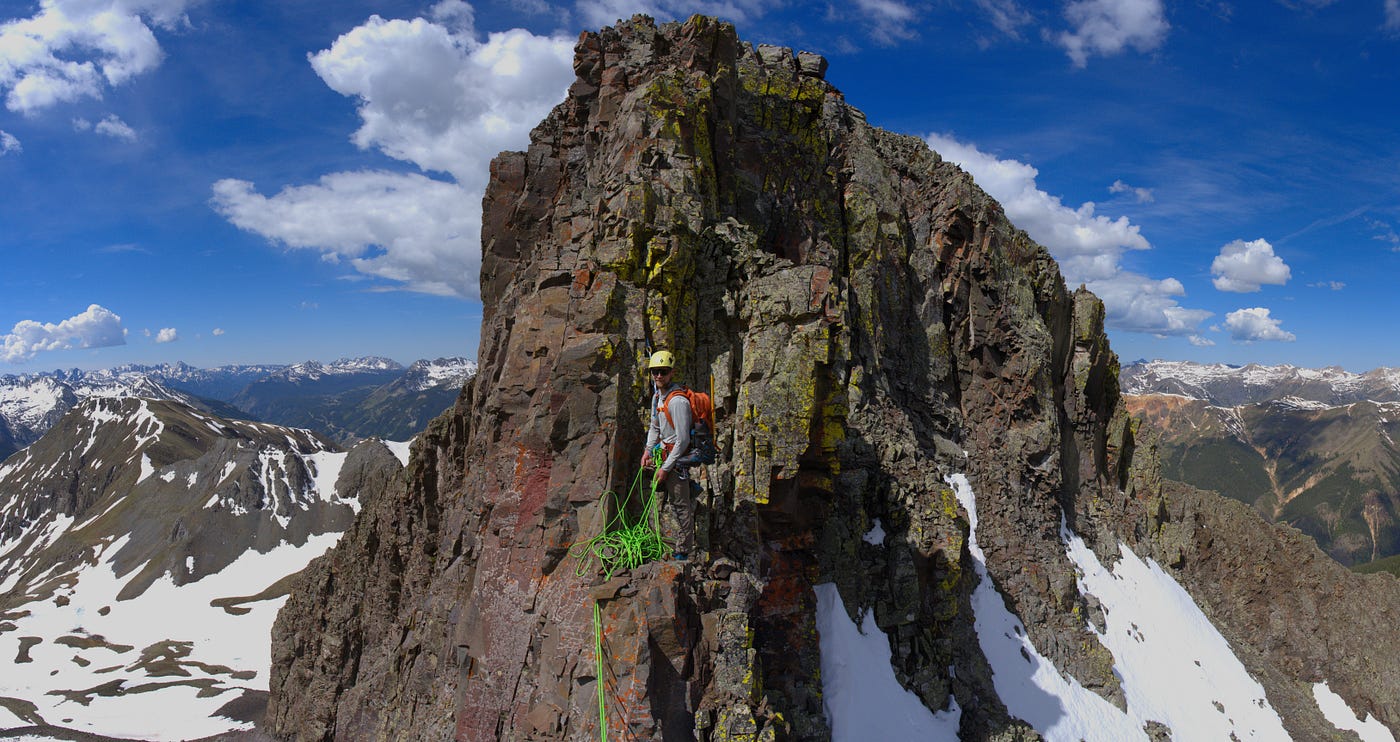
David standing above notch 2, with some of the 4th class scrambling and ledge route in red. The class 4/5 crux is around the corner, out of view
At the second notch, we were met with some fun route finding and descent possibilities. We dropped a very short distance west, and descended a short but vertical section of class 4/5 to the notch. Alternatively, you could drop west on the talus field visible on satellite imagery back up the ridge, and ascend the gentle 2nd class talus on the west slopes of N2 after circumventing the entire remainder of the ridge. We opted for something a bit spicier.

David traversing a small ledge past notch 2 (l) then starting to ascend the arête (r).
From the bottom of the notch, we planned a route up the obvious arête in front of us after a short ledge traverse. David started up first, knowing I wanted to snap some photos with him on the climb for scale. It quickly became apparent that this (relatively) short ascent was low 5th class, which became interesting with skis on our packs. I followed up a slightly different route, moving off a ledge promptly as David noted he was about to progress through a loose zone above me. This immediately proved the importance of communication and situational awareness, as a soccer ball sized rock and debris fell 20 feet and hit the ledge I had been standing on seconds earlier with a thud before thundering down the cliff.
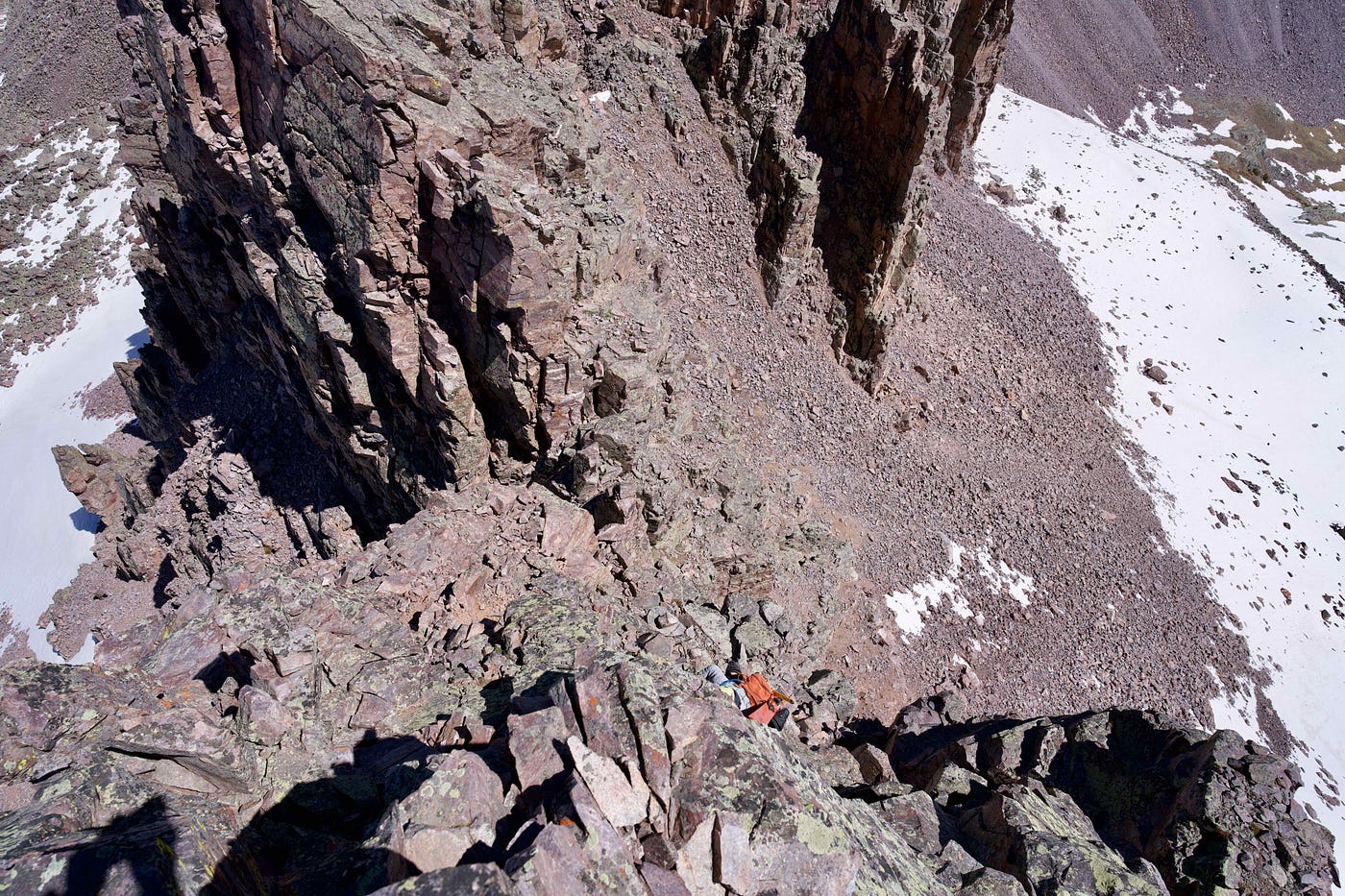

David climbing the class 4/5 crux, the descent into notch 2 visible above him (r).
Sticking to the arête proper proved to be the easier, though airier line. As I passed David’s elevation, I found myself looking through a gap in the rock and seeing daylight and air, then perched on an exposed narrow rib. Immediately beyond this, the ridge widened and mellowed to class 2, and the summit was a short jaunt away to the south.
We tested the snow, and found to our delight that it was very nice spring corn. We prepped our gear, donned our skis, and descended the moderate west slope of N2 on weaving bands of snow to just above where we had put our crampons on in the morning. The descent was worth every bit of effort, and was the icing on the cake. There is nothing like skiing down a mountain looking at the rest of the world apparently mid-summer far below.

GPX track of the route. Distance is 7.5 miles and elevation 2851' — the track wasn’t initiated until about a mile in.
Debrief: The scrambling through most of this route was fun high-quality quartzite, offering good protection. I would be comfortable with an alpine rack and full set of nuts and a short rope to protect the tougher sections. David and I both agreed we would have taken a quick belay through here. Rappels would likely be largely unnecessary except perhaps on descent into the second notch. Perhaps the preferable way to protect the descent here would be down leading, allowing you to take a very short rope (I think 30–40m would be plenty) and still retain effective protection and minimal weight. This was a missed opportunity to practice alpine rope work.
We both agreed that we were at the tail end of spring conditions with very thin snow. We would opt for leaving the avalanche gear behind to shed weight, perhaps replacing it with my 50m Beal Gully rope and a stripped down ultralight alpine technical gear rack.
Mental map the most continuous snow and how you want to route your descent, then take a photo of it somewhere with the best view. We popped skis and put on runners to go across a stretch of dry rock, but suffered getting back on snow that had been in sun all morning. We post holed to our waists for 1/8th to 1/4 mile back to where we put crampons on earlier in the day. In hindsight, it would have been good to just keep the boots on a bit longer and have been able to ski these segments.
My nemesis has been getting enough carbs. I assessed my hydration needs well, but due to the scrambling, mental involvement, and a bit of time pressure, I didn’t eat as many solids as I prefer. The flip side is that this was a very short day for my current stamina levels, and I could have left some food to shed more weight and been okay, but with little safety margin.
Gear: Black Diamond 33l Climbing pack (great for technical higher gear volume days, too heavy otherwise) La Sportiva Kilo ski boots (excellent progressive flex, range of motion, light weight)
- Blizzard LT80 mountaineering skis (brand new, I enjoyed the edge hold and stiff flex)
- Ski Trab Titan Vario Bindings & Leashes (very damp and secure) Dynafit Speed Vario 2.0 Pole (light weight and seem to be solid for carbon poles) Petzl Lynx crampons (I prefer automatic crampons w/vertical points)
- 3L CamelBak bladder w/1.75l (the most reliable I have found across many brands)
- Sun glasses (always critical) *Orange quarter zip columbia sun shirt (perfect for the calm warm day and for visibility)
- Black Diamond Ghost Whisperer Down hooded jacket (Critical safety item)
- Blue Ice 50cm Hummingbird Ice axe (Fantastic lightweight second tool for high dagger in snow)
- HMG camera pod (great for protecting camera and keeping it handy)
- A7CR & 40mm F/2.5 lens (Great camera. Lens a bit narrow but high quality)
- Medium weight Mountain Hardwear gloves (useful keeping skin away from cold ice axe metal)
- Dynafit Sky Pro GTX gaitered mountain runners (excellent for keeping scree and snow out)
- Mammut Hiking softshell pants (Adequate. the search continues)
- Pared down first aid kit w gear repair items and Katadyn Aqua Tabs (these have proven to be very valuable)
Unused Items Today:
- Arc’teryx Squamish wind breaker
- Balaclava
- Ski Crampons
- Pomoca Ski Skins
- Marmot Helium rain jacket
Unsolicited Advice:
Gear is cheap, your life is not. If the situation demands gear be purchased for a climb or left in a crack on the mountain, don’t give it a second thought and do what is needed to give you the greatest chance of going home alive.
메타데이터
- post_id
- c6746ca44a04
- slug
- snowdon-and-n2-ski-mountaineering-san-juan-mountains-colorado-c6746ca44a04
- url
- https://medium.com/@kurttagliareni/snowdon-and-n2-ski-mountaineering-san-juan-mountains-colorado-c6746ca44a04
- canonical_url
- https://medium.com/@kurttagliareni/snowdon-and-n2-ski-mountaineering-san-juan-mountains-colorado-c6746ca44a04
- author_url
- https://medium.com/@kurttagliareni
- status
- ok
- fetched_at
- 2026-06-09 15:37:30