Environmental DNA: From Innovation to Policy, and What Comes Next
By Elizabeth Weller, Science & Policy Exchange
Environmental DNA: From Innovation to Policy, and What Comes Next
By Elizabeth Weller, Science & Policy Exchange
Edited by: Julian Lau
You may not realize it, but everywhere you go, you leave behind a piece of yourself, literally. All organisms continuously shed genetic material into their surroundings in the form of environmental DNA (eDNA) and RNA (eRNA). Together, these are known as environmental nucleic acids (eNA). While eNAs are often associated with forensic science, it has quietly become one of the most powerful emerging tools in environmental and health research. By collecting traces of this “genetic footprint” from water, soil, or even air, scientists can detect life without ever needing to see or disturb it. For policymakers, this shift is more than just a scientific advance, it revolutionizes our understanding of observing and managing the natural world. These molecular traces can reveal which species are present or absent in an ecosystem, monitor the spread of pathogens before outbreaks escalate, reconstruct past ecological communities, and even provide early warning signals of environmental stress or pollution. From biodiversity monitoring to public health surveillance and biosecurity, eDNA and eRNA offer a scalable, non-invasive approach to gathering the kind of data that has traditionally been costly, time-consuming, or simply impossible to obtain.
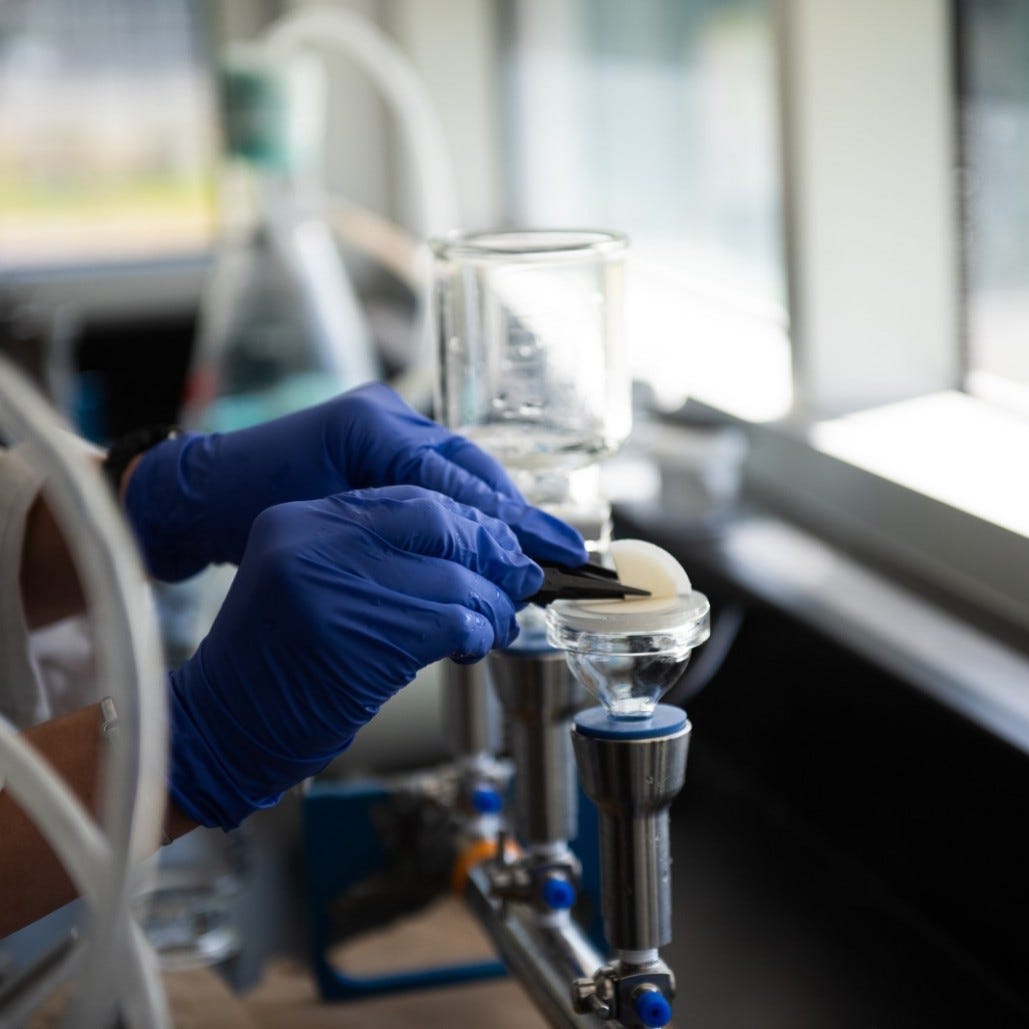
Photo of McGill University researchers Liz Weller and Simone Miklosi collecting eRNA samples from lake water at Gault Nature Reserve (Photo: Alex Tran)
Over the past couple decades, research in this area has surged. eDNA studies have followed a clear exponential trajectory, growing from fewer than 10 publications annually in 2008 to over 600 by 2024 (Sahu et al., 2025). This represents an approximate 5,900% increase in annual output over 15 years. In contrast, eRNA research is an emerging but still limited field. A 2025 synthesis identified only 77 eRNA-related studies to date, meaning eRNA output currently represents less than 2% of the total environmental nucleic acid literature (Zou et al., 2025). While eRNA publications have grown rapidly in recent years, increasing by over 400% between 2021 and 2025, the majority of this work remains in the experimental phase, with roughly 90% of studies conducted under controlled laboratory conditions rather than in natural freshwater systems (Zou et al., 2025). But why is there a gap in the current literature between eDNAs and eRNAs? The difference lies in key structural characteristics of eDNA and eRNA. eDNA is more stable than eRNA, meaning it can survive in the environment long-term (days to weeks), while eRNA degrades rapidly in the environment (minutes to hours) (Marshall et al., 2021). Additionally, to study eRNA, scientists must convert the eRNA back to DNA for processing, increasing the cost of each eRNA sample. As a result, it is much more practical for scientists to study eDNA in the environment. However, eRNA is still critical in providing information to scientists and policymakers. While the long-term presence of eDNA tells us what has happened and what may be present, eRNA reveals what is happening and is currently present in that environment, capturing key transient signals linked to activity, stress, and biological function (Yates et al., 2021). Together, they offer a powerful continuum, moving from detection to interpretation, and from presence to process.
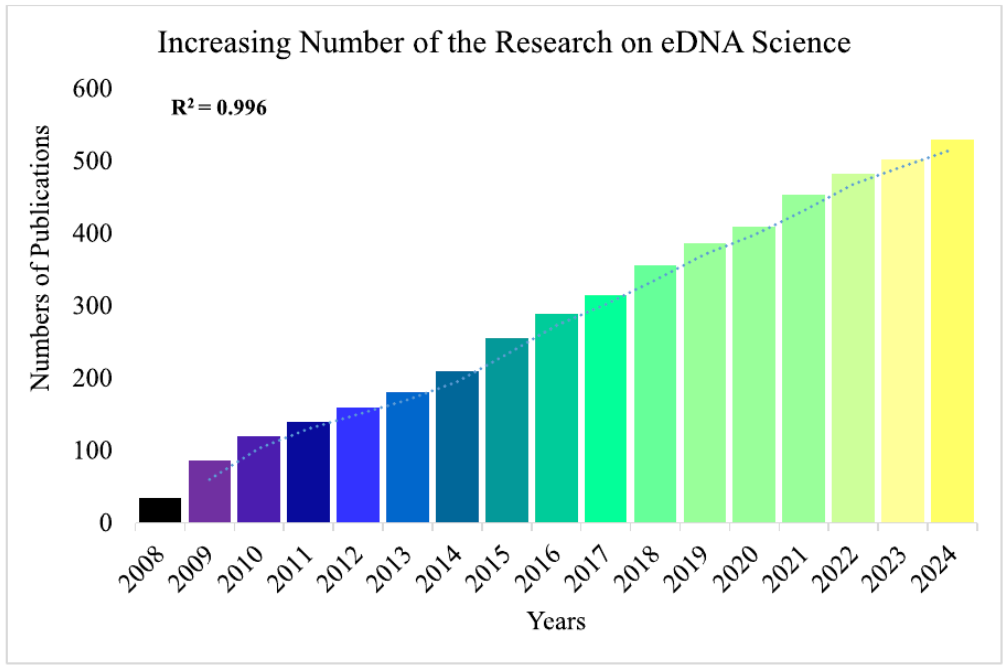
Graph presenting the cumulative number of eDNA studies increasing year by year (Sahu et al., 2025).
In response to this rapid growth and surge of interest in eNA research, many countries around the world have begun significantly investing in establishing initiatives and infrastructure to support eNA research and implementation. Canada offers a prime example of this, having begun building infrastructure needed to integrate eNAs into real-world decision-making. This foundation was first established through the federal Genomics Research and Development Initiative (GRDI), which from 1999 to 2019 delivered high-quality research and development (R&D) solutions across six phases to implement eDNA on a national scale. Phase 6 (2014–2019) marked a turning point, launching key eDNA applications including the detection of colonizing aquatic organisms to track species, the development of tools for aquatic invasive species (AIS) and species at risk, and the evaluation of portable eDNA detection devices to enable rapid, on-site responses. This early investment in applied science quickly transitioned into national strategy, with the 2019 framework outlining priority needs for Fisheries and Oceans Canada (Baillie et al., 2019), followed by the establishment of standardized reporting and assay protocols through CSA W214 (2021) and CSA W219 (2023) (CSA W214:21; CSA W219:23). From there, implementation accelerated. In 2020, the Canadian Food Inspection Agency integrated eDNA into near real-time pathogen detection (Canadian Food Inspection Agency, 2020), while Parks Canada incorporated it into routine biodiversity monitoring by 2024, including applications such as Bull Trout detection to inform habitat models. This trajectory culminated in 2025 with Genome Canada’s $11.3M eDNA Surveillance Initiative, funding 12 regional projects, including PrairieDNA and Biodiversity: Assessing eDNA as an aid to surveillance (BADAS), to build national monitoring capacity. By 2026, federal and provincial investments, including Quebec’s “Wealth Creation” package, have positioned eDNA as both an environmental and economic priority, with substantial funding directed towards innovation (Ministère des Finances, 2026). At the same time, eRNA remains in the early stages of implementation, with most applications still being explored rather than widely deployed. While efforts at key eRNA research hubs in Canada such as McGill University (Morgado‐Gamero et al., 2025), University of Waterloo, and University of Guelph are still ongoing, they are showing promise in detecting active biological signals, such as live pathogens and organismal stress. However, progress on a national scale is limited by a lack of standardized methods and sustained funding. This creates a critical gap: without large-scale implementation there is limited evidence, and without strong evidence, investment and policy adoption remain slow.
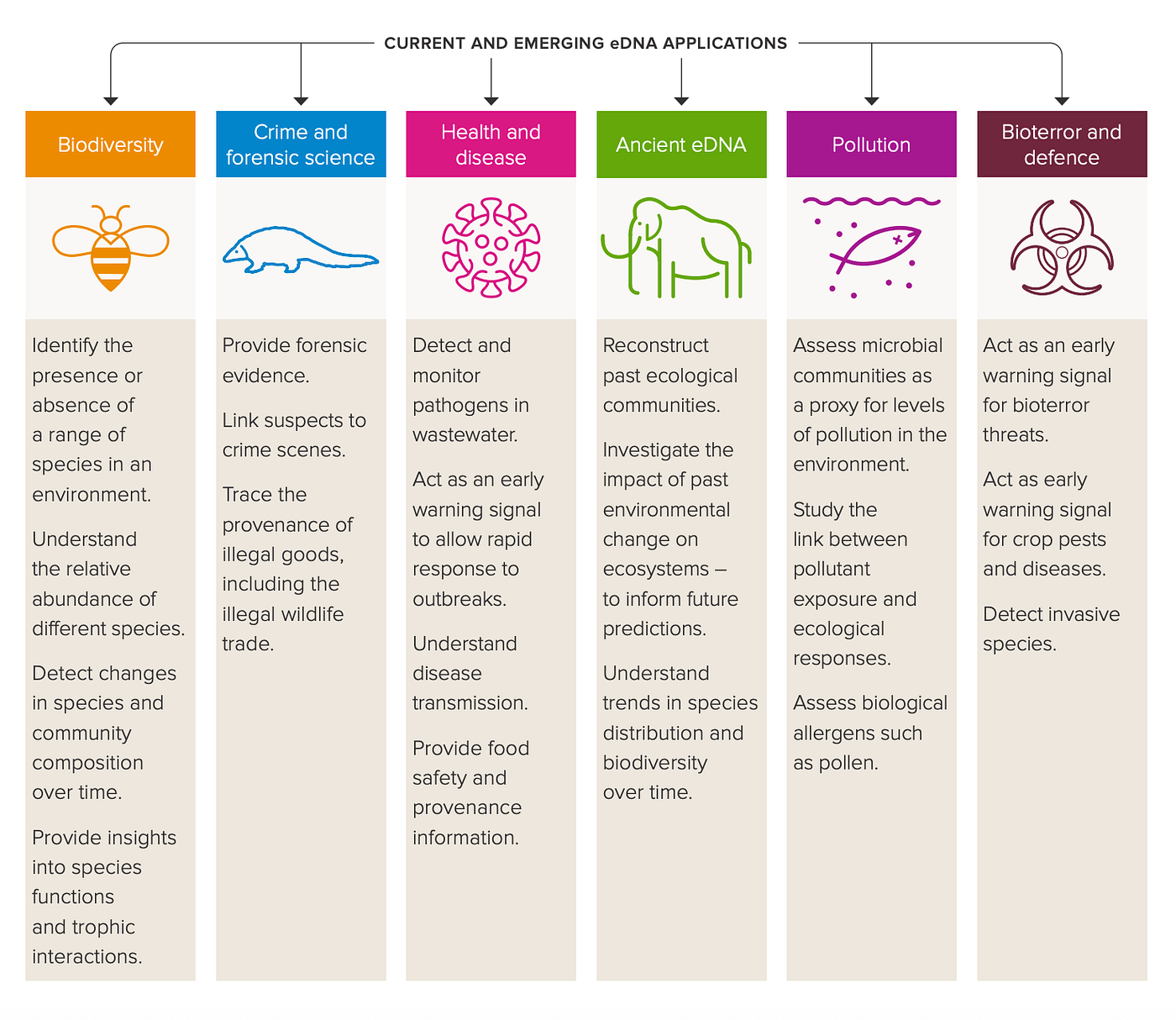
A summary of the current and emerging policy-relevant applications of eDNA (The Royal Society)
The question is no longer whether eNAs can inform policy, but how to build the infrastructure needed to efficiently integrate them into the decision-making process of policymakers. eDNA provides a clear example of this transition, where sustained growth in publications enabled method development, field validation, and standardization, ultimately supporting the creation of large-scale monitoring programs now being adopted into policy. We are now seeing a similar story unfold, just in an earlier chapter, for eRNA. Despite its potential to provide more dynamic insight into biological activity, stress, and active health threats, its smaller research base and limited number of standardized, field-tested applications continue to constrain its use beyond pilot studies. However, Canada’s experience shows how this progression can succeed: research leads to validation, validation to standards, and standards to policy. New tools will follow that same sequence. What sets Canada apart is its ability to sustain that progression, turning emerging science into systems that can be used consistently. Without it, innovation stalls; with it, environmental nucleic acids become part of everyday environmental monitoring.
References
Baillie, S. M., McGowan, C., May-McNally, S., Leggatt, R., Sutherland, B. J., & Robinson, S. (2019). Environmental DNA and its applications to Fisheries and Oceans Canada: National needs and priorities. Fisheries and Oceans Canada.
Canadian Food Inspection Agency. (2020). eDNA: Another tool in the toolbox. Government of Canada. https://inspection.canada.ca/en/inspect-and-protect/animal-health/
CSA Group. (2019). Performance criteria for the analyses of environmental DNA by targeted quantitative polymerase chain reaction (Standard No. CSA W219:23).
Marshall, N. T., Vanderploeg, H. A., & Chaganti, S. R. (2021). Environmental (e) RNA advances the reliability of eDNA by predicting its age. Scientific Reports, 11(1), Article 2769. doi.org
Ministère des Finances. (2026). Budget 2026–2027: Budget plan. Government of Quebec. gouv.qc.ca
Morgado‐Gamero, W. B., Tournayre, O., & Cristescu, M. E. (2025). Comparative decay dynamics and detectability of eDNA and eRNA in connected and isolated freshwater mesocosms using digital PCR. Molecular Ecology Resources, 25(8), Article e70028. doi.org
Sahu, A., Singh, M., Amin, A., Malik, M. M., Qadri, S. N., Abubakr, A., … & Ahmad, I. (2025). A systematic review on environmental DNA (eDNA) science: An eco-friendly survey method for conservation and restoration of fragile ecosystems. Ecological Indicators, 173, Article 113441. doi.org
Yates, M. C., Derry, A. M., & Cristescu, M. E. (2021). Environmental RNA: A revolution in ecological resolution?. Trends in Ecology & Evolution, 36(7), 601–609. doi.org
Zou, N., Wang, S., Qiu, W., Kong, W., Wang, G., & Wang, S. (2025). Environmental RNA as a transformative tool for aquatic ecosystem health assessment: Progress and challenges. Ecological Indicators, 180, Article 114328. doi.org
메타데이터
- post_id
- c67910df2df4
- slug
- environmental-dna-from-innovation-to-policy-and-what-comes-next-c67910df2df4
- url
- https://medium.com/@dsp-spe/environmental-dna-from-innovation-to-policy-and-what-comes-next-c67910df2df4
- canonical_url
- https://medium.com/@dsp-spe/environmental-dna-from-innovation-to-policy-and-what-comes-next-c67910df2df4
- author_url
- https://medium.com/@dsp-spe
- status
- ok
- fetched_at
- 2026-06-13 09:42:26