He Fought Over 60 Duels and Never Lost Once. The Impossible Life of Miyamoto Musashi.
Most people peak at one thing in their lifetime. Miyamoto Musashi became the greatest swordsman in Japanese history, a celebrated painter…
He Fought Over 60 Duels and Never Lost Once. The Impossible Life of Miyamoto Musashi.
Most people peak at one thing in their lifetime. Miyamoto Musashi became the greatest swordsman in Japanese history, a celebrated painter, a sculptor, a philosopher, and the author of a strategy book still read by CEOs and military commanders today. He was one man. And he did all of this — starting from nothing.
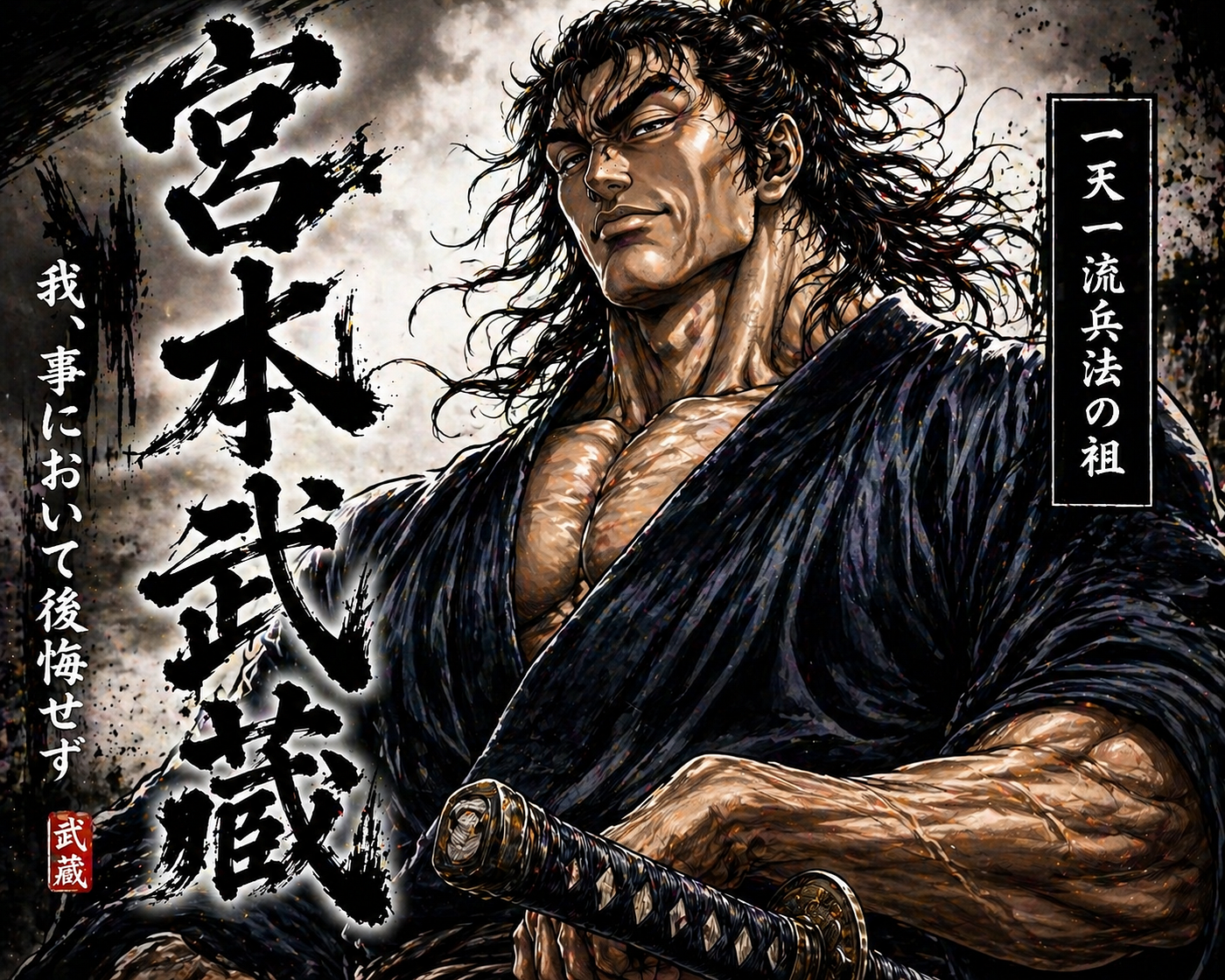
A Boy With Nothing to Lose
The story begins in 1584, in a small village in western Japan.
Musashi’s early life was not easy. His mother died when he was young. His father — himself a skilled martial artist — either died or abandoned him, depending on which historical account you read. By the time Musashi was seven years old, he was essentially alone, raised by an uncle who was a Buddhist monk.
He was not a child of privilege. He had no powerful lord, no famous family name, no network of connections. He had only one thing: an obsession with swordsmanship that bordered on madness.
At the age of thirteen, he fought his first duel.
His opponent was a grown man named Arima Kihei — a traveling swordsman with a fearsome reputation who had challenged anyone in the region to fight him. Nobody took the challenge seriously when a scrawny thirteen-year-old stepped forward.
Musashi beat him so badly that the man died.
A legend had just been born — and it had no idea what it was yet.
The Road of a Thousand Fights
After that first duel, Musashi made a decision that shaped the rest of his life.
He left home and became a musha shugyō — a warrior on a pilgrimage. This was a tradition in samurai culture: a fighter who traveled the country alone, seeking out the strongest opponents, learning through real combat rather than practice.
No school. No teacher. No comfort.
Just the road, the sword, and whatever he encountered.
Over the next two decades, Musashi fought in real battles — including the massive Battle of Sekigahara in 1600, one of the most important military engagements in Japanese history, where over 160,000 soldiers clashed in a single day. He survived. His side lost. He disappeared into the mountains and kept moving.
He also fought individual duels — dozens of them, against some of the most skilled swordsmen in Japan.
His official record: over 60 duels. Zero defeats.
Not one loss. In over 60 life-or-death fights.
To understand how extraordinary this is, consider that even the second or third greatest swordsman of any era loses sometimes. Everybody does. Musashi simply didn’t. Historians and martial artists have debated for centuries how this was possible.
Part of the answer lies in how differently Musashi thought about fighting.
The Man Who Broke All the Rules
Most swordsmen of Musashi’s era followed strict schools of technique. There were established forms, established footwork, established ways of holding the sword. You studied a school. You mastered its curriculum. You fought within its framework.
Musashi didn’t belong to any school. He observed them all, took what worked, discarded what didn’t, and invented his own approach entirely.
His most famous innovation: Niten Ichi-ryū — the “Two Heavens as One” style. Fighting with two swords simultaneously — one long katana in one hand, one short wakizashi in the other.
This sounds simple. It was, in practice, almost impossibly difficult. Using two swords effectively requires a completely different kind of body coordination and spatial awareness. Most trained swordsmen who tried it found it worse than using one.
Musashi made it look inevitable.
He was also deeply unconventional in his behavior. He famously showed up to duels late — sometimes hours late — to unsettle his opponents psychologically. He arrived dirty and unkempt, dressed like a wandering peasant, when the tradition called for formal attire.
His most famous duel — against Sasaki Kojirō, considered by many to be the second greatest swordsman in Japan — took place on a small island in 1612. Musashi arrived by boat, nearly two hours late, seemingly half-asleep, having carved his wooden sword from an oar while crossing the water.
Kojirō was furious. He had been waiting for hours, perfectly prepared, perfectly composed.
Musashi killed him in a single strike.
Whether the lateness was deliberate psychological warfare or simply Musashi being Musashi — no one knows for certain. But the result was the same.
The Sword Retires. The Brush Takes Over.
Here is where Musashi’s story takes its most surprising turn.
At around the age of 50, Musashi stopped fighting duels.
Not because he was afraid. Not because he had lost his skill. He had simply gone as far as the sword could take him — and he knew it. His attention shifted.
He began to paint.
And he was extraordinary at that too.
Musashi’s ink paintings — done in the spare, minimalist style of Zen Buddhism — are now considered national treasures in Japan. His most famous works depict birds, landscapes, and figures with just a few precise brushstrokes. Nothing wasted. Every mark intentional.
He also sculpted. He made wooden statues and functional objects. He practiced calligraphy. He designed a garden that still exists today.
The same qualities that made him unbeatable with a sword — absolute focus, economy of movement, the elimination of everything unnecessary — made him extraordinary in the arts.
He wasn’t a warrior who dabbled in painting. He was a complete person who happened to express himself through whatever medium was in his hands.
The Book That Outlived the Sword
In 1643, near the end of his life, Musashi retreated alone into a cave called Reigandō in southern Japan.
He was old. His body, after a lifetime of war and wandering, was giving out. He had no family, no wealth, no estate to leave behind.
What he had was a mind still sharp, and a lifetime of insight about strategy, discipline, and the nature of mastery.
He spent his final months writing.
The result was Go Rin No Sho — The Book of Five Rings.
It is a short book. Five sections, each named after an element: Earth, Water, Fire, Wind, Void. On the surface, it is a guide to sword fighting strategy. But every chapter opens into something much larger: a philosophy of how to face any conflict, in any domain, with clarity and full commitment.
Musashi finished the manuscript days before his death in 1645, at around 61 years old.
Centuries later, The Book of Five Rings was translated into English and became a global bestseller. Japanese business executives gave it to American partners in the 1980s as a window into Japanese strategic thinking. It has been studied by military officers, competitive athletes, entrepreneurs, and chess players.
A dying old man, alone in a cave, writing by candlelight — and the words he left outlasted every sword he ever picked up.
What Makes Musashi Unforgettable
Plenty of warriors have been skilled. Plenty of artists have been talented. Plenty of philosophers have been wise.
Musashi was all three, in a single life, achieved entirely alone — without a school, without a patron, without a guide.
He built his mastery the hardest possible way: by walking out the door with nothing and refusing to stop learning until the end.
There is a line from The Book of Five Rings that cuts to the heart of everything he believed:
“Think lightly of yourself and deeply of the world.”
Not confidence without humility. Not humility without confidence. Both, held together, in perfect balance.
Like two swords. Moving as one.
This is part of an ongoing series on Japanese history and culture. Follow for more.
메타데이터
- post_id
- c67c61625dfe
- slug
- he-fought-over-60-duels-and-never-lost-once-the-impossible-life-of-miyamoto-musashi-c67c61625dfe
- url
- https://medium.com/@koimatsu1113/he-fought-over-60-duels-and-never-lost-once-the-impossible-life-of-miyamoto-musashi-c67c61625dfe
- canonical_url
- https://medium.com/@koimatsu1113/he-fought-over-60-duels-and-never-lost-once-the-impossible-life-of-miyamoto-musashi-c67c61625dfe
- author_url
- https://medium.com/@koimatsu1113
- status
- ok
- fetched_at
- 2026-07-10 23:32:07




