How Visiting Hampi, Badami, and Bijapur Changed My Understanding of Indian History
A Personal Exploration of Karnataka’s Timeless Cities and Their Living Legends
How Visiting Hampi, Badami, and Bijapur Changed My Understanding of Indian History
Visiting the historic cities of Hampi, Badami, and Bijapur expanded my understanding of Indian history. The architectural marvels and ruins revealed India’s diverse past, telling stories of kingdoms, cultural exchanges, and artistic achievement. This journey deepened my appreciation for India’s enduring legacy.
In mid-December, we began planning our itinerary, aiming for mid-January. The weather in Hampi from November to January is ideal for travel. Additionally, we used ChatGPT to help plan stops, popular sites, GPS routes, and hotels.
The Long Journey
On a Friday morning in January at around 5:00 am, I took a cold shower — something I really dread during winter — before we loaded our luggage into a white Maruti Suzuki Grand Vitara, our adventure transporter, and packed some snacks for the journey. Traveling with me were my mom, aunt, and uncle. This road trip marked the beginning of an adventure filled with discovery, laughter, and unforgettable moments.
The journey from Pune was long. We traveled through the night as the sun began to rise. The roads buzzed with cars, buses, and bikes, each carrying people to their destinations. After leaving Pune, we crossed into the mountains, and I helped my uncle with navigation.
A few hours later, we stopped for breakfast in Karad, a small city in Maharashtra’s Satara district. The visit brought back memories of nearly a decade ago, when I traveled to Karad following my eldest cousin’s wedding and our visit to the Dongarai Devi Mandir.
After breakfast, we drove on and stopped to refuel near Kolhapur. Crossing into Karnataka, we passed through Belgaum (Belagavi), where one of my mom’s cousins lives. Soon after, we reached Hubballi and enjoyed lunch at a Savji restaurant renowned for its non-vegetarian specialties, including mutton, green chicken, and meatballs.
After lunch, we drove for several more hours before stopping for tea at a construction site. We then continued our journey and finally arrived in Hospet, where we unpacked and had dinner at a nearby restaurant. There were both vegetarian and non-vegetarian options; I chose butter chicken, my favorite, while my mom, aunt, and uncle shared biryani and other dishes.
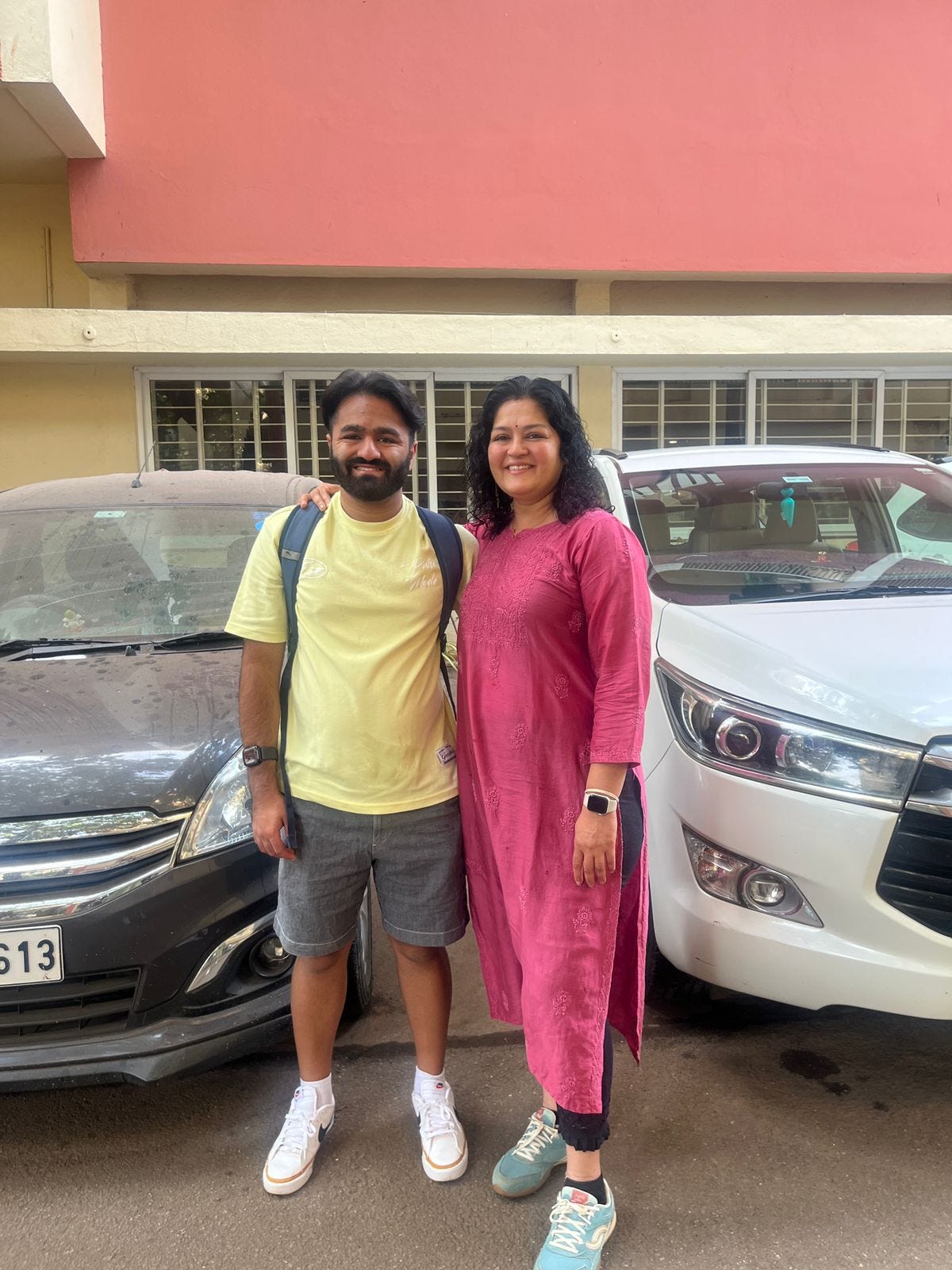
My mother and I before we began the tour.
The Beginning of Sightseeing
On the first day of our trip, we had breakfast near the hotel. There was a lot of generic South Indian food — idlis, dosas, medu wadas, and upma. I eventually had upma and medu wada, trying to keep my stomach light.
Our sightseeing began at the Queen’s Bath, an Indo-Islamic building dating back to the Vijayanagara Empire, likely used by King Achyuta Raya and his own queens. We snapped plenty of photos, soaking in the history.

Water tanks like the Octagonal tank— known as Pushkaranis — were used for rituals, bathing, and temple functions.
After seeing the Queen’s Bath, we headed to the Royal Palace, a 59,000-square-meter UNESCO-listed site with ruins of the Vijayanagara Empire’s palace bases, temples, and the Mahanavami Dibba platform. We visited the King’s Audience Hall, underground chambers, and the Octagonal Tank (Pushkaranis), used for rituals, bathing, and temple functions. These granite water tanks feature geometric steps and central pavilions.
Next was the Hazara Rama Temple, built in the 15th century by King Devaraya II, initially simple, later renovated with a porch and beautiful pillars. “Hazara Rama” means “a thousand Ramas”. The walls are decorated with panels from the Ramayana, including Krishna’s lila, depicting scenes such as the Vali-Sugriva episode. This site was called Kishkindha in the Ramayana, where Rama resided and fought Vali and Ravana with Sugriva’s help to save Sita, making it a key historical and mythological landmark.

We visited the Vijaya Vittala Temple, a 15th-century UNESCO World Heritage Site known for its Dravidian architecture and dedicated to Lord Vishnu. Famous for its Stone Chariot and musical pillars that produce sound, the temple showcases Vijayanagara craftsmanship. Located on the Tungabhadra River, Hampi's importance grew during Raja Krishnadevraya’s reign, when he expanded the Hampi kingdom and built the Vitthala temple in 1513. The Vitthal statue was later moved to Pandharpur by saint Bhanudas, adding religious significance.

The Stone Chariot, a 16th-century shrine built by King Krishnadevaraya of the Vijayanagara Empire.

Myself, mom, and my aunt/uncle next to a tree.

Matang Hill, the highest point in Hampi, is in the distance.
After a long day of sightseeing, we got back to our hotel in Hospet, freshened up, and played some Badam Saat, filling up our room with laughter and chatter. Dinner followed, and then we called it a night. It was at this time that I began writing about the trip.
The next day started with a 30-minute coracle ride on the Tungabhadra River. These round boats, made of bamboo and plastic, are used in Asia for transporting people and livestock. The ride was fun initially, but became dizzying when our operator spun the coracle — still, it was memorable!

Myself across the Tungabhadra River.

Before our coracle ride.
After the coracle ride, we visited the famous Virupaksha Temple, an active 7th-century temple dedicated to the Hindu god Shiva, and part of the Group of Monuments at Hampi, designated as a UNESCO World Heritage Site. The name “Hampi” comes from a goddess named Pampa (a Kannada form of Parvati), and the temple’s main deity is known as Pampapati — another name for Shiva.

Outside the temple.


Temple entrances

A Hanuman Langur eating food
After visiting the Virupaksha Temple, we ate at a nearby vegetarian restaurant and then saw the Lotus Mahal. Built in the Vijayanagara style, the two-storied Lotus Mahal features 24 carved pillars and no walls. Also called the Chitrangini Mahal, it was constructed in the 15th century as a royal residence, showcasing a three-story architectural marvel supported by intricately carved pillars.
Outside the Lotus Mahal.
Following our visit to the Lotus Mahal, we stopped at a small restaurant for tea. I was very tempted to buy magnets from Hampi, but I realized that I didn’t have enough cash at hand. Our tour guide also came to meet us, and we even met his daughter.
A Ganesh temple was on our list. The Kadalekalu Ganesha — one of the largest statues in Hampi — was a place definitely worth visiting. The temple housing the huge statue has stone pillars carved with mythical figures and themes.

Statue at the Kadalekalu Ganesha
After viewing this monument, we took many beautiful photos. We then returned to our hotel to rest, as the afternoon heat was quite intense. However, rest wasn’t our only focus — playing cards was also on our agenda, and we enjoyed it immensely! Later, we had dinner. I worked on my article afterward, and then we called it a night.
Going and Exploring Badami
The next day, we went to Badami on schedule. It’s a historically significant town. Waking up, showering, and breakfast were one thing, but the drive from Hampi to Badami took 3–4 hours.
Badami, formerly Vatapi, was linked to the Chalukya dynasty, which made Vatapi its capital under Pulakeshin II in the 7th century. Vatapi was chosen for its natural defenses, and the brown caves and temples carved here show ancient Indian art and architecture. During the Chalukya Empire, Badami was a hub of arts, culture, and administration, leaving a lasting influence.
At Hotel Badami Court, a three-star hotel, we met a tour guide who took us to Pattadakallu Temples, a UNESCO World Heritage Site known for its 7th- and 8th-century architecture blending northern Nagara and southern Dravidian styles. Inside the temple, I saw bats but wasn’t scared — they were peaceful. Taking photos was a must.

My mom and I are at the Pattadakallu Temple premises

Funny thing was that there were a lot of monkeys. I managed to avoid trouble but saw a small Hanuman mandir; I ended up praying there!

I am at the temple premises.
After we toured this massive temple complex, we had lunch across the street. It was purely vegetarian, and we had to eat without spoons. There were many schoolchildren on the premises waiting to eat, but they didn’t disrupt our efforts.
Following lunch, we resumed exploring the area. We ended up going to Aihole, known for its Durga Temple, which is renowned for its unique apsidal (horseshoe-shaped) design.
After taking many photos, we went into a small museum in the temple complex, but learned that photography was not permitted. Nonetheless, I saw many interesting things.
Following our visit, we returned to our hotel and played a round of Badaam Saat. However, something unexpected happened. From our hotel room, we saw the Chief Minister of Karnataka arrive, amid a large crowd gathering to greet him. It was the first time I had seen an Indian politician in person!
Following this, we went downstairs for dinner and called it a night.
Last Day in Badami
The second day of our trip was the last day of the whole tour. We woke up, had breakfast and tea, and then ended up seeing among the most famous monuments in the area.
The Badami Fort was our first stop. It features over 200 steps and four caves with temples, making for a breathtaking first impression!
Carved from massive sandstone cliffs overlooking tranquil Agastya Lake, the Badami Caves each have their significance. Three are dedicated to Hindu gods (Shiva and Vishnu), while the fourth belongs to Jainism. Notably, the third cave houses some of Karnataka’s earliest surviving colored fresco paintings. The Badami Fort and Structural Temples sit atop rugged cliffs, offering panoramic views of the town below.
Nearby, the Bhutanatha Temple complex is situated right on the water, creating a striking visual against the red rock that we went to. The view there was breathtaking despite the heat.

Lake next to the temple

Black and white photo of the Bhoothnath Temple

At the top of the caves, overlooking the Agastya Tirtha Lake and Bhoothnath Temple
Following our visit to those important places, we left the city, carrying important memories with us.
A Brief Stop in Bijapur
On the way back, I realized it wasn’t the end of the journey; we had one more city to visit: Bijapur (officially Vijayapura). The journey from Badami to that city took only two hours.
After reaching the city, I observed a lot of crowds. My mom, aunt, uncle, and I debated on what to eat for lunch, while my mom took me to see the Gol Gumbaz.
The Gol Gumbaz is a 17th-century mausoleum that houses the remains of Mohammad Adil Shah, the seventh sultan of the Adil Shahi dynasty, and some of his relatives. Begun in the mid-17th century, the structure was never completed by 1656. It is known for having the largest dome in India, second only in size to St Peter’s Basilica in Rome.

My mom and I outside the monument

One of the stairs leading to the Whispering Gallery.

Outside view of Bijapur from the monument

The cenotaphs of Sultan Mohammad Adil Shah and five of his relatives.
When my mom and I reached the mausoleum, we heard numerous echoing sounds around us. This is due to the central chamber, known as the Whispering Gallery, where every sound echoes seven times. About 110 feet high, a single whisper can travel clearly around the dome’s base to the opposite side. Additionally, any sound in the chamber — such as a clap or footstep — is repeated 7 to 14 times before fading away.

The Whispering Gallery
I also got to see the tombs of the Bijapur Sultanate’s leader and relatives. After hearing all of these noises, we decided to climb 7 stories of stairs to reach the Whispering Gallery. We took lots of photos and videos inside, and going there felt like I was in heaven, unsure of what was going on in the outside world. But being on top felt really scary!
After we explored the monument, I took additional photos of a museum on the opposite side, but didn't go inside. We then had lunch at a vegetarian restaurant. Then, we left the city, taking around six hours to reach Pune.

Next to cannons at the Archaeological Museum in Vijayapura
Returning to Pune
The journey from Bijapur to Pune was challenging. A few hours later, we crossed Solapur but continued without stopping. Eventually, we paused for tea, snacks, and a break before heading back home. I tried to relax and ended up finishing a Netflix docuseries. Afterward, I watched a documentary about the Titan submersible that sank in 2023 during a deep-sea dive to the Titanic.
Once we arrived in Pune, we decided to dine out. We went to the Cantonment area and enjoyed kebab rolls for dinner — they were delicious! After dinner, we met my grandfather, unpacked our belongings, and went to sleep, knowing this would be a trip to remember.
Concluding Thoughts
My trip to Hampi, Badami, and Bijapur changed my perspective on Indian history, which I didn’t know before. Seeing magnificent temples and experiencing each city’s vibrant culture and hospitality left me with lasting memories and insights. Visiting these sites was a journey through centuries of Indian heritage. I return with a deeper appreciation for the history that has shaped modern India and a renewed wonder at its legacy.
Note: This article took several months to write, owing to family commitments and tennis obligations in Pune, as well as returning to the United States.
메타데이터
- post_id
- c6832b37b5ce
- slug
- how-visiting-hampi-badami-and-bijapur-changed-my-understanding-of-indian-history-c6832b37b5ce
- url
- https://medium.com/@arkhode/how-visiting-hampi-badami-and-bijapur-changed-my-understanding-of-indian-history-c6832b37b5ce
- canonical_url
- https://medium.com/@arkhode/how-visiting-hampi-badami-and-bijapur-changed-my-understanding-of-indian-history-c6832b37b5ce
- author_url
- https://medium.com/@arkhode
- status
- ok
- fetched_at
- 2026-06-12 22:02:08