📁 Dossier 2: Negative Access to Justice in Sweden — How Courts Systematically Exclude Children…
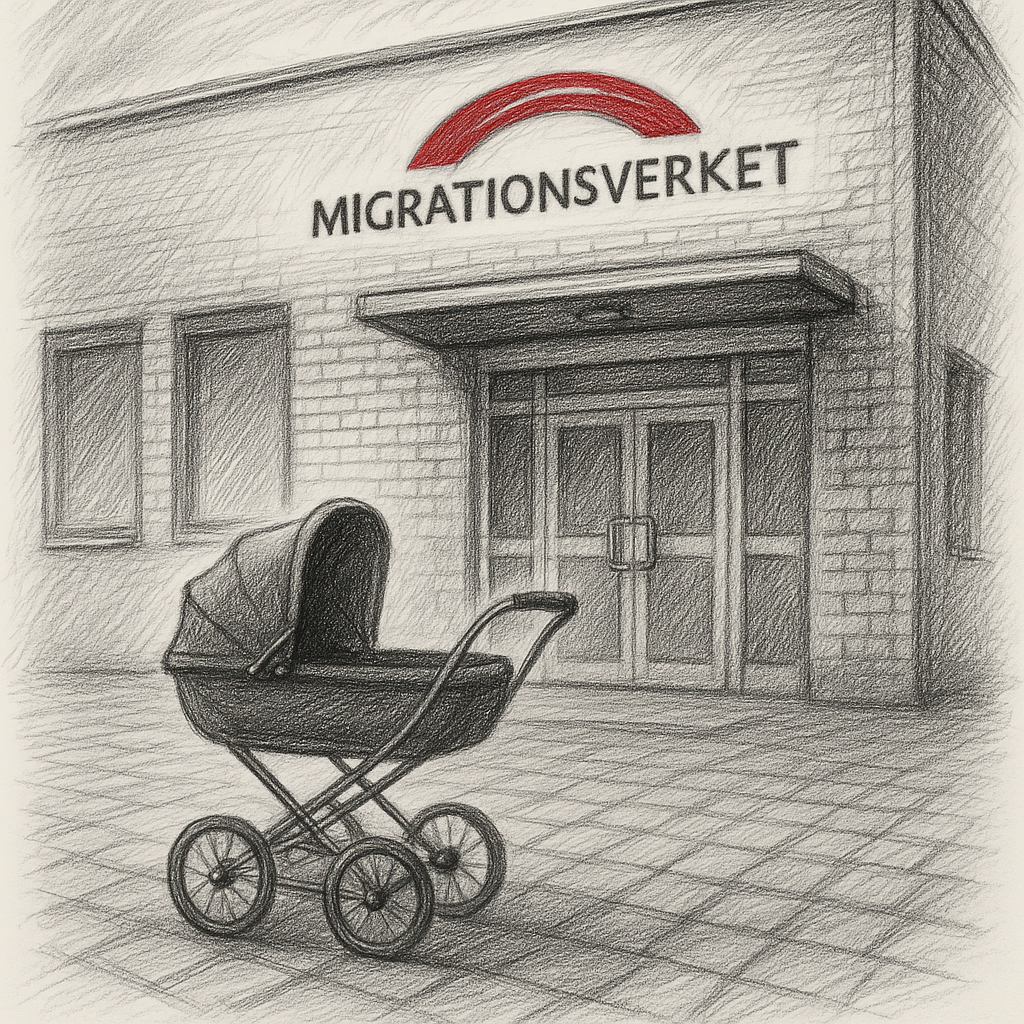
A newborn is billed 6,300 SEK by the Swedish state — no ID, no rights, no justice. When courts deny children, what remains of the rule of…
📁 Dossier 2: Negative Access to Justice in Sweden — How Courts Systematically Exclude Children from Legal Protection
When a newborn receives a letter from the Swedish government demanding 6,300 SEK in debt — instead of an ID or protection — something is fundamentally broken in Europe’s system of legal guarantees.
These legal denials are not theoretical. They inflict real harm: financial threats issued in the names of children, total exclusion from identity registration, and a retroactive housing invoice delivered days after the birth of a child. Sweden has not just created a legal vacuum — but a humanitarian one.
Sweden is consistently ranked among the world’s top rule-of-law nations and is widely praised for its transparent institutions. But what happens when those institutions quietly fail — especially against the most vulnerable? This dossier is not about an isolated error. It documents a deeper systemic failure: a legal regime that effectively blocks refugee children from defending their rights.
The cases are real. The filings are complete. The pattern is undeniable.
📌 Executive Summary: Why This Matters
If refugee children under EU protection are systematically denied access to courts — even when citing the Charter of Fundamental Rights, EU Directives, and ECtHR case law — then legal safeguards are no longer functioning. What follows is not merely a national administrative failure. It is an existential challenge to EU-level guarantees, especially when national courts openly disregard interpretations issued by the European Commission.
This dossier presents four legal cases from Sweden — each showing a different facet of structural denial of justice. Together, they paint a picture of how even children with full documentation, legal standing, and direct violations of EU law can be excluded from court access through silence, misclassification, and institutional refusal.
In Germany, Spain, and the Czech Republic, children under Temporary Protection (TPD) can simultaneously apply for asylum. In Sweden, courts reject not only asylum requests — but even the right to file a complaint about being denied that right.
📚 Legal Framework Violated
- Article 6, 13 of the European Convention on Human Rights (ECHR) — Right to fair trial and effective remedy
- Articles 24, 47 of the EU Charter of Fundamental Rights — Right of the child to be heard and to an effective remedy
- Directive 2001/55/EC (Temporary Protection) — Article 13: right to subsistence and housing
- Directive 2011/95/EU, 2013/32/EU — Continued applicability for persons under temporary protection (DG HOME, 2025)
- Swedish Förvaltningslagen (Administrative Procedure Act) — §10 and §31: obligation to register and respond to petitions
📋 Institutional Breakdown

🔴 1. Complaint from a Minor — Denied Support and Ignored in Court
Person: Mariia Verkhovych (born 2008) Filed: 22 April 2025
A complaint was submitted challenging the denial of subsistence support (“dagersättning”) and a 6,300 SEK “debt letter” sent in the child’s name. The court acknowledged receipt but never registered the case, issued no reference number, and never responded to a legal follow-up submitted on 24 June.
The child received a financial denial in Swedish only, without translation or explanation. Her complaint, was met with complete institutional silence.
EU context: Article 13 of Directive 2001/55/EC guarantees subsistence for persons under protection. The refusal to even register this appeal violates both EU law and Articles 6 and 13 of the ECHR.
Such administrative conduct violates not only national law (Förvaltningslagen §§5, 7, and 9), but also Article 41 of the EU Charter of Fundamental Rights, which guarantees the right to good administration and to be heard prior to any adverse decision. The refusal to process, respond to, or properly adjudicate repeated submissions from minors and guardians amounts to structural denial of these rights.
🔴 2. Legal Objection to Imposed Protection Status — Ignored
Person: Mariia Verkhovych (2008) Filed: 13 June 2025
A formal complaint under §31 Förvaltningsprocesslagen challenged the child’s forced reassignment to temporary protection. This status was never requested and resulted in the denial of asylum, child benefits (barnbidrag), healthcare, and education access.
Despite the legal basis and the reference to the UN Convention on the Rights of the Child, the court refused to register the case and issued no reply, even after a formal reminder.
EU standards ignored: According to CM/Rec(2019)11 of the Council of Europe, children must have independent and effective access to judicial protection. Sweden violated this standard.
🔴 3. Misclassification of Complaint — Administrative Bypass
Person: Yevhenii Verkhovych Filed: 6 May 2025
***Yevhenii Verkhovych to Förvaltningsrätten Status Complaint Rejected 1861–25E 6May2025.pdf***
This complaint under §10 of the Swedish Administrative Procedure Act challenged the administrative assignment of temporary protection without consent. Initially, the court forwarded the case to the Migration Agency without registration. After protest, it was registered — but classified as an “E” (admin) case and dismissed as “migration-related.”
Violation: Courts are required to transfer cases they deem beyond their jurisdiction. Here, the court instead invalidated the complaint by misclassifying and dismissing it.
European case law violated: Denying justice by refusing to transfer a complaint contradicts established ECtHR jurisprudence (Bellet v. France; Z and Others v. United Kingdom).
Migrationsverket admitted in writing that no consent or request existed, and status was imposed administratively — yet courts refused to review this.
🔴 4. Fresh Complaint with DG HOME Letter — Rejected as an Appeal
Person: Yevhenii Verkhovych Filed: 19 July 2025
This new complaint included the official DG HOME letter from 25 June 2025, confirming that:
- Temporary protection does not preclude asylum applications,
- Directives 2011/95 and 2013/32 remain applicable,
- Case C-195/25 is pending before the CJEU addressing the same issue.
Despite these new facts, the court redefined the case as an appeal to a previous complaint, forwarded it to the wrong instance, and refused to open a new case.
This was a new filing, new content, new EU-level legal basis. The refusal to register it amounts to defiance of EU institutional interpretation.
🚧 Institutional Breakdown: Even Oversight Bodies Refuse to Act
Despite multiple appeals, no national body — not the Ombudsman, ***not the Chancellor of Justice**, not children’s agencies, nor civil rights NGOs — provided a single actionable remedy. Even complaints submitted directly by a child were ignored or deflected. Sweden’s entire domestic human rights architecture failed to respond when children under protection demanded help (see other articles for references).*
This constitutes a direct violation of Article 24 of the EU Charter, which requires all administrative and judicial bodies to prioritize the child’s best interests.
📊 Systemic Consequences for the EU
- Sweden’s courts refused access to justice for a child and her family.
- Even properly filed complaints with supporting EU law were dismissed or ignored.
- European Commission (DG HOME) interpretations were disregarded.
- National oversight mechanisms failed to respond.
This is not a theoretical dispute. These cases are now before the European Court of Human Rights (Verkhovych and Others v. Sweden) and under review by DG HOME and EU institutional bodies.
Each new refusal is now recorded as international legal evidence.
📢 Conclusion: This Is Not Just a Family Story. This Is a Legal Precedent.
These four cases illustrate a pattern of silent exclusion and administrative denial. This is not a malfunction. It is a systemic tactic of procedural erasure or disappearance that gives the illusion of legal access while structurally denying it.
If even children under EU protection are denied judicial access in Sweden — despite citing EU law and submitting official complaints — then the EU legal order itself is compromised.
This dossier is not about one family’s struggle. It is about the erosion of the legal contract between the state and the refugee child.
When a court refuses to register a complaint, it creates a legal illusion — a system where children appear to have rights but are denied any procedural path to enforce them.
The documents are filed. The silence is on record. And the consequences are now international.
🧾 A Final Note — If You Disagree, Say So
I am not a lawyer. I am a father of four, forced into legal battles because Sweden’s bureaucracy left me no other choice. Despite my background in humanitarian organizations like the UN and ICRC, I never imagined I would have to become the legal defender of my own children — just to secure their most basic rights.
This dossier is not perfect. But it is factual. If you find a legal error, say so — publicly, in writing, and on the record. If not, then your silence will only confirm what this document shows: that even in a democratic state, children under protection can be silenced not by law, but by administrative design.
I welcome correction.
메타데이터
- post_id
- c69b7b100e01
- slug
- dossier-2-negative-access-to-justice-in-sweden-how-courts-systematically-exclude-children-c69b7b100e01
- url
- https://medium.com/@agv82/dossier-2-negative-access-to-justice-in-sweden-how-courts-systematically-exclude-children-c69b7b100e01
- canonical_url
- https://medium.com/@agv82/dossier-2-negative-access-to-justice-in-sweden-how-courts-systematically-exclude-children-c69b7b100e01
- author_url
- https://medium.com/@agv82
- status
- ok
- fetched_at
- 2026-07-18 15:41:54