The Greek Language as a Continuous Living System Across Three Millennia
How Speech, Script, and Transmission Sustained One Language Without Rupture
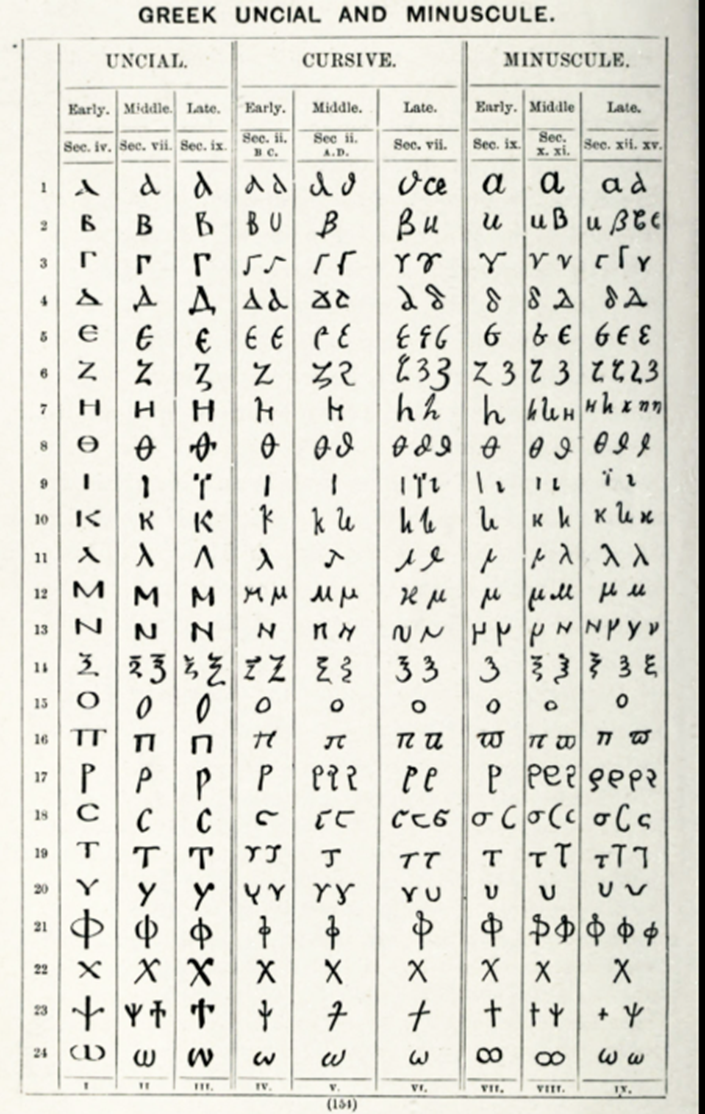
Greek letterforms across time: uncial, cursive, and minuscule styles from late antiquity through the medieval period. The alphabet remains the same, while letter shapes adapt to changing scribal and educational needs — illustrating continuity of script within a living language rather than linguistic rupture.
The Greek Language as a Continuous Living System Across Three Millennia
How Speech, Script, and Transmission Sustained One Language Without Rupture
Abstract
This essay examines the Greek language as a continuous linguistic system sustained across more than three millennia through uninterrupted native transmission. Rather than treating Greek as a sequence of disconnected historical stages — Mycenaean, Classical, Koine, Medieval, and Modern — it argues that Greek is best understood as a single evolving language whose identity persists through structural continuity, regular sound change, and sustained social transmission. Particular attention is given to the distinction between language and writing technology, showing that major script transitions — from Linear B to the alphabet, and later from uncial to minuscule — represent changes in inscription rather than linguistic rupture. By situating Greek in comparative perspective alongside Latin, Egyptian, and Sanskrit, the essay clarifies why Greek did not require revival, reconstruction, or rediscovery at any point in its history. The case of Greek demonstrates how a language can change extensively while remaining continuous, provided it remains spoken, taught, and written within a living community. Greek endures not by resisting change, but by accommodating it within an unbroken tradition of use.
I. Introduction — How Languages Persist Over Time
Languages do not remain the same across centuries, but they remain themselves.
All long-lived languages change. Sounds shift, grammar simplifies or reorganizes, vocabulary expands and contracts, and writing conventions adapt to new technologies. These changes are not signs of rupture. They are the normal behavior of languages that continue to be spoken across generations.
For this reason, linguistic continuity is not measured by surface similarity or by whether speakers separated by centuries can understand one another. Instead, continuity is identified through deeper criteria: the persistence of grammatical structure, the transmission of language through native speakers, and regular, law-governed patterns of change that link earlier and later forms. When these elements are present, linguists treat the language as a single evolving system rather than a sequence of unrelated stages.
Greek provides an unusually well-documented case of this process. Few languages can be followed across such a long span of time with both written evidence and uninterrupted spoken transmission. From its earliest attestations to its modern form, Greek allows us to observe how a language can change continuously without losing its identity. The sections that follow trace this continuity through speech, writing systems, and transmission, showing how Greek persisted as one language across more than three millennia.
II. What Linguists Mean by Continuity
When linguists speak of continuity, they are not referring to whether a language “sounds the same” across long stretches of time. Languages change too much for that to be a meaningful standard. Instead, continuity is identified through structural and historical criteria that reveal whether later forms descend from earlier ones.
The most important of these criteria is grammar. Grammatical systems are highly resistant to replacement. While individual endings may shift or merge, the underlying architecture of a language — its way of marking relationships, forming verbs, and organizing sentences — tends to persist across centuries when transmission remains unbroken.
A second indicator is core vocabulary. Words for basic actions, family relations, natural elements, and bodily experience change slowly and predictably. These items form a stable layer of language that survives even when borrowed terms enter from elsewhere.
Sound change provides a third diagnostic. Phonological shifts occur, but they do so in regular, rule-governed ways. When the differences between earlier and later forms of a language can be accounted for by systematic sound laws, linguists treat those forms as stages of the same language rather than separate entities.
Finally, continuity depends on transmission. When a language is passed from parents to children without interruption, change occurs internally rather than through replacement. Written records may disappear for periods of time, but native speech ensures the survival of the linguistic system itself.
For this reason, mutual intelligibility between distant historical stages is not required. Speakers of modern English do not readily understand Old English, yet no linguist treats them as unrelated languages. Continuity is a matter of descent and structure, not conversational ease.
III. Greek Before the Alphabet: Mycenaean Greek
The earliest written evidence of Greek predates the alphabet by several centuries. This form of the language is known as Mycenaean Greek, documented between roughly the sixteenth and twelfth centuries BCE in administrative records from mainland Greece and Crete.
Mycenaean Greek was written using Linear B, a syllabic script adapted for record-keeping in palace economies. Linear B does not represent individual sounds in the way an alphabet does; instead, each sign typically corresponds to an open syllable (such as pa, to, or ne). As a result, the script is an imperfect fit for Greek phonology and often obscures consonant clusters and final consonants.
Despite these limitations, the language encoded by Linear B is unambiguously Greek. Its grammatical structure aligns with later forms of Greek in fundamental ways: nouns are inflected for case and number, verbs show familiar tense and aspect distinctions, and core vocabulary corresponds closely to later Greek words once predictable sound differences are taken into account. The difficulty of reading Linear B arises from the constraints of the script, not from uncertainty about the language itself.
What is most striking is that Greek appears in these earliest records already structurally complete. There is no evidence of a formative or pre-Greek transitional stage. The language recorded in Linear B is not a precursor awaiting development, but an early attested form of the same linguistic system that will later be written alphabetically.
This has an important implication for the history of Greek. The adoption of the alphabet in the early first millennium BCE did not mark the beginning of the language, but a change in how it was written. Greek existed, functioned, and was transmitted before its most famous writing system came into use.
Greek, in other words, predates the alphabet that would later become synonymous with it.
IV. Spoken Continuity After the Mycenaean Period
Following the collapse of the Mycenaean palace systems around the end of the second millennium BCE, the use of Linear B disappears from the archaeological record. For several centuries, Greek is no longer attested in writing. This absence of texts has sometimes been misinterpreted as a linguistic rupture. In fact, it reflects a change in social organization, not the disappearance of the language itself.
Writing systems are tools tied to institutions. Linear B existed to serve centralized administrations; when those institutions vanished, the script vanished with them. Spoken language, however, does not depend on bureaucratic infrastructure. Greek continued to be transmitted orally within families and communities, as all living languages are.
During this period, Greek did not stagnate. It diversified. Regional varieties developed more clearly as communities became less interconnected, laying the foundations for the dialect groups later visible in the archaic period. This process of differentiation is precisely what linguists expect when a language remains spoken but lacks a standardized written form.
Crucially, there is no evidence of linguistic replacement. There is no sign that Greek-speaking populations were supplanted by speakers of another language, nor that Greek ceased to function as the primary medium of everyday communication. The continuity of settlement patterns and the later reappearance of Greek in alphabetic form both point to uninterrupted transmission.
When writing returns in the early first millennium BCE, it does not record a new language. It records Greek as it had continued to be spoken, now rendered with a different and more flexible script.
Writing systems can vanish without languages vanishing with them.
V. The Greek Alphabet as a Writing Technology
In the early first millennium BCE, Greek speakers adopted a new writing system based on Phoenician letter forms. This development is often treated as a cultural turning point, but its linguistic significance is frequently misunderstood. The adoption of the alphabet represents a change in writing technology, not a change in language.
The Phoenician script provided a set of symbols designed to represent consonants. Greek speakers adapted this system to their own linguistic needs, making a decisive innovation: they reassigned several signs to represent vowel sounds. This step transformed a consonantal script into a true alphabet, capable of representing Greek speech with far greater precision than a syllabary like Linear B.
The result was not uniform from the outset. Early Greek alphabetic writing shows considerable regional variation in letter shapes and usage. These local alphabets reflect differences in convention, not differences in language. Greek was already diverse in its spoken forms, and the new script accommodated that diversity without creating it.
What matters for linguistic history is that the language written with the alphabet is recognizably the same Greek that had existed before its adoption. The grammar, core vocabulary, and structural features align with what is later seen in archaic and classical texts. The alphabet simply allowed Greek to be written more efficiently, more flexibly, and for a wider range of purposes than had previously been possible.
The transition from Linear B to the alphabet, therefore, does not mark the birth of Greek, nor a linguistic restart. It marks the replacement of one writing tool with a better one. The language itself continues across this transition, unchanged in identity even as its means of inscription improve.
This is a tool change, not a language change.
VI. Archaic and Classical Greek as Literary Phases
(c. 800–323 BCE)
By the time Greek appears extensively in the alphabetic record of the archaic period (c. 800–500 BCE), it is already a mature language with regional diversity. Multiple dialects coexist across the Greek-speaking world, including Ionic, Doric, Aeolic, and Attic. These varieties differ in pronunciation, morphology, and preferred vocabulary, yet all are recognizably Greek and mutually connected through shared grammatical structure.
The archaic period gives Greek its earliest surviving literary monuments, most notably the epic poetry attributed to Homer (traditionally dated to the late 8th or early 7th century BCE). These works do not inaugurate the language; they reflect a long-standing oral tradition that had already shaped Greek poetic form and formulaic expression. Writing makes this tradition visible, but it does not create it.
During the classical period (c. 500–323 BCE), one dialect — Attic — acquires particular cultural prominence. This is a historical outcome of Athenian political, economic, and intellectual influence, not a linguistic turning point. Attic becomes the primary medium for philosophy, drama, and much prose literature, including the works of Plato (4th century BCE) and other classical authors. Its prestige later leads it to be treated, retrospectively, as “Classical Greek” par excellence.
This prominence can obscure an important fact: Attic is one Greek dialect among others, elevated by circumstance rather than by origin. Greek did not converge on Attic because it was new or linguistically foundational, but because it was associated with institutions that produced influential texts. By the classical period, Greek already had a documented history extending back nearly a millennium.
Seen in this light, archaic and classical Greek are best understood as literary phases within a longer continuum, not as the starting point of the language. They represent periods of exceptional cultural output and stylistic refinement, not moments of linguistic birth.
VII. Koine Greek and Widespread Use
(c. 323 BCE — c. 300 CE)
Following the campaigns of Alexander the Great (d. 323 BCE), Greek enters a new phase of its history commonly known as Koine Greek. This period is characterized by dialect leveling: features shared across major Greek dialects become more prominent, while strongly local forms recede. The result is a broadly intelligible common variety that facilitates communication across an expanded Greek-speaking world.
Koine Greek is not a constructed language and not a departure from earlier Greek. It is the natural outcome of increased mobility, administration, and contact among Greek speakers. The underlying grammatical system remains recognizably Greek, while certain complexities are streamlined in ways typical of languages used by large, diverse populations.
Crucially, Koine functions simultaneously in several domains. It is a spoken language used in daily life across cities and regions. It is an administrative language, employed in governance, trade, and legal contexts throughout the eastern Mediterranean. It is also a religious language, serving as the medium of major texts such as the Septuagint and, later, the New Testament. These uses reinforce one another, ensuring both breadth of adoption and stability over time.
Rather than marking a decline, this period demonstrates Greek’s durability. A language capable of serving everyday conversation, imperial administration, and religious transmission at such scale is not becoming diluted; it is proving adaptable. Koine preserves the core structures of earlier Greek while extending the language’s reach to millions of speakers.
Equally important, Koine forms the foundation of later Greek. The developments seen in medieval and modern stages grow out of Koine usage, not in opposition to it. Phonological shifts and syntactic tendencies that appear later can be traced to patterns already present in this common language.
During the Koine period, Greek becomes more widely used than at any previous point in its history. It does not become less Greek in the process. It becomes more firmly established as a living language capable of continuity across changing political and social conditions.
VIII. Medieval Greek and the Teaching Tradition
(c. 300–1453 CE)
From late antiquity through the medieval period, Greek continues as a spoken, written, and taught language. This continuity is not incidental. It reflects sustained social transmission across generations, supported by education, administration, and religious life in the eastern Mediterranean.
Greek remains the everyday language of large populations, while also serving as the medium of record, correspondence, and scholarship. Importantly, classical Greek texts are not treated as relics. They are copied, commented on, and learned within a living educational tradition. Grammar, rhetoric, and philosophy are taught by Greek-speaking teachers to Greek-speaking students, maintaining familiarity with earlier registers of the language even as the spoken vernacular continues to evolve.
It is useful to clarify terminology at this point. Modern historiography often refers to the medieval eastern Roman state as the Byzantine Empire. The Greek-speaking population of that world, however, identified itself as Roman (Rhomaioi), and its society as Romiosýni. In this essay, the term Romiosýni is used only to denote that Greek-speaking social carrier — the community through which Greek was transmitted natively — rather than as a label for imperial administration.
Within this milieu, Greek literacy never becomes detached from native speech. High-register writing, middle-register prose, and everyday vernacular coexist, serving different functions but remaining structurally connected. The development of new script styles and orthographic conventions responds to practical needs — speed, clarity, pedagogy — without disrupting linguistic identity.
The significance of this period lies not in stylistic imitation of antiquity, but in continuity of practice. Classical Greek remains readable because it remains taught; later Greek develops because it remains spoken. The two processes occur side by side, reinforcing rather than replacing one another.
By the end of the medieval period, Greek has undergone substantial phonological and stylistic change, yet it has never passed through a phase of silence or rediscovery. Its transmission has been continuous, embedded in a living community that carried the language forward as both inheritance and everyday tool.
IX. Writing System Evolution Within Greek
Across the medieval period and into early modernity, Greek continues to be written with the same alphabet, even as the visual form of that alphabet evolves. This evolution reflects practical adaptation within a continuous scribal tradition, not a change in language.
The alphabet itself remains the Greek alphabet — letters retain their identity and order — but letterforms change. Earlier manuscripts commonly use uncial (majuscule) writing: rounded, upright capital forms suited to formal copying. Over time, scribes increasingly adopt minuscule forms: smaller, more fluid letters that allow faster writing, clearer word separation, and more economical use of space. By the ninth century, minuscule becomes the dominant book script.
This transition does not introduce new symbols or alter how Greek sounds are represented. It reorganizes how familiar letters are shaped and connected on the page. The underlying orthographic system remains intact, and readers trained in Greek continue to read texts across these styles without encountering a different language.
Manuscript culture adapts in parallel. Abbreviations, ligatures, punctuation, and layout evolve to meet the needs of education, administration, and copying at scale. These changes improve efficiency and readability, particularly in school contexts where texts are actively used rather than ceremonially preserved.
A helpful analogy is the history of letterforms in modern European languages. The shift from Roman capitals to lowercase letters did not create new languages; it created more efficient writing. In the same way, the Greek shift from uncial to minuscule represents refinement within continuity.
The persistence of the alphabet through these visual changes reinforces a central point: script evolution occurs within a living linguistic system. Greek writing adapts because Greek continues to be written, taught, and read. The alphabet remains the same; only its handwriting grows more practical.
This continuity of script mirrors the continuity of language itself — one system, reshaped over time to suit changing needs, without losing its identity.
X. Early Modern and Modern Greek
(c. 1453 CE — present)
From the late medieval period into early modernity, Greek continues its development as a living vernacular. Phonological shifts already underway in earlier centuries progress naturally, syntax simplifies in predictable ways, and everyday vocabulary adapts to changing social conditions. None of these developments indicate a break; they are the expected outcomes of uninterrupted native transmission.
The introduction of printing marks an important practical change. Greek texts are printed in increasing numbers from the late fifteenth century onward, particularly in centers such as Venice that served Greek-speaking communities and diasporas. Printing does not create a new language; it stabilizes spelling and orthographic convention. Variants that had coexisted in manuscript culture are gradually regularized, making written Greek more uniform across regions.
Education continues alongside these changes. Greek remains taught at multiple levels, from basic literacy to higher instruction in grammar and literature. Older forms of the language are learned as part of education, while the spoken vernacular continues to evolve in daily use. This coexistence of registers — learned and spoken — preserves continuity while allowing change.
By the nineteenth century, what we call Modern Greek is clearly identifiable, yet it is not the result of revival or reconstruction. There is no moment of rediscovery, no linguistic resurrection from silence. The language is already there, spoken and written, shaped by long internal development. Debates over style and register in the modern period reflect choices about standardization, not questions of linguistic identity.
The emergence of Modern Greek, therefore, is best understood as the latest stage of an ongoing process. Greek moves into the modern world by evolution rather than reinvention. Its continuity lies not in resisting change, but in sustaining transmission — through speech, education, and writing — across shifting historical circumstances.
No rupture. No reinvention.
XI. Greek in Comparative Perspective
Placing Greek alongside other long-attested languages helps clarify what makes its history distinctive. The comparison does not rely on claims of superiority, but on differences in transmission.
Latin, for example, ceased to be transmitted as a native spoken language in late antiquity. While it remained influential through writing and education, its later forms — whether ecclesiastical Latin or scholarly revivals — were learned languages rather than mother tongues. The Romance languages that descend from Latin represent continuity through transformation, but Latin itself no longer functioned as a living spoken system.
Egyptian presents a different case. It was written for millennia in various scripts, yet eventually fell silent as a spoken language. Modern understanding of ancient Egyptian depends on decipherment from inscriptions and texts that had long ceased to be read by native speakers. The continuity is documentary, not social.
Sanskrit occupies yet another position. It was preserved with extraordinary care through ritual, grammar, and education, but primarily as a liturgical and scholarly language. Its transmission was formal and regulated, not vernacular. Everyday speech continued in related but distinct languages, while Sanskrit itself remained largely outside ordinary conversational use.
Greek differs from all three cases in a quiet but significant way. It was never reduced solely to a learned language, never fell completely silent, and never required reconstruction from undeciphered texts. At every stage, Greek continued to be spoken natively while also being written and taught. Earlier forms remained accessible through education within the same speech community that carried the language forward.
This combination — continuous native transmission alongside continuous literacy — is rare. It explains why Greek can be traced across such a long span without invoking revival, rediscovery, or reconstruction. The comparison does not elevate Greek above other traditions; it simply clarifies the conditions under which linguistic continuity operates.
XII. Conclusion — Continuity as a Lived Process
The history traced in these sections is not the story of a language preserved unchanged, but of a language sustained through use. Languages do not survive because they are fixed in time. They survive because they continue to be spoken, learned, and adapted by people who carry them forward.
Greek exemplifies this process with unusual clarity. Across more than three millennia, it has remained one language expressed through many stages, registers, and writing systems. Its scripts have changed — from syllabary to alphabet, from uncial to minuscule, from manuscript to print — but the linguistic system those scripts recorded has continued to evolve internally rather than being replaced.
At no point did Greek pass through silence. Its speakers did not disappear, and its transmission did not rely on rediscovery or reconstruction. Earlier forms remained accessible through education, while spoken usage continued to shape later developments. Continuity was maintained not by resisting change, but by accommodating it within a living tradition.
Seen in this light, Greek’s history is best understood as a continuous process rather than a sequence of disconnected periods. One language persists through many forms because the social conditions that sustain language — speech, teaching, and writing — remain intact.
Greek endures not because it resisted change, but because it remained spoken, taught, and written without interruption.
메타데이터
- post_id
- c6a33d0a71cd
- slug
- the-greek-language-as-a-continuous-living-system-across-three-millennia-c6a33d0a71cd
- url
- https://medium.com/@bill.giannakopoulos/the-greek-language-as-a-continuous-living-system-across-three-millennia-c6a33d0a71cd
- canonical_url
- https://medium.com/@bill.giannakopoulos/the-greek-language-as-a-continuous-living-system-across-three-millennia-c6a33d0a71cd
- author_url
- https://medium.com/@bill.giannakopoulos
- status
- ok
- fetched_at
- 2026-07-20 04:41:04