Making Sense of Zen Koans
In the West, Zen koans are often misunderstood as mere riddles designed to short-circuit logical thinking. Philip Kapleau, in The Three…
Making Sense of Zen Koans

In the West, Zen koans are often misunderstood as mere riddles designed to short-circuit logical thinking. Philip Kapleau, in The Three Pillars of Zen, captures this perception when he describes them as paradoxical dialogues meant to undermine conventional reasoning:
The Chinese Zen masters, those spiritual geniuses who created these paradoxical dialogues, did not hesitate to thumb their noses at logic and common sense in their marvelous creations. By wheedling the intellect into attempting solutions impossible for it, koans reveal to us the inherent limitations of the logical mind as an instrument for realizing ultimate Truth. In the process, they liberate the mind from the snare of language, ‘which fits over experience like a straitjacket,’ pry us loose from our tightly held dogmas and prejudices, strip us of our penchant for discriminating good from bad, and empty us of the false notion of self-and-other, to the end that we may one day perceive that the world of Perfection is in fact no different from that in which we eat and excrete, laugh and weep.
Kapleau’s perspective is valuable — koans do reveal the limitations of conventional thought. However, dismissing logic entirely is a misstep. The Middle Way, central to Buddhism, warns against falling into the false dichotomy of either-or. If rigid logic has limitations, abandoning logic altogether creates its own pitfalls. Instead of rejecting reason, we should recognize that koans point to a broader, more dynamic form of understanding — one that transcends dualistic thought without discarding coherence.
The True Function of Koans: Invoking Doubt
Koans are not mere puzzles but tools for transformation. Their paradoxical nature serves a precise purpose: to provoke doubt, unsettle ingrained assumptions, and open the mind to direct insight. This process unfolds in several key ways:
- Encouraging Inquiry: By exposing the limits of conventional thought, koans push practitioners beyond habitual cognitive patterns.
- Loosening Attachments: They challenge fixed conceptual frameworks, fostering a more fluid and adaptable perception of reality.
- Deepening Meditation: Serving as focal points for contemplation, koans draw practitioners into deeper states of awareness.
- Awakening Insight: The tension within a koan can trigger moments of realization, dissolving dualistic thinking and revealing a more profound truth.
Thus, koans do not defy reason but challenge the rigidity that accompanies logical thought.
Koans Challenge Mental Rigidity, Not Reason
It is crucial to distinguish between reason and mental rigidity. Reason — the ability to think coherently and systematically — is not the enemy. Mental rigidity, the tendency to cling to fixed concepts, is what Zen seeks to dissolve. Zen does not reject reason; it rejects the static frameworks that limit perception.
Koans function within a different kind of logic—one aligned with Buddhist principles such as Dependent Origination, No Self, and Emptiness. While conventional logic assumes discrete entities and linear causality, Buddhist logic recognizes that all things arise in dependence on others. Koans highlight this interconnectedness, dissolving the binary thinking of subject versus object, self versus other.
Beyond Conceptual Thinking
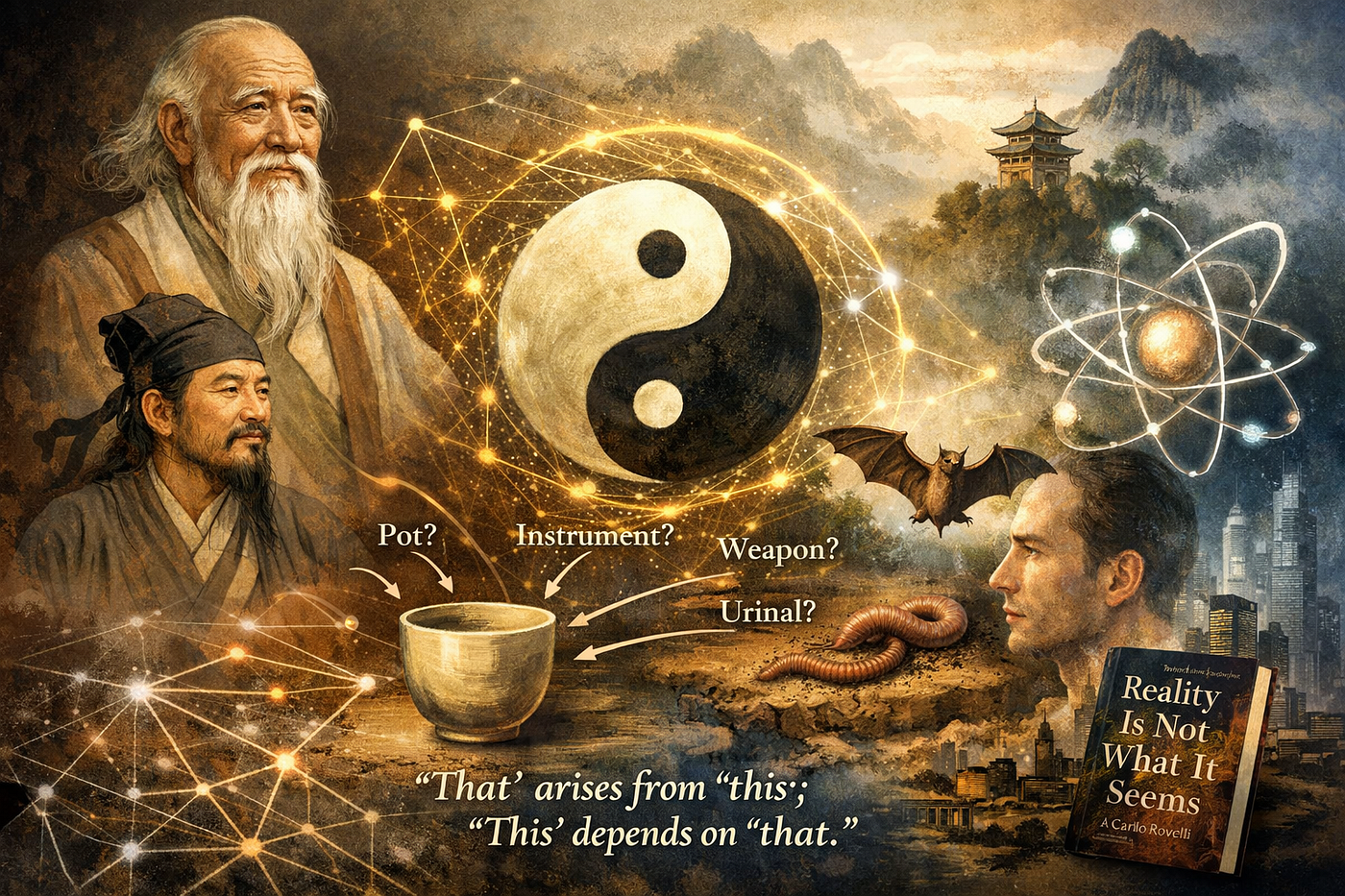
A fundamental tenet of Buddhism is that concepts are not reality itself. While useful, conceptual labels merely represent experience rather than embody it. A cup, for instance, may function as a drinking vessel, a flowerpot, or a musical instrument— its identity is fluid, shaped by perspective and context.
Koans break us free from fixed definitions and habitual thought patterns. They are not intellectual puzzles to be “solved” but catalysts for perceptual shifts. Rather than demanding logical solutions, they invite creativity, spontaneity, and direct engagement with experience.
Reason is Not the Enemy
Although koans resist conventional logic, this does not mean that “anything goes.” Different interpretations may arise, but some are deeper and more grounded than others. Just as in literary analysis, the best interpretations are those supported by careful attention to context, thematic coherence, and deeper insights.
Interpreting Koans and Literature: A Parallel Process
I didn’t take an English literature course until my 50s, when it became a requirement for my teaching certification in New York. That course gave me a newfound appreciation for literature and deepened my understanding of why literacy is essential for teachers. The online format required students to discuss various stories and poems.
Through these discussions, I realized that while literary interpretation is subjective, it is not arbitrary. Some interpretations were stronger than others — more evidence-based, more attuned to the text’s details, and more insightful. This realization led me to see a striking parallel between interpreting literature and interpreting koans.
Similarities Between Literary Interpretation and Koan Study:
- Grounded Subjectivity: Both literature and koans invite personal interpretations, but these interpretations must be grounded in textual or contextual evidence.
- Evidence-Based Understanding: In literature, themes, symbolism, and historical context guide interpretation. In koans, the principles of Zen and Buddhist philosophy serve as interpretive anchors.
- Context Matters: The deeper meanings of both literature and koans emerge when one considers their broader cultural and philosophical background.
- Insight and Author’s Intent: Strong interpretations reveal hidden layers of meaning while resonating with the intent behind the work.
- Objective Standards: Interpretations are assessed based on coherence, depth, and alignment with foundational ideas, whether in literature or Zen practice.
Just as literary criticism evaluates the depth of reading, Zen teachers assess a student’s response to a koan — not to determine a “correct” answer but to gauge the depth of their insight. The process is personal and subjective, yet not random or meaningless.
Koans as a Rational Gateway to a Broader Intelligence
Zen koans are not designed to annihilate reason but to reveal a broader intelligence that is intuitive, fluid, and non-dualistic. They challenge us to let go of fixed mental frameworks, not to abandon thinking altogether. In doing so, they lead us toward a deeper, more integrated way of understanding — one that harmonizes reason with direct experience, freeing us from the limitations of conceptual thought without falling into the trap of irrationality.
Demystifying Zen Koans: Some Examples
Zen koans often seem paradoxical or nonsensical to conventional reasoning. Still, their meaning becomes more apparent when interpreted through foundational Buddhist principles such as Dependent Origination (Pratītyasamutpāda), Anatta (non-self), and Śūnyatā (emptiness). Zen’s emphasis on non-attachment and its willingness to break free from conventional thought patterns contribute to its counterintuitive nature. By applying these principles, we can see that koans are not puzzles to be solved logically but invitations to experience reality beyond conceptualization.
The Strawberry and the Tigers Koan
In this koan, a traveler is pursued by two tigers and finds himself hanging over a cliff by a vine, which is being gnawed by two mice — one black and one white. As he dangles, he notices a strawberry growing nearby, picks it, and enjoys its taste.
At first glance, this story seems absurd. Why would the traveler stop to eat a strawberry when his life is in immediate danger? A well-known Chinese monk-scholar once remarked that the traveler was foolish for enjoying the strawberry while facing imminent death. However, taking the story literally misses its deeper significance. Zen stories, much like great literature, employ figurative language, metaphors, and symbols to convey meaning beyond the surface.
The two mice, one black and one white, can be interpreted as symbols of night and day, representing the passage of time. The vine symbolizes life itself, which is gradually being eroded by time. In Buddhism, impermanence (Anicca) is one of the Three Marks of Existence and a fundamental cause of suffering (Dukkha). The two tigers chasing the traveler symbolize this suffering — an inescapable truth of existence.
Rather than resisting impermanence, the traveler embraces the present moment by savoring the strawberry. This embodies the Zen attitude of non-attachment and full presence in the now. Instead of clinging to life or fearing death, he accepts reality as it is. The koan, therefore, is an allegory for the human condition — one in which suffering and impermanence are unavoidable, but joy can still be found in direct experience.
The Sound of One Hand Clapping
A Zen teacher asks, “What is the sound of one hand clapping?” This question appears absurd because clapping conventionally requires two hands.
To decode the koan, we must consider its symbolic meaning. What does “one hand” represent? What is “clapping” a metaphor for?
Numbers, like all concepts, are context-dependent rather than absolute. Looking at our own body, we may say it is one because of unity and harmony. Yet, behind the oneness, there is also multiplicity. Each human body is estimated to contain about 30 trillion cells. This insight leads us to an exploration of the word “universe.”
The word universe comes from the Latin universum, meaning “everything turned into one” or “unity in multiplicity.” This suggests an inherent interconnection of all things, aligning with Dependent Origination, which teaches that nothing exists in isolation — everything arises through causes and conditions.
Thich Nhat Hanh’s concept of Interbeing echoes this: “To be is to inter-be.” Just as a tree depends on soil, rain, and sunlight, a person exists only in relation to their environment. The word “universe” itself reflects this fundamental oneness.
What about clapping? Clapping occurs when two opposing forces — yin and yang, self and other — come together, unleashing the universe’s creative energy. This aligns with Hegelian dialectics, in which thesis and antithesis synthesize into something new.
Thus, the sound of one hand clapping is not a literal question but an invitation to transcend dualistic thinking and directly experience the oneness of existence.
Where Does the One Return?
The koan asks, “If the ten thousand things return to the One, where does the One return?”
At first, this seems to follow a logical progression — if all things unify in the One, then where must the One return? However, this question is based on a category error: it assumes that the One is an object that, like the ten thousand things, must move or return somewhere.
The One is not a separate entity but a symbol of unity itself. Asking where the One returns is like asking, “Where does the universe return?” The question falsely reifies the One as an independent thing.
Master Zhaozhou’s response breaks this illusion: “When I was in the state of Chou, I made a hemp shirt. It weighed seven pounds.” This answer seems unrelated but forces the student out of conceptual abstraction and back into immediate, concrete experience. By doing so, it disrupts mental fabrication and compels direct awareness of reality.
The Goose in a Bottle
A Zen master asks, “If a goose is placed inside a bottle while it is small and grows until it fills the bottle, how do you get it out without breaking the bottle or harming the goose?”
Taken literally, this is an impossible problem. But, as with all koans, it must be understood metaphorically. The goose may be interpreted to represent the self or the ego. The bottle may represent conceptual constraints — attachments, mental constructs, and self-imposed limitations.
The student struggles to find a logical solution until the Zen master simply declares: “The goose is out.” On the surface, this appears to be cheating. But the point is precisely that there was never a real problem — only a conceptual trap.
This parallels a classic Zen story where the Second Patriarch asks Bodhidharma to “settle his mind.” Bodhidharma replies, “Show me your mind.” The student realizes that “mind” is merely an abstraction of mental processes and a label for fleeting thoughts and emotions — there is nothing to settle because there was never a real “thing” to begin with.
The lesson? Many of our problems are imagined. Like the goose in the bottle, they exist only because we mentally create them. The solution is to stop imposing a prison that does not exist. The goose was never trapped. It was free all along.
Conclusion: Zen Koans as Literature
The key to understanding Zen koans is to read them as literature. Taking them literally misses their point; instead, we must recognize their use of figurative language, symbols, and metaphors.
Koans should not be treated as math problems with logical solutions nor as unsolvable riddles. Rather, they are invitations to experiment with creative thinking, change our perspective, and see the world differently.
By viewing koans through the lens of Buddhist philosophy — Dependent Origination, Anatta, and Emptiness — we unlock their deeper meaning. More than anything, koans challenge us to let go of mental fabrication and return to the immediacy of the present moment. When we approach them with curiosity and insight, we discover a rich universe of meaning waiting to be experienced.
메타데이터
- post_id
- c6accee0d7dc
- slug
- making-sense-of-zen-koans-c6accee0d7dc
- url
- https://medium.com/@kleong54/making-sense-of-zen-koans-c6accee0d7dc
- canonical_url
- https://medium.com/@kleong54/making-sense-of-zen-koans-c6accee0d7dc
- author_url
- https://medium.com/@kleong54
- status
- ok
- fetched_at
- 2026-07-10 18:03:05