Can Generative AI Design Antibodies Without a Lab?
A critical look at PG-AbD, a GFlowNet–PLM framework for antibody design, and why in silico metrics still need wet-lab validation
Can Generative AI Design Antibodies Without a Lab?
A closer look at PG-AbD and the missing link between in silico claims and real-world function
The idea of using large language models to design antibodies isn’t new, but combining them with GFlowNets to guide exploration is a genuinely interesting advance. In their recent AAAI 2025 paper, Yin et al. introduce PG-AbD, a framework that generates antibody CDR sequences using a protein language model (ProGen2) as a reward signal and a Potts model to provide target-specific guidance.
The output? Diverse, high-scoring CDR-H3 sequences that look plausible, fold well in simulation, and outperform baselines on several sequence-level metrics.
And yet, something’s missing.
What PG-AbD Gets Right
The authors tackle an increasingly important problem in antibody discovery: how to escape the narrow tunnel of known motifs and design CDRs that are both developable and diverse. PG-AbD approaches this with:
- No training data requirement for de novo generation
- A joint reward¹ combining global sequence plausibility (via a PLM) and local evolutionary constraints (via a Potts model)
- GFlowNet-based sampling, which encourages exploration of many high-reward solutions instead of just one optimal point
Across RabDab and SabDab benchmarks, the method shows strong performance: improved amino acid recovery, lower perplexity², and significantly increased novelty over models like ProtBert, ESM-2, and RefineGNN. AlphaFold-Multimer results suggest the generated antibodies also form structurally reasonable complexes.
On paper (and in simulation) it’s a clean, well-executed story.
But Where’s the Assay?
Despite the impressive computational work, the paper stops short of answering the one question that matters in practice:
Do any of these antibodies actually work?
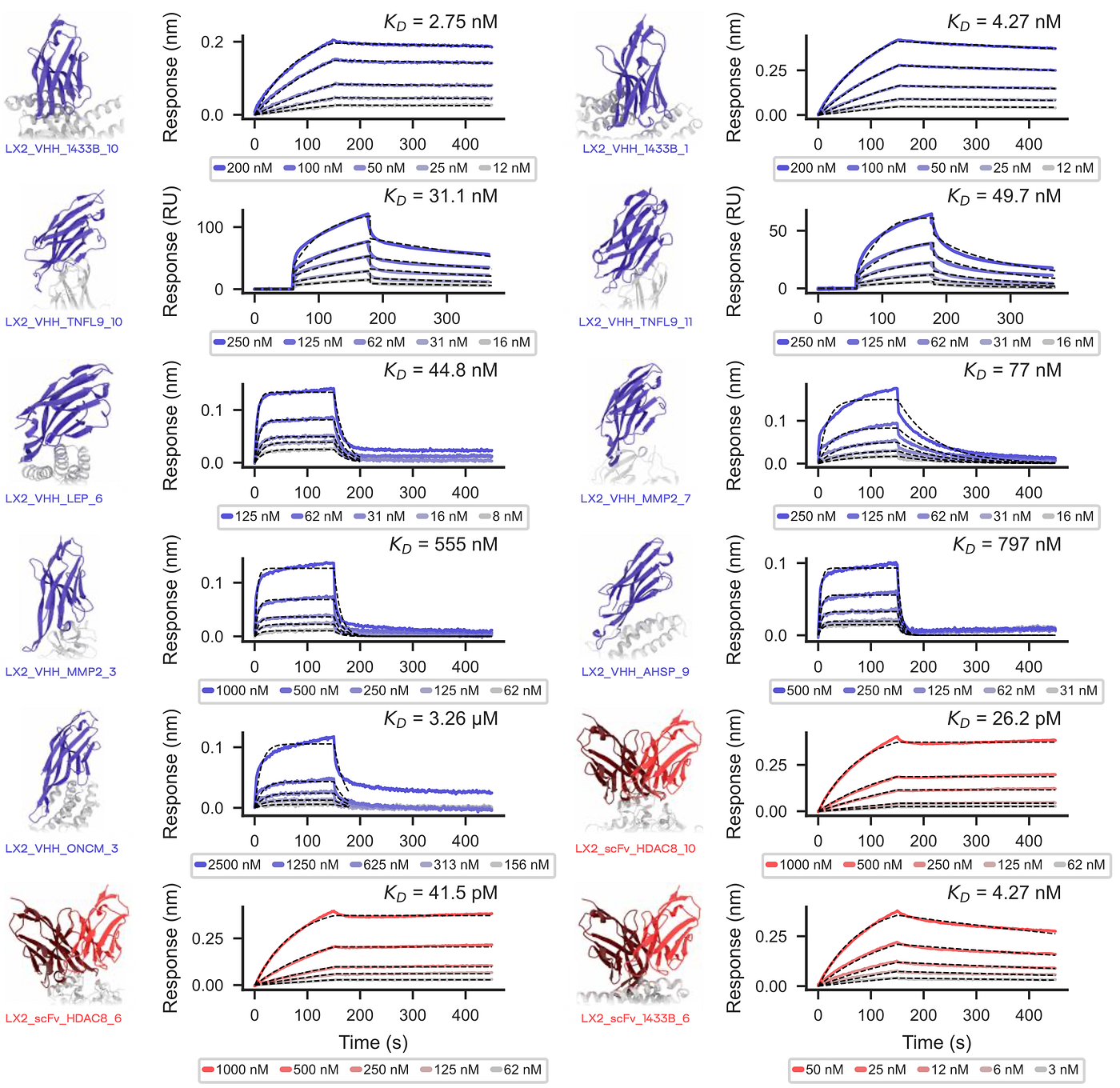
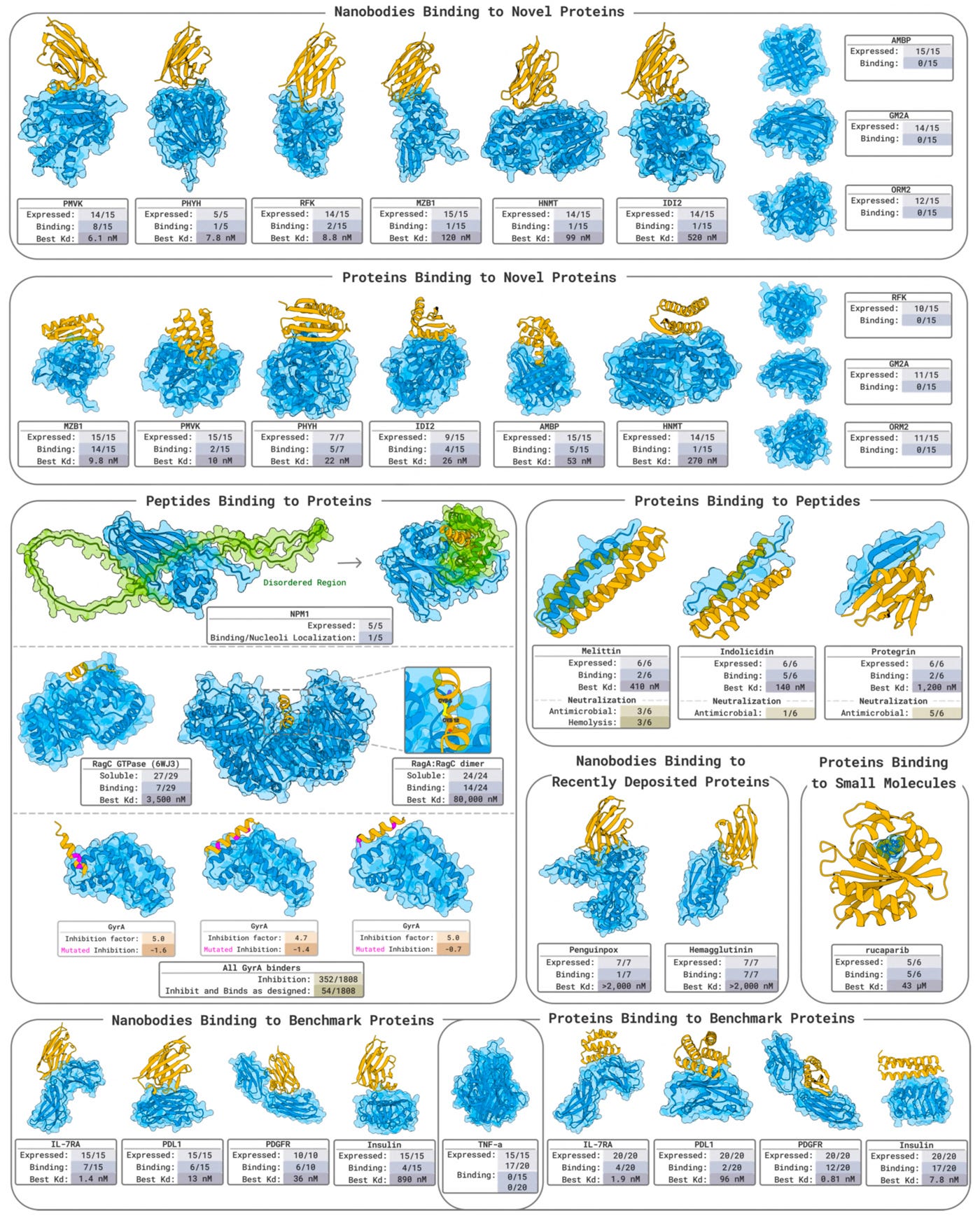
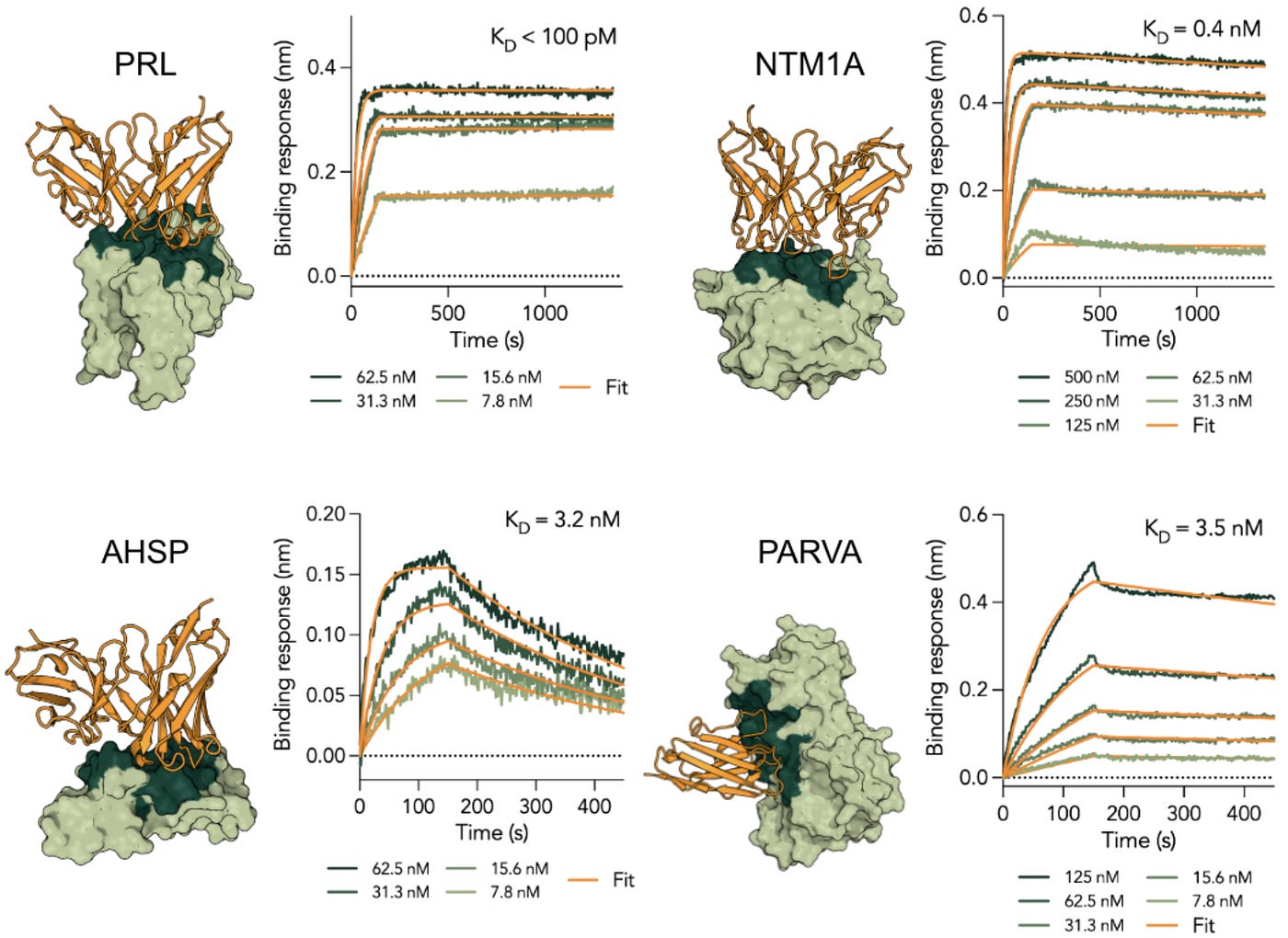
There’s no binding assay. No neutralization screen. No experimental expression or thermal stability test. Not even a back-of-the-envelope ELISA. Just simulated metrics and structural predictions.
To be clear: this isn’t a flaw in the authors’ implementation. It’s a choice: one that reflects the norms of both the conference (AAAI) and the authors’ backgrounds, which are solidly computational. None of the four lead authors (Yin, Zhou, Hou, Wu) typically include wet-lab work in their publications. They validate ideas using benchmarks, simulations, and clever scoring functions. And within that context, PG-AbD does what it promises to do.
But this is where we hit a broader issue: not with this paper, but with the field.
The Growing Gap Between Sequence and Function
In antibody design, we’re increasingly seeing papers that propose novel models, show diversity metrics, simulate folding or binding, and then stop. The assumption is that structural stability + PLM scores = function. But any wet-lab scientist who’s screened CDR variants knows that even high-quality, stable folds can produce antibodies that don’t bind, don’t express, or fall apart on purification.
We need to stop pretending that sequence plausibility is a proxy for function.
If you’re trying to discover binders, the proof isn’t in the perplexity. It’s in the plate. Because if we build the perfect antibody in silico, and it never binds anything in the real world, what have we actually built?
From Computational Promise to Practical Impact
PG-AbD is well worth reading if you’re working in antibody design, generative modeling, or simply curious about what GFlowNets can offer the field. It’s a solid example of how to guide sequence generation using multimodal priors, and it does that well.
But like many recent papers, it also reflects a broader trend: the growing tendency to treat computational screening as a standalone endpoint, rather than the first step toward discovering something that works.
Here’s the good news: this is solvable.
The model architecture is already strong enough to justify functional testing. This isn’t a case of needing another generation of refinement, it’s a case of taking a few top-ranked sequences, running an expression screen, and seeing what sticks.
For computational teams, the barrier to wet-lab validation is no longer technical: it’s collaborative. A partnership with an experimental lab (or a small budget for a CRO screen) could move candidate sequences into binding assays within a couple of months. If the team’s already at a company, or connected to one, it could be even faster.
These models are getting powerful. The next step isn’t to make them more plausible, it’s to see what they can actually do.
Yin, M., et al., April 11, 2025, Proceedings of the AAAI Conference on Artificial Intelligence, 39(21), 22164–22172.
Follow me on Substack, Medium, Bluesky, and LinkedIn for more posts on drug discovery, assay development, and screening workflows.
Appendix
¹ What is a Joint Reward in This Context?
In PG-AbD, the model uses reinforcement learning (via GFlowNets) to explore sequence space. But instead of rewarding a sequence for one thing (like binding or stability), it uses a joint reward, a combination of two signals:
- Global sequence plausibility
- Local, target-specific constraints
This means the model isn’t just looking for what “makes sense” in general, it’s also guided by what works for a particular antibody family or target.
Global Plausibility: Protein Language Model (PLM)
They use ProGen2, a pretrained protein language model. This model has learned general features of natural protein sequences by training on millions of known proteins. It assigns higher scores to sequences that look biologically plausible, e.g., those that follow evolutionary grammar, secondary structure preferences, etc.
In PG-AbD, this part of the reward helps the model stay grounded in “real protein space”, rather than generating unrealistic or unphysical sequences.
Local Constraints: Potts Model
The Potts model is a statistical model trained on a multiple sequence alignment (MSA) of related antibody sequences. It captures pairwise residue dependencies, i.e., which amino acids tend to co-occur at specific positions across evolution.
This means the Potts model encodes what’s “typical” or functionally tolerated in a specific antibody lineage. So while the PLM says “this looks like a real protein,” the Potts model says “this fits with what we know about this particular family of antibodies.”

Yin, M., et al. Proceedings of the AAAI Conference on Artificial Intelligence, 39(21), 22164–22172
Why Combine Both?
Think of the PLM as general knowledge and the Potts model as local memory. The combination allows the model to:
- Explore new CDR-H3 sequences that are diverse and novel
- Still maintain developability and structural realism
- Stay biologically consistent with what’s known about that antibody family
In practice, this joint reward helps balance exploration and relevance: a key challenge in generative antibody design, where purely PLM-based models often drift into unrealistic sequence space, and Potts-based models tend to be overly conservative.
— — — — — — — — — — — — — — — — — — — — — — — — — — — — — — — — — — — — —
² What Do “Amino Acid Recovery” and “Perplexity” Actually Measure?
These two metrics, amino acid recovery (AAR) and perplexity (PPL), are commonly used in sequence generation models, especially those trained on proteins or antibodies. Here’s what they mean, practically:
Amino Acid Recovery (AAR)
This is a measure of how well the model can reconstruct a known antibody sequence, particularly when part of it (like the CDR-H3 loop) is masked or excluded during training.
- Imagine you hide the CDR-H3 from a known antibody and ask the model to generate it.
- If the model’s output matches the original, that’s a “recovered” residue.
Higher AAR = the model can regenerate known functional antibodies more accurately.
This is useful as a proxy for biological relevance. If the model consistently recovers CDRs seen in nature, it’s probably learning something real about antibody design constraints.
Perplexity (PPL)
Perplexity comes from natural language processing. In protein modeling, it’s a measure of how “surprised” the model is when it sees a given sequence.
- Technically, it’s the exponentiated average negative log-likelihood.
- Intuitively: Lower perplexity = the model thinks the sequence is more natural.
In the antibody design context, low perplexity means the sequence fits well with what the model has learned about natural antibodies, i.e., it’s grammatically and biophysically plausible.
Why These Metrics Matter (and Don’t)
Both AAR and PPL are helpful for benchmarking models, especially when comparing methods or tuning hyperparameters.
But they have limits:
- High AAR doesn’t mean the antibody binds anything. It just means the model learned the right statistical priors.
- Low perplexity doesn’t guarantee function. It just means the model sees the sequence as “fluent.”
In the absence of wet-lab validation, these metrics tell us that a model is learning something coherent, but not necessarily something useful.
Follow me on Substack, Medium, Bluesky, and LinkedIn for more posts on drug discovery, assay development, and screening workflows.
메타데이터
- post_id
- c6adb58f2dd5
- slug
- can-generative-ai-design-antibodies-without-a-lab-c6adb58f2dd5
- url
- https://medium.com/@enginyapici/can-generative-ai-design-antibodies-without-a-lab-c6adb58f2dd5
- canonical_url
- https://medium.com/@enginyapici/can-generative-ai-design-antibodies-without-a-lab-c6adb58f2dd5
- author_url
- https://medium.com/@enginyapici
- status
- ok
- fetched_at
- 2026-08-23 10:17:39