Honest Preply Review: Is Preply Worth It? (June 2026)
Real lessons, real money, and the one question that decides whether Preply is worth it for you: does the subscription maths work?
Honest Preply Review: Is Preply Worth It? (June 2026)
Real lessons, real money, and the one question that decides whether Preply is worth it for you: does the subscription maths work?
Full Disclosure: I’m not a language teacher, a polyglot YouTuber, or one of those people who claims they learned seven languages in six months. I’m just a language learner who’s spent years bouncing between apps, subscriptions, false starts, and expensive experiments. In fact, before Preply, I’d already sunk more than $1,000 into Verbling. So no, I didn’t arrive here starry-eyed. If anything, I came in sceptical..
Preply Review: the 60 Second Verdict
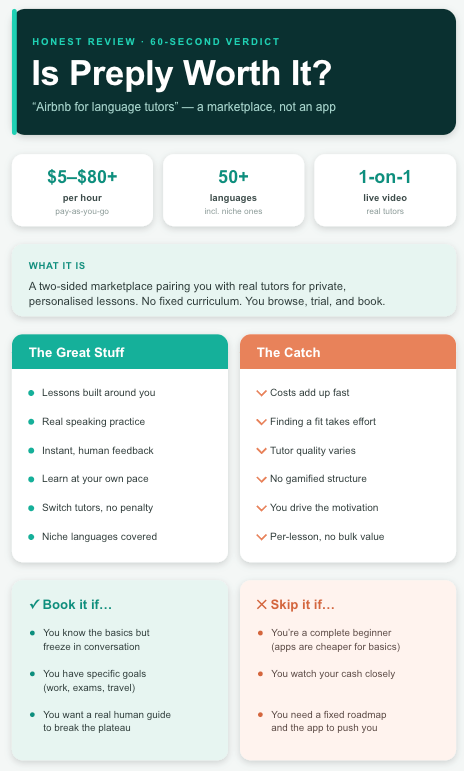
Is Preply Worth It
Think of Preply as Airbnb for tutors.
You’re not buying a fixed course like Duolingo or Babbel. You’re browsing a marketplace of real people: watching intro videos, comparing prices, checking availability, reading reviews, and trying to work out who might actually be able to help you.
That’s both the best thing about Preply and the bit that might make it slightly exhausting.
If you find the right tutor (at the right price), **Preply** can be an excellent option.
You can get proper conversation practice, real-time feedback, and lessons shaped around what you actually need. The lessons can be tweaked to exam prep, grammar, casual speaking, or whatever else is your learning goal.
A good tutor will also adjust as they go. If something is too easy, they can make it harder. If you’re struggling, they can slow down. If your goal changes, the lesson can change with it. That flexibility is the whole point.
And it’s not just languages anymore. Preply also has tutors for things like programming, maths, business, music, and arts, which makes the platform more interesting than I expected going in.
If you pick the wrong tutor, though, the whole thing can start feeling expensive very quickly. So pay attention during the trial lessons, and listen to your gut (and then do the pricing match to assess if the tutor is within your budget).
And you can try Preply at a 50% discount on your trial lesson
My verdict
So, is Preply worth it? Yes, for the right kind of learner.
If you can afford it, Preply (with usually options across all price ranges) is absolutely worth it. No app, AI or otherwise, really comes close to practising with an actual human being.
If you prefer self-learning over human tutoring or you’re trying to learn as cheaply as possible, I’d start with an app first.
Disclosure: Some of these may be affiliate links and often include special discounts or extended trials you won’t find elsewhere. I earn a small commission at no extra cost to you, which helps fund more honest reviews.
How I Tested Preply

How I tested Preply
I cannot realistically test every tutor on Preply (and no human really can). There are over 100,000 tutors on the platform. What I can test is something more useful: does Preply give you enough information and tools to choose well?
I also started with a budget of $300 for testing. It was an important (and self-imposed) limitation. If I cannot decide if Preply is worth it after $300, then it isn’t worth it.
So here’s the checklist I actually used while testing.
Get My Insider Reviews & Recommendations: Join 1000+ smart readers getting my honest breakdowns, comparison guides, and exclusive insights you won’t find in these public articles.
My testing checklist

My testing checklist
1. Can I find tutors that match my exact situation?
I need tutors who can work with my skill level, my goal (speaking with family), my budget, and a schedule that works around a full-time job and running a family.
2. Do the filters actually help, or are they cosmetic?
Price range, availability, native speaker status, specialisation, country. Are these filters useful in practice, or just there to look thorough?
3. Are the tutor profiles honest enough to make a decision?
Intro video, lesson count, reviews, qualifications, bio, hourly rate. Can I form a reasonable judgement without having to message every tutor first or take trial lessons?
4. Does the intro video tell me anything real?
Communication style, energy, accent, English ability where relevant, and whether they sound like someone I’d actually want to spend an hour with.
5. Is the trial lesson a fair reflection of an ongoing subscription?
Or does it feel like a softer, sales-y version of what I’d actually be paying for?
6. Does the platform set accurate expectations on price and commitment?
Is the platform using cheap tactics to steal my money, or is it absolutely clear why I pay for and what I get in return.
7. Does Preply work outside languages?
I tested this directly by booking a Python lesson at a very different price point, on the same platform, to see whether the experience held up beyond Preply’s core marketing.
8. Does the Preply Classroom actually work?
Audio, video, screen sharing, whiteboard, mobile-to-desktop handoff. I didn’t expect anything fancy — but just something that is easy and reliable.
9. Does the platform make it easy to switch or stop?
Switching tutors, pausing the plan, transferring credits, cancelling. These decisions should feel low-friction, not punishing.
10. Would I personally come back to Preply after the test?
Honest gut check. If I wouldn’t pay for it with my own money once the budget for testing ran out, that tells you more than any review claim.
What I actually did
To test all of this in practice, I did the below:
- Browsed tutors across German, Danish, Romanian, and a few non-language subjects
- Compared at least 15–20 tutor profiles before booking anything
- Booked a trial lesson with a German tutor (Michelle, around USD 60/hour)
- Booked a Python lesson with Ankita at around USD 10/hour to see how the platform held up outside languages
- Used Preply on both my Mac mini and the Preply mobile app, including switching mid-lesson
- Read through the subscription, pause, and cancellation pages directly so I wasn’t relying on memory or marketing copy
My First Lesson on Preply: Meet Michelle

My First Lesson on Preply: Meet Michelle
The tutor I picked for my German lessons was **Michelle**. The intro video was what made the difference. I booked due to her interesting background living in India and her intro video was in English. It felt more comfortable learning from someone who has more of a shared background. But test trial lesson was going to be the true test.
The lesson started with a bit of small talk, which honestly helped. Within a few minutes she had a decent read on where I was: I can put a few basic sentences together, probably know around a hundred words, and the reason I’m doing this is so I can actually have a conversation with my German family in German.
What I liked was that she didn’t treat the first lesson like a sales pitch or a warm-up exercise. It felt a lot more like the language classes I’ve done in person years ago. She figured out my level quickly and then jumped straight into the bits I actually needed.
We worked on basic sentence structure and the grammar foundations I was missing — I, you, they, and how verbs change with each. It was very similar to how my Danish lessons went, and felt comfortable enough to start there instead of learning ABCs.
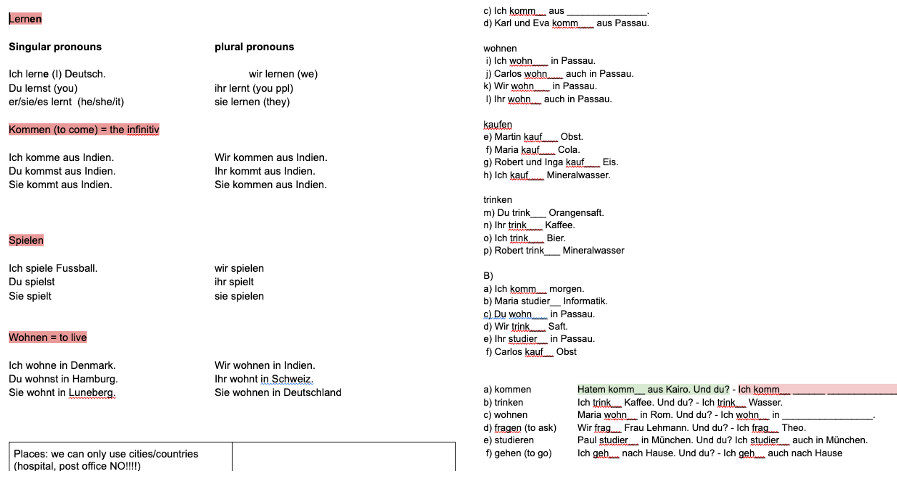
My notes from the German class + Homework
Michelle create a Google doc though the classroom had a whiteboard. The idea was to have something that we can both work with without having to use Preply platform. Works for me!
I joined from my Mac mini at first and switched to the Preply mobile app partway through, and the experience didn’t skip a beat. No audio drops, no video glitches, no fiddling around.
Michelle herself was excellent. She was polite, easy to talk to, and found the right balance between talking and listening as a tutor. When I told her the homework felt a bit too easy, she adjusted the difficulty without making it a big deal. That kind of small calibration is exactly what makes humans better tutors.
If I’m honest, I genuinely enjoyed the lesson. I hadn’t expected this little experiment to actually kick-start something, but it did. I’m now seriously thinking about taking language lessons properly, beyond this test.
So would I book Michelle again?
Short answer: I would have liked to.
But after the trial lesson, the natural next step on Preply isn’t “book another one whenever you want”. It’s a subscription, and the minimum option I was offered was four lessons a month. At her rate, that was more than I could justify spending right now.
That isn’t really a complaint about Michelle, or even about Preply. It’s just the honest reality of the price point. Was the lesson worth $60? Yes. Could I afford four of them a month? No.
Which actually answers one of the bigger questions I had going into this test: does Preply set accurate expectations?

I think it does.
The platform did a decent job of helping me pick someone who matched what I needed. The trial lesson was a fair reflection of what I’d be paying for. And the move to a subscription was clearly signposted, not buried.
(To Michelle: If you ever read this review — thank you! You were great, and I highly recommend Michelle for anyone who wants to learn German)

The unexpected bit
Here’s the thing I didn’t see coming.
This one lesson got me into a learning mindset I hadn’t been in for a while. So I went back to Preply and booked something completely different: Python lessons, at around $20 for a 50 minute lesson.
I’ll talk more about that experience later, but it’s worth flagging now because it shifted how I think about Preply. It’s not just a language tutor marketplace.
It’s a tutor marketplace, full stop. The price ceiling and floor are wildly different depending on what you’re trying to learn, and that quietly changes the value question.
Testing Preply Beyond Languages: My Python Lesson

My Python tutor — Ankita
After the Michelle lesson, I went back to Preply expecting nothing in particular and ended up booking something completely different: a Python tutor.
I manage teams that build things in Python, but my own career path skipped the writing-code part mostly. I wanted to fix that and understand more of what my teams actually do day to day. That felt like a low-pressure, high-value goal to learn around.
The tutor I picked was **Ankita**. The approach was the same as with Michelle. I watched multiple intro videos, read through the reviews, looked at the pricing, and went with the option that felt like the right fit. At $20 per lesson, it also felt very affordable if I chose to continue with a subscription model.
How the lesson went
We had a quick chat to figure out my level, what I wanted from the lessons, and how I would like to learn. From there, we got straight into the basics: syntax, variables, functions, and a small bit of self-learning homework at the end.
What I liked was the pace control. Ankita had her own prepared material, but I skimmed through it and pointed out the bits I wanted more time on. When I didn’t get something, I just asked her to re-explain it. She did, in a different way, without making me feel like I was slowing her down. The lesson went exactly at the pace I found useful.

The Preply Classroom worked fine for a technical lesson too. Nothing fancy, but reliable. Screen sharing was smooth, the audio and video were clean, and there were no glitches that pulled me out of the learning. For a coding session, that’s really all you need.
If I’m being honest, by the end of the lesson I already knew I’d subscribe.
Why I subscribed for Python but not for German
This is the part of the test I didn’t plan for.
I walked away from Michelle’s German lesson mainly because the subscription minimum at her rate was beyond what I could justify (though I think she’s a great tutor). With Ankita, the math just worked differently. $80 a month (4 lessons X $20 a lesson) -that’s a budget I can actually carry.

But it wasn’t only about price. A few things lined up:
- The topic is closer to my career interests. Python helps me at work as well
- I can’t realistically learn too many things in parallel. Picking one focus made the decision easier.
- The trial gave me enough confidence in the tutor and the format. I wasn’t guessing whether this would work.
The subscription flow itself was clean. There was no hidden fees, no surprise markup, no upsell games. The price I expected from the trial was the price I paid for the plan.
So for the first time in a long time, I’m actually in a structured weekly learning routine with another human on the other side of it. That feels different from any app I’ve used.
What this changed in my head about Preply
Going into this review, I thought of Preply as a language platform. After the Python lesson, I don’t anymore.
Used like this, Preply sits in a genuinely interesting space. Self-paced platforms like Coursera, Udemy, Skillshare, and YouTube are great for learning at your own speed, and I’d still recommend them for plenty of situations. But for my learning style and motivation, a real human teaching me consistently is more effective than another self-paced course I half-finish.
What Preply quietly offers (often at a much lower price point than its language marketing suggests) is a one-to-one alternative to a lot of those self-paced learning platforms. Same idea (learn something new). Very different experience (a person, not a course library).
One honest note before I move on
The biggest thing this lesson did for me was something I didn’t expect.
It wasn’t really about Python. It was about how easy Preply made it for me to actually start learning something new. I hadn’t consciously planned this. I tried one platform, found a tutor I liked, picked a topic I cared about, and now I’m a few weeks into a real learning habit.
That said, I’d be doing you a disservice if I framed Preply as the only sensible option. It isn’t. There are other platforms out there that will fit different budgets, different learning styles, and different topics better than Preply will. The point I’d urge you to take away is less about Preply and more about this:
Keep moving along the learning curve, whichever platform helps you do that.
Preply happens to be the one that worked for me this time. The next one might be different.
What Preply Actually Is
Preply is a tutor marketplace. You pick a subject, browse profiles, watch intro videos, compare prices, and book lessons with whoever you think will actually help you. Then you log into a video call and have a lesson.
With Duolingo or Babbel, you pay for access to a curriculum the platform has already built. With Preply, you’re paying for an actual person’s time. That changes pretty much everything: how much it costs, how structured your learning is, and how much of the effort falls on you.
How the marketplace works

Preply currently has more than 100,000 tutors across 120+ subjects, with learners in over 180 countries. The tutors set their own rates and availability. Some are native speakers, some are certified teachers, some are subject specialists from outside teaching. Quality and pricing are all over the place, which is why the platform’s search and filtering matter as much as the tutors themselves.
As a learner, your job is basically what I’ve been doing for the last few weeks: scrolling through profiles, watching intro videos, reading reviews, comparing prices, and trying to figure out who might genuinely help.
Preply takes its cut from the tutor’s side, so the price you see on the profile is broadly what you pay. There are no surprise markups at checkout. What you do need to pay attention to is the subscription model.
Preply is now subscription-first
After your trial lesson, the next step is to book a monthly subscription with a minimum number of lessons. You can adjust the plan, pause it, transfer it to a different tutor, or cancel it altogether. But it’s still a subscription, not a casual top-up.
Preply does offer 2 more additional trial lessons if the first one doesn’t work. However, after the trial lessons are done, you will have to make a choice to either continue to a subscription of cancel and do nothing.
How Preply differs from the language apps

How Preply differs from the language apps
If we line the two up bluntly:
The big language apps (Duolingo, Babbel, Busuu):
- Fixed curriculum that millions of other users also follow
- Short, gamified lessons
- No real-time conversation with a teacher
- Subscriptions in the $8–$15 a month range
- Genuinely good for getting started, less useful at higher levels
Preply:
- A personalised plan built around your goals
- Live, one-to-one video lessons of 50 minutes
- Real conversation and immediate feedback
- Per-lesson rates from roughly $5 to $100+ an hour, depending on the tutor and the topic
- Scales with you from beginner to advanced
The closest competitor in functionality is italki, with Verbling sitting nearby (and yes, I’ve burned plenty of money on Verbling in the past). But Preply is the biggest in the number of tutors & topic choices available by a huge margin.
Lessons are built around you, not a syllabus
The first lesson usually doubles as a kind of informal assessment. The tutors typically ask about your level, your goals, what you actually need the language for, what your interests are etc.,
For my own German trial with Michelle, it meant we skipped the textbook intro entirely and went straight to the sentence structures and verb forms I needed in order to talk to my German family.
You don’t get that kind of calibration from an app. An app doesn’t know you’re tired, distracted, frustrated, or just need someone to explain a concept a different way. A good tutor does and adjusts in real time.
The Preply Classroom
Lessons happen inside the Preply Classroom, which runs in your browser. No software to install. You get:
- Live video and audio
- Screen sharing
- A digital whiteboard for grammar, sentence work, or quick notes
- Materials and homework your tutor can drop straight into the lesson
- Automatic notes and vocab lists so you can review later
It is not flashy, but I like it. I want to focus on learning and technology out of the way.
Some tutors also bring in their own preferred tools like Google Docs for shared notes, Quizlet for vocab, YouTube videos for listening, news articles in the target language.
Michelle and I ended up running our lesson with Google Docs alongside the Classroom, and it worked fine. Preply lets each tutor shape their own setup around what works for them and you.
The mobile app
Preply has iOS and Android apps that cover almost everything you’d need on the go: booking, rescheduling, messaging your tutor, reviewing materials, and even taking lessons by mobile video.
In practice, I used the Mac mini for the main lesson and switched to the mobile app partway through, and the handoff was seamless — no dropped audio, no video glitches, no fiddling. For booking and messaging, the app is genuinely nice. For actual lessons, I’d still pick a laptop or tablet over a phone.
It’s easier to use than I expected
This is one of those things you only really appreciate after using a few competitor platforms. Preply doesn’t try to be clever. You can:
- Search and filter by subject, price, availability, and specialty
- Watch intro videos before committing to anything
- Book trial lessons in a couple of clicks
- Track your progress and lesson history
- Message your tutor without leaving the platform
Not just languages (many don’t notice this)
Preply is mostly marketed as a language platform, and that’s where the bulk of demand sits. The catalogue covers around 90+ languages from the obvious ones (English, Spanish, French, German) to genuinely niche ones like Danish, Romanian, Arabic, Hebrew, Hindi, Swahili, and even Esperanto. For less common languages, Preply is often the most credible place to find a native speaker who can actually teach.
But the thing I didn’t fully appreciate until I started testing the platform is that Preply isn’t only a language tutor site. It now has tutors for programming, maths, science, music, business skills, and more.
I’ve covered this in detail above, but I ended up booking a Python lesson at around $20 on the same platform, with the same booking flow, the same Classroom, and the same mobile experience.
So if you’ve been thinking about Preply as “the speaking practice place” and dismissing it for budget reasons, it’s worth knowing that the platform stretches a lot further than its marketing currently suggests.
What Preply Gets Right

What Preply Gets Right and where it falls short
Real teachers, not a curriculum
The biggest thing Preply has going for it is also the most obvious: you’re learning from an actual person, in real time. That sounds basic until you’ve spent a few months on apps and realised the thing you can’t do alone is actually speak.
You also get genuine choice. Whether you’re learning English, Spanish, German, Romanian, or something more niche, the pool of tutors is usually deep enough to find someone whose background actually matches what you need. With over 100,000 tutors across 120+ subjects, you are likely to find a tutor on preply that fits exactly your needs.
Lessons that adapt to you, not the other way round
This is the bit Preply genuinely deserves credit for.
A good tutor figure out where you are, what you actually want the language for, and what’s slowing you down and build lessons around that. I experienced this first hand in both my lessons.
In my trial with Michelle, that meant going straight to the sentence structures and verb forms I actually needed. When I told her the homework felt too easy, she increased the difficulty up without making it a big deal. That kind of mid-stream calibration is exactly what an app can’t do.
Flexibility that actually fits real life
No fixed semester, no missed-class guilt, no “you have to be online at 7pm on Tuesdays forever”. You book around your week. Skip when you’re on holiday. Add a couple of extra sessions before an exam. Cancel when you cannot make it to the class.
For anyone with a job, a family, or any kind of unpredictable schedule, that flexibility is often the difference between sticking with learning and quietly dropping it.
Easy to switch tutors
If a tutor isn’t working out, you’re not trapped. You stop booking with them, find someone else, and move on. No awkward conversation or penalty. You can also transfer your subscription directly to a new tutor instead of starting from scratch.
That alone takes a lot of the pressure out of picking your first tutor. You don’t have to get it perfect on the first try.
A platform that stays out of the way
Search, filters, intro videos, booking, messaging, materials, lesson history are all in one place, and all reasonably well-designed. I switched between my Mac mini and the Preply app mid-lesson without any drama. No dropped audio, no glitches, nothing fiddly. After some of the chaos I’ve waded through on other learning platforms, that alone is worth something.
It sets accurate expectations
This is the bit I didn’t expect to find myself writing.
The trial lesson with Michelle didn’t feel like a sales pitch dressed up as a lesson. It felt like a fair preview of what an ongoing subscription would actually look like. The price I paid, the materials we used, the way she taught, the homework she sent afterwards — all of it lined up with what I’d be buying if I committed.
It works for more than languages
This is the bit Preply’s own marketing undersells.
The platform has tutors for programming, maths, business skills, music, and more — and the price points outside languages can be very different. I booked a Python lesson for around $20/hour. If you’ve dismissed Preply as too expensive, it’s worth knowing the floor is much lower than the language category suggests.
Where Preply Falls Short
Finding the right tutor takes effort
This is the trade-off with any open marketplace.
Preply gives you a huge range of tutors, and that range is part of the appeal. A 5$-an-hour conversational tutor and a certified exam-prep teacher charging much more can both be good value. They’re just good for different learners.
The catch is that you have to do some of the sorting yourself.
Some tutors are brilliant at relaxed conversation practice. Some are stronger on structure and grammar. Some are great with children. Some are better for adults with a very specific goal. And yes, some simply won’t be the right fit for you, whether that’s down to teaching style, communication, internet quality, or just plain chemistry.
Preply does give you useful signals to work with: profiles, intro videos, reviews, lesson counts, pricing, and filters. That’s enough to make a sensible shortlist. If you want to narrow the field faster, filters like Professional Tutor and Super Tutor do help, even if they don’t guarantee the perfect match.
But it’s not enough to remove the trial-and-error completely. At some point, you still have to book a lesson and see how it feels.
That means Preply asks for more effort upfront than an app does. If your ideal learning setup is “download it, press start, and let the system guide me,” this will feel like work before it feels like progress. You have to compare, watch, filter, book, and decide.
For a lot of people, that effort pays off. For others, it’ll feel like friction. I think that’s the fairest way to put it.
Costs add up quickly at the higher end
There’s no economy of scale on Preply the way there is on app subscriptions. Each lesson costs what it costs.
The catch isn’t that this is unfair pricing. A live human is always going to cost more than a piece of software. The catch is that Preply now defaults to a subscription model with a monthly lesson minimum, so you can’t treat it casually anymore. That was exactly the wall I hit after my trial with Michelle. The lesson itself was worth the money, but the four-lesson-a-month minimum was beyond what I could justify.
It is also the reason I continue my lessons with Ankita.
Your progress depends a lot on tutor fit
Preply’s biggest strength is hyper personalisation. But is also where things can fall apart. With an app, everyone gets the same lesson whether it’s great or not. With Preply, your experience is almost entirely shaped by the tutor you end up with.
The platform helps you stack the odds with profiles, reviews, intro videos, and trial lessons. But the responsibility still lands on you to make a sensible pick. Do that work, and you’re likely to get something genuinely good. Skip it and pick the cheapest option blindly, and you may not.
It can feel unstructured
You and your tutor decide what to work on. For self-directed learners, that’s a feature. For people who genuinely need an app nudging them daily, it can feel like a lot of freedom and not enough push. If structure and gamification are what make you show up, Preply probably isn’t the right primary tool — at least not on its own.
No Certificates
Completion of the few lessons on Preply leads to enhanced skill and knowledge. But it is something that you can advertise on LinkedIn. If you need industry recognized certificates from your learning journey, focus on platforms like Coursera.
Who Preply Is For & Isn’t For (Yet)
Who Preply Is For & Isn’t For (Yet)
Preply may be for you if:
- Have already done some basics and now need to actually speak
- Want personalised lessons, not a generic curriculum
- Have specific goals like exam prep, business communication, travel, work
- Don’t mind spending a bit of time finding the right tutor
- Have the budget to commit to regular lessons rather than the odd one-off
It’s also a genuinely strong option for niche languages (Danish, Romanian, Hebrew, Swahili, and so on), and increasingly for non-language subjects like programming, where the price points are much more forgiving.
Preply may not be right for you if:
- Are starting a language completely from scratch- apps will get you to A1/A2 for a fraction of the cost
- Want a fixed roadmap, gamification
- Are inconsistent and won’t actually use a monthly lesson plan
- Hate the idea of having to choose, trial, and possibly switch tutors
- Need very low monthly costs without any commitment
- Need certificates to showcase on your CV
Preply Alternatives
Preply isn’t the only place to learn, and depending on what you’re trying to do, something else might suit you better. Here’s how I’d think about the realistic options.
italki
italki is the most direct competitor. Same idea of a tutor marketplace, similar trial lesson setup, similar booking experience. The big practical difference is that italki has stayed closer to pay-as-you-go, whereas Preply has moved firmly into subscriptions.
italki can also be cheaper at the lower end if you’re looking for community tutors rather than certified teachers. If your priority is flexibility without committing to a monthly plan, this is probably the first place I’d compare Preply to.
Duolingo, Babbel, and Busuu
If you’re starting a language from scratch, these are honestly fine. They’ll get you to a basic level cheaply, and Duolingo in particular is good at building daily consistency.
The wall most learners hit later is speaking. Apps don’t correct pronunciation in real time, they don’t adapt to how you specifically learn, and they certainly don’t hold a conversation back. That’s the moment people usually start looking at Preply or italki.
Verbling
I have history with Verbling. I spent more than a thousand dollars on it before I found Preply. The teaching was good, the platform felt a bit heavier, and I never found the tutor catalogue as wide. If you’re already on Verbling and happy, no real reason to move. If you’re choosing today, I’d start with Preply or italki.
Coursera, Udemy, Skillshare
These come up more now that Preply is also used for non-language learning. I tested it with Python, so the comparison feels real to me. Self-paced platforms are great if you want a structured course, a certificate at the end, and the ability to pause for weeks without anyone noticing.
Where they fall flat for me is accountability. Nobody’s expecting me on Tuesday. Nobody asks why I didn’t do the homework. If you’re the kind of person who actually finishes self-paced courses, you don’t need Preply for these subjects. If you’re like most of us and start ten and finish two, a real tutor changes the equation.
In-person tutors and language schools
Still very much a thing, especially in cities. The downsides are obvious: less flexibility, higher cost, and you’re stuck with whoever happens to live near you. The upside is a classroom feel, real social contact, and other students who are in the same boat.
I’d say in-person is worth it if you specifically want the classroom atmosphere. Preply replaces the tutor part. It doesn’t replace the room full of other learners.
Free options people forget about
Tandem, HelloTalk, YouTube channels, free podcasts, language learning subreddits. None of these will give you a personalised plan or fix your grammar. But if your real constraint is money, they’re much better than doing nothing. I’d rather see someone making slow progress on Tandem than waiting six months for a budget that never quite arrives.
How I’d actually choose
A rough decision tree from how I think about it:
- Brand new to a language and tight on budget: start with Duolingo or Busuu.
- Past the basics and your speaking is what’s holding you back: Preply or italki.
- Want certificates for work: Coursera or Udemy.
- Want a classroom feel and live nearby: a local language school.
- Money is the main constraint: free apps, language exchange, YouTube.
You can absolutely use more than one of these at the same time. I do. The point isn’t loyalty to a platform, it’s whether you’re actually moving forward.
Is Preply Worth It?
Yes. With a few honest caveats.
If you have a real reason to learn like speaking with family, prepping for an exam, levelling up at work, picking up a new skill alongside your job etc., and the budget to commit to a regular cadence, Preply is one of the best options out there. The platform is well built, the tutor pool is deep, the trial does an honest job of previewing what you’re actually buying, and the pricing range across subjects is wide.
After my own testing, I walked away from German because the maths didn’t work at $60/hour. I’d decided to test-drive a Ferrari knowing I could only afford a Ford. But in my defence, I was only testing.
I stayed with Python at $20/hour because there, the maths does work. That alone tells you most of what you need to know. Preply works when the lesson plan you’d realistically subscribe to is one your budget can support every week, not just for a month or a curious afternoon.
On a side note: there are plenty of good tutors in the $5–10 range. Don’t let your biases trick you into paying more than you need to. Cheap isn’t necessarily bad — just account for how the value of your currency (euros or dollars) translates into the market the tutor is coming from.
If you’re looking for the cheapest possible way to learn, or you’d genuinely rather self-pace through an app or course, Preply isn’t the right starting point. Start with an app, build the basics, and come back to Preply when human practice becomes the bottleneck.
But for the right learner, at the right stage, with the right budget — yes, Preply is absolutely worth it.
Frequently Asked Questions
Is Preply legit?
Yes. Preply has been around since 2012 and lists more than 100,000 tutors on the platform. The reviews on Trustpilot seem to agree.

How much does Preply cost in 2026?
The pricing depends entirely on the tutor. The platform itself does not have any fixed fee. The lesson price is shown clearly on each tutor’s profile, so you know what you’re paying before you book.
Is the first lesson free?
No. The first lesson is a paid trial lesson, and usually discounted at 50%. Think of it as a low-cost way to test fit rather than a freebie.
Do I have to subscribe, or can I pay per lesson?
Preply works on a subscription model. After your trial, you will need to start a lesson plan with a monthly minimum. For me, that was four lessons tailored to my needs each month. You can change lesson plans, pause, transfer your subscription to a different tutor, or cancel lessons entirely if you need to.
Can I cancel my Preply subscription anytime?
Yes. You can cancel from your account settings or pause if you just need a short break. Just check the timing rules so you don’t pay for an extra cycle you didn’t want.
How many lessons a week do I actually need?
How many lessons you need depends on your goal. As a rough rule, weekly classes are the practical minimum to see steady improvement. Two a week is the sweet spot if budget allows. Three or more is fast progress, but starts to feel like a real budget category.
Does Preply offer a placement test?
Yes, for a limited set of languages — English, Spanish, French, German or Portuguese (for now).
How is a Preply lesson actually structured?
Usually a quick check-in, then targeted work based on your learning plan, then a small wrap-up. A great tutor will adapt mid-lesson if something isn’t landing and adjust homework when you give feedback. Some run informal progress tests every few weeks, especially if you’re doing weekly classes.
Can I learn at my own pace and on my own schedule?
Pretty much. You book around the tutor’s availability and pick a cadence that fits your week. Changing or cancelling does not need too much notice. One can normally change classes up to 12 hours before the lesson.
What if my learning style doesn’t click with the tutor?
This is honestly the most important question on the list. Your learning style matters as much as the tutor’s qualifications. If the teaching style feels rigid, slow, or scattered, you can switch tutors without any penalty. Trial someone new and move on. Preply also has a satisfaction guarantee policy, offering a free replacement tutor if the trial lesson does not meet expectations.
How do I pick the right tutor?
Watch the intro video, scan the reviews, check the lesson count, compare prices, and look at how many of their existing students seem similar to you. The intro video is honestly the single best signal. It tells you more in a minute than a bio does in a paragraph.
Are Preply tutors native speakers?
Many are native speakers of the target language, but not all. Some are highly fluent non-native language teachers, and many are certified professionals with proper teaching experience. None of these is automatically better, what matters is whether they can teach you.
Do tutors answer messages between lessons?
In my experience, yes. Tutors answer messages through the platform, usually within a few hours. Most of them treat language learners as ongoing students rather than transactions, which makes the learning journey feel less isolating.
Does Preply work for niche languages?
Surprisingly well. The Romanian online course options are deeper than most people expect, and the same is true for Danish, Hebrew, Swahili, and other less common languages. For niche languages, Preply is often the most credible online platform to find experienced, native-speaking language tutors.
Is Preply only for languages?
No, and this is the bit people miss. Preply is genuinely an amazing learning opportunity for subjects outside languages too, like programming, maths, music, business, and more. I tested it with Python at around $20 per lesson and got the same Preply Classroom, the same booking flow, the same Preply app.
How does Preply compare to self teaching or other online learning programs?
For absolute beginners, self teaching through an app is usually cheaper and good enough to get you to a basic level. The gap shows up later. Once you need real speaking practice, immediate feedback, or someone to listen patiently and adapt as you go, a live tutor beats almost any self-paced course.
Preply claims that people who use the platform build 60’% more speaking confidence than self-learning app users, and progress 3X faster than industry benchmarks. But for you, the easiest way to buy that is to take a trial lesson and figure for yourself.
Does Preply work on mobile?
Yes. The Preply app (iOS and Android) covers booking, rescheduling, messaging, and lesson materials, and it has a genuinely user-friendly interface. You can take lessons through it too, though I’d still pick a laptop or tablet for the actual lesson if you can.
Is Preply worth it?
Short answer: yes, if you have a real learning goal and the budget to commit to a regular cadence. Preply is worth the price when human interaction is the bottleneck in your language learning or skill-building. For most learners past the basics, that’s exactly when it earns its place.
Are Preply tutors actually experienced, or is it a mix?
It’s a mix. Some of the tutors I looked at had over 1,000 lessons under their belt. Others had maybe 20. Both showed up on the same search results. Preply shows you lesson counts and reviews on every profile, which helps, but you do have to look properly.
My own rule by the end of testing was simple: if I cared a lot about the subject, I paid more for experienced tutors. If I was just curious about something, I’d try a newer tutor at a lower price. Worked fine both ways.
Can a Preply tutor help with proper job-relevant skills?
Yes, and this is the bit Preply doesn’t market enough. Plenty of English tutors on the platform basically do executive coaching dressed up as English lessons. Interview prep, presentation rehearsal, writing emails that don’t make you sound like a robot, dealing with annoying clients in a second language. Same goes outside English.
Many tutors specifically list business communication, technical interview prep, or specific industries. If your reason for learning is work, an online tutor is honestly a better spend than another self-paced course you won’t finish. Just be specific in your first message. Vague request, vague lesson.
Does Preply actually work around a busy schedule, or is that just marketing?
Worked for me, with one caveat. I’ve already rescheduled twice. Once because of a work meeting that ran late, once because of something at home. Both times the tutor was fine about it. Most tutors on Preply seem to genuinely get that people have busy lives and don’t treat a reschedule like a personal insult.
Online language classes (and everything else) run in 25 or 50 minute slots, so there’s usually something that fits a gap in the day. The bit nobody tells you: cancel inside the cancellation window and you’ll pay for the lesson anyway. Which is fair. I’d expect the same from a private tutor in person.
Are there student discounts or any real way to bring the cost down?
Not really, if I’m being honest. There’s no permanent student discount. Sometimes Preply runs first-time credits or seasonal promos around new year, back to school, that kind of thing.
There’s a referral system that gets you a bit off when a friend signs up. None of this changes the maths much. What actually saves you money is the tutor you pick.
Can I Practice between lessons?
Preply has put more effort into between-lesson support than I expected, although right now the AI tools are mostly for English and Spanish learners.
The main extras are:
- Daily Exercises, which turn lesson content into short follow-up practice
- Scenario Practice, which lets you rehearse real-life situations like meetings, travel, or presentations
- **Lesson Insights**, an AI-generated summary with vocabulary, grammar feedback, speaking notes, and corrections.
I wouldn’t oversell these as the reason to choose Preply. The tutor is still the product. But they do make the platform feel less like a one-hour-a-week experience and more like an actual learning system.
메타데이터
- post_id
- c6cbb7d64cde
- slug
- preply-review-is-preply-worth-it-c6cbb7d64cde
- url
- https://medium.com/@ilampadmanabhan/preply-review-is-preply-worth-it-c6cbb7d64cde
- canonical_url
- https://medium.com/@ilampadmanabhan/preply-review-is-preply-worth-it-c6cbb7d64cde
- author_url
- https://medium.com/@ilampadmanabhan
- status
- ok
- fetched_at
- 2026-07-13 06:23:13