FINE ON THE RHINE
On cruises on the Rhine, you can explore European cities and villages every day — or just watch the river go by. Whatever floats your boat.
FINE ON THE RHINE
On cruises on the Rhine, you can explore European cities and villages every day — or just watch the river go by. Whatever floats your boat.
BY BOB COOPER
You won’t find much about the Hohenzollern Bridge, which crosses the Rhine in Cologne, Germany, in cruise brochures or travel guidebooks. Yet my wife and I found it more romantic than any castle and more spiritual than any cathedral we saw — and we saw plenty — on a one-week cruise of the Rhine River last spring.
Locals, we learned, call it Liebe Brucke — the Love Bridge. Tens of thousands of padlocks glistened in the sun, draping nearly every inch of a 400-yard-long metal fence on the railroad and pedestrian bridge. We began reading: “Klaus & Claudia 9–9–2005”….”Tanya + Vito”….”Carlos & Jenny 4-Ever.” Each couple had engraved or written their names on the locks, snapped them shut and tossed the keys in the Rhine, symbolizing their permanent commitment. How romantic is that?
The bridge was just one on the surprises that eased our concerns that on a river cruise, our first, we would feel trapped on the boat and unable to explore freely on land — the problem we encountered on our only ocean cruise. But the “Rhine Getaway” cruise aboard a 147-yard-long Viking River Cruises Longship proved to be full of Love Bridge-like surprises of the sort that transform travel from a scripted experience to a journey of discovery.
Surprise, Surprise!
The surprises started on our first jet-lagged afternoon in Europe. Soon after checking into our stateroom, we were off on the first daily guided tour, a stroll through the heart of Basel, Switzerland. As we walked through an echoing corridor outside the Romanesque cathedral, a cellist in jeans and a sweatshirt, seated on a portable stool, played a flawless Bach suite. A few minutes later, a middle-school band dressed in traditional Swiss Alpine outfits — recruited to enliven a wedding reception on the cobblestone cathedral plaza — began playing a brassy tune for the couple. Back in our stateroom, another couple drifted side-by-side to just below four balcony — a pair of swans — seemingly to welcome us to Europe.
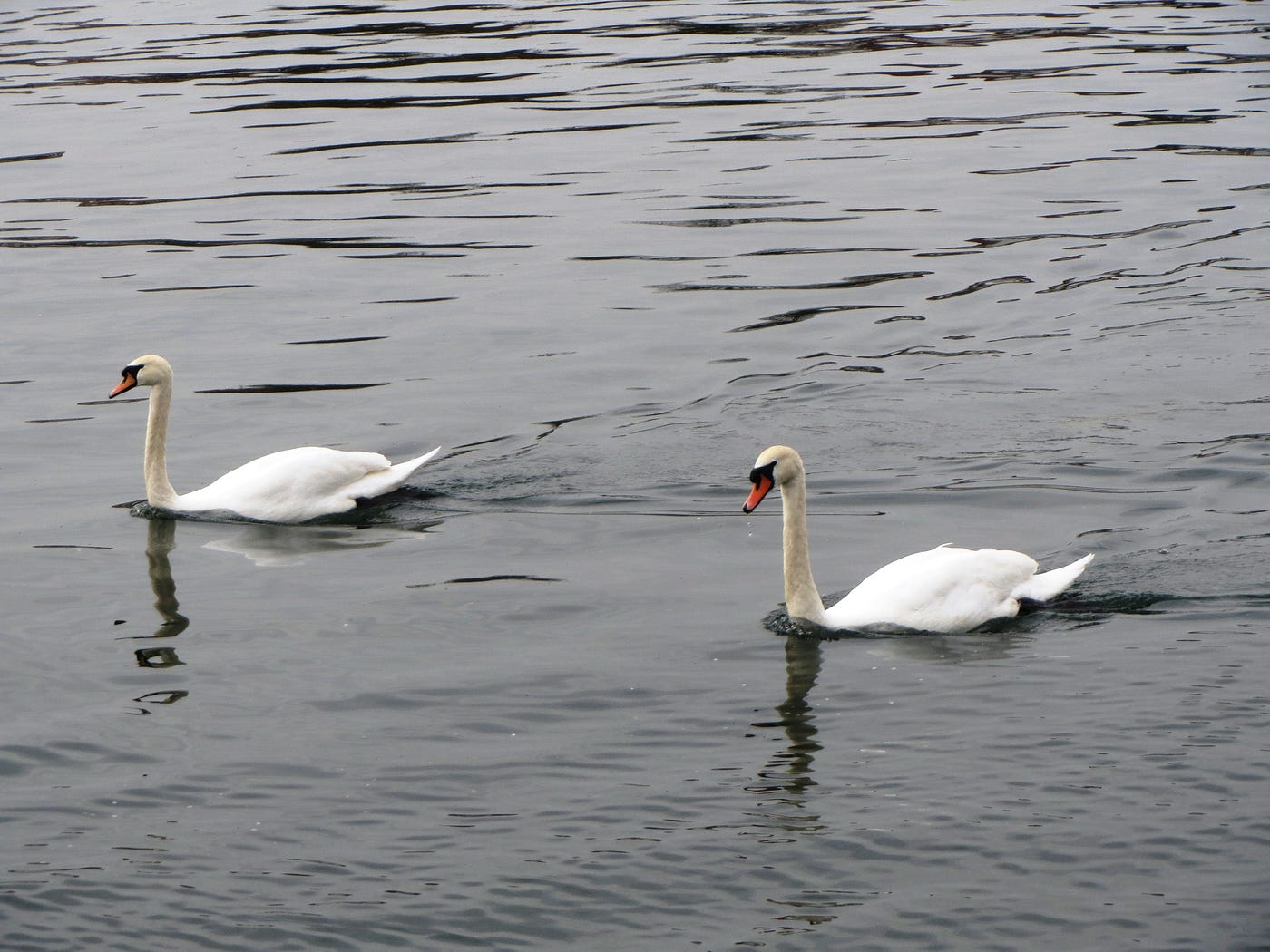
Swans greet visitors to the Rhine in many villages. Photo by Bob Cooper
The surprises kept coming after that exhilarating first day. Our visit to Strasbourg, France, coincided with its Carnival parade, an hours-long procession of floats, bands and dance troupes that filled the city’s historic Grande Ile (Grand Island) with color, sound and thousands of families and university students who came to watch. Carnival happens just once a year, but cruise passengers are just as likely to stumble on a fall wine festival, “Christmas market” or summer art or music festival, depending on when they travel.
Later we watched archeologists sift through a pile of unearthed ceramic fragments at Marksburg Castle in Braubach, Germany; an octogenarian shepherd minding hundreds of sheep in a riverside park in Cologne (while riding bikes rented for five Euros apiece); and flocks of giggly Dutch schoolgirls pedaling home on balloon-tired bikes in Kinderdijk, Holland. Wonderment happens if you pay attention, even on a river cruise with four-page daily activity schedules placed nightly on your pillow.
Rollin’ on the River
Luxury river cruises on the Rhine and other great rivers are exploding in popularity, partly due to the troubles that have plagued ocean cruises. Instead of fearing a norovirus outbreak during days at sea on a 4,000-passenger ship, river cruises let you travel at night on boats that accommodate fewer than 200 people and let you explore each day on your own or on small guided tours. The ships are small, but ours still squeezed in a putting green, shuffleboard court and walking track onto the sun deck; computers and a small library near the lobby; a piano played nightly by an onboard musician in the lounge; and high-def TVs with on-demand movies in the staterooms.
Noble, a retired insurance agent from Gordon, Texas, spent much of one shipboard dinner with us talking over plans to join a cruise-sponsored evening pub crawl with his wife, Gloria, and other couples they’d met on the ship. Soon the conversation shifted to the differences between ocean and river cruises; they’ve done both on four continents. “On river cruises you’re right on the water instead of 11 stories up,” he noted. “Here you feel, breathe and smell the water and you’re so close to the countryside. It’s very intimate.”

River cruising lets you see towns and villages from the boat or on foot away from the crush of “tourist” sights. Photo by Bob Cooper
At night the staterooms are quieter than most hotel rooms — you can barely hear the hybrid engine or feel the waves. Indeed, the newer ships — mine was among 16 identical longboats christened the month before my sold-out cruise — are floating four-star hotel-restaurants, with a concierge, 24-hour front desk, daily housekeeping, wakeup calls and a kitchen staff that prepares three daily meals. But the land-vacation hassles of nightly hotel hopping are avoided. You check in once, fold your clothes into the dressers and don’t have to pack again until you’re shuttled to your departing flight. You also tip only once (except for drinks at the bar) — on the last day in an unmarked envelope — and there are no money-changing hassles with all but a half-day in countries using the Euro.
“We’ve been pampered by the crew from the moment we were picked up at the airport,” Mary told me after returning from a tour of World War II sites in southern France. Mary, a nutritionist, and her husband Howard, an oncologist, had flown in from Fargo, North Dakota. “You never deal with luggage, and when you return to the boat at the end of the day, it feels like you’ve come home.”
Decisions, Decisions
River cruises, we learned, are not only free of hassles but full of choices. We chose to return to Strasbourg’s Grande Ile on a cruise shuttle bus, even after a morning tour there, to see the Carnival parade. It was a good choice. We spent the afternoon watching the parade, ducking into several museums (which were free that day), and strolled the river path that encircles the island. We also climbed the steps of the cathedral, at 466 feet the tallest building in the world for two centuries, with its views halfway to Germany.
Once in Germany, we took bus or walking tours each morning and explored solo on foot each afternoon. Other passengers took afternoon or evening tours to wine-taste or visit historic sites. In Breisach we followed the 700-year-old city wall past 500-year-old houses whose residents grew single rows of Riesling grapevines in their front yards. In Saint Peter we walked up a village road and waved to a young couple on horseback and an old farmer driving a mini-tractor. In Cologne we saw sections of the Berlin Wall in a riverside park. In Heidelberg we pretended to be royals in the 1214 castle, students in the 1386 university library, parishioners in the 1398 church and guests in a 1592 hotel.

Heidelberg Castle, built in 1214, is among the places river cruise passengers tour on excursions. Photo by Bob Cooper
The hardest choice came in the Black Forest. Hike or cake? Cake or hike? Hiking in the woods that inspired Grimms’ Fairy Tales was on the bucket list, but the black forest cake-making demonstration sounded too sweet to miss. So we did both, cutting the hike short and speed-hiking back in time to see how sponge cake, cherries, cherry jam, cherry brandy, chocolate shavings and three cups of whipped cream can be transformed into one of the world’s most decadent desserts.
Castles High and Low
The highlight of any Rhine cruise is the Upper Middle Rhine — so historically rich that the entire 40-mile stretch of river is a UNESCO World Heritage Site, with an average of one hilltop or riverbank castle, castle ruin or fortress per mile. It was there that the boat spent the longest period of time traveling in daylight so that passengers wouldn’t miss the spectacle.
We marveled at the unique architecture of each medieval castle as we drifted past them at a leisurely 14 mph. The program director, a transplanted New Englander, could be heard from everywhere onboard as he commented on the history and legends of each castle as it came into view: Katz and Maus Castles (yes, German for “cat” and “mouse”); Sterrenberg and Liebenstein Castles (owned by the “hostile brothers” who feuded over the same woman); Granfenstein (built on an island in the middle of the Rhine) and Gutenfels Castles (on the hill above it); and on and on. Most tower high above riverside villages with their half-timber houses, churches and small cathedrals — and the steep vineyards and forests above each village. Some of the castles are ruins, while others are lovingly restored to become museums, hotels or restaurants.
Once I returned home, my brother-in-law complimented my castle photos (my sister is coaxing him to join her on a river cruise), but his remark about Cologne’s Love Bridge hit a nerve. “Sounds like a tradition started by the local locksmith,” he quipped. My sister shot him a look. Later I went online and was cheered to learn there are many “love-locked” bridges worldwide, especially in Europe, and that the tradition dates back a century or more to either Serbia or China. So, pack a padlock if you take a river cruise in Europe, and leave your cynicism at home.
…………………………………………………………………………………………………
When You Go
English Only: Passengers on most river cruise ships needn’t worry about language barriers because most specialize in one language. On my ship, the cruise staff spoke good English and all passengers were from English-speaking countries — most from the U.S., Canada or Great Britain — which made conversations at the nightly dinner-for-six table a breeze. Walking-tour guides, who can be heard on headsets so that you don’t have to crowd around them like football players in a huddle, also spoke excellent English.
Shipboard Activities: The size of riverboat cruise ships, typically with no more than 100 staterooms, means there are fewer activities onboard than on ocean cruises, though they also aren’t as necessary with the boat docked on shore most days. But mine did offer numerous lounge presentations, where I learned how to make Rudesheimer Kaffee (coffee, sugar, cognac and a match to set it afire) and say a few German phrases while my wife learned how to make flammkuchen, the Alsatian version of pizza. Other presentation topics ranged from German glassblowing to Dutch cheeses.
Meals on Keels: Typical of European river cruises, my ship featured an indoor/outdoor casual dining area, where breakfasts and lunches could be enjoyed buffet-style, as well as an indoor restaurant, where wait staff serve passengers three meals a day — with no tipping expected. Alcoholic beverages served with meals, like just about everything, are included in the cruise cost.
메타데이터
- post_id
- c6d4586fec7b
- slug
- fine-on-the-rhine-c6d4586fec7b
- url
- https://medium.com/@bobcooper_94874/fine-on-the-rhine-c6d4586fec7b
- canonical_url
- https://medium.com/@bobcooper_94874/fine-on-the-rhine-c6d4586fec7b
- author_url
- https://medium.com/@bobcooper_94874
- status
- ok
- fetched_at
- 2026-07-11 13:37:47
