7 ZKML + ZK-Coprocessor Use Cases That Feel… Inevitable
The practical, non-hype ways teams are using ZKML and ZK coprocessors to ship verifiable apps — without turning everything into a proof for…
7 ZKML + ZK-Coprocessor Use Cases That Feel… Inevitable
The practical, non-hype ways teams are using ZKML and ZK coprocessors to ship verifiable apps — without turning everything into a proof for sport.
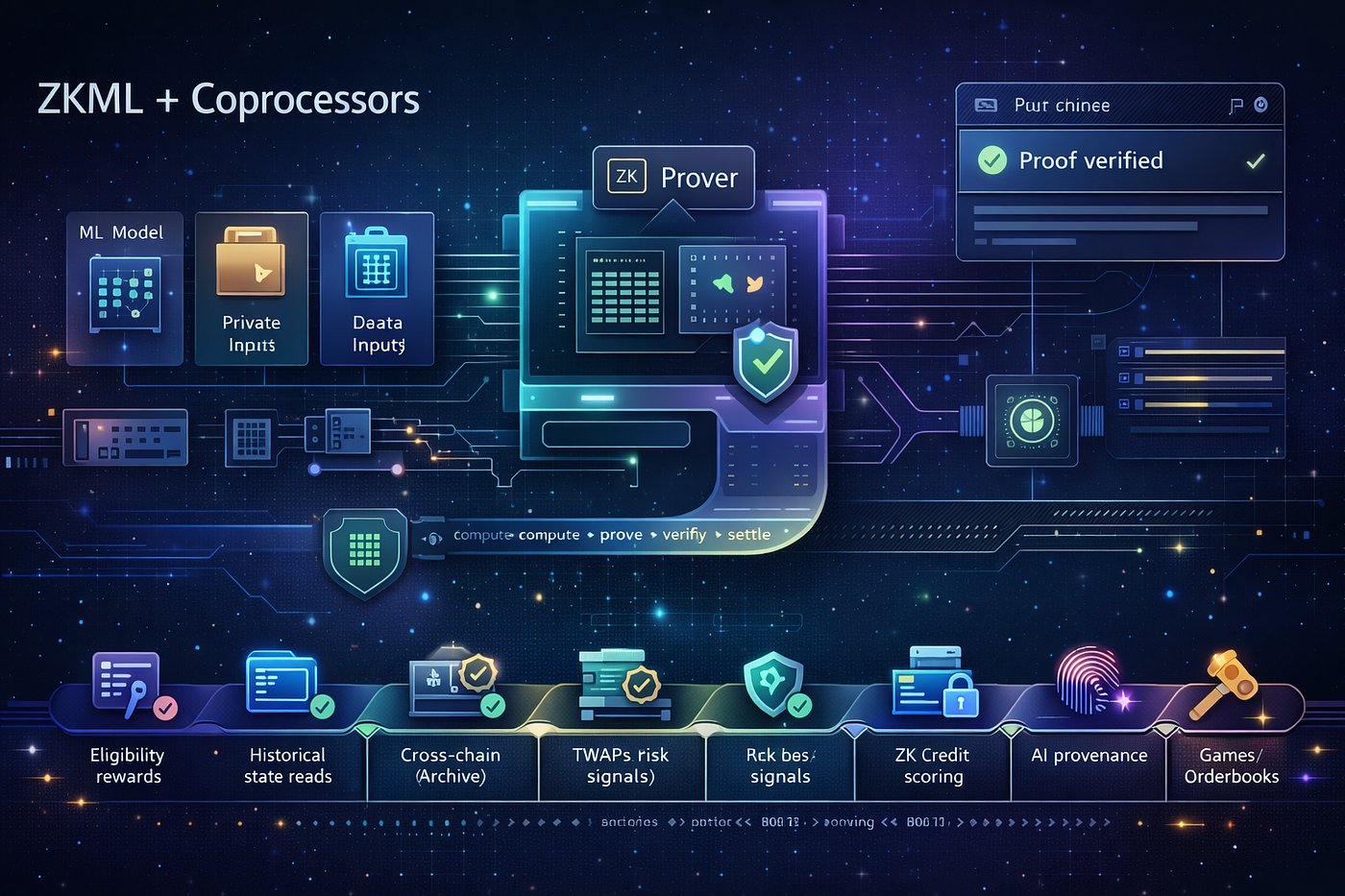
Discover 7 real ZKML and ZK-coprocessor use cases that don’t feel forced: verifiable inference, trustless data reads, ZK oracles, gaming, and more.
Let’s be real: most “ZK + AI” demos feel like a science fair project. Impressive, sure. But the moment you ask “who pays for proving?” the room gets quiet.
The trick is to look for use cases where ZK isn’t decoration. Where it’s the only clean answer to a hard constraint: trust, privacy, cost, or composability.
So here are seven ZKML and ZK-coprocessor use cases that actually earn their complexity.
A quick mental model: ZKML vs ZK coprocessors
These two get mixed up a lot, so here’s the simplest split:
ZKML: prove "this ML model ran correctly" (often hiding inputs)
ZK Coprocessor: prove "this heavy computation / historical query is correct"
               then bring a tiny result on-chain
ZKML is about verifiable inference. Coprocessors are about verifiable off-chain computation + on-chain verification, often over large datasets or chain history.
1) “Show me you qualify” rewards, without trusting indexers
If you’ve ever shipped a token distribution, you know the nightmare: eligibility logic lives in a dashboard, a spreadsheet, or an indexer someone controls.
ZK coprocessors make a cleaner promise: prove eligibility from on-chain history, then let the contract verify it.
Why it doesn’t feel forced
Because the alternative is always worse:
- centralized allowlists
- opaque indexers
- endless community disputes
Best-fit examples
- loyalty programs (activity-based rewards)
- retention quests that can’t be gamed
- “power user” tiers for fee discounts
2) Trustless historical state reads for DeFi that outgrow the EVM
Smart contracts are famously amnesiac. In many environments, they can’t access deep history, past states, or rich aggregates without external trust assumptions.
Why it doesn’t feel forced
Because “just use an oracle” quietly reintroduces trust and operational risk.
Best-fit examples
- verifying whether a transaction succeeded long ago
- historical vault balances for fee rebates
- provable “time-in-market” metrics
3) ZK oracles for cross-chain state (storage proofs as a product primitive)
This is the version of “oracles” that feels like infrastructure, not vibes: prove a storage value from chain A, verify it on chain B.
Why it doesn’t feel forced
Because cross-chain apps already need state reads — and the trusted oracle model is a single point of failure.
Best-fit examples
- cross-chain governance (prove voting power on a source chain)
- cross-chain collateral checks
- trust-minimized bridging designs
4) ZK TWAPs, risk signals, and “analytics you can settle”
Here’s where coprocessors quietly become the “missing middle” between Dune and on-chain logic.
Why it doesn’t feel forced
Because DeFi desperately wants:
- manipulation-resistant signals
- provable aggregates
- cheap verification on-chain
Architecture sketch
(1) Contract requests metric
(2) Coprocessor computes over historical blocks
(3) Generates proof for result
(4) Contract verifies proof + uses metric
Best-fit examples
- lending markets using provable volatility bands
- insurance pricing based on provable drawdowns
- DAO policy automation (“if utilization > X for Y blocks…”)
5) Verifiable ML inference for credit and underwriting (without exposing data)
If you’ve ever tried to put “credit scoring” on-chain, you’ve hit the wall: the model and inputs are sensitive, but the outcome needs to be trusted.
That’s basically ZKML’s home turf: prove that a specific model produced a specific output without revealing everything inside the sausage.
Why it doesn’t feel forced
Because the non-ZK alternative is: upload private data, leak model IP, or trust a centralized scorer.
Best-fit examples
- undercollateralized lending with private inputs
- compliance screening with selective disclosure
- prediction-based payouts where you don’t want to reveal raw features
6) “Prove this content came from that model” (and stop arguing on vibes)
This use case is sneaky important: verifiable AI provenance.
Why it doesn’t feel forced
Because provenance is becoming a business requirement, not a crypto hobby:
- marketplaces want authenticity guarantees
- brands want “this was generated under policy”
- platforms want automated moderation signals
Best-fit examples
- creator marketplaces (verified generation settings)
- watermark alternatives (harder to strip, easier to verify)
- enterprise “approved model only” pipelines
7) On-chain apps with off-chain brains: games, simulations, orderbooks
Some applications just don’t belong inside gas limits. But they do belong inside on-chain settlement.
Why it doesn’t feel forced
Because it’s literally the only way to get:
- rich game logic
- complex matching engines
- simulations / backtests …without turning the chain into a calculator with a meltdown.
Best-fit examples
- provable on-chain order matching
- strategy games with hidden state + provable turns
- tournaments where results must be indisputable
A tiny, working-style ZKML sketch (what “proof of inference” looks like)
Here’s the practical shape most ZKML systems converge on (tooling differs, but the flow doesn’t):
Train model -> export to ONNX -> generate circuit/proving key
User provides input -> prover runs inference + generates proof
Verifier checks proof -> accepts output without seeing input
That’s it. Not magic. Just an expensive computation compressed into something verifiable.
Conclusion: the “not forced” filter
If you want a simple rule: ZKML and ZK coprocessors win when they replace a trusted intermediary — an indexer, an oracle, a scorer, a game server — with something verifiable.
Not everything needs a proof. But the things that do? They tend to rhyme:
- historical data you can’t natively access
- privacy you can’t compromise
- computations too heavy for on-chain
- trust assumptions you can’t afford
If you’re building in this space, comment with what you’re proving (inference, history, cross-chain state, or heavy compute). I’ll suggest the cleanest architecture — and the part you should not over-engineer. Follow if you want more ZKML/ZK-coprocessor breakdowns that stay grounded in shipping.
메타데이터
- post_id
- c6eb9f4802e1
- slug
- 7-zkml-zk-coprocessor-use-cases-that-feel-inevitable-c6eb9f4802e1
- url
- https://medium.com/@Quaxel/7-zkml-zk-coprocessor-use-cases-that-feel-inevitable-c6eb9f4802e1
- canonical_url
- https://medium.com/@Quaxel/7-zkml-zk-coprocessor-use-cases-that-feel-inevitable-c6eb9f4802e1
- author_url
- https://medium.com/@Quaxel
- status
- ok
- fetched_at
- 2026-06-23 17:05:31