India cannot afford to lose Iran: A Strategic, Historical, and Moral Reckoning
Long before artificial borders carved up ancient civilisations, the Indus Valley and the Persian plateau were bound by millennia of…
India cannot afford to lose Iran: A Strategic, Historical, and Moral Reckoning
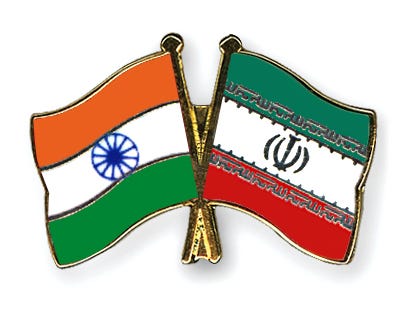
India and Iran Flag
Long before artificial borders carved up ancient civilisations, the Indus Valley and the Persian plateau were bound by millennia of exchange. From the Achaemenid Empire (550–330 BCE), where Persian emperors employed Indian archers and imported Indian teak, spices, and elephants, to the Silk Road caravans that carried saffron, poetry, and philosophy through the Khyber Pass; from the Zoroastrian refugees who fled Arab conquest in the 7th–8th centuries and became India’s Parsis founding Bombay’s first cotton mills, the Tata steel empire (producing India’s first indigenous steel in 1912), half the factories in Bombay’s port area by the mid-20th century, India’s first vernacular newspaper, first Indian-owned bank, and even contributing Homi Bhabha to India’s nuclear programme to Persian as the Mughal court language for over 300 years: the ties are not diplomatic. They are civilisational and familial.
No other neighbour offers this depth. Yet, in the past decade, India has systematically downgraded this irreplaceable relationship, sacrificing geography, energy security, and autonomy at the altar of short-term alignments that deliver little in return.
Present-day illusion
High-level visits were routine post-1947. Iranian oil flowed reliably. Today, the relationship is reduced to bureaucratic whispers and crisis-driven calls. Indian imports of Iranian crude stand at zero since mid-2019 (down from peaks of 479,000–620,000 bpd in 2018/19, representing up to 11–23% of India’s basket pre-sanctions). Overall, bilateral trade has shrunk 87% since 2019, with mineral fuels collapsing 99%.
The silence is deafening. After the US-Israel strikes killed Supreme Leader Ayatollah Ali Khamenei on 28 February 2026 and a precision strike hit the Shajarah Tayyebeh girls’ school in Minab (killing 110–119+ children aged 7–12 plus teachers), India issued no immediate condolences, no condemnation of the assassination of a sovereign leader, and no outrage over the civilian massacre. Only on 5 March did the Foreign Secretary sign a condolence book five to seven days late. PM Modi’s call with President Pezeshkian came on 12–13 March, 13–14 days after the strikes triggered not by vision but by public pressure: LPG shortages, panic-buying, stranded tankers, and opposition/Shia community protests amid ~50% of India’s crude and higher LPG/LNG volumes at risk through Hormuz. The call focused narrowly on “safe passage” and Indian nationals' damage control, not strategic reset.
This is not neutrality. It is a policy that cannot defend itself publicly because it serves interests beyond India’s.
Geography That Remains Permanent
Iran is India’s only non-hostile Western neighbour. Pakistan has defined itself in opposition for 78 years. China occupies territory and encircles it via the String of Pearls. Engagement with Afghanistan (even after recent Taliban re-engagement) remains unstable and not regular. Iran shares zero territorial disputes, has never sponsored terror against India, and historically has countered Pakistan.
Historical nuance proves the point: The pre-1979 Pahlavi regime (Shah) was actively pro-Pakistan and anti-India. Declassified records show Iran acted as Pakistan’s arms purchasing agent in 1965 (supplying equipment when Western channels closed), loaned helicopters and artillery in 1971, provided refuelling for Pakistani jets, and offered full diplomatic backing, calling India’s actions “aggression” and declaring Iran “100% behind Pakistan.” The Shah viewed Pakistan as a CENTO buffer.
Contrast: The post-1979 Islamic Republic, despite ideological differences, was never anti-India. It offered discounted oil on rupee terms, credit, and proximity. A US-backed regime change (Pahlavi restoration or similar) risks reverting to that hostility realigned with Washington and Islamabad, sidelining Chabahar for IMEC/Gulf routes, and eroding India’s last western gap. Geography is permanent; alignments are not. Losing the current (flawed but pragmatic) Iran could surround India on all sides.
Chabahar: The Gateway India Envisioned But Has Been Allowed to Languish, Missing Massive Strategic Opportunity
Envisioned as India’s direct counter to China’s Gwadar port (just 72 km away across the border in Pakistan), Chabahar was positioned as the linchpin of India’s access to Afghanistan, Central Asia, and beyond, bypassing the hostile Pakistan entirely and breaking geographic encirclement on the western seaboard. The 2016 trilateral agreement (India-Iran-Afghanistan) was hailed by Prime Minister Narendra Modi himself as a “milestone” that would “open new avenues of connectivity,” enabling faster, cheaper trade routes to landlocked neighbours and integrating India into Eurasian networks via the International North-South Transport Corridor (INSTC).
In May 2024, India Ports Global Ltd (IPGL) signed a 10-year operations contract for the Shahid Beheshti Terminal, committing $370 million total: $120 million in equipment/infrastructure (fully disbursed by early 2026, per parliamentary and MEA updates) plus a $250 million credit line. India supplied 6 harbour cranes and facilitated humanitarian shipments (e.g., 2.5 million tonnes of wheat and 2,000 tonnes of pulses to Afghanistan). Cargo handling has grown modestly from ~2.5 million tonnes annually pre-2018 to ~8.5 million tonnes in recent years, with the port operating at a fraction of its potential.
Yet, nearly a decade after the trilateral deal, Chabahar remains severely underutilised and underdeveloped, operating at under 500,000 TEUs (twenty-foot equivalent units) capacity annually, far below targets. No major breakthroughs occurred in 2025–2026; mid-2026 completion targets (for capacity expansion to 500,000 TEUs and rail integration) appear increasingly optimistic or stalled.
India secured a conditional US waiver in October 2025 (extended to 26 April 2026 after September 2025 revocation), but no fresh 2026–27 budget push and post-strike damage nearby signal hesitation. A policy dependent on American permission is not autonomy; it is dependence.
Chabahar was India’s golden ticket to Eurasian connectivity and a non-hostile western gateway. India invested modestly but executed timidly, hampered by fear of sanctions, under-prioritisation, and alignment pressures, allowing Gwadar to pull ahead decisively. The ongoing hesitation (no fresh funds, waiver roulette, conflict shadows) compounds the blunder: a project of immense geographic/moral/strategic logic is atrophying while rivals advance unchecked. True recalibration demands treating Chabahar as an existential priority, not a sanctions-dependent side project — before the window closes permanently amid regional volatility.
Energy Abandonment — Data That Exposes the Cost
Pre-2018, Iran was a cornerstone of India’s energy security: it supplied cheap, proximate crude oil often at discounts relative to global benchmarks on highly favourable terms, including rupee-rial payments (bypassing dollar volatility and US financial dominance), 60-day credit lines, and low freight costs due to geographic proximity (shorter tanker routes reducing transit time and insurance premiums). In peak years (e.g., 2017–2018), Iranian crude accounted for up to 23–25% of India’s total imports in some months, with volumes reaching 479,000–620,000 barrels per day (bpd). This was ideal for a country with ~85–88% import dependence on crude (India consumes ~5–5.5 million bpd total), as it provided negotiating leverage against other suppliers, reduced forex outflows, and aligned with India’s push for rupee internationalisation in trade.
The turning point came in May 2019, when India fully complied with renewed US “maximum pressure” sanctions after the Trump administration withdrew from the JCPOA and ended temporary waivers. Imports from Iran dropped abruptly to zero within months and have remained at zero through 2025 and into March 2026. No Iranian crude has flowed to Indian refineries since then, despite occasional US waivers for other countries or projects (e.g., Chabahar). In exchange for this compliance, India received no meaningful quid pro quo and no compensatory long-term discounted supply deals from the US or allies. The decision was driven by heavy US leverage threats of secondary sanctions on Indian banks, refiners (e.g., Reliance, IOC), and broader economic ties amid deepening Quad/Indo-Pacific alignment.
Contrast this with China’s approach: Beijing signed a 25-year Comprehensive Strategic Partnership in March 2021 (often valued at $300–400 billion in potential investments across energy, infrastructure, and petrochemicals). China became Iran’s lifeline buyer, absorbing ~80–90% of Iran’s exported oil in recent years (e.g., 1.38 million bpd average in 2025 per Kpler data, representing ~13.4% of China’s seaborne imports). Iranian Light crude trades at steep discounts to Brent ~$8–10 per barrel (widening to over $10 in early 2026) via shadow fleets, renminbi settlements, and intermediaries that evade US sanctions. This has secured China a cheap, reliable supply while deepening geopolitical influence in Tehran.
The cumulative costs for India are now starkly visible in March 2026:
- Higher Acquisition Costs and Lost Leverage: Without Iranian crude’s proximity and favourable terms, India pays premiums for distant alternatives (e.g., higher freight from US Gulf, Latin America, or even adjusted Russian grades). Pre-2019, Iran’s cost advantage helped moderate overall import bills; its absence has contributed to elevated expenses, especially amid global volatility.
- Increased Hormuz Vulnerability: Despite diversification efforts (India now imports from ~40 countries, with ~70% of crude routed outside Hormuz per Petroleum Ministry statements in March 2026), a significant portion still remains exposed. Estimates vary: ~40–52% of crude imports transit the Strait (S&P Global: ~52% of ~5 million bpd total; other reports cite 40–45% in recent months), with key suppliers like Iraq, Saudi Arabia, UAE, Kuwait, and Qatar dominating Gulf flows. LNG and LPG exposure is even higher (55–65% via Hormuz, Qatar alone ~40% of LNG). The ongoing conflict (US-Israel strikes, Iranian threats/mines, semi-effective blockade) has spiked prices (Brent ~$85–107+), caused stranded tankers, LPG shortages/panic-buying, and forced reactive pivots.
- Reactive Shifts and Waiver Dependence: Russian imports, once ~1.7 million bpd peak in 2025, fell to ~1.0–1.15 million bpd in Jan–Feb 2026 under once again US pressure/tariffs, dipping to ~1 million bpd in February before surging ~45–50% in early March (to ~1.5 million bpd average March 1–12 per Vortexa) after US 30-day waivers on at-sea Russian/Iranian oil (granted March 5–6 to stabilize markets). Gulf suppliers filled gaps: Iraq ~1.18 million bpd (two-year high), Saudi Arabia ~0.998–1.009 million bpd (multi-year peak), UAE ~0.554 million bpd. Total imports hit record ~5.3 million bpd in February, but reliance on conditional US waivers (short-term band-aids) underscores dependence, not autonomy.
- Broader Energy Security Risks: National reserves (~74 days of net imports, including strategic petroleum reserves ~9.5 days + commercial stocks) provide a buffer, but prolonged Hormuz disruption could trigger acute shortages, inflation spikes, rupee pressure, higher current account deficits, and industrial/welfare strain (e.g., LPG household impacts). Diversification to non-Hormuz routes (Russia, US, Venezuela resuming under licenses, Latin America) is progress, but lacks Iran’s structural advantages: cheapest/proximate option, rupee trade, credit terms.
In essence, the 2019 abandonment traded a strategically logical, low-risk supplier for higher costs, greater chokepoint exposure, and waiver-dependent hedging. China gained leverage and discounts; India gained nothing commensurate, leaving energy security more fragile amid encirclement risks and volatile geopolitics. This isn’t mere policy drift; it’s a quantifiable strategic cost that compounds daily in the current crisis.
INSTC: The Road Still Not Taken
The 7,200-km corridor promises Mumbai–Moscow transit slashed from 40 days to 20–25 days (40% shorter, 30% cheaper than Suez). Rasht–Astara rail (critical link) is slated for an early-2026 start with Russian funding, but customs, finance, and sanctions keep it “on paper.” Cargo volumes remain low. China advances competing BRI routes aggressively.
The Israel Tilt: Valuable but Non-Existential, Plus the Tech and Moral Blunder
India-Israel ties (post-2014 strategic partnership, billions in defence deals) deliver drones, missiles, and intelligence — useful against Pakistan/China. But they replace nothing Iran offers: geography, energy, connectivity.
Compounding error: Ignoring Iranian Shahed-136 drones proven devastating in Russia-Ukraine (swarm tactics overwhelm defences). Cost: $20,000–50,000 each vs. Israeli/Western interceptors at $1–4 million (ratio 20–100:1 advantage). India spent billions on expensive Israeli systems instead of co-developing affordable Iranian tech, a self-reliance blunder amid asymmetric threats.
Morally: India’s Historical Values Stand in Stark, Unforgivable Contrast — And Silence Is No Longer Tenable
India’s foundational foreign policy has always rested on non-alignment, anti-colonialism, civilian protection, and consistent support for Palestinian self-determination. Nehru’s India opposed the 1947 UN partition of Palestine, became the first non-Arab nation to recognise the PLO in 1974, repeatedly voted for Palestinian rights at the UN, championed a two-state solution based on international law, and stood with anti-colonial struggles worldwide from Algeria to South Africa.
That legacy now clashes violently with India’s current silence in the face of what multiple UN experts, Human Rights Watch, Amnesty International, the UN Commission of Inquiry (September 2025 report), and the International Court of Justice (provisional measures finding “plausible risk of genocide”) have described as genocide in Gaza:
- Over 70,000–126,000+ Palestinians killed since October 2023 (official Gaza Health Ministry ~72,000 as of Feb 2026; independent Lancet/Max Planck estimates far higher, including indirect deaths from starvation and disease).
- At least 20,000–64,000 children are killed or maimed every hour in peak phases; children constitute 27–44% of deaths despite being ~40% of Gaza’s population.
- 97% of schools damaged or destroyed (76% directly hit); 793 attacks on healthcare facilities, leaving only 14 of 36 hospitals partially functional; deliberate use of starvation as a weapon (acute malnutrition in 31% of under-twos in north Gaza); repeated strikes on shelters, hospitals (Nasser, Al-Shifa), and ambulances documented as apparent war crimes.
The horror is not abstract. It is systematic: children starved, schools erased, hospitals bombed, while pregnant women and newborns die without care.
And Israel is now extending the same pattern, deliberate attacks on civilian infrastructure in Lebanon and Iran. In Lebanon, even after the post-2024 ceasefire, Israeli strikes have killed hundreds of civilians, including over 248 children by late 2024 and dozens more in 2025 (83 in one week alone, 100+ total reported, including 8 children in a Palestinian refugee camp strike). Hospitals, ambulances, and medical workers have been hit repeatedly, acts HRW explicitly labels as potential war crimes. Schools and civilian homes were razed.
In Iran, the Minab school massacre on 28 February 2026–110–168+ children slaughtered in a US-Israel precision strike on a girls’ elementary school adjacent to a military site, using outdated intelligence, is the latest emblem. Amnesty calls it unlawful; survivors and satellite imagery show no military justification. Bombing schools and hospitals is not “collateral.” It is a pattern.
Now, some may say India stayed silent on Russia’s actions in Ukraine, too, but the thing is, it was completely different. What Israel is doing in Gaza is genocide because there is no moral reason to kill babies, children, and women on this scale, no justification under any law of war can excuse the deliberate, systematic targeting of entire civilian generations through starvation, erasure of schools, and destruction of hospitals. Trying to do the same in South Lebanon under the guise of attacking Hezbollah is also not a reason to give silence a pass: the civilian toll children buried in rubble, families starved or displaced en masse cannot be excused as “counter-terrorism” when the pattern is so consistent and the humanitarian catastrophe so vast. Russia’s war, while brutal and condemnable, has not been credibly characterised by major international bodies as genocide in the same legal and moral terms; the ICJ has not issued provisional measures on plausible genocide risk there. The distinction matters: one is a war of territorial aggression with civilian casualties; the other is the alleged extermination of a people through methods designed to make life unsustainable. India’s principled non-alignment has always drawn lines at mass civilian extermination and colonial-style erasure, and silence now betrays that history.
India cannot now remain silent. When children are deliberately targeted across Gaza, Lebanon, and Iran, when genocide allegations carry the weight of the ICJ and UN inquiries, and when civilian protection is trampled, neutrality becomes complicity. India’s deepened Israel ties balanced, unambiguous condemnation of these atrocities, directly erode its soft power in the Global South, among Gulf partners, and within India’s own Muslim community. It undermines decades of moral credibility built on anti-colonial solidarity and makes New Delhi appear selective: vocal on some civilian suffering, mute on others when strategic partnerships are at stake. If India continues to stay silent or limit itself to vague, balanced calls for “restraint” and “civilian safety” without directly addressing Israel’s actions in southern Lebanon (ongoing targeted strikes on Hezbollah infrastructure that have caused hundreds of civilian deaths, including children in residential areas, refugee camps, and healthcare facilities) and the deliberate targeting in Iran (most starkly the February 28, 2026, US-attributed precision strike on the Shajarah Tayyebeh girls’ elementary school in Minab, killing 110–175+ children and teachers, confirmed as unlawful by Amnesty International and Al Jazeera investigations citing outdated intelligence and no military justification) then it stands to lose its moral credibility as a leader of the Global South.
This credibility is not abstract; it is built on India’s historical legacy: Nehru’s non-alignment, early recognition of the PLO (1974), consistent UN votes for Palestinian rights, opposition to apartheid, and vocal advocacy for postcolonial sovereignty and civilian protection in conflicts. In the Global South, spanning Africa, Latin America, much of Asia, and the Arab/Muslim world, Palestine, Lebanon, and now Iran are seen through an anti-imperial, anti-colonial prism. The pattern of civilian devastation (schools erased, hospitals bombed, children starved or killed en masse in Gaza; similar extensions in Lebanon post-2024 ceasefire fragility; Minab as emblematic of school/hospital targeting in Iran) is framed as selective application of international law: strong condemnation when weaker states act, silence or hedging when powerful actors (US/Israel) do so.
This moral rupture is not peripheral. It is central to why Tehran feels betrayed and why future cooperation with Iran will be poisoned by distrust. India, which once led the Non-Aligned Movement and stood for humanity’s conscience, now risks being seen as choosing arms deals over dead children.
Transparency Deficit and Influence Concerns
Unlike the US (AIPAC disclosures), India has zero foreign lobbying transparency. 2026 opposition allegations (Epstein-Barak links via documents) remain uninvestigated. Citizens deserve to know if the policy serves Indians or captured interests. If there is an Israel Lobby in India like it is in the USA, then it is going ot be very detrimental for India and its interests.
Conclusion: Geography, History, and Consequences Demand Recalibration
India cannot afford to lose Iran, not for Israel, not for conditional US waivers, not for any alignment. Pre-1979 history warns that a successor regime could revert to hostility. The current one offered energy and gateway access, which India rejected.
The policy of neglect, evident in 2019 capitulation (nothing gained), Chabahar waiver roulette, INSTC inertia, tone-deaf 2026 silence, and reactive diplomacy under public/energy pressure, is not strategic. It is compromised, leaving India more vulnerable: encircled if Iran destabilises, energy hostage today, and trust eroded for tomorrow.
Geography is permanent. History records the stakes. The Minab children, Hormuz disruptions, and lost leverage are warnings. It is time to choose India boldly, transparently, and with civilisational memory intact before the last non-hostile western door closes forever.
메타데이터
- post_id
- c6f3d7f0fbd2
- slug
- india-cannot-afford-to-lose-iran-a-strategic-historical-and-moral-reckoning-c6f3d7f0fbd2
- url
- https://medium.com/@adam201/india-cannot-afford-to-lose-iran-a-strategic-historical-and-moral-reckoning-c6f3d7f0fbd2
- canonical_url
- https://medium.com/@adam201/india-cannot-afford-to-lose-iran-a-strategic-historical-and-moral-reckoning-c6f3d7f0fbd2
- author_url
- https://medium.com/@adam201
- status
- ok
- fetched_at
- 2026-06-12 18:14:10