Technofeudalism may have killed capitalism
But that’s beside the point
Technofeudalism may have killed capitalism
But that’s beside the point
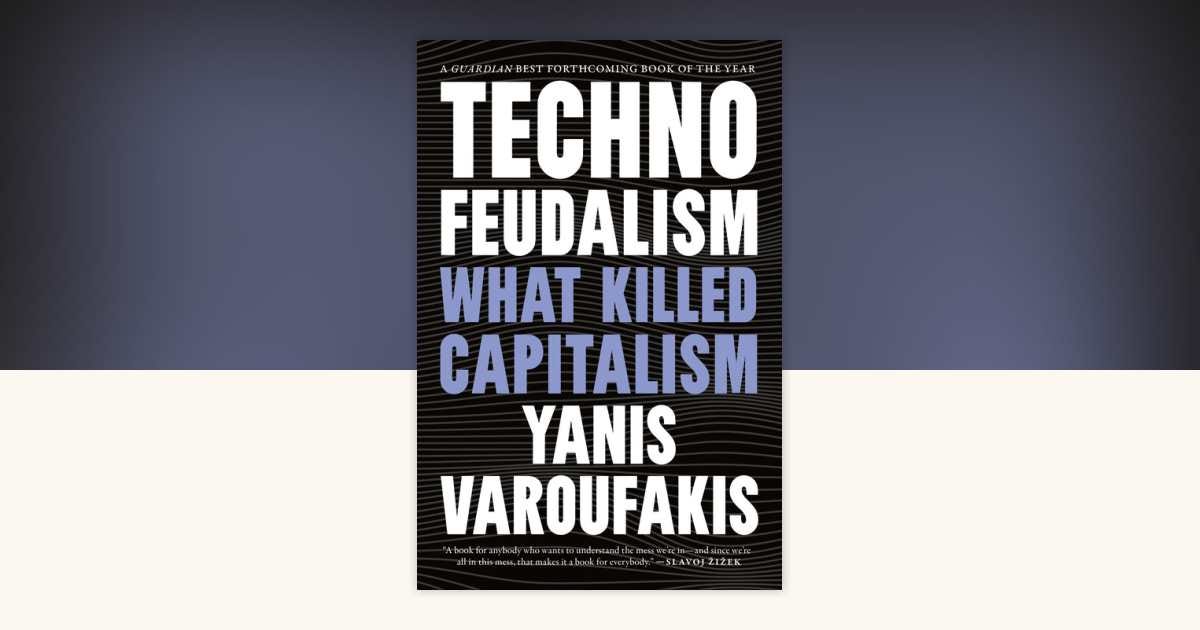
Technofeudalism by Yanis Varoufakis, 2023
In Technofeudalism, Yanis Varoufakis argues that the rise of tech giants has brought about the end of capitalism. The system driven by markets and firms competing within them to maximize profit is obsolete–our economy now hinges on a new class of firms that play by a different handbook. Tech giants, which Varoufakis calls “cloudalists,” no longer need to profit in the traditional sense. Instead, they extract “rents” in the form of commissions or the collection and sale of data by hegemonizing exclusive slices of our digital markets; in the case of Amazon–the market for goods, Apple–the market for mobile apps, Meta–the market for attention. In Varoufakis’ view, these “cloud fiefs” are fundamentally unlike their terrestrial counterparts. In each, the cloudalist is said to extract what is essentially unpaid labor not just from the regular people who use them, who are “cloud serfs,” but also traditional capitalists and industrialists (e.g. car manufacturers), which he calls “cloud vassals.” The defining attribute of cloudalists is that they wield “cloud capital” (algorithms, AI, etc.) which, unlike traditional capital, has the added, automated ability to modify behavior and to continually extract more value. The notion of a new form of capital that can command everything from consumers and markets to human behavior is already important and has reached new heights of practicality in the burgeoning AI era.
Technofeudalism, by its very title, makes it easy to lose sight of its most valuable contribution–cloud capital. Indeed, most reactions to this book concern why Varoufakis refuses to characterize our reality as just another, aggressively monopolistic, mutation within the capitalist system (Hochuli, 2025). Had Varoufakis named his observations “cloud capitalism,” it would not have carried the urgency that befits the radical power of cloud capital; it would undermine his argument that a clear rupture is now apparent. Varoufakis arrived at technofeudalism through dialectical reasoning–the study of a system’s internal contradictions that transforms it into something else. Framed this way, the question of whether capitalism has ended risks missing the point, directing attention away from the underlying transformation it seeks to capture: the rise of cloud capital. In this review, let us examine several of capital’s present-day contradictions, as well as mutations of the tech landscape that Varoufakis could not have foreseen but fit quite seamlessly into his framework.
In a landmark trial this March, a L.A. jury found Meta and Alphabet liable to pay a combined $6M in damages to a 20-year-old plaintiff for designing their social media platforms (Instagram and YouTube, respectively) to be addictive to minors (Chmielewski et al., 2026). Many consider the ruling to be a bellwether for future legal action against tech firms whose algorithms have advanced rapidly and have so far outpaced regulatory efforts. In Varoufakis’ language, what the ruling certainly accomplished was acknowledging cloud capital’s powerful third nature, which “commands consumers to reproduce cloud capital (i.e. turns them into cloud serfs)” (pg. 235). Take Instagram Reels as an example of Meta’s own produced means of production, a complex system built around an algorithm that serves as a piece of capital. With every scroll a user makes on Reels, Meta provides a service (access to entertainment and digitalized social connection) and then remunerates itself with the occasional advertisement; but crucially, it also very incrementally improves itself. Standing in contradiction to traditional capital (e.g. land or machinery in a factory), cloud capital gains value through its use, and at little marginal cost to its proprietor. Cloud capital is empowered largely by the data it collects from its users, who Varoufakis believes are unwitting unpaid laborers. As users spend more time on social media, advertisements can become imperceptible as skipping them becomes muscle memory or as they camouflage themselves as regular content. Advertising itself is not inherently pernicious, but what is worrying is the extent to which algorithms such as Reels’ can target a user’s desires, as well as the freedom Meta has to leverage its big data. Billions worldwide are users in the Facebook family of platforms. Social pressure can convince even the skeptical to shrug off the fact that their activity is turned into data, fed into Meta’s many other projects, including data-hungry new AI models, or allowed to fall into the hands of unscrupulous third parties (Harbath & Fernekes, 2023).
Ownership of four of the world’s most used social media platforms allows Meta to acquire users without them having an alternative. Much like serfdom was not a matter of choice but of birth, extreme dominance and human FOMO allow Meta to similarly inherit its users, though in a less sinister sense. The cloudalist business model provides another feudal comparison born out of another key contradiction. Varoufakis contends that cloudalist revenue is primarily a rent on its users, and cannot be considered capitalist profit. For him, data collection falls under the category of Monopoly Rent, which he defines as “mark-up” or what “the seller can charge the consumer over and above a commodity’s exchange value” (the other three categories of rent being financial, ground, and digital) (pg. 225). Some might consider mark-up to be a driver of profit, but to Varoufakis they are separate. His official definition of profit (in the appendix) is somewhat nebulous; he best sums it up earlier in the book, admitting that the distinction is “qualitative, almost abstract: profit is vulnerable to market competition, rent is not” (pg. 124). That is, the classification of given revenue hinges on a subjective judgment of whether a tech firm is fairly competing. In Varoufakis’ framework, cloudalists are not competing, at least in their digital platforms, which he considers a world inside a world; they do not obey capitalist market principles and therefore cannot be understood by existing frameworks. Whether to achieve concision or timelessness, Varoufakis does not extensively apply his framework to any one example, but doing so can help us understand why he sees digital platforms as fiefs and not markets.
The only competition within Instagram itself is between content creators–cloud serfs–who, having chosen to operate in this cloud fief (often alongside TikTok and other platforms they are not discouraged from using), now fight to influence the most people, even as their success remains at the mercy of the platform’s owners. The real competition between cloudalists, then, centers on attracting the time and attention of each individual. This competition ends when they click on the app and transform themselves into a cloud serf. The user then enters their own, much more difficult battle with their brain’s reward signals to snap out of the addictive feedback loop that the AI algorithm-powered infinite scroll provides. The most vulnerable are adolescents, as affirmed by scientific studies (De et al, 2025) and understood as an ethical and legal problem by the L.A. courthouse. The youngest generations are at risk of finding themselves hardwired to click the bright purple and orange icon on their home screen as automatically and unconsciously as they breathe. This is the cloudalist endgame: when entry into their digital fief is successfully made into a behavioral compulsion, they eliminate the need to compete with other cloudalists even in the terrestrial world.
In a rare vestige of competition, cloudalists might occasionally compete to attract content creators to operate only on their platform, usually offering large sums of cash. Spotify notably employed this strategy in an attempt to create a “walled garden” ecosystem of exclusive podcasts–for example with a deal worth over $200M for the Joe Rogan Podcast (Rosman et al., 2022). It has since abandoned the exclusive aspect of the strategy, probably recognizing that widening Rogan’s reach into other platforms (like Apple Podcasts or Amazon Music) while maintaining control over his show’s advertising can be more lucrative than a subscription-maximizing strategy. Unlike other platforms that are happy to passively benefit from the many rents it can charge cloud vassals (traditional capitalist organizations) for advertising and consumer data, Spotify is a cloudalist that takes a particularly heavy-handed approach to securing revenue that otherwise would be decided between the cloud serf and its vassal sponsors. (In this framework even very large influencers ought to be considered cloud serfs not vassals, unless they leverage their personal branding to merchandise their own products. A similar but rarer step up can be made to become a cloudalist, e.g. Donald Trump creating Truth Social) The case demonstrates how advertising has become perhaps the central driver within cloud fiefs, fighting it out valiantly with other rent-extraction mechanisms like the subscription (for gatekept products) or the commission (à la Apple App Store).
So far, it has become clear that this digital means of production behaves differently from its terrestrial counterpart, in ways that make its cloudalist owners reign supreme. Cloud capital does not depreciate as a car-making machine would with technological advancement and wear and tear–instead they seem to have the ability to improve themselves simply by operating. This is the driving philosophy behind the current AI boom. Major AI companies are bleeding heavy financial losses as they invest in computation; OpenAI does not expect to be profitable until 2030 (Jin & Rattner, 2026). By keeping their base models free to use (though now with ads), they encourage widespread adoption of the technology among cloud serfs, but just as importantly, they get valuable input to train and continually improve their models. LLM chatbots like ChatGPT and Claude had not yet emerged when Varoufakis was writing this book, yet they absolutely typify the evolution of cloud capital. The present use of AI chatbots is that of a superior search engine, one that not only provides answers to questions but can also do your work and offer a feeling of social interaction. Due to their built-in sycophancy and increasing personalization, they modify the user’s behavior to make themselves seem indispensable (Cheng et al., 2026). A future can be imagined in which AI cloudalists ride the wave of mass consumer buy-in to expand their attention-hoarding capabilities; for instance a social network being added to ChatGPT or Claude holding the entirety of one’s daily workflow. This is not to say that AI innovations cannot be useful or exciting, but that we should heed Varoufakis’ pre-GenAI warnings–we continue to underestimate the uncapitalist powers of cloud capital.
Nowadays even traditional capitalists rush to build up cloud capital. Disney is rolling out a short-form video platform perfect for their young audience, even as the recent trial in L.A. shows how regulation might sluggishly do its work. Still, on the day of that ruling, the share prices of the two defendants traded up, an outcome which would not surprise Varoufakis. In the context of Covid-19, he explains: “Share markets do rise in response to bad news, but only when the news, however awful, turns out at least somewhat better than anticipated.” (pg. 96) In the grander scheme of these cloudalist enterprises (and clearly in the view of those that trade their stocks), the ruling was something closer to a mosquito bite than a structural threat; it hit at an ethical problem, the kind that new technologies get to exploit before public understanding and legal processes catch up. A greater ripple might have been achieved by targeting an underlying, structural cause of cloud capital’s power–the size of cloudalists. Like the monopolists of the Gilded Age, cloudalists have been allowed to merge with and acquire major companies that have greatly enhanced the dominance of their platforms yet do not get considered as competitors. These moves can also fly under the radar of the general public, perhaps because these absorptions are frequently welcomed by the company being absorbed (often a startup’s goal) unlike the aggressive expansions conducted by Rockefeller and Morgan. With fewer terrestrial ties, cloud capital is even easier to concentrate and like normal capital, this brings greater yields (e.g. the power of aggregating big data or integrating different platforms).
The current exorbitant size of cloudalists (especially their reach across various unrelated services whose integration benefits them but not the consumer, e.g. Google Search + YouTube) is at least in some part due to a lack of renewed anti-trust threat (Wu, 2018), a solution not nearly revolutionary enough for Varoufakis. Varoufakis would of course object to the diagnosis that this is a problem of excessive monopoly within capitalism. Accordingly, the remedies he offers in the final chapter of his book are radical, envisioning global “cloud rebellion” (pg. 210) and decentralization of quixotic proportions. The chapter is among the book’s shortest and may disappoint in its lack of explanation–preferring to briefly summarize the suggestions from his 2020 book, Another Now. Varoufakis’ primary aim in Technofeudalism was clearly to provide context and back-up for his contentious claim that capitalism is dead (indeed, this argument is logical, but feels slightly circular since it is based on his own narrow definitions of capitalism and of rent vs. profit). Nonetheless, the book and its novel framework serves as a useful lens for the average reader even without them having to engage in polemics over our stage in history. Cloud capital especially shines as a bit of coinage that helps in conceptualizing technology and our rapidly changing relationship with it. Let us not miss the point–whether capitalism is alive or dead, capital has certainly evolved. As technologists feverishly race to build Artificial General Intelligence (AGI), with far broader, human-like capabilities that would amplify cloud capital with inconceivable new powers–how prepared will we be?
References
Cheng, M., Lee, C., Khadpe, P., Yu, S., Han, D., & Jurafsky, D. (2026). Sycophantic AI decreases prosocial intentions and promotes dependence. Science, 391(6792). https://doi.org/10.1126/science.aec8352
Chmielewski, D., Rozen, C., & Godoy, J. (2026, March 25). Meta, Google lose US case over social media harm to kids. Reuters. https://www.reuters.com/legal/litigation/jury-reaches-verdict-meta-google-trial-social-media-addiction-2026-03-25/
De, D., El Jamal, M., Aydemir, E., & Khera, A. (2025, January 8). Social Media Algorithms and Teen Addiction: Neurophysiological Impact and Ethical Considerations. Cureus, 17(1), 1–7. https://doi.org/10.7759/cureus.77145
Harbath, K., & Fernekes, C. (2023, March 16). History of the Cambridge Analytica Controversy. Bipartisan Policy Center. https://bipartisanpolicy.org/article/cambridge-analytica-controversy/
Hochuli, A. (2025, August 20). Technofeudalism versus Total Capitalism — American Affairs Journal. American Affairs Journal. https://americanaffairsjournal.org/2025/08/technofeudalism-versus-total-capitalism/
Jin, B., & Rattner, N. (2026, April 6). An Inside Look at OpenAI and Anthropic’s Finances Ahead of Their IPOs. The Wall Street Journal. https://www.wsj.com/tech/ai/openai-anthropic-ipo-finances-04b3cfb9
Rosman, K., Sisario, B., Isaac, M., & Satariano, A. (2022, February 17). Spotify Bet Big on Joe Rogan. It Got More Than It Counted On. The New York Times. https://www.nytimes.com/2022/02/17/arts/music/spotify-joe-rogan-misinformation.html
Wu, T. (2018). The Curse of Bigness: Antitrust in the new Gilded Age. Columbia Global Reports.
Yanis Varoufakis. (2023, September). Techno-Feudalism. Bodley Head Childrens.
메타데이터
- post_id
- c702f10e35bf
- slug
- technofeudalism-may-have-killed-capitalism-c702f10e35bf
- url
- https://medium.com/writ340spring2026econ/technofeudalism-may-have-killed-capitalism-c702f10e35bf
- canonical_url
- https://medium.com/writ340spring2026econ/technofeudalism-may-have-killed-capitalism-c702f10e35bf
- author_url
- https://medium.com/@naotoort
- status
- ok
- fetched_at
- 2026-06-09 15:37:30