Dedicated Freight Corridor Corporation of India Limited (DFCCIL): Driving the Future of Freight in…
Indian Railways has always been the backbone of the nation’s transport network. But with tracks crowded by both passenger and freight…
Dedicated Freight Corridor Corporation of India Limited (DFCCIL): Driving the Future of Freight in India
Indian Railways has always been the backbone of the nation’s transport network. But with tracks crowded by both passenger and freight trains, efficiency often suffered. Enter DFCCIL (Dedicated Freight Corridor Corporation of India Limited) — a game-changing initiative to give freight its own express highways on rails.
Let’s dive into what DFCCIL is, why it matters, and how it is reshaping India’s logistics landscape.
What is DFCCIL?
Founded in October 2006 under the Ministry of Railways, DFCCIL is a Public Sector Undertaking (PSU) tasked with planning, building, and operating Dedicated Freight Corridors (DFCs).
Think of it as creating separate, high-capacity tracks just for goods trains — freeing up passenger lines, boosting efficiency, and making logistics faster and greener.
Why Do We Need DFCs?
- Indian Railways runs a mixed traffic system, with both passenger and freight on the same lines.
- High passenger demand slowed down freight — average speed: just 25 km/h.
- Freight’s share in India’s transport mix was falling due to delays and unreliability.
- India needed faster, cost-effective, and environmentally friendly freight transport.
That’s where the Dedicated Freight Corridor Project came in.
Objectives of DFCCIL
- Decongest existing passenger routes.
- Increase freight speed to 70–100 km/h.
- Run longer, heavier, double-stack trains.
- Lower logistics costs (from ~13% of GDP to ~8%).
- Promote green logistics with all-electric traction.
- Strengthen India’s supply chain and exports.
Organizational Snapshot
- HQ: New Delhi.
- Managed by a Chairman & Managing Director (CMD) with a Board of Directors.
- Ground-level implementation handled by Project Implementation Units (PIUs) across key corridor cities.
The Corridors
Phase I (Under Implementation)
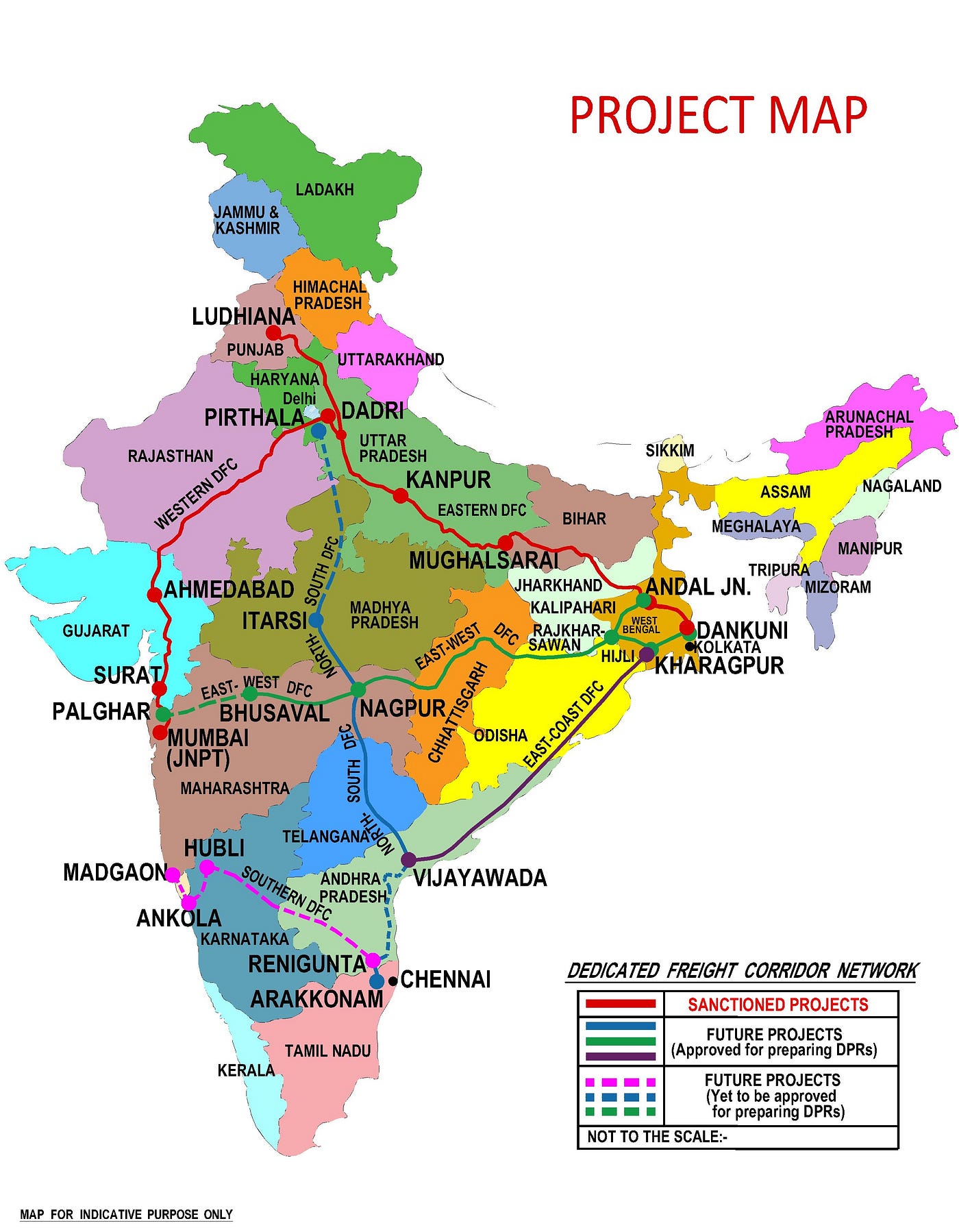
- Eastern Dedicated Freight Corridor (EDFC)
- 1,337 km, Ludhiana (Punjab) → Dankuni (West Bengal).
- Commodities: coal, steel, food grains, cement.
- Funded by the World Bank.
- Western Dedicated Freight Corridor (WDFC)
- 1,506 km, Dadri (UP) → JNPT (Mumbai).
- Commodities: containers, POL, cement, fertilizers, steel.
- Funded by JICA.
Together, these form the Golden Quadrilateral Freight Backbone, linking ports, factories, and consumption hubs.
Future Corridors (Planned)
- East–West (Kolkata–Mumbai).
- North–South (Delhi–Chennai).
- East Coast (Kharagpur–Vijayawada).
- Southern (Chennai–Goa via Bengaluru).
Tech Highlights
- Gauge: Broad (1676 mm).
- Speed: Up to 100 km/h (vs. 25 earlier).
- Train length: 1.5 km (double today’s length).
- Axle load: 25–32.5 tonnes.
- Electrification: 2 × 25 kV AC.
- Smart signalling: ETCS-2, GSM-R.
- Double-stack container trains on WDFC.
Financing the Dream
- World Bank → EDFC.
- JICA → WDFC.
- Government of India equity support.
- Phase I cost: ~₹81,000 crore.
- Future expansions may use PPP models.
Progress Update (2025)
- WDFC: 1,200+ km operational.
- EDFC: 1,000+ km operational.
- Full completion target: 2025–26.
- Running double-stack container trains (360+ containers) already.
Impact
Operational
- Freight speed: ↑ from 25 to 70–100 km/h.
- Passenger trains get more breathing room.
Economic
- Lower logistics costs.
- Boost to Make in India & industrial growth.
- Ports and exports become more competitive.
Environmental
- All-electric = lower carbon footprint.
- Estimated 450 million tonnes CO₂ saved over 30 years.
Strategic
- Strengthens Delhi–Mumbai Industrial Corridor (DMIC) & Amritsar–Kolkata Industrial Corridor (AKIC).
- Enhances port connectivity (JNPT, Mundra, Pipavav, Kolkata-Haldia).
Challenges
- Land acquisition delays.
- Multi-state coordination.
- Contractor execution gaps.
- Smooth integration with Indian Railways.
The Road Ahead
- Complete WDFC & EDFC by 2025–26.
- Launch new corridors (North–South, East–West, etc.).
- Develop Logistics Parks & Multimodal Hubs.
- By 2030, DFCs may carry 70% of India’s rail freight.
In Summary
DFCCIL is more than just new railway lines — it’s a logistics revolution. By offering faster, cheaper, and greener freight movement, DFCCIL is decongesting passenger traffic, empowering industries, and making India’s supply chains globally competitive.
🚂 DFCCIL isn’t just about freight trains; it’s about fast-tracking India’s growth story.
Source: https://dfccil.com/

메타데이터
- post_id
- c70ec2a49ea4
- slug
- dedicated-freight-corridor-corporation-of-india-limited-dfccil-driving-the-future-of-freight-in-c70ec2a49ea4
- url
- https://medium.com/@rashidnwr/dedicated-freight-corridor-corporation-of-india-limited-dfccil-driving-the-future-of-freight-in-c70ec2a49ea4
- canonical_url
- https://medium.com/@rashidnwr/dedicated-freight-corridor-corporation-of-india-limited-dfccil-driving-the-future-of-freight-in-c70ec2a49ea4
- author_url
- https://medium.com/@rashidnwr
- status
- ok
- fetched_at
- 2026-06-25 12:15:08