The Songs We Didn’t Choose
What could national anthems possibly have to do with mathematics?
The Songs We Didn’t Choose
What could national anthems possibly have to do with mathematics?
At first glance, nothing. An anthem is the least quantitative object a nation owns: a tune, some fierce old words, a flag-shaped feeling. There is no theorem in it. And yet I have spent the last few weeks watching the world’s anthems parade past at the FIFA world cup, two per match, and the mathematician in me refused to sit still. The thing about anthems is not found in any single one of them, it is the pattern they make together, and patterns are the one thing mathematicians cannot leave alone. So let me make the case that national anthems are a small, singing branch of applied mathematics. They are shaped by the same forces that shape codes, dynamical systems, and every other structure that has to survive being passed from hand to hand for a very long time. First, though, the parade.
A few weeks at the FIFA fossil museum
If you want to hear the anthems of the world in rapid succession, there is no better place than a major football tournament. Before every match, two nations stand in a line and sing, and the camera pans across faces that are trying, with varying success, to remember the second verse. It is the largest regular performance of national music on Earth, and it is essentially a museum tour conducted at gunpoint by a broadcast schedule. What struck me was how odd they are once you actually listen, or translate their lyrics. We sing these songs so automatically that we stop hearing the words.
The bizarre examples
France opens the bidding with sheer ferocity. “La Marseillaise” has, in my opinion, one of the most stirring melodies ever written, composed in a single night in 1792 by an army engineer named Rouget de Lisle. It is genuinely thrilling. But, it is also, on inspection, a call to water the nation’s furrows with the “impure blood” of its enemies. I confess I loved it for years, before I read the lyrics. The tune is immortal; the words are a very specific 18th-century war cry that the modern French Republic sings at football matches while, sensibly, not taking the taxidermy literally. Its author, a royalist at heart, was later imprisoned during the Revolution and nearly guillotined by the movement his song came to define. The United States set its war poem, about the bombardment of Fort McHenry in 1814, to the melody of “To Anacreon in Heaven,” the song of an 18th-century London drinking society named for a Greek poet whose entire opus concerns wine and love. So the American anthem is a hymn for a Greek hedonist, arranged for a British glee club, repurposed to celebrate beating the British, and pitched across a range of an octave and a half that almost every singer detonates on. It is magnificent and only a few immortals can sing it, my favorite being Whitney Houston. The Netherlands is stranger still. The “Wilhelmus” is reckoned the oldest anthem in the world, dating to the 1570s, and it is sung in the first person as Willem the Silent, the father of Dutch independence. In its opening lines Willem declares that he has “always honored the King of Spain.” A nation forged by throwing off Spanish rule chose as its eternal song, a declaration of honor to the Spanish crown. And it hid a signature in it: the first letters of the fifteen stanzas spell WILLEM VAN NASSOV, an acrostic. Greece wins on sheer scale. The “Hymn to Liberty” runs to 158 stanzas. In practice they sing two. That is a truncation rate of about ninety-nine percent, an anthem that is, almost entirely theoretical. Spain, at the far end, offers the limiting case: the “Marcha Real” has no official words at all. Every attempt to add lyrics has foundered on politics, so forty-seven million Spaniards simply hum it. I could go on. Britain had a verse praying for a general to “crush the rebellious Scots,” now discreetly dropped, set to a tune that Americans sing as “My Country, ’Tis of Thee.” The same melody is royalist and revolutionary, depending on which shore you stand on. Italy cheerfully insists it is “ready to die,” sung with gusto by a people not known in a hurry to fulfill its words.
Line them up and you feel it — these are not designed objects. They are found ones. Which is exactly where the mathematics begins.
Four ways the math sneaks in
- Anthems are frozen accidents. There is a beautiful idea that runs through evolutionary biology and dynamical systems alike, the frozen accident. Francis Crick used the phrase for the genetic code: an arbitrary early choice that got frozen, after which it was too costly to change it. The economists call it lock-in. Their favorite examples are the QWERTY keyboard (arranged to slow the typist down on 1870's typewriter) and the width of railway gauge, which descended, cart rut by cart rut, from the axles of Roman wagons. An anthem is a frozen accident you can sing. A song adopted in one specific convulsion: a war, a revolution, a bombardment, and then it sets like plaster, while the nation underneath it flows and changes. The result is a modern liberal republic singing about impure blood, and loyal Dutch burghers pledging fealty to their Spanish oppressor. Nobody would write these words today. That is precisely why they cannot be changed; the accident, once frozen, is load-bearing.
- Anthems are error-correcting codes. The Dutch acrostic WILLEM VAN NASSOV of the verses is deliberately built into the structure so the text can be checked and reconstructed if a piece goes missing. That is the principle of an error-correcting code, the mathematics that lets a scratched CD still play and a signal from a distant spacecraft arrive intact. Anthems are shot through with this. They rhyme, they scan, they repeat, they hammer the same cadence again and again, not for beauty alone, but because a crowd of eighty thousand people has to reconstruct the same signal in unison, with no conductor, from imperfect memory. Lossless group transmission is the goal. It also explains a small mystery of the heart: why the tune survives when the words are forgotten. The melody is the low-entropy channel: robust, redundant, hard to corrupt. The lyrics are the fragile payload.
- Anthems are fixed points, the inputs a transformation leaves unchanged, the still spots at the center of all the motion. A nation is a system in perpetual change. The anthem is the one cultural object held invariant by choice, almost by superstition. Spain shows you what happens at the limit. Strip a fixed point of all its content and you are left with the null case. The “Marcha Real” is the mathematically honest solution, the empty set sung.
- Anthems live in a space, and spaces can be mapped. They seem to vary along several preposterous axes: bloodiness, anachronism, loyalty to a former enemy, un-singability, length, as well as sheer melodic power Now that is something a mathematician cannot resist. Map it, and the curiosities become coordinates.
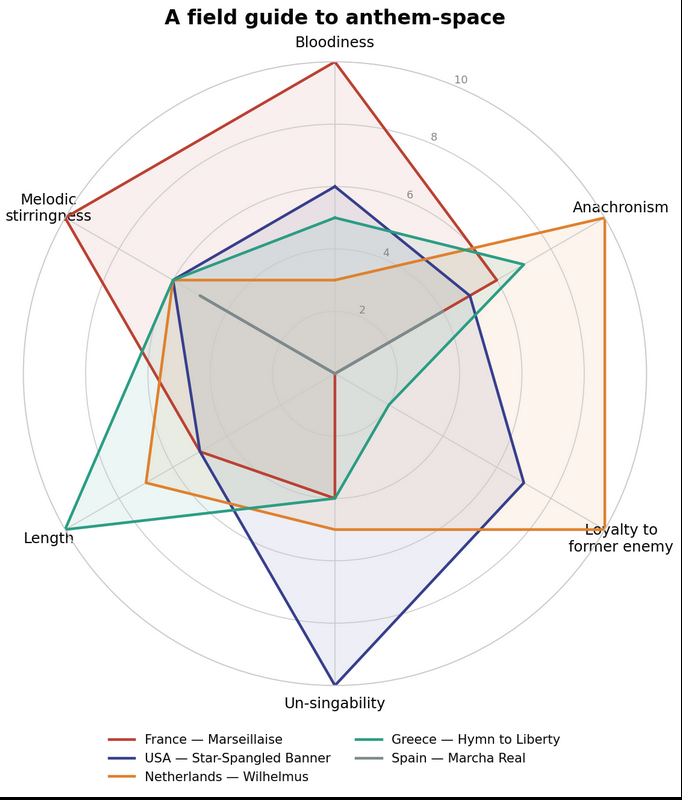
France pins the Bloodiness axis to the wall. The Netherlands maxes out Loyalty-to-Former-Enemy, a corner of the space almost no one else visits. The United States claims Un-singability outright. Greece runs off the edge of Length. And Spain sits modestly near the origin, the anthem that scores low on every axis because it declined to make a claim on any of them. Each nation’s peculiarity is just its position in anthem-space, and the taken as a whole its shape resolves, if you squint, into a scatter plot of national identity.
The coda
A couple of weeks ago I wrote about the mathematical constants, the numbers we didn’t choose: values like π that no one voted for, forced upon us by the deep structure of things. National anthems, I have come to think, are the cultural mirror. They are the words we didn’t choose, forced upon us by history, a sentence blurted out in a moment of crisis and then, by the same lock-in that fixes a keyboard or a genetic code, never revised. We inherit both kinds. The constants we cannot change because the universe won’t let us, the anthems we cannot change because we won’t let ourselves. And so eighty thousand people rise before a football match and sing, with their whole hearts, a song none of them would have written, about a world none of them live in, carried by a melody crafted three centuries ago to be impossible to forget. It is, when you think about it, a very strange thing to be moved by. I am moved by it anyway. The mathematics only tells you why the fossil survived. It cannot tell you why, when the tune swells and the furrows and the drinking songs and the dead Spanish kings all come flooding back, you find that you are, against rational thought, singing along.
메타데이터
- post_id
- c71a36ef7ece
- slug
- the-songs-we-didnt-choose-c71a36ef7ece
- url
- https://medium.com/@alynrock/the-songs-we-didnt-choose-c71a36ef7ece
- canonical_url
- https://medium.com/@alynrock/the-songs-we-didnt-choose-c71a36ef7ece
- author_url
- https://medium.com/@alynrock
- status
- ok
- fetched_at
- 2026-07-29 04:16:27



