🕉️ The Cosmic Source Code: Unveiling Lord Shiva as the Ultimate Poet 💻
We often visualize Lord Shiva in the extremities of his nature: the ascetic in deep meditation 🧘♂️ atop Mount Kailash, or the ferocious…
🕉️ The Cosmic Source Code: Unveiling Lord Shiva as the Ultimate Poet 💻
We often visualize Lord Shiva in the extremities of his nature: the ascetic in deep meditation 🧘♂️ atop Mount Kailash, or the ferocious Rudra performing the Tandava of destruction 🔥.
But in my journey through the vast corridors of Indic literature — from the Sangam landscapes of Tamil to the mystic Vachanas of Kannada and the folk rhythms of Konkan — I have discovered a different, softer, and perhaps more profound avatar of the Great God.
As a Software Engineer, I live in a world governed by syntax and logic. We build structures to hold information. As a Human, I crave meaning and emotion.
I realized that Shiva is the bridge between these two worlds. He is Vidyapati (Lord of Knowledge) and Nataraja (Lord of Arts). He wrote the “Source Code” of language, yet He is the ultimate Poet who breaks those very rules for love.
Here is the Full Stack Documentation of the Mahadeva’s poetic legacy. 👇
1. The Kernel: The Maheshwara Sutras (Sanskrit) 🐚
Role: System Architect
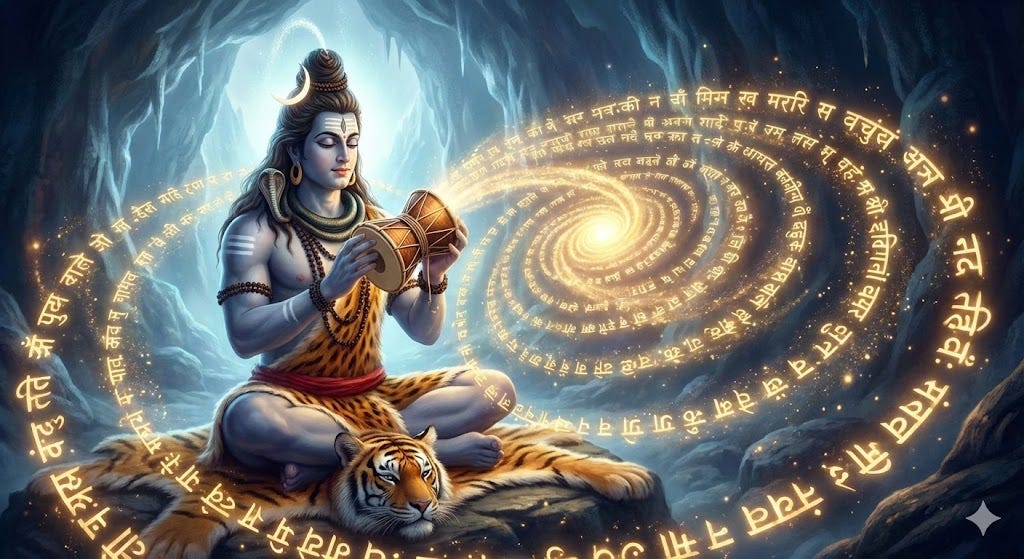
Before poetry (the UI), there must be structure (the Kernel). Just as software needs a valid syntax to compile, language needs a grammar to function.
Legend tells us that the great grammarian Panini performed severe penance. Pleased, Shiva did not speak a word. Instead, he played his Damaru (hand drum) 14 times. 🥁
The sounds that emerged were not random beats. They were the Algorithms of Phonetics.
╔══════════════════════════════════════╗
║ THE SOURCE CODE ╚══════════════════════════════════════╝
📜 Sanskrit:
अइउण् | ऋऌक् | एओङ् | ऐऔच् | हयवरट् | लण् …
🔤 Transliteration:
A-i-u-n | R-lk-k | E-o-ng | Ai-au-ch | Ha-ya-va-rat | Lan …
🇬🇧 English Meaning:
These are the 14 aphorisms that organize the phonemes of the Sanskrit language. From the raw sound (Nada) of the Damaru, Shiva created the framework for all human expression.
2. The Open Source Rebel: Vachana Sahitya (Kannada) 📜
Role: Open Source Contributor

While Sanskrit focused on structure, the 12th-century Sharana movement in Karnataka focused on accessibility. Here, Shiva is not a distant server; He is localhost.
Allama Prabhu, the mystic saint, used poetry to challenge the "Metaphors" of the world, proving that Truth cannot be wrapped in fancy UI—it must be raw backend logic.
╔══════════════════════════════════════╗
THE BUG REPORT ╚══════════════════════════════════════╝
📜 Kannada:
ಬೆಟ್ಟವನೆಲ್ಲಾ ಅರೆದು ಸುವರ್ಣವ ಮಾಡಿದಡೆ, ಬೆಟ್ಟಕ್ಕೆ ಕಡೆಯುಂಟೆ ? ಅಕ್ಷಯದ ಗಣಿಯನಗಿದು ತಂದು ಕೊಟ್ಟಡೆ, ಪೃಥ್ವಿಗೆ ಬಡತನವುಂಟೆ ? ಗುಹೇಶ್ವರಾ, ನಿಮ್ಮ ಶರಣಂಗೆ ಉಪಮೆ ಇಲ್ಲ.
🔤 Transliteration:
Bettavanella aredu suvarnava maadidade, bettakke kadeyunte? Akshayada ganiyanagidu tandu kottade, pruthvige badatanavunte? Guheshwara, nimma sharanange upame illa.
🇬🇧 English Meaning:
"If you grind the whole mountain to make it gold, is there an end to the mountain? If you dig up an endless mine and give it away, is there poverty in the earth? O Guheshwara (Lord of Caves), there is no metaphor (simile) that can match your devotee."
Here, Shiva (through Allama) teaches us that poetry is not just decoration; it is a tool for radical truth-telling.
3. The Divine Listener: Chilambu (Malayalam) 👂
Role:
User Experience (UX) Researcher

In the Kerala tradition, we find a Shiva who values the User Experience (Poetry) even over his own Process (Dance).
The Chera King Cheraman Perumal Nayanar sang the famous Ponvannathandadi. Legend says Shiva stopped his Cosmic Dance just to listen to the poetry of his devotees, proving He is the ultimate Rasika.
╔══════════════════════════════════════╗
║ THE USER FEEDBACK ╚══════════════════════════════════════╝
📜 Tamil/Malayalam (Old Dialect):
பொன்வண்ணம் எவ்வண்ணம் அவ்வண்ணம் மேனி பொலிந்திலங்கும் மின்வண்ணம் எவ்வண்ணம் அவ்வண்ணம் வீழ்சடை வெள்ளிக்குன்றம்…
🔤 Transliteration:
Pon vannam evvannam avvannam meni polinthilangum Min vannam evvannam avvannam veezh sadai velli kundram…
🇬🇧 English Meaning:
“Like the color of gold, His body shines radiantly. Like the flash of lightning, His matted locks fall upon the silver mountain (Kailash)…” (Shiva loved this description so much, He paused the Universe to hear it).
4. The Critic & The Debugger: The Golden Prize (Tamil) 🕵️♂️
Role: Code Reviewer / QA Lead

In the Thiruvilayadal Puranam, Shiva becomes a Ghost Writer. He wrote a poem for a poor priest, Dharumi, to answer a query: “Does a woman’s hair have a natural fragrance?”
When the court poet Nakkiran flagged a “Functional Error” (Logic Bug) in the poem, Shiva debated him. Nakkiran refused to merge the pull request, even when Shiva showed his Admin privileges (Third Eye).
╔══════════════════════════════════════╗
║ THE PULL REQUEST ╚══════════════════════════════════════╝
📜 Tamil:
கொங்கு தேர் வாழ்க்கை அஞ்சிறைத் தும்பி காமம் செப்பாது கண்டது மொழிமோ… செறியெயிற்று அரிவை கூந்தலின் நறியவும் உளவோ நீயறியும் பூவே?
🔤 Transliteration:
Kongu ther vazhkkai anjirai thumbi Kaamam seppaathu kandathu mozhimo… Seriyeyitru arivai koonthalin Nariyavum ulavo neeariyum poove?
🇬🇧 English Meaning:
“O Bee, with beautiful wings! Do not speak to please me, but tell the truth. Is there any flower you know that smells more fragrant than the hair of this woman?” (Nakkiran’s famous reply: “Even if you open your Third Eye, a bug is a bug!” / Netrikkan thirappinum kutram kutrame!)
5. The Rhythm of the Earth (Konkani & Folklore) 🥁
Role: Hardware / Low-Level Audio

In the Konkan coast (Goa) and parts of Maharashtra, Shiva is worshipped as Khandoba or Ravalnath. Here, the code isn’t written in high-level languages; it’s written in Assembly (Rhythm).
The Ghumot (an earthen drum) is His instrument. The poetry here is not Vak (Speech) but Laya (Tempo). Legends say Khandoba became a shepherd to woo his wife Banai, singing folk songs (Ovis) to her in the forest.
╔══════════════════════════════════════╗
║ THE SYSTEM CLOCK ╚══════════════════════════════════════╝
🎵 The Call (Folk Chants):
येळकोट येळकोट जय मल्हार! (Yelkot Yelkot Jai Malhar!)
🇬🇧 English Meaning:
A rhythmic poetic cry invoking the Lord of the Hills (Malhari). The beat of the drum is the poem.
6. The Paradox of Purity (Telugu) In the Telugu Srikalahasteeswara Satakam, the poet Dhurjati uses Ninda Stuti (praise through blame) to highlight Shiva’s empathy. He asks Shiva why He ate the meat offered by the hunter Boya Tinnadu (Kannappa). Tinnadu had tasted the meat first to ensure it was sweet — an act that technically made it “impure” (Engili). Dhurjati writes: ”You have fire in your eye to cook, the Ganga on your head to clean, and a deer in your hand to eat. Why, O Lord of Kalahasti, did you crave the saliva-tainted meat of a hunter?”
The poem reveals the answer in the question itself: Shiva craved the flavor of love, not the protein. He accepted the “syntax error” of the ritual because the “logic” of devotion was perfect.
6. Version Control & Sacrifice: Hanumad Ramayana 🐵
Role: Git Reset --Hard

Hanuman (Avatar of Shiva) wrote the Ramayana on rocks before Valmiki. It was the perfect version. But seeing Valmiki sad that his version would be obsolete, Hanuman deleted his own repository (threw rocks into the sea).
This is the ultimate lesson: The Code (Creation) matters more than the Credit (Fame).
╔══════════════════════════════════════╗
║ THE DELETED REPO ╚══════════════════════════════════════╝
📜 Sanskrit:
अजाड्यम् वाक् पटुत्वम् च हनुमत् स्मरणात् भवेत् ॥
🔤 Transliteration:
Ajaadyam Vaak Patutvam Cha Hanumat Smaranaat Bhavet ||
🇬🇧 English Meaning:
"Sharpness of mind and Skill in Speech (Poetry) come from remembering Hanuman."
7. Exception Handling: The Hunter’s Love (Telugu) ❤️
Role: Handling Edge Cases

In the Srikalahasteeswara Satakam, the poet Dhurjati uses Ninda Stuti (Irony) to ask why Shiva accepted “corrupted data” (meat tasted by the hunter Kannappa).
Shiva accepted it because the Intention (Logic) was pure, even if the Implementation (Ritual) was wrong.
╔══════════════════════════════════════╗
║ THE EXCEPTION LOG ╚══════════════════════════════════════╝
📜 Telugu:
నీకున్ మాంసము వాంఛయేని కరవా? నీ చేత లేడుండగా జోకైనట్టి కుఠారముండ, ననలజ్యోతుండ, నీరుండగా పాకంబొప్ప ఘటించి చేతి పునుకన్ భక్షింపకా బోయచే జేకొంటెంగిలి మాంసమిట్లు తగునా శ్రీకాళహస్తీశ్వరా!
🔤 Transliteration:
Neeku mamsamu vaanchayeni karava? Nee chetha ledundaga Jokainatti kutharamunda, nanalajyothunda, neerundaga Paakamboppa ghatinchi chethi punukan bhakshimpaka boyache Jekontengili mamsamitlu taguna Srikalahasteeswara!
🇬🇧 English Meaning:
The Meaning: “Oh Lord of Kalahasti! If you were so hungry for meat, was there a shortage? You hold a deer in your hand. You have a sharp axe to cut it. You have the fire (in your third eye) to cook it. You have the Ganga (water) to clean it. You could have cooked it and eaten it from your own skull-bowl. Instead, was it proper for you to accept the saliva-tainted meat from that hunter?”
8. The Refactor: Sant Narhari Sonar (Marathi) 🛠️
Role: Backend Integration Specialist

In Maharashtra, the story of Sant Narhari Sonar teaches us about “Refactoring” our code (beliefs). Narhari was a goldsmith and a staunch Shiva devotee who refused to look at Lord Vithoba (Vishnu). He had hardcoded his devotion to Shiva alone.
When he was forced to go to Vithoba’s temple blindfolded to fit a waistband, a “runtime error” occurred. When he touched Vithoba’s waist, he felt the Tiger Skin. He touched the head and felt the Matted Hair and Ganga.
He realized that the “Interface” (Form) might be different (Vithoba), but the "Backend Class" (Divinity) is the same. This realization burst forth as poetry.
╔══════════════════════════════════════╗
║ THE INTEGRATION LOG ╚══════════════════════════════════════╝
📜 Marathi (Abhang):
शिव आणि विष्णू एकचि प्रतिमा । नाही भेद आम्हा। नरहरी सोनार ॥ विठ्ठली आवडी, शंकरी जो प्रेम । दोघां एक नाम, पांडुरंगा ॥
🔤 Transliteration:
Shiv ani Vishnu ekachi pratima | Nahi bhed amha | Narhari Sonar || Vithali avadi, Shankari jo prem | Dogha ek naam, Panduranga ||
🇬🇧 English Meaning:
“Shiva and Vishnu are the same image. There is no difference for us, says Narhari the Goldsmith. The love I have for Vithoba is the same love I have for Shankar. Both have one name: Panduranga.”
9. Conclusion
As I navigate the complexities of software engineering and leadership at HARA, I find inspiration in this balance. We need the structure of Panini, but we also need the empathy of Kalahasteeswara.
Om Namah Shivaya.
🎥 Video Fact-Check (Visual References) For those who prefer a visual summary, here are short videos and reels that validate each story mentioned above. 1. The Origin of Grammar (Sanskrit)
- Video: Sanskrit Alphabets origin from Maheswara Sutras
- Context: Explains how the 14 beats of the Damaru created the alphabet.
- https://www.youtube.com/watch?v=sO7jjtaUBRQ 2. The Debate with Nakkiran (Tamil)
- Video: Thiruvilayadal Movie Scene — Netrikkan Thirappinum
- Context: The famous scene where Sivaji Ganesan (as Shiva) debates the poet Nakkiran about the “flaw” in the poem.
- https://www.youtube.com/watch?v=pGTKijupZ9c 3. The Hunter’s Offering (Telugu)
- Video: Best Climax Scene from Bhakta Kannappa Movie
- Context: The iconic scene from the classic Telugu movie where Krishnam Raju (as Kannappa) offers his eyes to the Lingam.
- https://www.youtube.com/shorts/s7nxFI1MKmc 4. The Divine Listener (Malayalam)
- Video: Lord Shiva’s Miracles | Cheraman Perumal Nayanar
- Context: A short retelling of how Shiva stopped his dance to listen to his devotee’s poem.
- https://www.youtube.com/shorts/jD144V677Eg 5. The Sacrifice of Hanuman (Hanumad Ramayana)
- Video: The FIRST Ever RAMAYAN in the World — Hanuman Ji #shorts
- Context: A short retelling of why Hanuman destroyed his own superior version of the Ramayana.
- https://www.youtube.com/shorts/TcU0BA_efRo 6. The Mystic Poet (Kannada)
- Video: Allama Prabhu Vachana Philosophy
- Context: A look at the radical, metaphor-destroying philosophy of the Vachana Sahitya tradition.
- https://www.youtube.com/watch?v=yW6aDftU9kI 7. The Rhythm of God (Konkani/Goa)
- Video: Ghumot — The Heritage Instrument of Goa
- Context: Listen to the beat of the Ghumot to understand the “rhythm” aspect of Shiva (Ravalnath) in Konkani folklore.
- https://www.youtube.com/watch?v=8y_WkKkXk_E
메타데이터
- post_id
- c73a67aa34b7
- slug
- ️-the-cosmic-source-code-unveiling-lord-shiva-as-the-ultimate-poet-c73a67aa34b7
- url
- https://medium.com/@alapaty/%EF%B8%8F-the-cosmic-source-code-unveiling-lord-shiva-as-the-ultimate-poet-c73a67aa34b7
- canonical_url
- https://medium.com/@alapaty/%EF%B8%8F-the-cosmic-source-code-unveiling-lord-shiva-as-the-ultimate-poet-c73a67aa34b7
- author_url
- https://medium.com/@alapaty
- status
- ok
- fetched_at
- 2026-06-24 11:06:28