The Perceptron Conspiracy: How One Book Nearly Killed Neural Networks
Imagine 1958: headlines scream about an “electronic brain” that learns like a human. Frank Rosenblatt’s Perceptron promises to…
The Perceptron Conspiracy: How One Book Nearly Killed Neural Networks
Imagine 1958: headlines scream about an “electronic brain” that learns like a human. Frank Rosenblatt’s Perceptron promises to revolutionize AI. Then, a devastating critique buries it for decades — was it sabotage? [1][2][3]
Dawn of the Electronic Brain
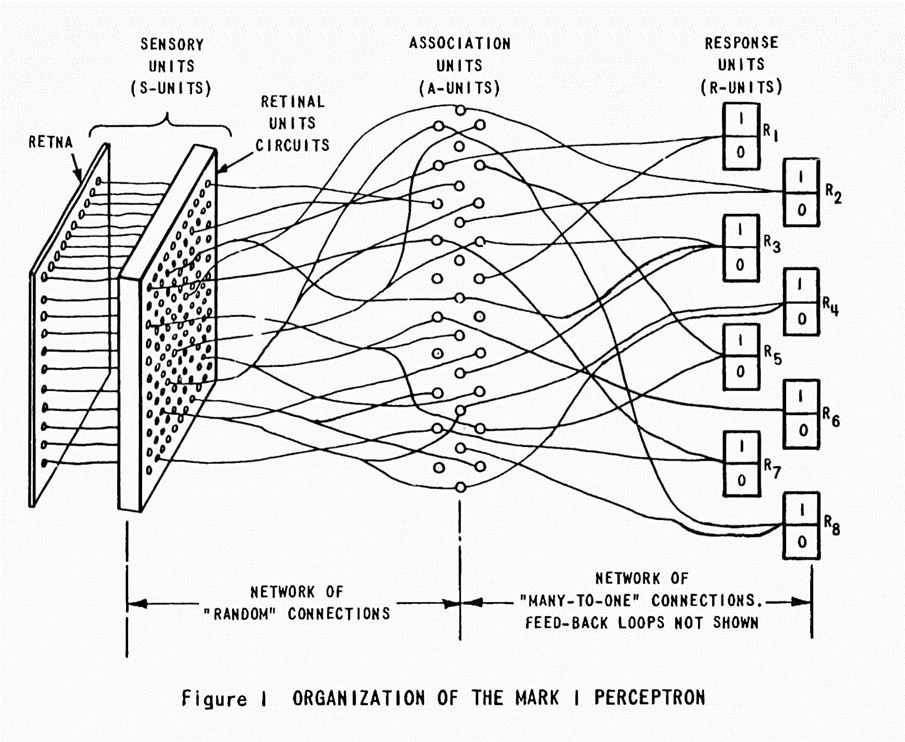
Frank Rosenblatt, a bold psychologist at Cornell, unveils the Mark I Perceptron in 1960 — a hulking machine of wires, relays, and a camera “retina” that learns to classify patterns by tweaking its own weights. [1][2][4]
· No hand-coding needed; feed it examples, and it adapts.
· The U.S. Navy pours in funding, envisioning robot soldiers spotting enemies.
· Picture Rosenblatt grinning beside his beast: plywood panels buzzing with photocells.
This wasn’t sci-fi hype. It was the first hardware demo of machine learning, predating backpropagation by decades. [5][6]
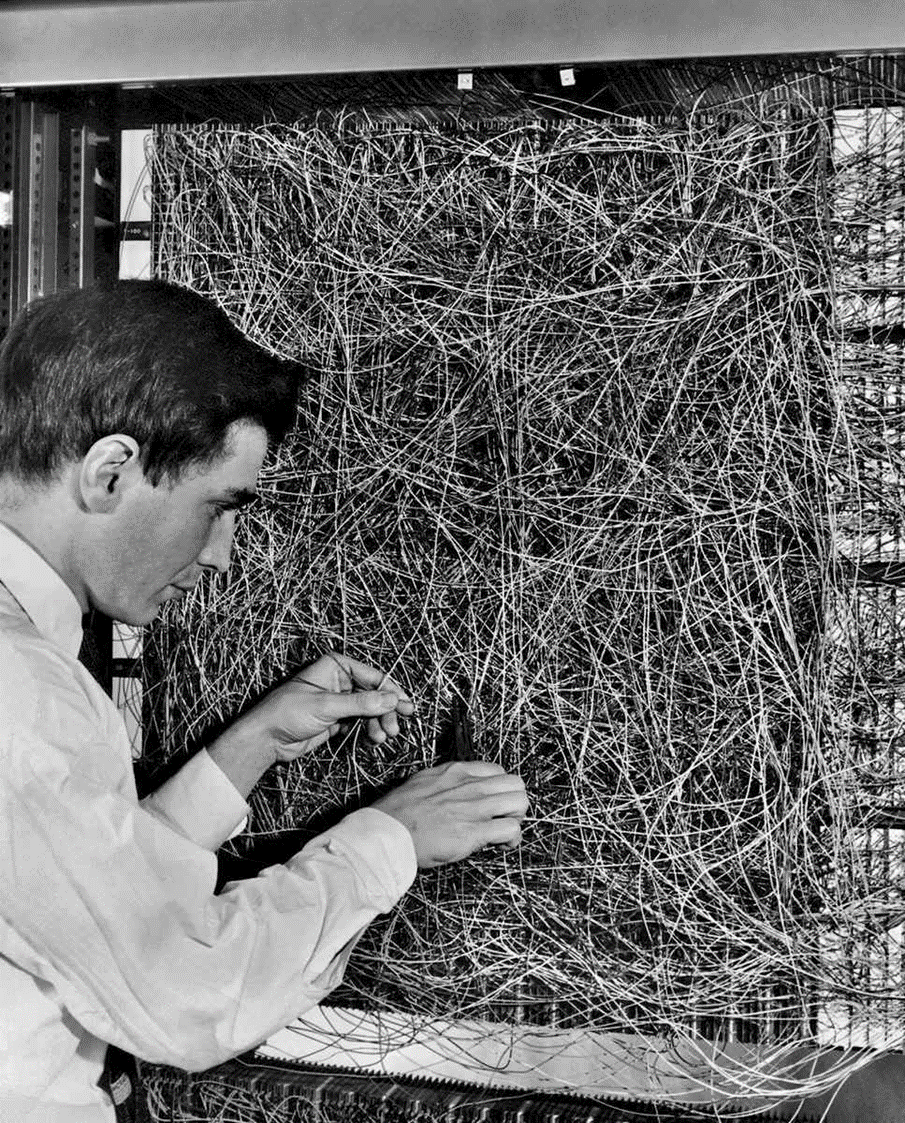
Frank Rosenblatt stands beside the Mark I Perceptron at Cornell Aeronautical Laboratory, 1960. The machine represents the first successful hardware implementation of a learning algorithm.
The Promise of the Machine
The perceptron wasn’t just another calculator — it was revolutionary because it could adapt its own parameters from data. Unlike the McCulloch-Pitts neuron before it, which required engineers to manually set weights, Rosenblatt’s perceptron learned from examples, mimicking the adaptive behavior of biological brains. [1][4][5]
The U.S. Office of Naval Research saw potential and funded the project, envisioning applications from automatic target recognition to language translation. Front-page newspaper stories proclaimed that thinking machines were finally here. [2][4]
The Villains Arrive: Minsky & Papert Drop the Bomb
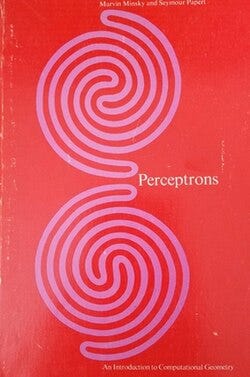
Fast-forward to 1969. Two intellectual heavyweights at MIT, Marvin Minsky and Seymour Papert, release Perceptrons, a mathematically rigorous treatise that becomes a death sentence for an entire research paradigm.
They prove, with surgical precision, that single-layer perceptrons cannot solve the XOR problem — a simple logic gate requiring non-linear separation:
· (0,0) = 0
· (0,1) = 1
· (1,0) = 1
· (1,1) = 0
*No straight line can separate the 1s from the 0s*. [3][7][8]
Their mathematical proof is correct. The problem: the field interprets it as “neural networks are fundamentally limited,” when it actually means “single-layer linear models are limited.” [3][8][9]
The 1969 publication of “Perceptrons” by Marvin Minsky and Seymour Papert. This slim volume would reshape the trajectory of neural network research for decades.
The Narrow Critique Goes Nuclear
Minsky and Papert’s work is mathematically sound, but here’s the thriller twist: Minsky’s immense influence at MIT and in funding circles allows their skepticism to metastasize far beyond its intended scope. [1][3][10]
At conferences and in grant committees, the narrative shifts from “single-layer models have limits” to “neural networks are a dead end.” The distinction gets lost in translation, and an entire field suffers. [7][10][11]
Conspiracy Unfolds: Whispers, Funding Cuts, and Silence
No smoke-filled rooms, but the fallout feels orchestrated:
· Minsky’s institutional clout redirects government grants from connectionist research toward symbolic AI and rule-based systems. [1][3][10]
· Psychological barriers crystallize: graduate students are quietly advised against pursuing neural network research; journal papers face skeptical reviewers.
· Rosenblatt drowns in 1971 — the visionary champion is removed from the board just as the tide turns against his work. [11][12]
· DARPA slashes funding for broad, speculative AI research amid widespread disappointment over unmet promises.
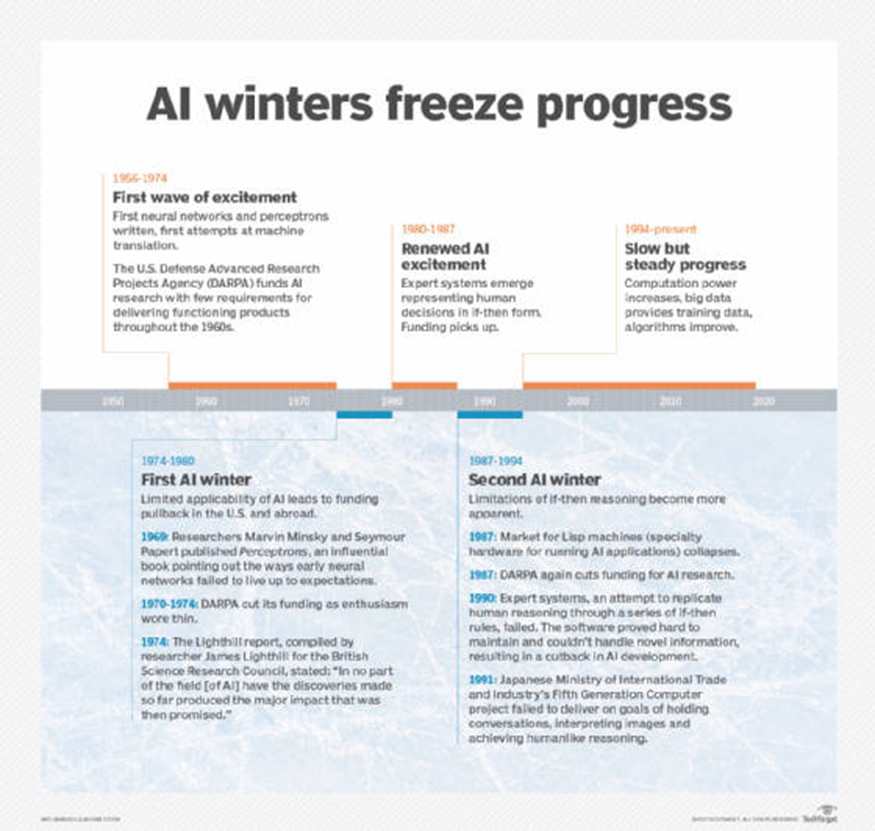
Welcome to the First AI Winter (1974–1980). [1][2][10]
The AI winter timeline shows how funding cycles, institutional gatekeeping, and scientific skepticism combined to nearly erase neural network research.
The Machinery of Suppression
What historians now call “psychological barriers” operated through:
-
Gatekeeping at top institutions: MIT and Stanford controlled much of the narrative.
-
Funding concentration: Government agencies, already burned by AI hype, trusted established experts who pushed toward symbolic AI.
-
Narrative control: The Minsky-Papert critique became the “official story” of why neural nets failed.
-
Self-fulfilling prophecy: Lack of funding meant fewer researchers, fewer papers, fewer breakthroughs — which “proved” the field was dead.
Plot Twist: Tech, Not Pure Treachery
Here’s where the conspiracy narrative cracks — blame physics and silicon too.
Training deep neural networks required algorithms (backpropagation) that either weren’t discovered or were considered computationally infeasible on 1960s and 1970s hardware. [11][13][14]
· The algorithm problem: Efficient backpropagation wasn’t rediscovered until the 1980s. [14][15]
· The compute problem: Training multilayer networks on an IBM 704 or even early minicomputers was orders of magnitude slower than what we need for meaningful demonstrations. [13][14]
· The hype problem: Wild promises (“machines will think like humans soon!”) collided with reality, creating backlash. [2][11]
So the critique by Minsky and Papert landed at the worst possible moment: when the field lacked both the algorithmic tools and the computational power to prove those critics wrong. [13][14][15]
Perceptrons didn’t kill neural networks — it was perceptrons plus slow computers plus undiscovered training methods plus funding collapse that did the job. [11]
Epic Comeback: Hidden Layers Strike Back
The 1980s: Connectionism rises from the ashes.
Researchers including David Rumelhart, Geoffrey Hinton, and Ronald Williams dust off the backpropagation algorithm and apply it to multilayer perceptrons (MLPs). [3][14][15]
· XOR? Crushed. Hidden layers provide the non-linearity needed.
· Handwritten digit recognition? Solved. Networks learn features automatically.
· The Minsky-Papert critique? Vindicated — for single layers only. [3][14]
The field discovers that the “impossibility” theorems applied only to shallow, linear models. Add hidden layers, train with backprop, and the limitations vanish. [14][15]
From Winter to Spring
The 1980s and 1990s saw steady progress: backpropagation networks learn natural language, visual patterns, and game-playing strategies. The tide turns. [3][14][15]
By the 2010s, deep learning explodes: convolutional networks dominate image recognition, recurrent networks excel at sequence modeling, and transformer architectures power GPT and BERT. [14][15]
Rosenblatt’s fundamental insight — that simple units organized in networks can learn complex behaviors — was vindicated a thousand times over. He was right; he was just 60 years too early. [6][12]
The Real Conspiracy: How Science Buries Ideas
The “perceptron conspiracy” isn’t a shadowy plot — it’s something more subtle and more dangerous: the collision of rigorous criticism, institutional power, funding cycles, and historical bad luck. [3][10][11]
No one sent a memo declaring neural networks dead. Instead:
-
A correct mathematical critique landed at the wrong moment.
-
Influential skeptics controlled the narrative and funding.
-
The field lacked the tools (algorithms) and resources (computation) to fight back.
-
Hype backlash poisoned public perception.
-
Younger researchers steered away to safer, more “respectable” fields.
The result: an entire field of study went dormant for over a decade, not because it was wrong, but because it was premature. [1][11][13]
Lessons for Today
In 2026, as we navigate another AI boom, the perceptron conspiracy offers uncomfortable lessons:
· Authority is not infallible. Marvin Minsky was brilliant, but even brilliant people can miss where a field is heading.
· Narrow critiques can kill broad fields. One proof about one architecture became a veto on an entire research program.
· Funding follows narrative. Once the story becomes “this doesn’t work,” money dries up, and the story becomes self-fulfilling.
· Timing is destiny. Rosenblatt was right; he just needed better algorithms and faster computers.
The perceptron was not killed by conspiracy — it was killed by the conspiracy of circumstances: bad luck, good math applied too broadly, institutional inertia, and the computational limitations of an era. [1][3][11]
Coda: From Conspiracy to Vindication
Today, as transformer models generate human-like text and vision models recognize objects with superhuman accuracy, Frank Rosenblatt’s 1958 vision has triumphed. [14][15]
The Mark I Perceptron sits in the Smithsonian Institution, a historical artifact. The Perceptrons book remains a mathematical classic. Minsky’s critique was correct within its scope — but its scope was misunderstood by a generation. [4][6]
And neural networks? They’re not a footnote anymore. They’re the foundation of the AI that defines our age.
The conspiracy ends. The networks win.
References
[1] “AI winter — Wikipedia,” Wikipedia, accessed January 4, 2026, https://en.wikipedia.org/wiki/AI_winter
[2] “AI Winter: Understanding the Cycles of AI Development — DataCamp,” DataCamp, published November 2, 2025, https://www.datacamp.com/blog/ai-winter
[3] “History and Development of Neural Networks in AI — Codewave,” Codewave, published October 20, 2024, https://codewave.com/insights/development-of-neural-networks-history/
[4] “Rosenblatt’s Perceptron Uses a Type of Neural Network,” History of Information, accessed January 4, 2026, https://www.historyofinformation.com/detail.php?id=770
[5] “Professor’s perceptron paved the way for AI — 60 years too soon,” Cornell News, 2019, https://news.cornell.edu/stories/2019/09/professors-perceptron-paved-way-ai-60-years-too-soon
[6] “Electronic Neural Network, Mark I Perceptron,” Smithsonian National Museum of American History, January 31, 2004, https://americanhistory.si.edu/collections/object/nmah_334414
[7] “The Perceptron Controversy — Yuxi on the Wired,” Yuxi Liu’s Essays, December 31, 2023, https://yuxi-liu-wired.github.io/essays/posts/perceptron-controversy/
[8] “Perceptrons (book),” Wikipedia, June 2, 2008, https://en.wikipedia.org/wiki/Perceptrons_(book)
[9] “The Rosenblatt Perceptron — Deep Learning,” Statworx, December 7, 2017, https://www.statworx.com/en/content-hub/blog/the-rosenblatt-perceptron-the-early-beginnings-of-deep-learning
[11] “[PDF] A sociological history of the neural network controversy — Gwern.net,” Gwern, accessed January 4, 2026, https://gwern.net/doc/ai/nn/1993-olazaran.pdf
[12] “Frank Rosenblatt — Wikipedia,” Wikipedia, May 25, 2005, https://en.wikipedia.org/wiki/Frank_Rosenblatt
[13] “Deep learning: Historical overview from inception to actualization,” ScienceDirect, accessed January 4, 2026, https://www.sciencedirect.com/science/article/pii/S1568494625006891
[14] “Deep learning’s origins and pioneers — McKinsey,” McKinsey, May 7, 2018, https://www.mckinsey.com/featured-insights/artificial-intelligence/deep-learnings-origins-and-pioneers
메타데이터
- post_id
- c75008018c81
- slug
- the-perceptron-conspiracy-how-one-book-nearly-killed-neural-networks-c75008018c81
- url
- https://medium.com/@helenjoy88/the-perceptron-conspiracy-how-one-book-nearly-killed-neural-networks-c75008018c81
- canonical_url
- https://medium.com/@helenjoy88/the-perceptron-conspiracy-how-one-book-nearly-killed-neural-networks-c75008018c81
- author_url
- https://medium.com/@helenjoy88
- status
- ok
- fetched_at
- 2026-07-13 16:57:44