What is Money?
It is a deeply held belief by many that humans are the only creatures on Earth that “pay” to live, but this is not true. In reality, many…
What is Money?
It is a deeply held belief by many that humans are the only creatures on Earth that “pay” to live, but this is not true. In reality, many creatures living in large communities or hives, such as ants and bees, have some form of transaction or exchange of value among themselves so that the continuity and survival of their colony is maintained.
In bees, for example, each class has a specific role: worker bees gather nectar, clean, protect the queen, and build the comb, the queen ensures reproduction, and drones undertake fertilization. In times of instability, however, such as drought or overpopulation, the system adapts and drones are removed to conserve resources.
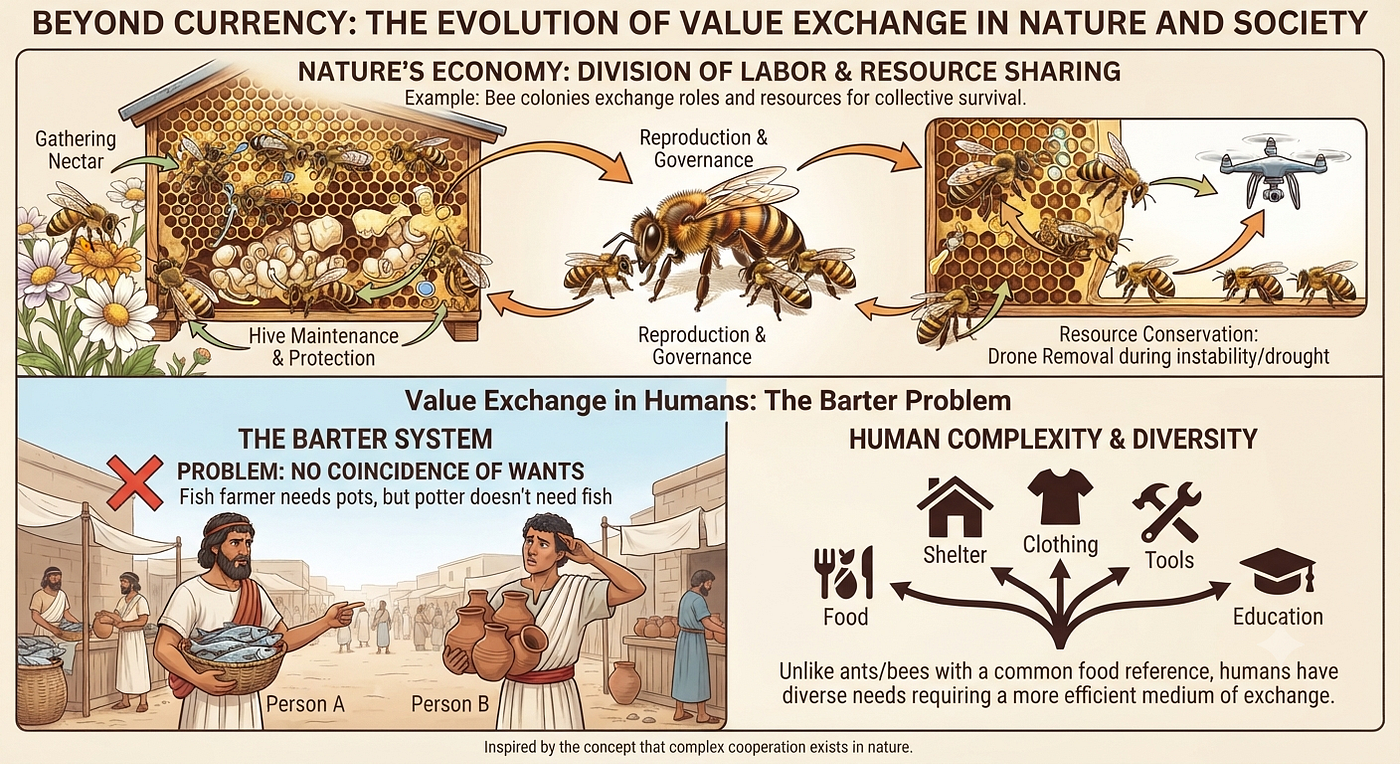
What do all these have to do with the exchange of value in humans? Human communities in ancient times were based on the exchange of goods and services. As the population grew, however, a fundamental problem arose: unlike ants or bees, which have a common reference point in food, humans have diverse and varied needs. The traditional barter system became inefficient because it required a simultaneous coincidence of wants between two parties.
With the development of large cities, the need for efficient daily transactions led to the birth of money. Instead of figuring out what has value for each individual separately, we transferred value into a neutral medium of exchange. Ultimately, humans are not the only creatures that pay in some way to live on the planet; they are simply the only ones that invented money to serve this purpose.
What is it, however, that makes a medium of exchange worthy of being called as such? These reasons are not based on a king’s decree or a government’s decision, but lie deep within human psychology. A mystery that anthropologists have spent years trying to solve is how human communities, scattered across the globe and without communicating with one another, ended up with similar mediums of exchange for their daily needs. Although money has many properties, we could condense them into five core ones that make it reliable both as a medium of exchange and as a store of value:

- Portability: Money must be easily transportable across space along with the person who holds it. It would make no sense if a worker, after completing a job, had to enlist an entire vehicle to haul their payment. This property explains why land or chunks of rock were never used as a universal medium of exchange. Land is only utilized in exceptional cases of large sums or direct exchange, such as when two people exchange properties and, through a legal contract, real estate essentially functions as money.
- Divisibility: Another reason land is unsuited for daily transactions is the inability to divide it easily. Money must be divisible. In daily life, someone gives us ten pounds, from which we pay five to a third party, and that person in turn gives two to buy something from the supermarket. The ability to subdivide is crucial for the flow of the economy, as it allows countless transactions to be executed seamlessly.
- Durability: Money must withstand both frequent daily transactions and the wear and tear of time. It would make no sense to receive something and have to get rid of it immediately before it lost its value. For this reason, fruit was never chosen as currency — it spoils within a few days and cannot withstand successive exchanges, unlike seeds, which were often used as money. In the realm of metals, gold was preferred because of its “immortality”: since it does not rust, it allows for the safe storage of value. If, for example, you were a family man in ancient Athens and wanted to leave capital for your children, between copper — which would have rusted in five years — and incorruptible gold, choosing gold was the only logical path.
- Scarcity: This property determines the value and purchasing power of the medium. Unconsciously, humans gravitate toward materials that cannot be found or produced by just anyone at home. The law of supply and demand reigns supreme here: the more limited the supply of a good and the greater the demand for it, the more its value skyrockets.
- Recognizability: Closely tied to scarcity, recognizability acts as a shield against counterfeiting. If money in any form could be manufactured by anyone, it would instantly lose its utility, as there would be no way to safeguard its scarcity.
Note(please read it): This is not financial advice and it is for educational purposes only. Any decision you make for your financial life is due to your own intelligence after your own research.
- The journey of wealth building never stops, just like the relentless work of the ants and bees. With the turning of the page to August 2026, our hypothetical 1,000 budget is put back to work with renewed discipline. To see how we apply the core pillars of saving, debt management, and fixed expenses this month, continue reading the full breakdown in Wealth Building: Ants, Bees, and the Monthly Paycheck.
- If you enjoy this article you can help us by leaving a review, if you really enjoy our financial tips, you could head over to my Page and dive into the e-magazine Ants and Bees, where we explore the history and evolution of money through the centuries — though rest assured, it is strictly a historical and educational journey, not a financial advice magazine!
Thank you very much.
메타데이터
- post_id
- c7635ec5aa90
- slug
- what-is-money-c7635ec5aa90
- url
- https://medium.com/@shaolin.praying.mantis/what-is-money-c7635ec5aa90
- canonical_url
- https://medium.com/@shaolin.praying.mantis/what-is-money-c7635ec5aa90
- author_url
- https://medium.com/@shaolin.praying.mantis
- status
- ok
- fetched_at
- 2026-08-15 22:37:29




