Why Society Was Upset When Kabir Realised the One
Kabir, the Brain–Mind, and why nations cannot awaken as easily as individuals
Why Society Was Upset When Kabir Realised the One
Kabir, the Brain–Mind, and why nations cannot awaken as easily as individuals
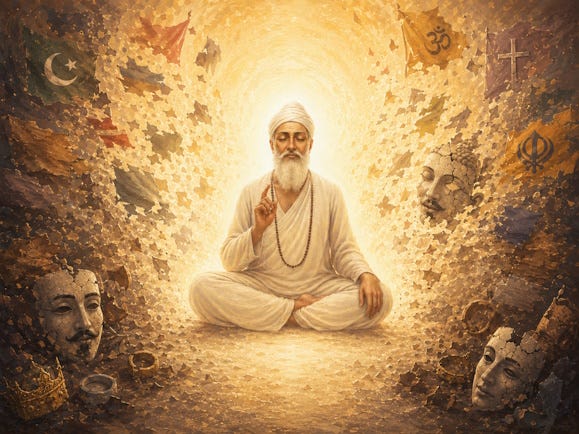
Do not ask the caste of a saint; ask about his wisdom. Value the sword, let the sheath lie aside. — Kabir
There is a line from Kabir in the Guru Granth Sahib that seems, at first, like a simple spiritual statement. But once we stay with it, it opens into something much deeper. Kabir says, “When I realised the One, why should people be upset?” He is not merely saying that God is One. He is asking why society becomes disturbed when a human being sees beyond the divisions that society itself depends upon. This is where Kabir becomes important not only as a saint, but as a direct translator of the brain and mind.
Kabir was speaking from a place where the social self had lost its authority. He had seen the One, and in that seeing the old boundaries no longer had the same power. Hindu and Muslim, caste and outcaste, honour and dishonour, purity and impurity, learned and unlearned, respectable and fallen — all these divisions belonged to the world of social recognition. They belonged to the human mind when it is organised around identity, memory, comparison and public approval.
So when Kabir says, “When I realised the One, why should people be upset?” he is not asking a casual question. He is exposing the whole structure of society. People were upset because his realisation dissolved the categories by which they knew themselves. If the One is seen, then caste loses its sacred authority. Religious identity loses its absolute boundary. Public honour loses its power to define the person. Reputation becomes a shadow. Ritual display becomes empty. The mind can no longer be held together by the old social mirror.
That is why Kabir goes further. He says he has lost his honour. He says he is dishonoured. He says do not follow after him. This is not self-hatred. It is not weakness. It is spiritual intelligence speaking in the language of social defeat. Kabir is saying: if society calls this dishonour, let it be dishonour. If society says I have fallen, let me be fallen. If society says I have lost my place, then I have lost my place. I am no longer living by your measurement.
This is the radical centre of the shabad.
Kabir does not try to restore his image. He does not argue with society and say, “No, I am still honourable.” He ends the need to be honourable in society’s eyes. That is awakening. The self is no longer being updated through the opinion of others. The brain–mind is no longer returning every experience back to the question: what does this say about me?
In the Brain–Mind Model, the self is an updating process. It takes experience, memory, image, fear, desire, praise, insult, success and failure, and uses them to continue the story of “me.” This process is necessary in ordinary life. It allows us to function, remember, communicate and survive. But when it becomes unconscious, it traps the mind inside self-continuity. Every observation becomes material for the self. Every insult must be repaired. Every honour must be protected. Every identity must be defended.
Kabir sees through this.
He sees that honour and dishonour are part of the narrative shell. They belong to the social mind. They are not Truth. They are measurements created by people who themselves are still trapped inside measurement. So when Kabir says he has lost honour, he is not collapsing. He is free. He has stepped out of the machinery that makes society powerful over the individual.
This is why people were upset. They were not merely upset because Kabir had a different opinion. They were upset because his realisation threatened the hidden agreement on which society rests. Society says: you must belong somewhere. You must be named. You must be approved. You must accept the divisions we live by. You must know your place. Kabir’s realisation says: the One is before all places.
Here the shabad becomes a direct translation of the brain and mind.
Before awakening, the mind lives through division. It must divide in order to continue itself. It says: this is me, that is not me. This is my religion, that is another religion. This is my caste, that is another caste. This is my honour, that is my shame. This is my nation, that is the enemy. The self needs boundaries because boundaries give it continuity. Without boundaries, the narrative self begins to lose its centre.
But direct perception sees before the boundary becomes identity. It sees the movement of mind as it is forming. It sees memory rising, image rising, reaction rising, defence rising, and it does not immediately become that movement. This is why awakening is first possible in the individual. One human being can see the self being formed. One human being can see honour and dishonour as movements of thought. One human being can step out of the demand to be confirmed by society.
A nation cannot easily do this.
A nation is collective self-continuity made visible. It has a flag, a border, a history, a wound, an enemy, a story, a pride, a fear, a memory of humiliation, a memory of greatness. It must teach its people to say “we.” It must protect the image of itself. It must not lose face. It must not look weak. It must defend sovereignty, dignity, security and honour.
So when we look at Iran and America, or any two nations locked in conflict, we are not only looking at politics. We are looking at the brain–mind scaled up into history. Each nation is doing what the individual self does. It updates itself through memory, threat and identity. Iran says: we must not be humiliated. America says: we must not lose credibility. Iran speaks of dignity, resistance and sovereignty. America speaks of security, order and leadership. But beneath these different words, the same movement is operating: the collective self is trying to preserve its image.
This is why Kabir’s line becomes so powerful in the modern world.
“When I realised the One, why should people be upset?”
Because the One is dangerous to every system built on separation.
The One is dangerous to caste. The One is dangerous to religious superiority. The One is dangerous to national pride. The One is dangerous to ideological certainty. The One is dangerous to the self that survives by being different from another self.
Kabir saw this inwardly. Nations resist it outwardly.
The individual can awaken because the individual can let honour fall. Kabir can say, I have lost my honour, and be free. But a nation cannot say this easily. A nation cannot say, we have lost concern for honour, because the political world may treat that as weakness. The nation must keep flying the flag. It must keep telling the story. It must keep defending the boundary. It may speak of peace, but it must also preserve the image of strength.
This is the tragedy of collective life.
Awakening asks for the ending of psychological division. Nationhood depends on organised division. That does not mean nations are unnecessary. Borders, laws, culture and memory have their functional place. But when the flag becomes the self, the nation begins to behave like an ego. It reacts, compares, fears, remembers injury, demands respect and calls this survival.
Kabir stands outside this movement. He does not destroy society by force. He simply refuses to be psychologically governed by it. He does not need society to tell him who he is. He has seen the One. That seeing has ended the authority of the divided self.
This is where the Brain–Mind Model helps us understand the deeper mechanism. The mind normally updates the self through every contact with the world. Society provides the strongest mirror for this update. It tells us whether we are honourable or dishonoured, pure or impure, successful or failed, acceptable or rejected. The self then absorbs these signals and continues its story. This is the karmic loop of identity.
Kabir interrupts the loop.
He says: I have seen the One. Therefore your measurements no longer define me. Your honour is not my truth. Your dishonour is not my fall. Your approval is not my awakening. What matters is not whether society accepts me, but whether the life I live is accepted by the Divine.
This is not withdrawal from life. It is freedom from false authority.
The modern world has not understood this. It still tries to create unity through systems that preserve division. It speaks of peace while defending honour. It speaks of humanity while protecting national superiority. It speaks of God while fighting over religious identity. It speaks of civilisation while preparing for violence. The outer language is unity, but the inner mechanism is still self-continuity.
Kabir’s shabad shows us the difference.
Unity is not an idea added to the self. Unity is what remains when the self no longer needs division to exist. The One is not a slogan. It is not a flag. It is not a religious claim. It is the ending of the psychological structure that says: I am this against that.
That is why awakening begins with the individual. The individual can see the movement directly. The individual can notice the self forming around insult, praise, identity, nation, religion, memory and fear. The individual can see how the brain–mind keeps returning to the story of me. And in that seeing, something new becomes possible. The self may still function, but it no longer dominates perception.
For nations, this is much harder. A nation cannot easily step into silence. A nation cannot easily abandon its image. A nation cannot easily say, like Kabir, I have lost honour and I am free. The nation lives through collective memory. It must negotiate with fear, territory, economy, power and history. So the awakening of nations, if it ever comes, will not begin with flags. It will begin with individuals who no longer worship the flag as the self.
This is the important translation of Kabir through the Brain–Mind Model.
Kabir is not simply teaching humility. He is showing the end of psychological dependence on society’s mirror. He is showing what happens when direct perception sees the One before the self divides it into honour and dishonour, mine and yours, pure and impure, Hindu and Muslim, nation and enemy.
The people were upset because Kabir no longer belonged to the divisions that made them feel secure.
The same is true today. The world is upset whenever the One is seen deeply, because the One exposes the unreality of the identities we defend as absolute. We may still live in countries. We may still speak languages. We may still inherit cultures. But these things need not become prisons for consciousness.
Kabir’s freedom was that he no longer asked society to confirm his existence.
That is the awakening.
The brain–mind no longer updates the self through honour. The karmic loop loses its authority. The social mirror breaks. What remains is not emptiness in the negative sense, but a vast simplicity: the One was always there before the divisions began.
So Kabir’s question is still alive:
When the One is realised, why should people be upset?
Because the One ends the story by which the divided self survives.
메타데이터
- post_id
- c76bb3bb7215
- slug
- why-society-was-upset-when-kabir-realised-the-one-c76bb3bb7215
- url
- https://medium.com/@siriperera2000/why-society-was-upset-when-kabir-realised-the-one-c76bb3bb7215
- canonical_url
- https://medium.com/@siriperera2000/why-society-was-upset-when-kabir-realised-the-one-c76bb3bb7215
- author_url
- https://medium.com/@siriperera2000
- status
- ok
- fetched_at
- 2026-07-09 15:12:33