Ukraine Tests FP-7x Ballistic Missile Interceptor
How long will it be before Ukraine can hit Oreshniks?
Ukraine War
Ukraine Tests FP-7x Ballistic Missile Interceptor
How long will it be before Ukraine can hit Oreshniks?

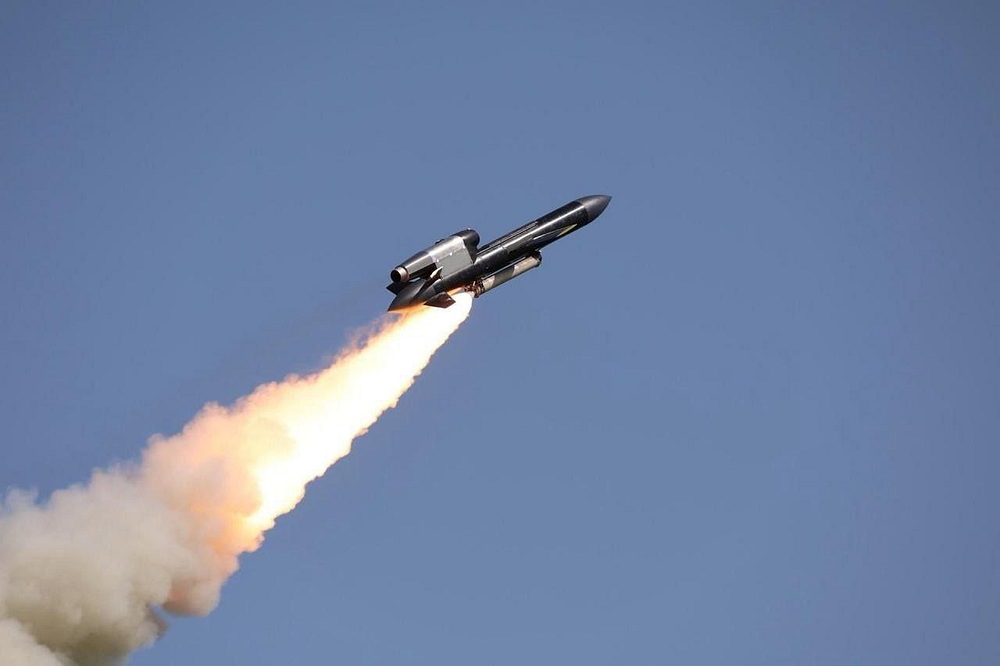
Collage from Fire Point FP-7.x video
The Ukrainian defence sector recently hit a milestone with the successful flight test of the FP-7.x missile. This project, spearheaded by the company Fire Point, represents a concerted effort to establish indigenous anti-ballistic capabilities.
The FP-7.x is an interceptor variant derived from the FP-7 tactical ballistic missile. Its design incorporates advanced composite materials and is engineered to achieve velocities between 1,500 and 2,000 metres per second (~Mach 4–6).
As the primary kinetic component of the proposed Freyja air defence system, this missile aims to provide a domestic alternative to existing, high-cost international systems such as Patriot and Iris-T.
Current development objectives focus on integrating this hardware into a wider defensive network that utilises NATO-standard communications and radar suites.
I speculated that they might load in to empty Patriot launchers and utilise Patriot radar and control systems if the engineers could overcome the probably significant software challenges.
But as the table shows, the FP-7 on which the FP-7.x is based, is a very much larger missile.

The baseline FP-7 surface-to-surface ballistic missile was engineered by simplifying and repurposing the heavy airframe and propulsion architecture of the Soviet-era 48N6 and 5V55 series missiles, which are traditionally used in S-300 and S-400 air defence systems.
While Fire Point modernised the platform by replacing the original structure with lightweight local carbon-fibre composites and introducing modern digital electronics, the core physical dimensions — such as the 7.25-metre length and the 0.53-metre fuselage diameter — remain directly derived from that legacy Soviet airframe family.
Design decisions
The decision to build a larger interceptor like the FP-7.x, rather than mirroring the smaller profiles of the Patriot PAC-3 MSE or IRIS-T, comes down to three main factors: targeting philosophy, range, and the engineering realities of domestic production.
Interception method and payload size
The Patriot PAC-3 MSE relies on a “hit-to-kill” philosophy. It is a highly compact, agile dart that directly collides with an incoming threat using tiny, millisecond-fast attitude control thrusters. Developing this ultra-precise guidance technology requires specialized component access and decades of iteration.
To bypass this hurdle, the FP-7.x operates more like the older Patriot PAC-2 GEM-T or Soviet S-300 variants. It utilises a much larger blast-fragmentation warhead (approximately 150 kg). Because it relies on a blast radius to destroy incoming ballistic missiles rather than a direct kinetic collision, the missile must be physically larger to carry that substantial explosive payload.
Kinetic energy and range requirement
To intercept high-speed tactical ballistic threats, an interceptor must achieve speeds between 1,500 and 2,000 metres per second (Mach 5 to Mach 6.7). Because the FP-7.x is designed to have an engagement range of up to 200 kilometres — significantly farther than a standard IRIS-T SLM — it requires a massive solid-fuel rocket motor.
Accelerating a heavier, warhead-carrying missile to hypersonic speeds over that distance demands an extensive fuel volume, dictating a longer and thicker airframe (7.25 metres long and 530 mm in diameter).
Leveraging existing airframes for fast production
The design of the FP-7.x is structurally adapted from the large 48N6/5V55 series missiles used in S-300 systems, but modernised using local carbon-fibre composites. By altering a proven heavy airframe design that already possesses good high-speed handling, the developers could fast-track development.
This allowed them to pivot a domestic tactical ballistic missile design into an air-defence role quickly, avoiding the complex, multi-year aerodynamic re-engineering that a completely new, downsized missile would require.
Challenges of ballistic missile interception
The task of intercepting ballistic threats is complex.
Ballistic missiles typically descend at extreme velocities, often exceeding Mach 5, which leaves an exceptionally narrow window for detection, tracking, and engagement. Most strategic ABM systems aim to intercept after the target’s boot phase when it is outside the atmosphere and before any warhead separation (there may be several in a MIRV) happens.
Some later designs have a degree of manouevrability — not as much as a hypersonic glide missile — but just enough to make small course adjustments using reaction jets. We saw this with Iranian missiles targeting Israel earlier in 2026.
![Iranian MARV adjusts course over Jerusalem March 2026. Credit:Etienne Marcuz [.gif]](https://miro.medium.com/v2/resize:fit:364/1*zXcMIsOijoJV3UTcVX2RQg.gif)
Iranian MARV adjusts course over Jerusalem March 2026. Credit:Etienne Marcuz [.gif]
The US Patriot missile system is designed to intercept ballistic missiles during their terminal phase. It does not require space-based sensors or large fixed-base long range over the horizon radars such as the Russian Voronezh system.
The terminal phase of a ballistic missile’s trajectory is when the threat re-enters the Earth’s atmosphere and descends toward its target. Because terminal-phase intercepts must occur very close to the defended area, this stage is typically short — often lasting less than a minute — and requires the high-speed, “hit-to-kill” precision characteristic of the Patriot PAC-3 variant.
Intercepting such targets requires a high-performance radar network capable of identifying a fast-moving object amidst atmospheric noise, as well as a guidance system that can calculate a precise collision point in real time.
Hit-to-kill is the preferred concept because it will physically displace the target off its trajectory whereas a proximity burst is usually designed to at least damage control electronics and guidance systems, such as in a cruise missile. But it does require very high precision and rapid actuation of control surfaces.
FP-7.x transition
The transition from a test environment to a operational combat setting presents additional difficulties in signal processing and sensor reliability.
The one positive aspect of this interception strategy is that ballistic missiles have predictable trajectories. Usually.
Russia’s Oreshnik missiles are of an old design and do not have this course adjustment capability.
[embed]
The nature of the oreshnik threat
The Oreshnik missile system poses a substantial challenge to contemporary air defence infrastructure.
Reports suggest this system can reach speeds of Mach 8-9 during its terminal phase. Beyond its velocity, the Oreshnik is noted for its ability to carry multiple independently targetable re-entry vehicles (MIRVs).

Oreshnik graphic credit: luftlage.substack.com
These payloads can complicate interception efforts by increasing the number of targets that must be tracked and engaged simultaneously.
Recent analysis by Ukraine’s Ministry of Defence has shown that the Oreshnik’s submunitions weigh approximately 50 kg each. According to the analysis, the impact elements are solid cast-iron spheres. Given their high-velocity terminal descent, their kinetic energy is significant.
The impact of a single unit moving at hypersonic speeds generates energy equivalent to several hundred kilogrammes of high explosive. This massive kinetic force allows the solid cast-iron bodies to penetrate deep into hardened structures without the need for traditional chemical explosive warheads, relying on mass and velocity for damage.
Oreshnik warheads/submunitions before impact. Image via Twitter
The missile travels at high altitudes through the upper atmosphere, which can obscure it from Ukraine’s traditional ground-based tracking systems until it is near its terminal approach.
The Oreshnik missile system is reported to carry six main warheads, which are deployed as Multiple Independently Targetable Re-entry Vehicles (MIRVs).
According to reports and expert analyses, each of these six main warheads is designed to contain a cluster of submunitions. Open-source estimates typically cite six submunitions per main warhead, resulting in a total of 36 individual impact elements per missile.
However, I have questions about these figures. 36 submunitions of 50 kg each amounts to a total of 1800 kg. That is not credible as a payload for the Oreshnik.
Also incredible is Russia’s claim that these are new missiles.
Oreshnik electronics retrieved by Ukraine. Image via Twitter
The “Oreshnik” that Russia launched at Ukraine in January was manufactured nine years ago according to Reuters. It contained exclusively Russian and Belarusian components.
“We were quite surprised because they claim it’s a very new missile. But when you look at the year of manufacture, it says 2017,” — the expert who presented the examined remains of the missile told Reuters.
Progress toward defensive parity
Ukraine’s strategy to counter such threats involves both the acquisition of established systems and the parallel development of indigenous technology.
The government continues to push for increased supplies of proven interceptors while simultaneously investing in the Freyja project.
Cooperation with European partners is central to this effort, particularly regarding the integration of radar networks and command-and-control architecture.
While the FP-7.x flight test demonstrates technical maturity, the transition to full operational readiness is likely to be a multi-year process. The aim is to create a layered defence that relies on both domestic interceptors and external support, ensuring a degree of technological sovereignty that is not tethered to foreign production cycles or political priorities.
Future operational outlook
Predicting when a system will be capable of intercepting a weapon as sophisticated as the Oreshnik is tricky. The Freyja system is currently projected for potential operational readiness by 2027, though this timeline is subject to the success of subsequent integration trials and the stability of the industrial supply chain.
Establishing a reliable defence against hypersonic ballistic threats is a persistent challenge for even the most advanced global militaries. While the FP-7.x provides a platform for development, it must be paired with sensors that can provide the necessary target telemetry before an engagement can be attempted, as I outlined above.
I have confidence in Ukraine’s ability to overcome technical challenges and feel sure that they will be able to beat the Oreshniks as Ukraine continues to build a world class armaments industry, forged in fire.
https://en.wikipedia.org/wiki/Oreshnik_(missile
https://odessa-journal.com/zelensky-and-rutte-prioritize-ballistic-missile-defense-for-ukraine
메타데이터
- post_id
- c76e794ca7ca
- slug
- ukraine-tests-fp-7x-ballistic-missile-interceptor-c76e794ca7ca
- url
- https://medium.com/the-dock-on-the-bay/ukraine-tests-fp-7x-ballistic-missile-interceptor-c76e794ca7ca
- canonical_url
- https://medium.com/the-dock-on-the-bay/ukraine-tests-fp-7x-ballistic-missile-interceptor-c76e794ca7ca
- author_url
- https://medium.com/@james-marinero
- status
- ok
- fetched_at
- 2026-06-14 11:28:49